

How can ordinary work make worship a place of truth, responsible care, and welcome?
Study overview
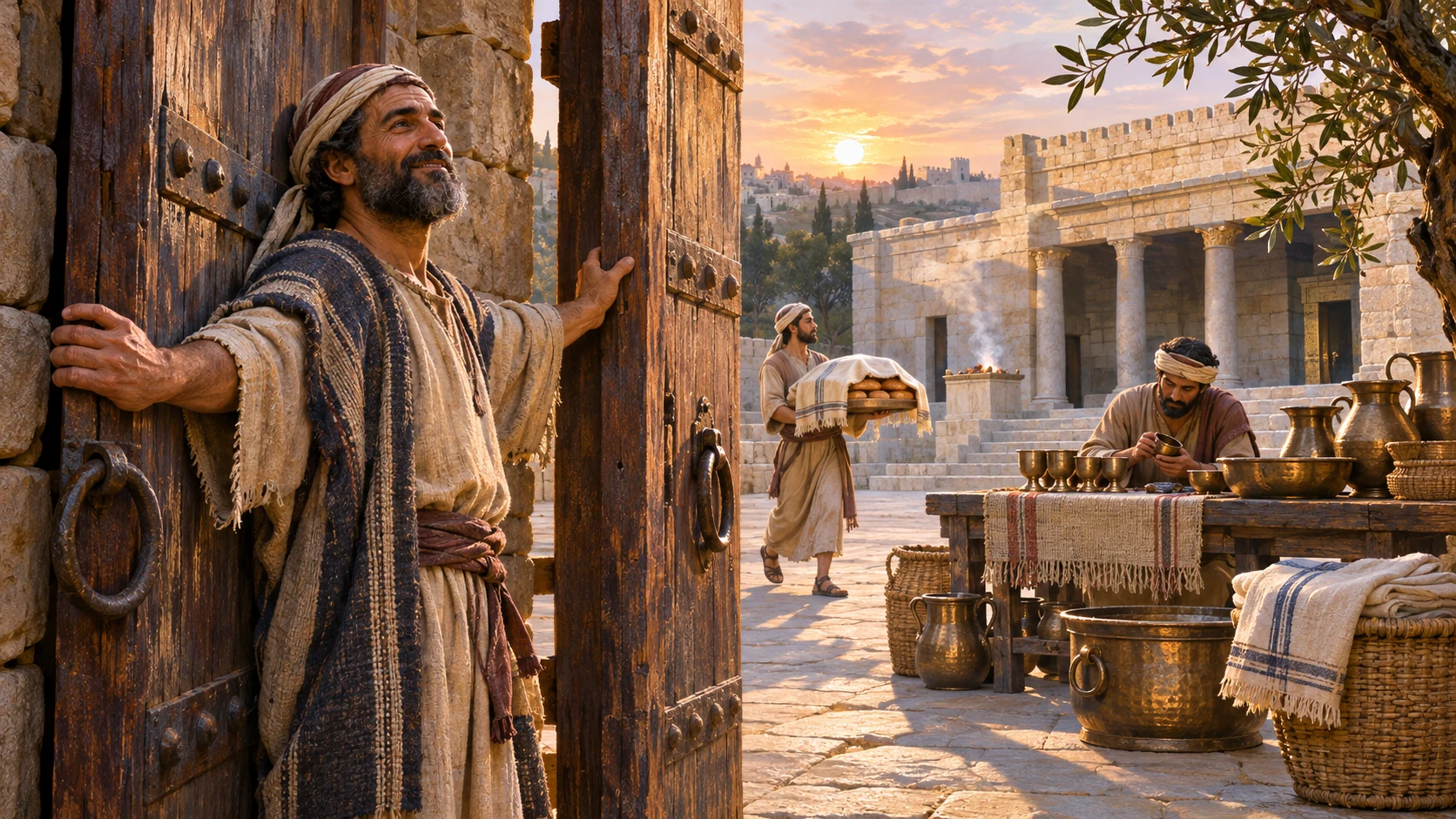
The city remembers its ashes, but morning arrives. Someone counts the vessels. Someone prepares the bread. Someone watches through the night so that the doors of God's house can open again.
Passage: 1 Chronicles 9:1–44
Controlling image: The doors of the house of God opening at dawn
Heart-question: After judgment and displacement, what does faithful rebuilding actually require?
Introduction: The Morning After the Ruins
After disaster, communities long for a new leader or a grand celebration. Harder work begins the following morning. Doors must be opened, responsibilities assigned, trust rebuilt, and neglected practices restored.
First Chronicles 9 brings Israel to that morning. After tracing Israel’s families from Adam, the Chronicler names exile (9:1), Jerusalem’s inhabitants (9:2–16), and sanctuary workers (9:17–34). Finally, Saul's family reappears (9:35–44), preparing the narrative of the fallen king.
This text is about a people marked by exile becoming a community ordered again around faithful worship. Return is more than arriving at an address. Return means learning again how to live before the Lord.
Historical and Literary Context: From Ancestral Names to a Living Community
First Chronicles 1–9 establishes Israel's identity before the narratives of Saul and David. Written after Babylonian destruction and return, the book addresses a community with a rebuilt temple but without its former Davidic monarchy (Ezra 3:8–13; Hag 2:1–9).
Chapter 9 joins those two horizons. The opening notices recall exile and habitation; the detailed duties reach backward to the tabernacle, Samuel, and David. Genealogy links ancestral calling and present responsibility. The lists overlap with Nehemiah 11:3–24, but differ in names and numbers; the records are not one identical census (Japhet 1993; Knoppers 2004).
Sailhamer (1983) particularly draws attention to the contrast between Jerusalem's households and Saul's Gibeonite lineage (9:34–35). Jerusalem is central to Davidic kingship and temple worship, while Gibeon also had an important sanctuary history (1 Chr 16:39–40; 2 Chr 1:3–6). The concern is covenant order, not contempt for Saul's relatives or Gibeon.
Walking Through the Text
When Exile Is Named, but the Record Continues (9:1–3)
The first verse gathers the preceding genealogies under the name all Israel. Then comes the wound: Judah went into exile in Babylon because of unfaithfulness (9:1; cf. 2 Chr 36:14–21). The Chronicler neither calls the disaster an accident nor allows exile to be the final sentence.
The next verse lists inhabitants associated with their towns: ordinary Israelites, priests, Levites, and temple servants (9:2). Jerusalem's population includes people connected with Judah, Benjamin, Ephraim, and Manasseh (9:3). The northern names resist reducing all Israel to one surviving political faction (cf. 2 Chr 30:1, 5–11).
The selective lists do not imply that every exile returned; the renewed community nevertheless bears a wider name than the ruined kingdom. Restoration begins with truthful memory: unfaithfulness must be named, and surviving belonging must also be recognized.
When the City Receives Families and Servants (9:4–16)
Judahite descendants appear through Perez and Zerah; Benjaminite households follow (9:4–9). The register gives leaders and numbers. Jerusalem contains households, not an abstract crowd.
The focus then turns to priests such as Jedaiah, Jehoiarib, Jachin, and Azariah, together with priestly relatives called capable men for the service of God's house (9:10–13). The Levites include descendants connected with Asaph and Jeduthun, names associated elsewhere with temple praise (9:14–16; 1 Chr 25:1–7).
After exile, worship requires prepared people, not announcements alone. Ancestry comes with assignments; belonging must become service. Yet lineage here describes Israel's historic temple offices, not a universal rule that Christian ministry must be inherited.
When the Threshold Becomes a Sacred Trust (9:17–23)
The narrative slows at the entrance. Shallum, Akkub, Talmon, and Ahiman are named among the gatekeepers; Shallum is identified as chief (9:17). The Korahite families guard the thresholds, recalling ancestors who kept the entrance of the tabernacle (9:19; cf. Num 3:27–32).
The text gathers memories across eras: Phinehas exercised oversight in earlier days, Zechariah guarded the tent's entrance, and David and Samuel were remembered as establishing gatekeepers in an office of trust (9:20–22). The named figures were not contemporaries; their service spans generations.
Two hundred and twelve gatekeepers are counted (9:22). Their vocation is described as a trust. The entrance is guarded because worship is holy and vulnerable to neglect. A gatekeeper does not own God's house. Stewardship protects what belongs to the Lord; stewardship must never become a license for domination.
When Faithfulness Opens the Doors Each Morning (9:24–27)
Gatekeepers serve on four sides—east, west, north, and south (9:24). Relatives from surrounding villages join the service in seven-day rotations (9:25). Four principal gatekeepers oversee chambers and treasuries (9:26).
Then comes the chapter's quiet, radiant picture: gatekeepers sleep near the house of God, watch through the night, and open the doors every morning (9:27). The great story of covenant renewal comes down to an ordinary act performed repeatedly.
An open door requires unseen labor. The first worshiper at dawn may never know the night watchman. Faithfulness needs no applause. Sometimes faithfulness sounds like a wooden door turning on its hinges because someone did not abandon the post.
When Bread, Vessels, and Song Become Holy Work (9:28–34)
Other servants keep an inventory of sanctuary vessels, counting objects as objects enter and leave (9:28). Others supervise furnishings, flour, wine, oil, incense, and spices (9:29–30). Mattithiah is entrusted with preparing baked offerings (9:31); certain Kohathites prepare the bread of the Presence each Sabbath (9:32; cf. Lev 24:5–9).
The singers receive a distinct mention. Exempted from other duties, the singers remain devoted to assigned work day and night (9:33). Bread, song, security, and accounting belong together in worship.
The Chronicler does not divide the holy from the practical. Missing supplies, careless accounting, and exhausted musicians can damage communal worship. God deserves more than spiritual excitement without responsible preparation. Faithful order makes room for grateful praise.
When Saul's Family Stands at the Edge of the Story (9:35–44)
Suddenly the account returns to Gibeon and Jeiel's family, tracing Ner, Kish, Saul, Jonathan, and later descendants (9:35–44). Much of this genealogy repeats 1 Chronicles 8:29–38, with differences in some forms of names. The repetition bridges to Saul's death in chapter 10 (Klein 2006; Knoppers 2004).
A chapter centered on restored worship ends with the family of a failed king. Saul's descendants are not erased, but royal ancestry will not excuse Saul's conduct. The coming narrative will name the central failure: Saul did not keep the Lord's word and did not seek the Lord (10:13–14).
The door to renewed worship opens toward a difficult examination of leadership. A community may rebuild its routines, but leaders must still answer the question of covenant faithfulness.
Theological Reflection: What Makes Return Real?
Repentance Must Face the Cause of Ruin
The word unfaithfulness in 9:1 echoes the Chronicler's account of the catastrophe (2 Chr 36:14). A congregation cannot rebuild deeply by renaming betrayal as misfortune. Confession, accountability, and changed practice are part of the road home (2 Chr 7:14; Neh 9:1–3).
Worship Belongs to a Whole Community
The register names households, priests, Levites, singers, and gatekeepers. The sanctuary is neither the king's trophy nor the priest's private possession. Every task is ordered toward God's presence among the people (Exod 25:8; 1 Chr 9:10–34). Worship is shared responsibility, not a performance purchased from specialists.
Holy Order Is a Form of Love
Counting vessels, rotating service, preparing Sabbath bread, and guarding entrances are acts of care (9:24–33). Order can become lifeless ritual, but disorder can also conceal neglect and injustice. Biblical worship joins reverence with integrity (Isa 1:16–17; 1 Cor 14:40). A well-kept sanctuary must never become an excuse for an uncared-for neighbor.
The Open Door Points Beyond the Old Temple
For the Chronicler, Jerusalem's sanctuary stood at the center of covenant life. The New Testament announces Jesus as the true meeting place of God's presence with humanity (John 2:19–21). Through Christ, believers become a dwelling place for God's Spirit and living stones in a spiritual house (Eph 2:19–22; 1 Pet 2:4–10). The church therefore guards holiness without treating grace as private property. Access to God rests on Christ, not ancestry or a human gatekeeper (Heb 10:19–22).
Life Application: Open the Doors Again
- Name the breach. Where misconduct, neglected teaching, or financial misuse has harmed a congregation, document the truth, protect those affected, and begin accountable repair.
- Rebuild the daily rhythm. Set realistic times for Scripture, prayer, Sabbath worship, family conversation, and practical care; keep the commitments after the excitement of renewal fades.
- Honor hidden service. Thank the people who clean, unlock, count offerings, maintain equipment, prepare music, and welcome worshipers. Provide rest and fair support.
- Guard entrusted resources. Use clear inventories, two-person financial checks, maintenance records, and transparent stewardship for shared church property.
- Make belonging visible. Welcome scattered families, newcomers, and people across old communal divisions without allowing ancestry, status, or wealth to determine dignity.
- Keep the doors genuinely open. Protect vulnerable people and appropriate boundaries, while removing needless barriers that keep the poor, grieving, disabled, or unfamiliar from joining the worshiping community.
Reflection Questions
- What unfaithfulness must be confessed before meaningful rebuilding can begin?
- Which people have been forgotten while buildings, programs, and leaders receive attention?
- Who carries the unseen night watch that allows the community to worship each morning?
- Where have sacred routines become empty, or informal habits become careless?
- What door of welcome, justice, prayer, or service must be opened this week?
Response Prayer
Lord of the covenant, meet the people standing among the ruins. Give courage to name unfaithfulness without surrendering hope. Place trustworthy hands at the doors, integrity in the treasury, bread upon the table, and songs upon the lips of the congregation. Restore forgotten servants; protect vulnerable neighbors; cleanse public worship of private pride. As morning comes, open hearts to the presence of Jesus Christ, the faithful Son of David and the true temple. Teach the church to keep watch, to welcome, and to serve. Amen.
Window into What Comes Next
The door opens; the genealogy ends. First Chronicles 10 moves from the restored community back to the battlefield of Gilboa, where Saul's reign collapses. The Chronicler will not begin David's story without first asking why a king lost the kingdom. The question waiting beyond the threshold is severe: What happens when leadership stops seeking the Lord?
Annotated Bibliography
- Japhet, Sara. I & II Chronicles: A Commentary. Old Testament Library. Louisville: Westminster John Knox, 1993. Explains the genealogical prologue's role in defining the restored community and highlights the Chronicler's distinctive historical presentation.
- Klein, Ralph W. 1 Chronicles: A Commentary. Hermeneia. Minneapolis: Fortress, 2006. Assists with the personnel lists, textual variations, and the repeated genealogy of Saul.
- Knoppers, Gary N. I Chronicles 1–9: A New Translation with Introduction and Commentary. Anchor Bible 12. New York: Doubleday, 2004. Offers detailed attention to Jerusalem's inhabitants, the gatekeepers, and the relationship with Nehemiah 11.
- Sailhamer, John. First and Second Chronicles. Everyman's Bible Commentary. Chicago: Moody Press, 1983. The supplied commentary stresses the movement from Saul's Gibeonite lineage toward Davidic Jerusalem and worship ordered according to God's purpose.
- Williamson, H. G. M. 1 and 2 Chronicles. New Century Bible Commentary. Grand Rapids: Eerdmans, 1982. Places the genealogies and temple responsibilities within the Chronicler's concern for restored Israel.

Be the first to leave a comment.