

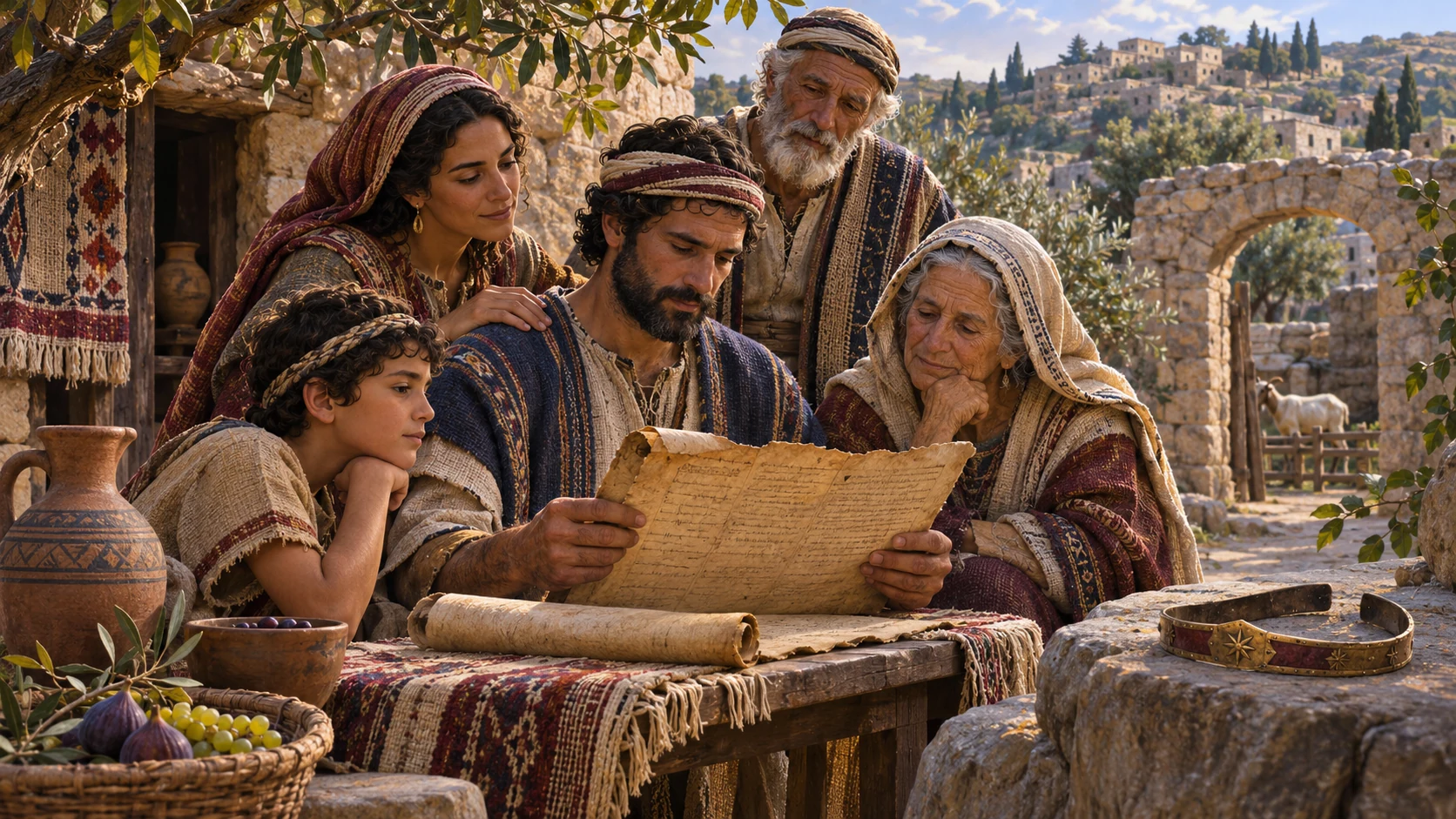
How can a community remember failed leadership without imposing inherited shame on relatives?
Study overview
The crown has fallen; the family names remain. Gibeon's households still have descendants, and Jerusalem still has neighbors. Before the story tells how Saul died, the Chronicler insists that Saul's people must not disappear from memory.
Passage: 1 Chronicles 8:1–40
Controlling image: Names beneath a fallen crown—family memory preserved without disguising failed leadership
Heart-question: How should God's people remember a failed leader without erasing the family, community, and responsibilities left behind?
Introduction: When a Name Carries Both Honor and Pain
A family name can open doors or become a burden. After a leader's disgrace, children may inherit suspicion and communities may prefer silence to truth.
First Chronicles 8 stands at such a doorway. Benjamin has already appeared among Israel's tribes (1 Chr 7:6–12), yet the Chronicler returns for an entire chapter. The genealogy moves through villages and households toward Saul, Israel's first king. Saul's death comes in chapter 10; first comes the family register.
That order matters. The Chronicler refuses to treat Benjamin as nothing more than Saul's failure, while also refusing to make Saul's ancestry proof of royal faithfulness. This text is about the memory of a fallen royal household becoming a call to covenant discernment and responsible remembrance. The crown fell; the people were not erased.
Historical and Literary Context: Between Two Royal Stories
First Chronicles 1–9 rebuilds Israel's memory before recounting the reigns of Saul and David. Judah's ancestry leads toward David (1 Chr 2–3); Levi's ancestry prepares the account of ordered worship (1 Chr 6). Benjamin's second genealogy now prepares the transition from Saul's kingship to David's (1 Chr 8–10). The repetition is deliberate (Japhet 1993; Knoppers 2004).
After exile, genealogies preserved belonging when royal authority and settlements had been broken. Benjamin mattered particularly because Benjaminite households were connected with Jerusalem and with the returned community (Ezra 1:5; Neh 11:4–9).
Sailhamer (1983) emphasizes the contrast between Gibeon, associated with Saul's family, and Jerusalem, chosen as the center of Davidic kingship and temple worship (1 Chr 8:28–33; 2 Chr 6:6). Yet Gibeon also hosted legitimate sanctuary service before the temple (1 Chr 16:39–40; 2 Chr 1:3–6). The issue is God's purpose, not contempt for a town.
Walking Through the Text
When Benjamin Receives a Second Beginning (8:1–5)
The chapter opens with Benjamin's five sons: Bela, Ashbel, Aharah, Nohah, and Rapha. Bela's descendants follow (8:3–5). This differs in selection and arrangement from the three lines named in 1 Chronicles 7:6. Genesis 46:21 and Numbers 26:38–40 also preserve differing forms and arrangements of Benjaminite names.
These are selective genealogies, not modern birth certificates. Individual identifications remain debated (Klein 2006; Knoppers 2004). Their meaning does not require forced harmonization.
The opening word, Benjamin, announces the real subject. Israel's first king came from a tribe whose story preceded the throne. No family should be reduced to its most celebrated or disappointing member.
When the Family Map Crosses Borders (8:6–13)
The record moves through the family heads associated with Geba and a relocation to Manahath (8:6–7). The circumstances cannot establish an Assyrian or Babylonian exile. Another branch remembers Shaharaim in Moab, together with Hushim, Baara, Hodesh, and their descendants (8:8–11). The genealogy does not commend every family decision.
Elpaal's descendants include Shemed, associated with building Ono and Lod, and Beriah and Shema, family heads at Aijalon who drove away inhabitants of Gath (8:12–13). As with Sheerah (7:24), construction matters alongside war.
Settlement, migration, marriage, and conflict have shaped this genealogy. Gath recalls Ephraim's tragedy (7:21), though no direct connection is established. Ancient conflict does not authorize violence in Christian mission.
When Jerusalem Is Also a Benjaminite Home (8:14–28)
The dense sequence of Beriah, Elpaal, Shimei, Shashak, and Jeroham's descendants ends with an important geographical note: these family heads lived in Jerusalem (8:28). Before mentioning Saul, the Chronicler places Benjaminite families in David's city.
Jerusalem therefore cannot be imagined as a city belonging to Judah alone. Benjaminite households shared its life (Josh 18:28; Neh 11:4–9). Royal leadership, temple worship, and communal life belong together; renewal demands more than dynastic victory.
Churches must remember the people around sanctuaries, not buildings alone.
When Gibeon Leads to Saul—and Jonathan's Son (8:29–38)
The scene turns to Gibeon, the home of an ancestral household whose wife is named Maacah (8:29). First Chronicles 9:35 identifies the household head as Jeiel; the form of 8:29 varies among translations and manuscript traditions. The genealogy connects Gibeon and Jerusalem through relatives and then proceeds to Ner, Kish, Saul, and Saul's sons (8:29–33). The repeated notices in 9:35–44 are debated (Gardner 2007).
Saul's sons include Jonathan, Malchishua, Abinadab, and Eshbaal (8:33). Eshbaal is generally identified with Ish-bosheth in 2 Samuel 2:8. Jonathan's descendant Meribbaal (8:34) corresponds to Mephibosheth in 2 Samuel 4:4 and 9:6. Differences involving baal and bosheth reflect naming and textual history; baal alone cannot prove religious allegiance (Klein 2006; Knoppers 2004).
The names point toward mercy. Jonathan's son Mephibosheth had lost security and standing after Saul's fall, yet David later welcomed Mephibosheth to the royal table because of a covenant with Jonathan (1 Sam 20:14–17; 2 Sam 9:1–13). That meal comes from Samuel, not Chronicles.
Saul's failure remains serious. First Chronicles 10:13–14 will judge Saul for unfaithfulness and failure to seek the Lord. Yet the genealogy preserves Jonathan's descendants beyond the fall of the throne. Judgment on a king is not permission to despise every person carrying the king's name.
When the Fallen Crown Is Followed by Living Descendants (8:39–40)
The closing verses remember Eshek, Ulam, Jeush, and Eliphelet. Ulam's descendants are described as capable archers, with 150 sons and grandsons. The chapter concludes by identifying the whole register as belonging to Benjamin.
Benjamin's descendants, not Saul's throne, close the chapter. Military skill does not promise a return of Saul's dynasty. Continued descendants do not signal restored Saulite rule.
The failed kingdom need not make its families disposable. Chapter 9 will repeat much of Saul's lineage immediately before chapter 10 recounts Saul's death. Memory comes before judgment, but memory does not cancel judgment.
Theological Reflection: What Survives the Crown?
Covenant Memory Is Truthful, Not Selectively Cruel
The Chronicler neither erases Saul's family nor hides Saul's end (1 Chr 8:33–40; 10:13–14). Biblical remembrance holds history and moral evaluation together. Hiding abuse or wrongdoing does not guard a holy legacy. Relatives must not be condemned by association. Justice names responsibility accurately (Deut 24:16; Ezek 18:20).
The Place of Worship Cannot Replace the God of Worship
Gibeon and Jerusalem were both significant in Israel's worship history (1 Chr 16:39–40; 2 Chr 1:3–6; 6:6). But buildings and ancestry did not secure faithfulness. The Chronicler repeatedly measures leaders by seeking the Lord, keeping the covenant, and caring for true worship (1 Chr 28:9; 2 Chr 7:14). Tradition can overshadow repentance, prayer, and justice (Isa 1:11–17).
Covenant Mercy Can Cross a Political Divide
Jonathan's covenant friendship with David outlived Saul's opposition (1 Sam 20:14–17). David's treatment of Mephibosheth shows mercy expressed through restored provision, protection, and a place at the table (2 Sam 9:7–13). Mercy refuses to make the vulnerable pay for Saul's wrongdoing.
The Hope of Israel Is Not a Restored Saulite Throne
The genealogy leads toward a fallen king, and the following narrative transfers the kingdom to David (1 Chr 10:14; 11:1–3). The Davidic promise subsequently anchors hope beyond exile (1 Chr 17:11–14; 2 Chr 36:22–23). Christian readers recognize the promised Son of David in Jesus (Luke 1:32–33), whose kingship gathers a people reconciled across former divisions (Eph 2:14–22). Christ's reign demands truth, worship, and peace.
Life Application: Caring for Names Beneath the Crown
- Tell the truth about failed leadership. Document harm, protect vulnerable people, use fair accountability processes, and resist rewriting congregational history merely to protect reputations.
- Refuse inherited stigma. Do not punish children, spouses, or coworkers for wrongdoing committed by a parent or leader; assess each person's conduct fairly.
- Remember ordinary households. Record the service of caretakers, builders, teachers, musicians, and families whose contributions disappear behind famous names.
- Repair worship at the roots. Evaluate whether teaching, prayer, financial integrity, pastoral care, and justice receive as much attention as buildings, anniversaries, and titles.
- Practice costly covenant kindness. Visit an isolated family after public disgrace; provide food, schooling support, or a safe listening space without demanding a public performance of gratitude.
- Cross old divisions without erasing harm. Pursue reconciliation where appropriate, while maintaining boundaries and accountability for abuse or continued danger.
Reflection Questions
- Which family or group has been unfairly defined by one leader's failure?
- What difficult truth has been omitted from the congregation's public memory, and who carries the cost of that silence?
- Where has pride in a sanctuary, denomination, or heritage displaced the practice of seeking the Lord?
- Who needs practical kindness resembling David's hospitality toward Mephibosheth, rather than another speech about forgiveness?
- What act of truthful remembrance and responsible repair should begin this week?
Response Prayer
Lord of Abraham, Benjamin, and David, teach the church to read the names beneath fallen crowns. Keep truth from becoming cruelty and mercy from becoming denial. Expose wrongdoing; protect the vulnerable; free children from the weight of inherited shame. Where worship has become a monument to reputation, reopen the door to prayer, repentance, and justice. Give leaders humble hearts and households the courage to rebuild. Through Jesus Christ, the faithful Son of David, gather a people who remember honestly and love generously. Amen.
Window into What Comes Next
The names of Benjamin have reached Saul's household, but the Chronicler is not ready to recount Saul's death. First Chronicles 9 turns to the people who inhabited Jerusalem after exile: families, priests, Levites, and gatekeepers. The question becomes: How will a wounded community worship after return?
Annotated Bibliography
- Gardner, Anne E. “1 Chronicles 8:28–32; 9:35–38: Complementary or Contrasting Genealogies?” Australian Biblical Review 55 (2007): 13–28. Examines the repeated Gibeon genealogy and cautions against assuming that the two passages are identical in structure or purpose.
- Japhet, Sara. I & II Chronicles: A Commentary. Old Testament Library. Louisville: Westminster John Knox, 1993. Explores the literary and theological work performed by the Chronicler's genealogies.
- Klein, Ralph W. 1 Chronicles: A Commentary. Hermeneia. Minneapolis: Fortress, 2006. Useful for the textual complexity of Benjamin's names and the comparison with Samuel.
- Knoppers, Gary N. I Chronicles 1–9: A New Translation with Introduction and Commentary. Anchor Bible 12. New York: Doubleday, 2004. Provides sustained analysis of Benjamin's genealogies, geography, and Saul's surviving family lines.
- Sailhamer, John. First and Second Chronicles. Everyman's Bible Commentary. Chicago: Moody Press, 1983. The supplied commentary interprets Gibeon, Jerusalem, and Saul's ancestry as preparation for the Chronicler's account of Davidic kingship and worship.
- Williamson, H. G. M. 1 and 2 Chronicles. New Century Bible Commentary. Grand Rapids: Eerdmans, 1982. Situates Benjamin's lineage within the Chronicler's concern for Judah, Jerusalem, and covenant continuity.
Be the first to leave a comment.