

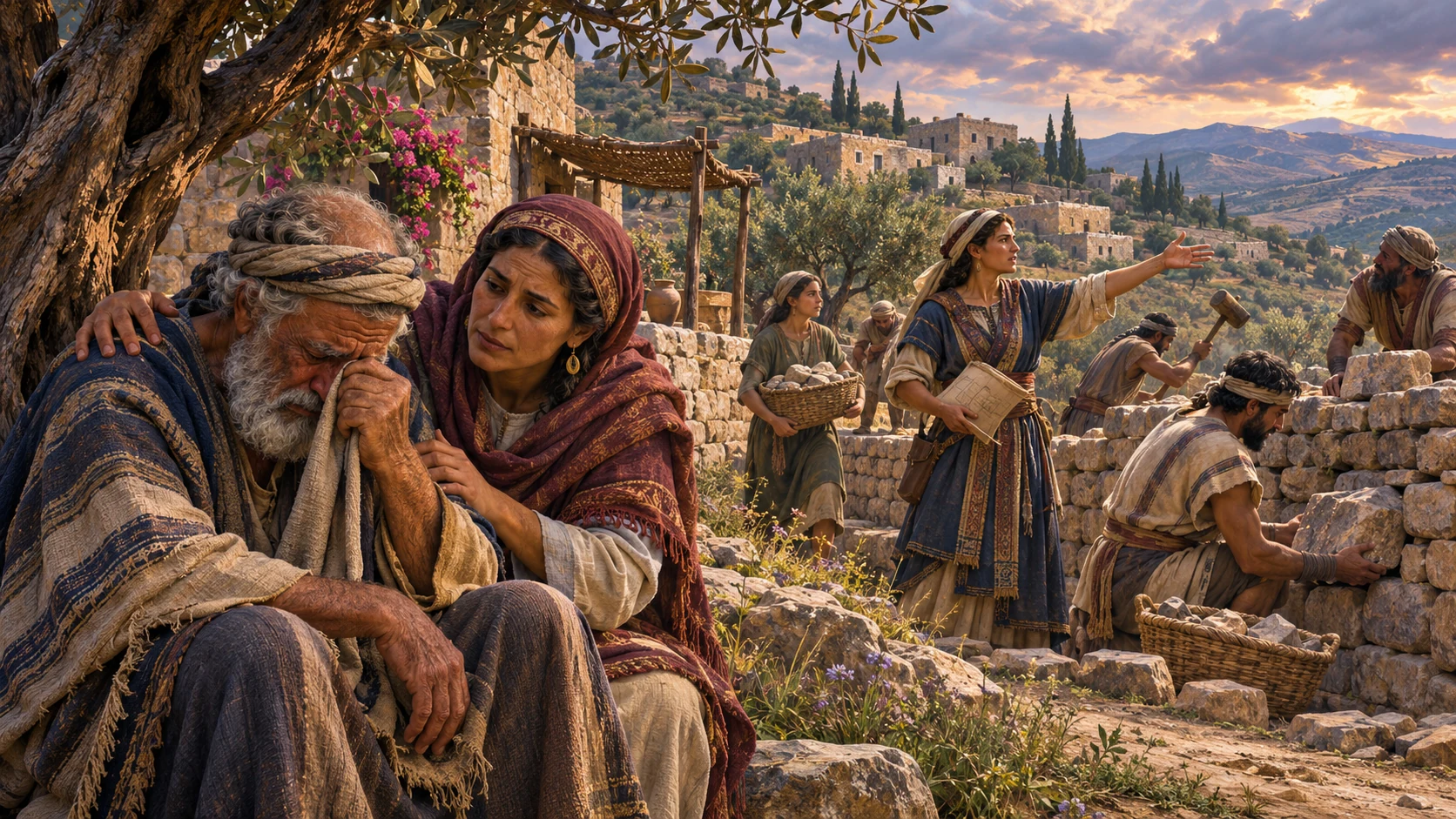
How can family memory honor grief while making room to build a future?
Study overview
The kingdom's map has been torn by war and exile. Yet family names remain like stitches across the broken seams. Among warriors and villages, a grieving father and a building daughter testify that loss need not have the final word.
Passage: 1 Chronicles 7:1–40
Controlling image: Stitches across a torn map—ancestral memory gathering a scattered people without concealing wounds
Heart-question: After a community has been scattered, what restores belonging: military strength, a celebrated ancestry, or faithfulness to the God of the covenant?
Introduction: When the Map No Longer Looks Like Home
A family keeps photographs after a house disappears. A congregation remembers members lost to migration, conflict, or death. Memory cannot reverse tragedy, but refuses to erase the scattered.
First Chronicles 7 offers no palace scene, temple ceremony, or royal speech. Instead, the Chronicler remembers households from Issachar, Benjamin, Naphtali, Manasseh, Ephraim, and Asher. The names recall warriors, land, women, loss, and rebuilding. Beneath military numbers lies a question: Can Israel still recognize a common calling after national collapse?
This text is about scattered ancestral memory becoming a summons to renewed covenant belonging. Names cannot rebuild Israel; the covenant God still calls a people to faithfulness.
Historical and Literary Context: Beyond Judah's Palace
First Chronicles 1–9 moves from Adam to the families and settlements of Israel, preparing the account of David and the temple. Chapter 2 gives Judah special prominence; chapter 3 remembers David's descendants; chapter 5 records eastern tribes carried into exile; chapter 6 preserves Levitical service. Chapter 7 widens the frame again. The story of God's people cannot be reduced to the royal household or the inhabitants of Jerusalem.
The Chronicler writes for a community seeking continuity after the Babylonian disaster. Ancestries, warriors, and settlements preserve memories later generations could forget. These selective genealogies sometimes differ from Genesis, Numbers, or Joshua; they are not modern population registers (Japhet 1993; Knoppers 2004).
Issachar, Benjamin, and Asher receive military totals; Naphtali receives one verse. Dan and Zebulun lack separate entries here, although both appear in 1 Chronicles 2:1–2. The reason remains uncertain. Sailhamer (1983) emphasizes Israel's continuing covenant role. Silence cannot justify condemning an entire tribe.
Walking Through the Text
When Ordinary Family Registers Carry the Weight of a Nation (7:1–5)
Issachar's four sons—Tola, Puah, Jashub, and Shimron—echo earlier records (Gen 46:13; Num 26:23–24). The Chronicler follows Tola's descendants and identifies household heads and warriors. During David's time, one line numbered 22,600 fighting men (7:2); another grouping numbered 36,000 (7:4). The wider Issachar total is given as 87,000 (7:5).
Ancestral houses, enrollment, and fighting ability portray an organized people. Such numbers describe tribal capacity, not guaranteed victory or a formula for church growth. The registers are not a modern census.
Israel consisted of families with responsibilities, not David's throne alone. Workers and defenders of settlements belonged to the covenant story beyond the centers of power.
When a Tribe's Record Is Uneven but Its Name Remains (7:6–13)
Benjamin receives three named lines—Bela, Becher, and Jediael—with detailed households and military enrollments (7:6–11). The fighting totals are 22,034, 20,200, and 17,200. Verse 12 names clans whose relationships remain uncertain. Chapter 8 will return to Benjamin and prepare the story of Saul (1 Chr 8:33; 9:39).
Naphtali follows in a single verse: Jahziel, Guni, Jezer, and Shallum, linked with Bilhah (7:13; Gen 46:24–25). A short entry should not be mistaken for an unimportant people. Brief records do not signal lesser worth.
Some families preserve thick archives; others retain a name. Rebuilding communities must not rank human worth by documentation, influence, or wealth. Naphtali remains within Israel's memory.
When Daughters Keep an Inheritance in View (7:14–19)
Manasseh's genealogy moves through Machir and Gilead, but the relationships and wording of several verses are difficult (7:14–17). The names of Maacah, Zelophehad's daughters, and Hammolecheth appear amid a family register usually dominated by men (7:15, 18). These women matter.
The mention of Zelophehad's daughters sends readers back to Numbers 27:1–11. When Zelophehad died without sons, five daughters brought an inheritance case before Moses; God affirmed the daughters' rightful claim. Joshua 17:3–6 records the inheritance arrangements within Manasseh. Family continuity exceeds male succession.
Chapter 7 does not retell the hearing or praise every named person. Yet faithful communities must challenge practices that erase vulnerable members. Land can mean livelihood, belonging, and a future.
When Grief Interrupts the Genealogy and a Daughter Builds (7:20–29)
Ephraim's list begins with Shuthelah and successive descendants. Suddenly the names become a story. Ezer and Elead are killed by men of Gath after going down to seize livestock (7:20–21). The attempted seizure receives no justification; neither are the deaths explicitly called divine punishment. The chronology remains debated (Bae 2020; Knoppers 2004).
Ephraim mourns, and relatives offer comfort (7:22). A newborn receives the name Beriah, recalling calamity (7:23). New life does not erase grief.
Then comes the startling notice: Sheerah, Ephraim's daughter, built Lower and Upper Beth-horon and Uzzen-sheerah (7:24). The genealogy preserves a woman's work. The line then continues to Joshua son of Nun (7:25–27), the leader associated with Israel's entrance into the promised land (Josh 1:1–9).
This movement suggests hope without promising that bereaved families recover children or property. Grief-stricken people may still contribute to a future shaped by God's promises (Gen 50:24; Josh 21:43–45).
The final settlement list names Bethel, Gezer, Shechem, and towns associated with Manasseh (7:28–29). The torn map receives another stitch.
When the Last Names Still Matter (7:30–40)
Asher's genealogy closes the chapter with household branches and a total of 26,000 men recorded for military service (7:40). The register includes Serah, sister of Asher's sons, and Shua, sister within Heber's family (7:30, 32). Serah is also remembered in Genesis 46:17.
The closing emphasis on capable leaders may sound like a celebration of power. Yet chapter 5 has already shown that military strength cannot secure covenant life when people abandon the Lord (1 Chr 5:18–26). The Chronicler's larger standard is not simply the ability to fight but the willingness to seek God, practice justice, and worship faithfully (2 Chr 7:14; 12:14; 19:6–7).
Asher's names bring no dramatic conclusion. Ordinary continuity matters even before kings and public revivals appear.
Theological Reflection: Belonging Beyond the Ruins
Covenant Memory Must Be Larger Than the Powerful
Royal descendants matter to Chronicles, but so do remote towns, brief entries, sisters, and forgotten family heads. God's covenant purposes begin with Abraham's promise to bless the families of the earth (Gen 12:1–3) and eventually encompass people from the nations in Christ (Gal 3:26–29). Prominence does not determine belonging.
Strength Is a Responsibility, Not a Savior
The military rosters preserve the capacity of Israel's households to defend their communities. Yet Deuteronomy warns against trusting in visible strength or claiming that achievement came from independent power (Deut 8:17–18; 17:16). The eastern tribes' exile confirms this (1 Chr 5:25–26). Security without covenant loyalty is a fragile foundation.
Grief and Hope Can Occupy the Same Household
Ephraim's mourning is neither suppressed nor condemned. Relatives come near, Beriah's name remembers trouble, and Sheerah's building marks continued life. Biblical hope makes room for lament (Ps 13; 126:5–6). Christian readers may see a fuller horizon in Jesus' resurrection (1 Cor 15:20–26), but Christian hope must not silence grief.
Faithfulness Requires Recognizing Overlooked People
Zelophehad's daughters, Sheerah, Serah, and Shua interrupt the assumption that only prominent men preserve a community's future. Numbers 27 demonstrates that justice sometimes requires changing an inherited legal practice in response to a legitimate claim. New Testament communities likewise receive differing gifts for the good of one body (1 Cor 12:12–27). Listen, honor service, and repair exclusion.
Life Application: Repairing the Torn Map
- Recover neglected names. Record the stories of families, local congregations, and unrecognized workers.
- Make room for grief. Accompany bereaved households with visits, meals, patient listening, and permission to lament without demanding an immediate testimony of victory.
- Honor women's work and protect inheritance. Examine decision-making, property practices, education, and ministry opportunities for exclusion; correct unfair arrangements with courage.
- Measure strength by covenant character. Review budgets and leadership for integrity, prayer, safeguarding, and care—not prestige alone.
- Include the less visible. Reconnect with remote churches, small groups, migrants, and households whose records or resources are thin.
- Build something that outlives grief. Support a child's schooling, repair a relationship, or establish a ministry after loss.
Reflection Questions
- Which people have disappeared from the congregation's memory because public attention follows only prominent leaders?
- Where has a community mistaken numerical strength or financial security for faithfulness to God?
- What grief is being hidden because lament feels unwelcome in worship?
- Whose legitimate voice, work, or inheritance remains overlooked because of gender, poverty, or social position?
- What concrete act of repair could turn remembered pain into service for the next generation?
Response Prayer
God of Abraham, Isaac, Jacob, and the scattered families of Israel, gather every name written on the broken map. Forgive pride in numbers, titles, and strength. Remember households carrying wounds that statistics cannot measure. Give companionship to the grieving, justice to the excluded, wisdom to leaders, and courage to builders. Let worship restore truth rather than disguise pain. Through Jesus Christ, Son of David and hope of the nations, teach the church to remember faithfully, repent honestly, and build generously. Keep the lamp of covenant hope burning among communities still learning to come home. Amen.
Window into What Comes Next
Chapter 7 has named families across Israel's landscape. First Chronicles 8 now returns to Benjamin with greater attention, tracing the family line that leads to Saul. Before the Chronicler tells the story of Saul's fall, the first king receives a genealogy. The next question is difficult and necessary: how should a community remember a leader whose story ended badly, without forgetting the people who belonged to that family?
Annotated Bibliography
- Bae, Hee-Sook. “The Fulfilment of God's Promises: A Literary-Homiletic Reading of 1 Chronicles 7:20–27.” Verbum et Ecclesia 41, no. 1 (2020). https://doi.org/10.4102/ve.v41i1.2054. Examines Ephraim's family tragedy, Sheerah's building, and the genealogy's movement toward Joshua; specific reconstructions remain debated.
- Japhet, Sara. I & II Chronicles: A Commentary. Old Testament Library. Louisville: Westminster John Knox, 1993. Explores the genealogies as literary and theological history rather than incidental records.
- Klein, Ralph W. 1 Chronicles: A Commentary. Hermeneia. Minneapolis: Fortress, 2006. Helpful for textual variants, complicated family relationships, and geographical notices.
- Knoppers, Gary N. I Chronicles 1–9: A New Translation with Introduction and Commentary. Anchor Bible 12. New York: Doubleday, 2004. Detailed treatment of tribal registers and debated readings in the Ephraim narrative.
- Sailhamer, John. First and Second Chronicles. Everyman's Bible Commentary. Chicago: Moody Press, 1983. The supplied commentary emphasizes covenant continuity and the continuing significance of all Israel's families.
- Williamson, H. G. M. 1 and 2 Chronicles. New Century Bible Commentary. Grand Rapids: Eerdmans, 1982. Situates the selective tribal genealogies within the Chronicler's wider vision of Israel.
Be the first to leave a comment.