

How can song, truth, and accountability renew worship after communal collapse?
Study overview
The temple stones have fallen, but the names of the servants remain. An altar is remembered, a choir is assembled, and towns are marked upon the land. Before the house can sing again, a scattered people must remember whom the house was for.
Passage: 1 Chronicles 6:1–81
Controlling image: A song carried across the ruins—worship preserved through remembered callings and renewed service
Heart-question: When familiar structures collapse, how can a community restore worship without losing holiness, accountability, and mercy?
Introduction: When the House Falls Silent
A congregation may retain a building while losing its song. Prayer grows thin while the choir still performs. Another congregation loses its building but keeps gathering, teaching Scripture, and caring for neighbors. Which community remembers the purpose of God's house?
First Chronicles 6 speaks into that question through names rather than a sermon. After the eastern tribes' exile (1 Chr 5:25–26), the Chronicler turns to Levi: priests, extended families, musicians, and towns. The story stretches from Sinai to Babylon. Rebuilding the temple requires more than collecting stones; worshipers must recover the vocation beneath them.
This text is about inherited sacred service becoming a summons to rebuild faithful worship. Can a wounded community approach God rightly and live accordingly?
Historical and Literary Context: Remembering the Servants of the House
First Chronicles 1–9 gathers Israel's ancestral memory for a community living after conquest and exile. Chapters 1–4 trace humanity, Judah, and David's house; chapter 5 remembers eastern tribes who lost their land. Chapter 6 turns toward the servants of the sanctuary. National failure does not erase Israel's vocation to worship.
The priestly genealogy ends with Jehozadak carried into Babylonian exile (6:15). Ancestry did not protect Jerusalem from judgment (2 Chr 36:14–19). Yet the remaining lists identify people and practices needed for restoration. After exile, disputed priestly records could prevent immediate altar service (Ezra 2:61–63; Neh 7:63–65). Sailhamer (1983) emphasizes the distinct tasks of Aaron's descendants, the wider Levites, and the settlement towns. Ancestry establishes responsibility, not a substitute for grace or obedience.
The chapter recalls Torah appointments (Num 3–4), Davidic song (1 Chr 15–16; 25), and Levitical towns (Josh 21). Verse numbering follows English Bibles; Hebrew editions differ.
Walking Through the Text
When a Priestly Line Reaches the Road to Babylon (6:1–15)
Levi's line leads through Kohath and Amram to Aaron, Moses, and Miriam (6:1–3). Miriam's presence within a largely male genealogy recalls the wider story of God's deliverance (Exod 15:20–21). Aaron's sons are named, but the genealogy continues through Eleazar and Phinehas toward Zadok's descendants and finally Jehozadak (6:3–15).
Repeated fathers and sons convey continuity, though genealogies may omit generations (Knoppers 2004). Then comes a shock: Jehozadak goes into exile when the Lord allows Judah and Jerusalem to be deported under Nebuchadnezzar (6:15).
The priestly line enters the nation's darkness. Holy office cannot excuse disobedience. Aaron's family itself knew judgment—Nadab and Abihu died after unauthorized worship (Lev 10:1–3). The Chronicler does not repeat that episode here, but the Torah warns against turning sacred appointment into presumption.
The naming of Jehozadak also keeps open the future. Ezra later identifies Jeshua, a priest involved in rebuilding the altar, as Jehozadak's son (Ezra 3:2). Exile interrupts institutions; memory prepares renewed service.
When Different Families Receive Different Work (6:16–30)
The Chronicler now returns to the three major Levitical families: Gershon, Kohath, and Merari (6:16–19). Each branch receives a distinct genealogy (6:20–30). The priestly line belongs to a larger serving community.
Within the Kohathite material appear Elkanah, Samuel, and Samuel's sons (6:27–28). Samuel's Levitical ancestry belongs beside the account of Samuel's prophetic ministry (1 Sam 3:19–21). Yet 1 Samuel 8:1–3 reports that Samuel's sons perverted justice. Celebrated ancestry cannot guarantee character.
Ancestral records establish service roles but cannot manufacture honesty. Ordered service must never become blind loyalty to officeholders.
In Numbers 3–4, Gershonites, Kohathites, and Merarites had differing responsibilities for the wilderness sanctuary. The house of God requires many callings; none deserves contempt.
When the Song Is Given Names and Places (6:31–48)
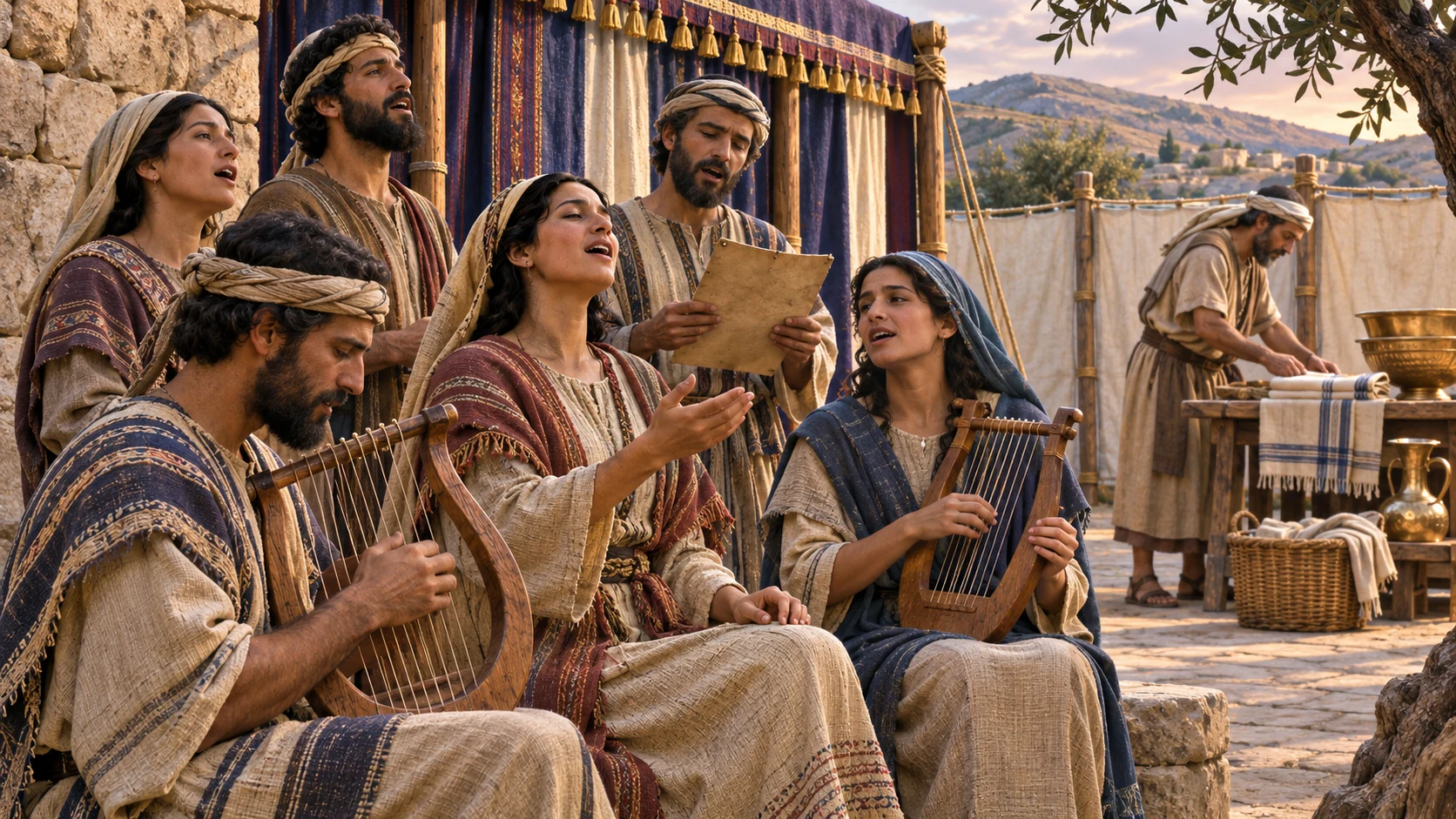
The narrative suddenly becomes audible. David appointed singers after the ark had found a resting place; singers served before the tent of meeting until Solomon built the temple, performing duties according to their appointed order (6:31–32).
Three leaders represent the Levitical branches. Heman descends from Kohath and Samuel (6:33–38). Asaph stands on Heman's right and descends from Gershon (6:39–43). Ethan stands on the left and descends from Merari (6:44–47). The placement signals ordered worship. Other Levites undertake sanctuary work (6:48).
The Chronicler sees music as ministry. The singers do not entertain a royal court; the singers serve before God. Chronicles later describes appointed musicians praising and prophesying with instruments (1 Chr 25:1–7). Psalms associated with Asaph and Korah's descendants preserve praise and lament (Pss 50; 73–83; 42–49; 84–85; 87–88).
Rest for the ark did not mean inactivity. Rest made sustained worship possible. After destruction, worship can be organized anew through skill, rehearsal, joy, and lament. The passage does not claim uninterrupted singing during exile; it preserves a calling that can be renewed.
When Song Gives Way to the Altar (6:49–53)
After the musicians, the account returns to Aaron and the priests. Aaron's descendants attend the altar of burnt offering and the altar of incense, carry out duties connected with the Most Holy Place, and make atonement for Israel according to Moses' command (6:49). The priestly line is briefly rehearsed again (6:50–53).
Music matters, but cannot replace reconciliation. The altar confronts sin, holiness, and the cost of restored communion (Lev 16; 17:11). Nor should the distinction be confused: every Aaronic priest was a Levite, but not every Levite was an Aaronic priest (Num 3:10; 1 Chr 6:48–49).
Worship follows God's instruction, not human convenience. For Christian readers, Hebrews identifies Jesus as the enduring high priest whose self-offering accomplishes what repeated sacrifices could not finally complete (Heb 7:23–28; 9:11–14; 10:11–14). This is a later canonical fulfillment, not the genealogy's explicit claim.
When the Sanctuary's Servants Live Across the Land (6:54–81)
The final section moves from people and duties to addresses. Aaron's descendants receive towns associated with Judah, Simeon, and Benjamin (6:54–60). Other Levitical families receive settlements across additional tribal territories (6:61–81). Hebron is explicitly named as a city of refuge (6:57; Josh 20:7).
Cities and pasturelands sustain worship. Sanctuary servants need homes, food, and community. The distribution recalls Joshua 21 and the wider teaching vocation of Levi (Deut 33:10). Israel's spiritual health cannot be confined to Jerusalem.
Some names and towns differ from Joshua's account. Differences require patience, not invented certainty (Klein 2006; Knoppers 2004). Worship reaches beyond one building into many neighborhoods.
Theological Reflection: Worship with a Memory and a Future
Holy Calling Is Grace, Not Entitlement
Aaron's priesthood rests on divine appointment (Exod 28:1; Num 18:1–7). Yet the genealogy ends in exile. Ancestry cannot prevent judgment. Today's church must honor spiritual vocations while insisting on transparent stewardship, ethical conduct, and accountability (1 Pet 5:2–3).
Worship Needs Both Song and Truth
Heman, Asaph, and Ethan represent disciplined communal praise, while Aaron's descendants remind Israel of holiness and atonement. Praise without truth becomes spectacle; ritual without repentance becomes camouflage (Isa 1:11–17; Amos 5:21–24). Healthy worship carries Scripture, confession, thanksgiving, lament, and care for neighbors together.
God Builds Community Through Different Forms of Service
The singers, priests, and other Levites are not interchangeable, yet the tasks belong to one calling. The New Testament likewise pictures a body with different gifts serving one Lord (1 Cor 12:4–27). Distinct responsibilities should produce cooperation, not spiritual rankings. The room preparer matters alongside the preacher.
The Presence of God Cannot Be Confined to One Address
Levitical towns spread across Israel, but Solomon later confesses that even heaven cannot contain God (2 Chr 6:18). Christian hope moves through Jesus, who identifies the temple with the body raised after death (John 2:19–21). In Christ, a people from many backgrounds becomes God's dwelling by the Spirit (Eph 2:19–22). Worship therefore reaches homes, classrooms, hospitals, and places where suffering hides.
Life Application: Helping the House Sing Again
- Restore worship's foundations. Review Scripture reading, prayer, congregational singing, confession, and care for the vulnerable—not only attendance and musical quality.
- Honor every calling. Publicly value cleaners, ushers, musicians, teachers, treasurers, and caregivers; provide training and appropriate support rather than applause alone.
- Demand integrity from sacred officeholders. Establish safeguards for money, protection of children, and credible processes for addressing harm, even when respected families are involved.
- Give lament a place beside praise. Invite grieving members to pray and sing honestly; avoid pressuring wounded people to perform happiness.
- Sustain servants materially. Budget fairly for essential ministry needs, support overworked volunteers, and practice transparent use of shared resources.
- Carry worship into neighborhoods. Organize Bible study, visits to isolated members, practical mercy, and local service beyond the central church building.
Reflection Questions
- Has the congregation preserved religious activities while neglecting prayer, holiness, or justice?
- Which faithful servants are invisible because their work happens away from the platform?
- Where has a respected spiritual title become a shield against accountability?
- Which families or neighborhoods lack the care that congregational worship should generate?
- What specific habit, policy, or ministry must be repaired so the house can truly sing again?
Response Prayer
God of Aaron, Moses, Miriam, and the singers of Israel, gather the names scattered beneath the fallen stones. Cleanse worship of pride, empty display, and hidden injustice. Give wisdom to priests and teachers, integrity to leaders, strength to unseen servants, and truthful songs to grieving hearts. Let prayer rise where the altar once stood; let mercy reach the streets surrounding the house. Through Jesus Christ, the faithful high priest and risen temple, form a people whose whole life praises the Lord. Give courage to confess, repair, and begin again. Amen.
Window into What Comes Next
The sanctuary's servants have received names, duties, and towns. 1 Chronicles 7 widens the view again to Israel's other families. The question moves from worship's entrusted servants to the breadth of the people: Who still belongs when conquest and exile have scattered the household?
Annotated Bibliography
- Hill, Andrew E. 1 & 2 Chronicles. NIV Application Commentary. Grand Rapids: Zondervan, 2003. Connects Chronicles' worship emphasis with responsible communal practice.
- Japhet, Sara. I & II Chronicles: A Commentary. Old Testament Library. Louisville: Westminster John Knox, 1993. Explains the Chronicler's reshaping of Israel's history through genealogies and temple traditions.
- Klein, Ralph W. 1 Chronicles: A Commentary. Hermeneia. Minneapolis: Fortress, 2006. Offers textual and historical analysis of difficult genealogies and settlement lists.
- Knoppers, Gary N. I Chronicles 1–9: A New Translation with Introduction and Commentary. Anchor Bible 12. New York: Doubleday, 2004. Provides detailed study of the Levitical lines, musicians, and towns.
- Sailhamer, John. First and Second Chronicles. Everyman's Bible Commentary. Chicago: Moody Press, 1983. The supplied commentary; highlights priestly descent, worship ministries, and the geographical reach of Levitical service.
- Williamson, H. G. M. 1 and 2 Chronicles. New Century Bible Commentary. Grand Rapids: Eerdmans, 1982. Helps situate priestly memory within postexilic covenant restoration.

Be the first to leave a comment.