

How can success deepen dependence upon God rather than pride in experience?
Study overview
The palace rises; the enemy advances. Once God says, “Go.” Another time God says, “Go around.” Beneath the moving treetops, a growing kingdom learns that strength must wait for the Lord.
Passage: 1 Chronicles 14:1–17
Controlling metaphor: The sound of marching in the treetops—a summons to attentive obedience
Heart-question: When success has increased confidence, will leadership still seek God's direction before acting?
Introduction: When Yesterday's Victory Becomes Today's Temptation
A leader may begin with prayer yet gradually rely on experience alone. A bigger office and former victories whisper: The next decision will be easy. Yesterday’s instruction, however, is not always today’s assignment.
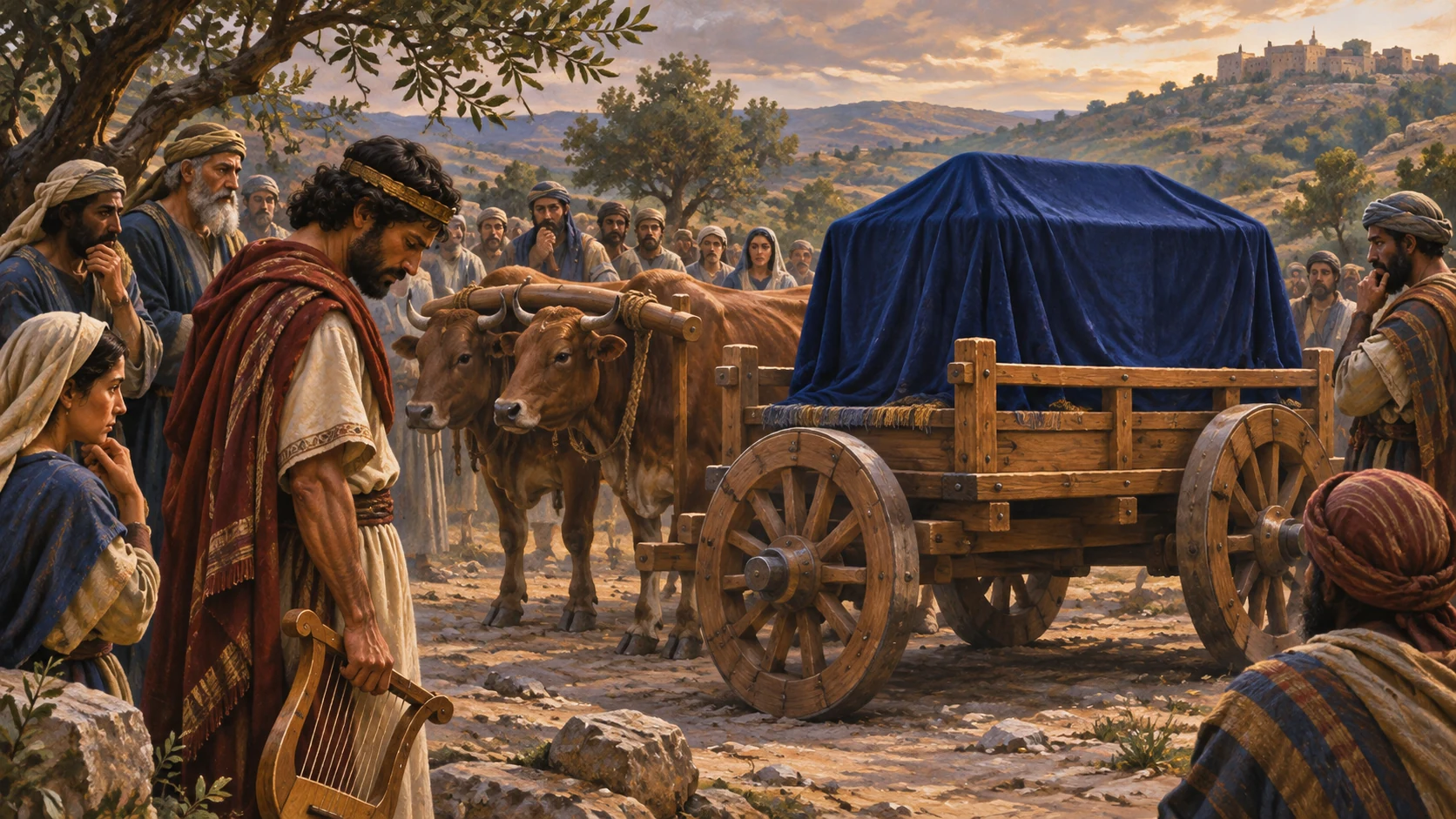
First Chronicles 14 finds David growing in strength. Hiram supplies materials for a royal house. David's family expands. The Philistines attack twice. David seeks God twice—and receives two different instructions. The chapter stands between a failed attempt to transport the ark (chapter 13) and the successful preparation for the ark's arrival (chapter 15).
This text is about increasing royal strength becoming renewed dependence on God's guidance. The deepest mark of covenant leadership is not the power to move quickly, but the humility to listen again.
Historical and Literary Context: The House, the Ark, and the Kingdom
The Chronicler presents David as a king preparing Israel for worship (1 Chr 13–16). After Uzzah’s death interrupts the ark procession, chapter 14 recounts David’s house and victories; chapter 15 corrects the ark arrangements. Royal success serves worship, not the reverse.
The parallel in 2 Samuel 5:11–25 shares the main events. Chronicles emphasizes repeated inquiry, burned idols, and God’s role in David’s reputation (14:10, 12, 14, 17). The thematic arrangement does not establish every event’s timing (Japhet 1993; Knoppers 2004).
Sailhamer (1983) interprets chapter 14 within the restoration of fellowship and covenant blessing following chapter 13. That insight illuminates the narrative arrangement, but it should not be converted into the claim that David had already corrected the ark procession. The explicit correction appears in 15:2, 13–15.
Postexilic readers likewise needed guidance beyond houses, officials, and memories of greatness.
Walking Through the Text
When Cedar from Tyre Builds a Royal House (14:1–2)
Hiram, king of Tyre, sends messengers, cedar timber, stoneworkers, and carpenters to build David a house (14:1). Foreign expertise supports Israel’s stability. David recognizes that God established the kingship for Israel’s sake (14:2).
The phrase for the sake of the people restrains royal vanity. The palace does not justify royal luxury; authority must serve Israel (Deut 17:18–20). Tyrian support will later aid Solomon’s temple (2 Chr 2:3–16).
The Chronicler gives credit to God's establishment without erasing human labor. Cedar, craftsmen, diplomacy, and divine purpose occupy one account. Spiritual leadership should neither despise skilled work nor worship institutional success.
When a Growing Household Carries Both Promise and Warning (14:3–7)
David takes additional wives in Jerusalem and has more sons and daughters. The sons are named, including Nathan and Solomon (14:3–7). Their presence links David's present growth to the future royal succession and the temple-building son (1 Chr 3:5–9; 22:9–10).
Within the chapter, the expanding household accompanies David's growing kingdom. Yet description is not unconditional approval. Deuteronomy 17:17 warns Israel's king against multiplying wives; David's household will later experience painful internal division (2 Sam 13–18). The Chronicler does not explore those complications here.
God preserves the Davidic line amid human failings. Neither a large household nor a flourishing institution certifies holiness. Hope rests on divine faithfulness.
When the First Battle Begins with a Question (14:8–10)
The Philistines hear that David has been anointed over all Israel and advance against the new king. The raiders spread through the Valley of Rephaim (14:8–9). The precise location remains disputed.
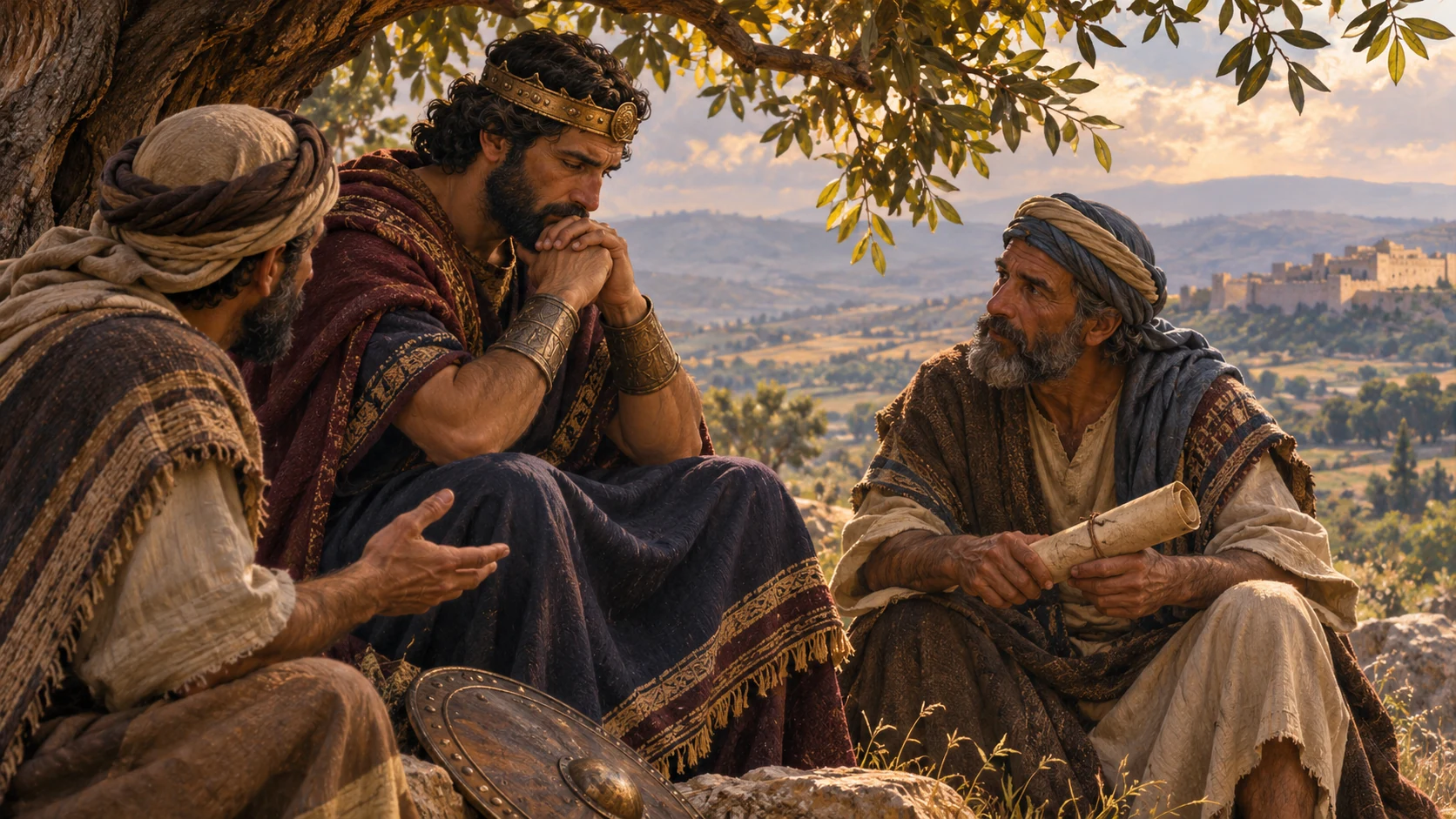
David does not attack on instinct. David inquires of God: Should the army advance, and will God grant victory? The Lord answers affirmatively (14:10). The contrast with Saul is striking: Saul's downfall was linked to not genuinely seeking the Lord (10:13–14).
The means of receiving God’s answer is unspecified. Experience cannot replace dependence.
When God Breaks Through Like Floodwater (14:11–12)
David defeats the Philistines at Baal-perazim and attributes victory to God, comparing divine intervention to floodwater breaking through a barrier (14:11). The site-name preserves that memory. The Hebrew root for breaking through recalls Perez-uzzah in chapter 13 (13:11): God's holy power may appear in judgment or deliverance (Sailhamer 1983).
David burns abandoned Philistine idols (14:12; Deut 7:5, 25). Second Samuel 5:21 reports their removal; Chronicles emphasizes destruction. This is covenant history, not permission for Christians to destroy others’ property.
The king receives victory without treating the victory—or captured idols—as a substitute for the living God.
When God Changes the Battle Plan (14:13–16)
The Philistines raid the valley again. David inquires of God again (14:13–14). This time the command changes. David must not advance directly; the army must circle behind the Philistines near the baca trees, variously translated balsam or poplar trees. At the sound of marching in the treetops, David is to act because God has gone ahead (14:14–15).
The tree species and sound remain uncertain. This sign is not a universal method of guidance.
Verse 16 supplies the decisive evaluation: David does what God commands. Victory follows from Gibeon toward Gezer. The parallel in 2 Samuel 5:25 reads Geba rather than Gibeon; the historical or textual relationship is debated. The Chronicler's theological emphasis is unaffected: the king asks again and obeys a different answer.
God's guidance is not a reusable military formula. The first victory cannot become permission to stop praying before the second battle.
When Fame Travels Farther Than the King (14:17)
David's reputation spreads, and the Lord places fear of David upon the nations (14:17). The verse credits divine action rather than autonomous royal greatness.
Yet fame is a dangerous gift. Prestige must not become an end. Postexilic readers could hope beyond current political weakness, while the coming ark procession would demand reverence.
Theological Reflection: The God Who Goes Ahead
Seeking the Lord Must Remain a Habit
The repeated inquiries (14:10, 14) are the chapter's center of gravity. Saul's failure to seek the Lord (10:14) and David's renewed dependence frame the contrast. Trust must be practiced at every new crossroads, not borrowed from yesterday's obedience (Prov 3:5–6).
Blessing Exists for the Good of God's People
The palace is built and the kingdom strengthened for Israel's sake (14:2). Leadership success should widen protection, justice, and worship, not privilege the ruler. God's provision calls for stewardship and shared benefit (Deut 17:18–20; Ps 72:1–4).
God's Presence Is Powerful but Not Manageable
God breaks through against the enemy (14:11), just as holy power broke out in judgment at the ark (13:11). The same Lord cannot be manipulated through ceremonies or strategies. The paired narratives call for reverence, trust, and obedience rather than superstition (1 Chr 15:13–15).
David's Dependence Points toward the Faithful Son of David
The Davidic promise will extend beyond David's lifetime (1 Chr 17:11–14). Christian readers see its fullness in Jesus, who lives in dependence upon the Father and seeks the Father's will (John 5:19, 30; Luke 22:42). Jesus secures peace not by prescribing warfare to the church, but through faithful self-giving and resurrection (Eph 2:14–18). The true King leads people into God's presence.
Life Application: Listen Before Moving
- Pray before repeating a success. Begin every new project or season with Scripture, prayer, and responsible discernment rather than copying last year's strategy.
- Ask whom success serves. Review whether growing buildings, budgets, and influence improve care for families, children, and vulnerable neighbors.
- Keep wise counsel close. Consult Scripture-informed leaders and affected members; never claim an untested personal impression is a binding word from God.
- Identify modern idols. Challenge the pursuit of reputation, control, wealth, or numerical growth when those goals displace covenant faithfulness.
- Correct methods without denying former blessings. When circumstances change, revise plans transparently, protect workers, and admit that a previous method is no longer appropriate.
- Refuse to weaponize battle imagery. Apply the call to courage through truth, reconciliation, justice, and patient service—not hostility toward religious or political opponents.
Reflection Questions
- Which decision is moving forward because of past success rather than renewed discernment?
- Who benefits from the community's expanding resources, and who remains neglected?
- What cherished method has become more important than obedience to God's word?
- Which form of reputation or influence is quietly becoming an idol?
- What concrete change would show that leadership has listened again?
Response Prayer
Lord of the covenant, God who breaks through barriers and goes before the people, quiet the noise of pride. Teach leaders to listen before moving and to seek the Lord again after victory. Let strong houses shelter the vulnerable, and let growing influence serve the worshiping community. Burn away the idols of prestige and self-reliance. When the treetops stir, grant wisdom to recognize the duty already made clear in God's word. Prepare Israel's remembered road toward the ark, and prepare the church to approach God through Jesus Christ, the faithful Son of David. Amen.
Window into What Comes Next
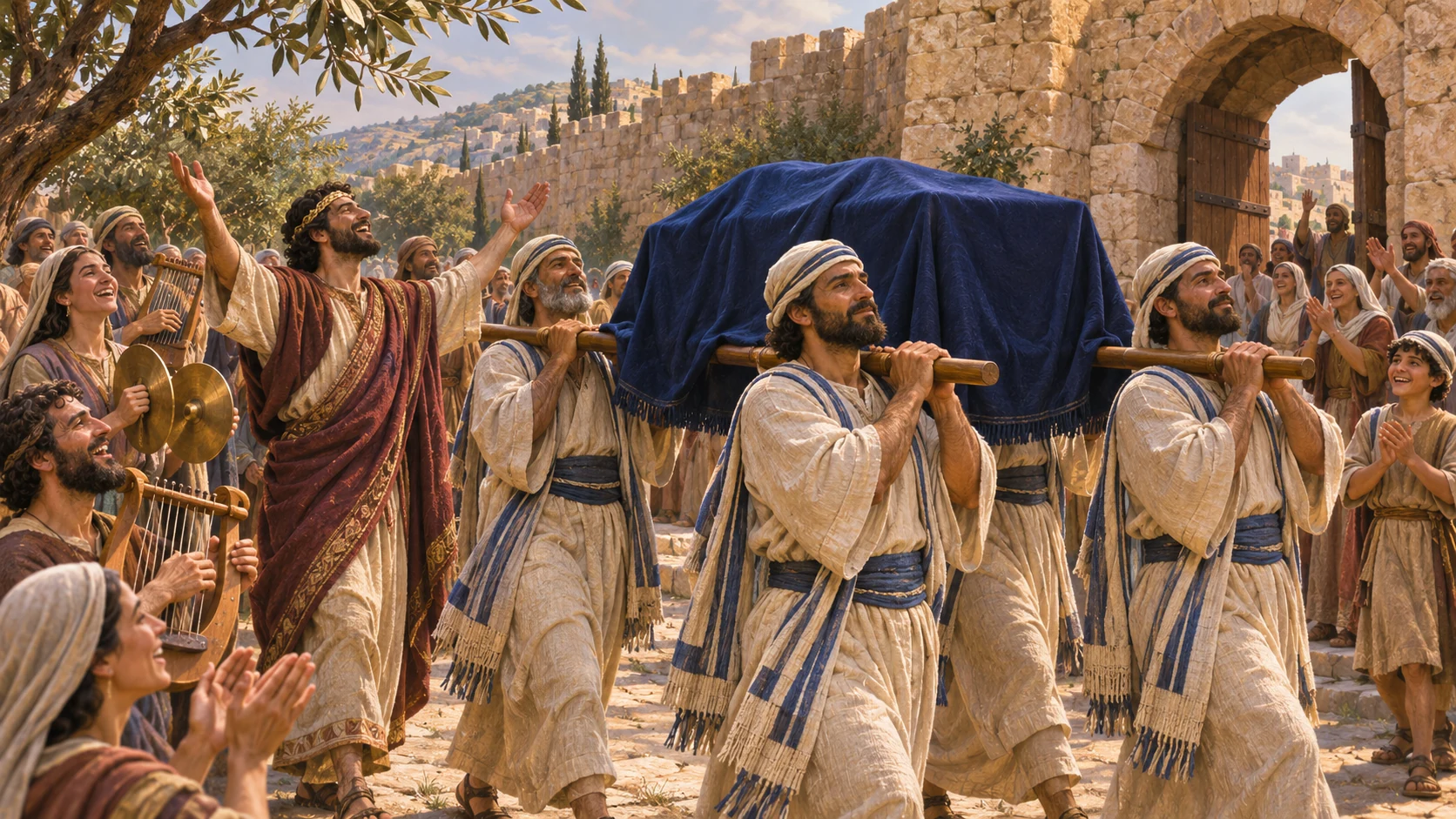
David has gained a palace, a growing household, and victory—but the ark still waits. First Chronicles 15 returns to the interrupted journey. This time David will prepare the Levites, honor the prescribed way of carrying the ark, and join careful obedience to joyful singing. The question is no longer only Will the king listen before battle? but Will the king listen before worship?
Annotated Bibliography
- Hill, Andrew E. 1 & 2 Chronicles. NIV Application Commentary. Grand Rapids: Zondervan, 2003. Connects David's royal development to stewardship, worship, and contemporary leadership.
- Japhet, Sara. I & II Chronicles: A Commentary. Old Testament Library. Louisville: Westminster John Knox, 1993. Examines the Chronicler's arrangement of the David traditions and their postexilic significance.
- Klein, Ralph W. 1 Chronicles: A Commentary. Hermeneia. Minneapolis: Fortress, 2006. Helpful for comparing Samuel, assessing textual variants, and interpreting the battle episodes.
- Knoppers, Gary N. I Chronicles 10–29: A New Translation with Introduction and Commentary. Anchor Bible 12A. New York: Doubleday, 2004. Provides literary and historical treatment of David's establishment and Philistine encounters.
- Sailhamer, John. First and Second Chronicles. Everyman's Bible Commentary. Chicago: Moody Press, 1983. The supplied commentary interprets the palace, descendants, and victories as signs of covenant blessing within the larger ark narrative.
- Williamson, H. G. M. 1 and 2 Chronicles. New Century Bible Commentary. Grand Rapids: Eerdmans, 1982. Situates seeking the Lord and the establishment of David's kingship within the theology of Chronicles.
Be the first to leave a comment.