

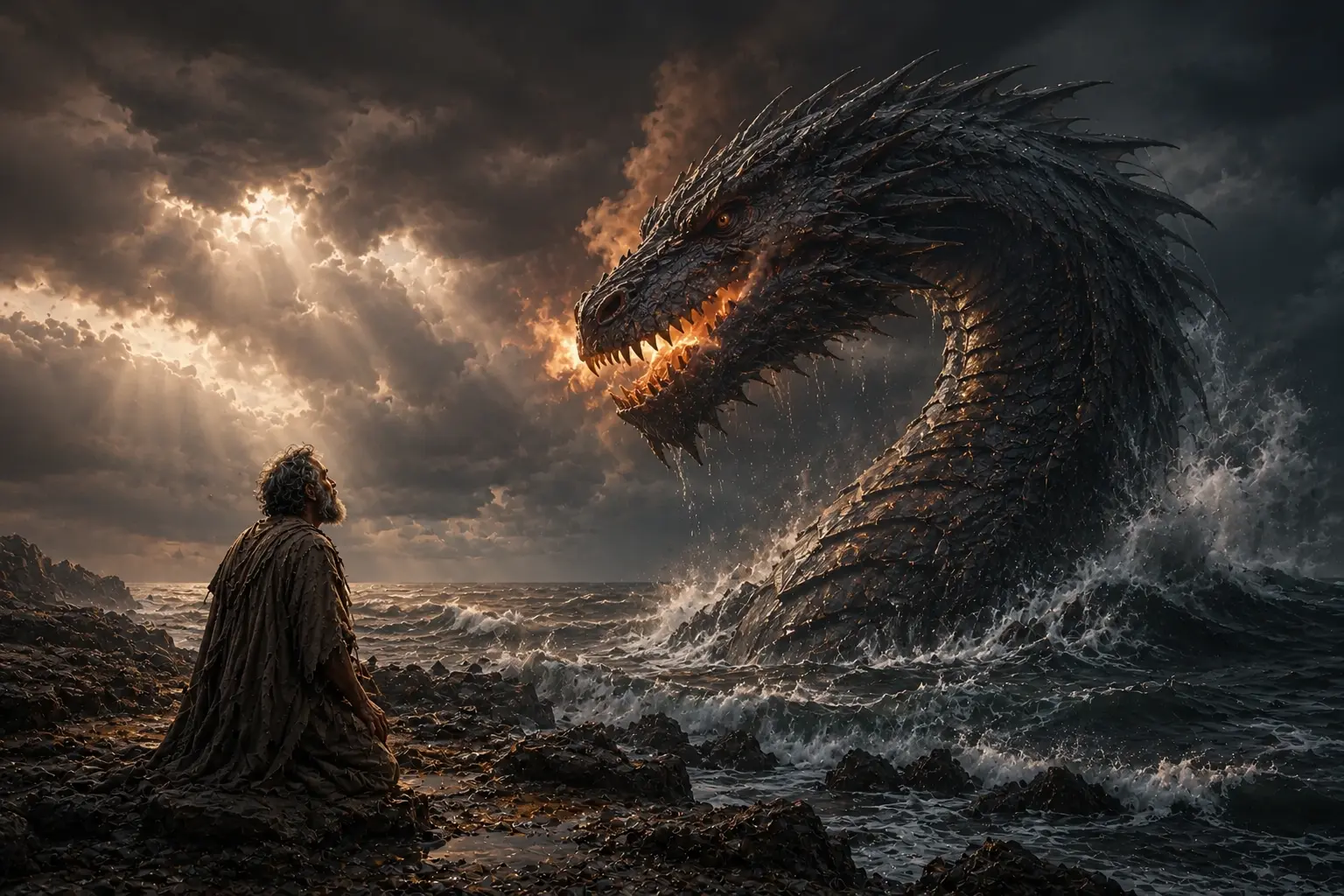
God brings Job to the edge of the deep and asks whether he can fish for the monster, bargain with the dragon, make a pet of terror, or stand before the creature whose armor laughs at human weapons. If Job cannot master Leviathan, how can he summon the Maker of Leviathan into court?
01
1. Introduction: When the Deep Answers Back
Some fears have names.
Loss. Shame. Illness. Death. Betrayal. Silence. Injustice.
But some fears are deeper than names. They move beneath the surface like shadows under dark water. They are the powers we cannot manage, the chaos we cannot domesticate, the forces that make human strength feel like straw in the wind.
Job 41 takes us to that deep place.
In Job 40, God confronted Job with the danger of condemning God in order to justify himself. Then the Lord pointed to Behemoth, the great creature of land—massive, calm, immovable before the rushing river. Behemoth stood as a living question: Can Job master the powers God has made? Can Job rule what lies beyond human control?
Now God turns from land to sea, from Behemoth to Leviathan.
Leviathan is not described as a tame animal in a nature documentary. It is terrifying, armored, fiery, unconquerable. The chapter begins with fishing imagery: Can Job draw Leviathan out with a fishhook? Can he press down its tongue with a cord? Can he put a rope in its nose? [Job 41:1–2]. The questions are almost absurd. To imagine Leviathan as a hooked fish is to misunderstand the creature entirely.
Then God presses the absurdity further. Will Leviathan plead for mercy? Will it speak soft words? Will it make a covenant and become Job’s servant? Will Job play with it like a bird or put it on a leash for his girls? Will traders bargain over it in the market? [Job 41:3–6].
The answer is no.
Leviathan cannot be captured, domesticated, commodified, or turned into a toy. It cannot be reduced to usefulness. It cannot be made safe for children. It cannot be priced by merchants. It is not a pet. It is not property. It is not manageable fear.
Then God describes the creature’s body: its impenetrable armor, terrifying teeth, shield-like scales, fiery breath, smoking nostrils, strength in its neck, heart like stone, weapons failing against it, the sea boiling behind it, and its final title: “king over all the sons of pride” [Job 41:34].
This chapter is strange, majestic, and unsettling.
It does not explain why Job suffered.
It does something more disruptive: it shows Job a creature that embodies the untamable powers of God’s world. Leviathan is not outside God’s sovereignty. But it is outside Job’s control. If Job cannot master Leviathan, he cannot master the cosmos. If he cannot stand before the dragon, how can he put the Dragon-Maker on trial?
Yet this is not a message of despair. Leviathan is terrifying to Job, but not to God. The creature that makes warriors tremble is one of God’s creatures. The deep that humans fear is not God’s rival kingdom. The monster has boundaries because the Maker is Lord.
Job 41 teaches that there are powers too great for human hands, but no power is too great for the God who made and rules them.
02
2. Historical and Literary Context: Leviathan in Yahweh’s Second Speech
Job 41 continues and completes Yahweh’s second speech, which began in Job 40:6. The second speech addresses Job’s challenge to divine justice more directly than the first. God asked whether Job would condemn him in order to justify himself, whether Job had an arm like God, whether he could clothe himself with majesty, humble the proud, tread down the wicked, and save himself by his own right hand [Job 40:8–14].
Then God presented two great creatures: Behemoth and Leviathan.
Behemoth, in Job 40:15–24, represents massive creaturely power associated with land, river, strength, and immovability. Leviathan, in Job 41, represents even greater terror associated with the sea, armor, flame, invulnerability, and pride.
The identity of Leviathan has long been discussed. Some readers connect it with the crocodile because of its watery habitat, scales, teeth, and terrifying strength. Others see mythic dragon imagery, recalling ancient Near Eastern sea monsters and biblical texts where Leviathan symbolizes chaotic powers subdued by God [Ps 74:14; Isa 27:1]. The chapter itself seems to blend creaturely and symbolic language. Leviathan is animal-like and dragon-like, natural and mythic, physical and theological.
That blend is important. The point is not simply to classify a species. The point is to confront Job with a reality that exceeds human mastery. Leviathan is everything Job cannot hook, leash, bargain with, pierce, price, or command.
Literarily, Job 41 is the climax of the creation tour. God began with earth’s foundations and the sea’s boundaries [Job 38:4–11]. He moved through dawn, death, snow, stars, rain, lions, ravens, mountain goats, wild donkeys, wild oxen, ostriches, horses, hawks, and eagles. Then came Behemoth. Now Leviathan rises.
The order matters. God’s speech moves from creation’s structure to creation’s wildness, from the skies to the wilderness, from animals beyond human use to monsters beyond human courage. The lesson grows sharper: Job does not know enough and cannot rule enough to judge God’s governance of the world.
The chapter also answers Job’s earlier language in a deep way. In Job 3, Job wished that those skilled in cursing days would rouse Leviathan against the night of his conception [Job 3:8]. Now God speaks of Leviathan directly. The monster Job once invoked in despair becomes the creature God uses to humble Job’s imagination.
This does not mean Leviathan is evil in a simple sense. God speaks of it with a kind of admiration. Its strength, armor, and fearlessness display divine workmanship. Yet Leviathan also symbolizes the proud, chaotic, terrifying forces that human beings cannot subdue.
The final line, “He is king over all the sons of pride” [Job 41:34], connects Leviathan to the moral challenge of the speech. Job has been tempted toward a prideful posture—not the pride of hidden wickedness, but the pride of thinking his case gives him standing to condemn God. Leviathan embodies the realm of prideful force. If Job cannot master the king over pride, he must not imagine he can rule the moral universe from his ash heap.
Leviathan is the final wilderness sermon: God’s world contains powers that terrify us, but the Lord of the whirlwind is not terrified.
03
3. Walking Through the Text: The Monster No Human Can Master
04
3.1 Can You Draw Out Leviathan with a Fishhook? (41:1–2)
God begins with an impossible image: “Can you draw out Leviathan with a fishhook or press down his tongue with a cord?” [Job 41:1].
A fishhook is too small for Leviathan. The tool does not match the terror. Job may know ordinary fishing, ordinary ropes, ordinary captures. But Leviathan is not an ordinary creature.
God continues: can Job put a rope in its nose or pierce its jaw with a hook? [Job 41:2]. These are images of control. To put a rope through an animal’s nose is to lead it. To pierce the jaw is to subdue the mouth. God asks whether Job can command the creature’s movement and speech.
The implied answer is no.
This opening matters because Job has wanted to draw God into court. He wanted to put questions to the Almighty, to require an answer, to manage the legal process. God now asks whether Job can even manage Leviathan.
Human beings often underestimate the size of what they are trying to control. We bring fishhooks to dragons. We bring neat explanations to grief. We bring slogans to injustice. We bring small tools to deep chaos.
Leviathan teaches humility at the edge of the deep.
Some powers cannot be hooked by human cleverness or led by human rope.
05
3.2 Will Leviathan Beg for Mercy? (41:3–4)
God asks whether Leviathan will make many pleas to Job or speak soft words to him [Job 41:3]. Will it make a covenant with Job to be taken as a servant forever? [Job 41:4].
The questions are almost humorous. Leviathan will not negotiate surrender. It will not become a vassal. It will not sign a treaty. It will not soften its voice to flatter Job.
Ancient covenant imagery stands behind the question. A weaker party might make terms with a stronger ruler. But Leviathan does not see Job as stronger. It will not sue for peace.
This exposes the limits of human authority. Job has been a great man. He was once respected at the gate. Young men hid when he approached, elders rose, princes kept silence [Job 29:7–10]. But public honor does not impress Leviathan. Social rank does not rule chaos.
There are forces in life that do not care about our status. Disease does not bow to reputation. Death does not flatter wealth. Trauma does not negotiate because we are admired. Injustice does not vanish because we once sat in honor.
The question is not whether Job had dignity. He did. The question is whether human dignity includes sovereignty over the deep. It does not.
Leviathan will not whisper soft words to human importance.
06
3.3 Can You Make a Pet of Terror? (41:5)
God asks: “Will you play with him as with a bird, or will you put him on a leash for your girls?” [Job 41:5].
The image is deliberately absurd and tenderly shocking. Children play with small birds. A family might keep a harmless creature for delight. But Leviathan is not safe for the household. It cannot be brought into the nursery. It cannot be domesticated into affection.
This question presses against our desire to make terrifying things harmless by naming them lightly. We often try to turn chaos into a pet. We joke about what we fear. We manage appearances. We pretend the monster is small enough for a leash.
But some realities must be respected as dangerous. Evil is not a toy. Death is not a pet. Pride is not harmless. The powers that destroy human life are not safe companions.
At the same time, the question reveals something about God’s mastery. Psalm 104 says Leviathan was formed to play in the sea [Ps 104:26]. What terrifies humans can be playful before God. The creature Job cannot make into a toy is still within God’s joyful sovereignty.
What human hands cannot safely leash, God can allow to play within his bounded sea.
07
3.4 Can Merchants Sell Leviathan? (41:6)
God asks whether traders will bargain over Leviathan or divide it among merchants [Job 41:6].
Here Leviathan enters the marketplace—but only as absurdity. No merchants can carve up this creature into profit. No trading guild can weigh, price, package, and sell the terror of the deep.
This is a sharp word for human economies. We often imagine that what can be captured can be commodified. The market wants to price everything: land, labor, bodies, attention, beauty, grief, even spirituality. But Leviathan resists commodification.
Not everything can be bought. Not everything can be sold. Not everything can be divided into marketable pieces. Some realities expose the arrogance of a world that thinks money can master creation.
Job once had great wealth. He knew the world of livestock, servants, trade, and abundance. But Leviathan belongs to no merchant’s stall. The deep has creatures beyond the economy of possession.
The marketplace cannot price what the human hand cannot possess.
08
3.5 Harpoons, Battle, and the Collapse of False Hope (41:7–9)
God asks whether Job can fill Leviathan’s skin with harpoons or its head with fishing spears [Job 41:7]. Then comes the warning: lay your hand on it; remember the battle; you will not do it again [Job 41:8].
The tone darkens. Anyone foolish enough to touch Leviathan will learn once. There will not be a second attempt.
Then God says hope of subduing it is false; one is laid low even at the sight of it [Job 41:9]. The creature defeats courage before battle begins. Its presence collapses human confidence.
This is the first great lesson of Leviathan: false hope must die. There is a hope that is faith, and there is a hope that is presumption. To imagine that Job can subdue Leviathan is not courageous faith; it is blindness.
In spiritual life, false hope often sounds brave. “I can handle this.” “I can control this sin.” “I can manage this chaos.” “I can carry this grief alone.” “I can fix what only God can redeem.” Leviathan exposes the lie.
There is mercy in the exposure. The death of false hope can become the birth of true trust.
False hope says, “I can subdue Leviathan”; faith says, “I cannot—but God can rule even this.”
09
3.6 Who Then Can Stand Before God? (41:10–11)
God now brings the point home: “No one is so fierce that he dares to stir him up. Who then is he who can stand before me?” [Job 41:10].
This is the theological center of the chapter.
If no one dares stand before Leviathan, who can stand before Leviathan’s Maker? If the creature terrifies, what of the Creator? If Job cannot confront the monster, how can he confront God as though God were a defendant under his authority?
Then God asks: “Who has first given to me, that I should repay him? Whatever is under the whole heaven is mine” [Job 41:11].
This line overturns every claim of entitlement before God. No one puts God in debt. No one gives first to God. No one owns something God must purchase. Everything under heaven belongs to him.
Job’s righteousness is real. His integrity matters. God will eventually defend him before the friends [Job 42:7–8]. But even Job’s righteousness does not make God a debtor. Job cannot say, “My innocence requires You to answer on my terms.”
This does not make God unjust. It makes him sovereign. Justice remains God’s own character, not a contract imposed on him by human beings.
The God who owns everything under heaven cannot be summoned as though he owed creation an apology.
10
3.7 The Armor No One Can Open (41:12–17)
God now describes Leviathan’s body: its limbs, mighty strength, and graceful form [Job 41:12]. No one can strip off its outer garment or penetrate its double coat of mail [Job 41:13]. No one can pry open the doors of its face; its teeth are surrounded by terror [Job 41:14].
Its back is like rows of shields, shut with a tight seal. One scale is so near another that no air can pass between them. They are joined and cannot be separated [Job 41:15–17].
The imagery is military. Leviathan wears armor. Its body is a fortress. It is shielded by creation’s own craftsmanship. Human weapons meet a living wall.
This is not only zoological description. It is theological poetry. Leviathan represents realities that human force cannot penetrate. Some evils are armored. Some fears cannot be talked down easily. Some griefs have scales sealed tight. Some powers seem immune to our tools.
Yet God describes this armor without anxiety. He is not afraid of the creature’s defenses. The impenetrable thing before us is transparent before him.
Leviathan is armored against us, but not against the God who formed every scale.
11
3.8 Fire, Smoke, and the Dragon of the Deep (41:18–21)
The language now becomes unmistakably dragon-like. Leviathan’s sneezes flash forth light; its eyes are like the eyelids of dawn [Job 41:18]. Firebrands stream from its mouth; sparks leap out [Job 41:19]. Smoke comes from its nostrils like a boiling pot and burning rushes [Job 41:20]. Its breath kindles coals, and flame comes from its mouth [Job 41:21].
The creature is no ordinary crocodile now. The imagery has moved into mythic grandeur. Leviathan is sea beast and fire-breathing dragon, dawn-eyed and smoke-nostriled, boiling the deep with terrifying splendor.
This poetic intensification matters. God is not merely asking Job about zoology. He is evoking the great fear-symbols of the ancient imagination: sea, dragon, fire, chaos, untamable power.
But again, God speaks of Leviathan as one of his creatures. The dragon is not God’s equal. It may breathe fire, but it does not breathe apart from the Creator’s permission. It may look like chaos, but it is described within God’s ordered speech.
This is a profound biblical pattern. Scripture can use mythic imagery without surrendering to mythic theology. There may be monsters, but there is one Lord.
The dragon’s fire may terrify the earth, but it cannot burn the throne of God.
12
3.9 Strength, Stone Heart, and the Fear of Warriors (41:22–25)
Strength dwells in Leviathan’s neck, and terror dances before it [Job 41:22]. The folds of its flesh cling together, firm and immovable [Job 41:23]. Its heart is hard as stone, hard as the lower millstone [Job 41:24]. When it rises up, the mighty are afraid; at the crashing, they are beside themselves [Job 41:25].
The hard heart is striking. In Scripture, hardness often has moral resonance. Pharaoh’s heart hardens against God. Israel is warned not to harden the heart. Here Leviathan’s heart is creaturely hardness, not repentance refused, but the image still resonates with pride and resistance.
The mighty fear it. Heroes lose composure. Human bravery reaches its boundary.
Job has wanted to stand before God and argue. God asks whether Job can stand before this creature whose rising terrifies warriors. The point is not that God is merely a bigger monster. The point is that creaturely terror already exceeds Job. Divine majesty exceeds him infinitely more.
Yet for those who trust God, there is comfort. The mighty may fear Leviathan, but God names and knows it. The terror that unmans heroes is not unnamed before heaven.
The thing that makes warriors tremble is still only a creature before God.
13
3.10 Weapons Become Straw: Human Technology Fails (41:26–29)
God lists human weapons: sword, spear, dart, javelin, iron, bronze, arrow, slingstone, club [Job 41:26–29]. None succeeds. Iron is straw. Bronze is rotten wood. Arrows do not make Leviathan flee. Slingstones become chaff. Clubs are counted as straw. Leviathan laughs at the rushing javelin.
The accumulated list is overwhelming. Human technology, courage, and violence fail against Leviathan.
This is a humbling word. We often trust our tools. If we build enough, invent enough, organize enough, legislate enough, strategize enough, we imagine we can defeat every monster. Tools matter. Human responsibility matters. But some forces exceed our inventions.
Leviathan laughs at weapons.
The laughter is important. In Job 39, the wild donkey laughs at city noise, the ostrich laughs at horse and rider, the horse laughs at fear. Here Leviathan laughs at the javelin. Creation contains forms of freedom and fearlessness that mock human control.
The question is not whether humans should act. We should. The question is whether our tools can become idols. Leviathan says no tool is ultimate.
When iron becomes straw before Leviathan, the soul must learn not to worship its weapons.
14
3.11 The Deep Boils Behind Him (41:30–32)
Leviathan’s undersides are like sharp potsherds; it spreads itself like a threshing sledge on the mire [Job 41:30]. It makes the deep boil like a pot and the sea like a pot of ointment [Job 41:31]. Behind it, it leaves a shining wake; one would think the deep had white hair [Job 41:32].
The creature changes the sea by moving through it. Its path churns the deep. The waters remember its passing.
This image speaks to the way some powers leave trails behind them. Trauma leaves a wake. Violence churns communities. Pride boils households. Death turns the sea white behind it. Some forces do not merely appear; they alter the emotional and social waters around them.
Job’s life has been churned by forces beyond his control. The deep of his soul has boiled. His bowels have seethed. His world has turned white with grief.
God does not deny that Leviathan churns the sea. But the sea is still God’s sea. The creature’s wake is not the final shape of the waters.
Leviathan may churn the deep, but it does not own the ocean.
15
3.12 Without Fear, King Over Pride (41:33–34)
God concludes: “On earth there is not his like, a creature without fear” [Job 41:33]. Then: “He sees everything that is high; he is king over all the sons of pride” [Job 41:34].
This is the final word of God’s second speech.
Leviathan is without fear. It surveys the high. It is king over pride. The creature embodies untamable arrogance, fearless strength, and royal dominance among proud powers.
Why end here?
Because Job’s deepest danger has not been ordinary wickedness. It has been the pride that can grow even in innocence—the pride of thinking that because one’s suffering is unjust, one is qualified to condemn God. Job is not the villain his friends imagined. But he is still human. And human righteousness can become proud when it forgets creaturehood.
Leviathan stands as the mirror of pride’s terrible majesty. Job cannot defeat it. He cannot leash it. He cannot price it. He cannot pierce it. He cannot stand before it. Therefore he must not let its spirit rule his own heart.
The next voice will be Job’s.
This time he will not merely put his hand over his mouth.
He will confess.
When God shows Job the king over pride, he is preparing Job to lay down the pride that had hidden inside his pain.
16
4. Theological Reflection: The Lord of Leviathan
17
4.1 Leviathan Reveals the Limits of Human Control
Job 41 is a sustained dismantling of human mastery. Job cannot hook Leviathan, covenant with it, domesticate it, sell it, pierce it, frighten it, or stand before it.
This is not simply about animals. It is about reality. Human beings live among powers we cannot control: death, evil, natural forces, political empires, spiritual pride, trauma, sickness, and chaos. We may resist them, name them, and act faithfully in their presence, but we cannot finally master them by our own right hand.
This is not meant to produce passivity. It is meant to produce humility. We fight what we are called to fight, but we do not pretend to be God.
18
4.2 God Rules What We Fear Most
The most comforting truth in Job 41 is that Leviathan appears in God’s speech. God names it. God describes it. God knows its body, habits, strength, armor, breath, and pride. The creature that terrifies humans is not hidden from God.
Fear grows when chaos feels unnamed. God names the monster.
This is a pattern throughout Scripture. God names seas, stars, nations, beasts, enemies, and demons. To be named by God is already to be placed beneath his sovereignty.
Leviathan is terrifying. But Leviathan is not ultimate.
19
4.3 God’s World Is Good, Wild, and Dangerous
Job’s friends wanted a morally simple world. The righteous prosper. The wicked suffer. Keep the rules, receive the reward. Break the rules, receive the blow.
God’s speeches reveal a more complex world. It is good because God made it. It is ordered because God governs it. But it is also wild and dangerous. Lions hunt. Eagles feed where the slain are. Behemoth stands against the river. Leviathan boils the deep.
This does not mean evil is good. It means creation’s danger cannot be reduced to moral arithmetic. God’s wisdom includes realities beyond human safety and usefulness.
Faith learns to trust God not because the world is tame, but because God is Lord of the untamed.
20
4.4 Pride Is the Monster Within the Monster
The final title—king over all the sons of pride—reveals that Leviathan is not only about danger outside us. It is also about pride within us.
Pride can be obvious: arrogance, domination, cruelty, refusal to submit. But pride can also hide inside moral injury. A person can be truly wronged and still become proud in the way they interpret reality. Job is innocent of the friends’ accusations, but he is not immune to the danger of pride.
This is a hard word. Pain does not automatically sanctify us. Innocence in one matter does not make us wise in all matters. The wounded heart still needs God.
21
4.5 Christ Defeats the Dragon by the Cross
The wider biblical story continues the imagery of sea monsters and dragons. Leviathan appears as a symbol of hostile chaos in the Psalms and prophets. Later Scripture speaks of the dragon, the ancient serpent, and the powers that oppose God’s people [Rev 12:9; 20:2].
Christian readers should not flatten Job 41 into a simple allegory. But canonically, Leviathan belongs to the Bible’s larger imagination of untamable powers that only God can defeat.
In Christ, God confronts the dragon not by human weapons but by the cross. The powers are disarmed through the crucified Messiah [Col 2:15]. Death is defeated by death. The proud are brought low by humility. The monster’s logic is overturned by self-giving love.
At the resurrection, the deep does not keep its prey. The dragon does not have the last word. The risen Christ stands as Lord over sea, storm, death, and every proud power.
The God who rules Leviathan in Job is the God who, in Christ, breaks the power of the dragon through crucified love and resurrection life.
22
5. Life Application: Naming the Leviathan You Cannot Leash
Job 41 asks us to stop pretending we can leash everything that frightens us.
Some of us are trying to hook Leviathan with a fishhook. We are trying to control grief with busyness, fear with money, anxiety with performance, sin with willpower, injustice with rage, trauma with silence, or uncertainty with endless planning.
But Leviathan will not be leashed.
This chapter invites us to a better path: name the monster, confess our limits, refuse false hope, and entrust the deep to God.
This does not mean we do nothing. We seek help. We practice justice. We resist evil. We tell the truth. We pray. We work. We heal. But we stop believing that our right hand can save us.
A practical exercise for this chapter:
Write down one “Leviathan” in your life—one reality that feels too large, too armored, too deep, or too proud for you to master. Then write three sentences beneath it:
“I cannot hook this with my small tools.”
“I will not pretend this is harmless.”
“Lord, this is not beyond Your rule.”
After that, choose one faithful action that belongs to you today—not the whole victory, just one act of obedience. Let God be God over the deep while you walk faithfully on the shore.
Faith is not putting Leviathan on a leash; faith is trusting the Lord who needs no leash to rule the sea.
23
6. Reflection Questions
Why does God ask Job whether he can catch Leviathan with ordinary fishing tools?
What is the significance of the absurd images of making Leviathan a servant, pet, or market commodity?
How does Leviathan reveal the limits of human power, technology, courage, and control?
Why is the line “Whatever is under the whole heaven is mine” central to God’s argument?
In what sense is Leviathan both creaturely and symbolic of chaos or proud power?
What “Leviathan” are you tempted to manage with tools too small for the task?
How does Christ’s victory through the cross reshape our understanding of God’s rule over proud and terrifying powers?
24
7. Response Prayer
Lord of the deep, Maker of Leviathan, Ruler of what we cannot hook, leash, pierce, price, or tame, we bow before You.
Forgive us for trusting our small tools too much. Forgive us for pretending danger is harmless. Forgive us for trying to master what belongs in Your hands. Forgive us for the pride that hides inside our pain.
Name the monsters we are afraid to face. Set boundaries to the chaos we cannot command. Teach us to act faithfully without pretending to be sovereign. Teach us to resist evil without becoming proud. Teach us to trust Your rule over the deep.
Lead us to Jesus, who faced the dragon by the cross, disarmed the powers through self-giving love, and rose from the depths with victory in His wounded hands.
You own all under heaven. We belong to You. Hold us fast.
Amen.
25
8. Window into the Next Chapter: When Hearing Becomes Seeing
The speeches from the whirlwind are finished.
God has opened creation before Job. He has shown him foundations and seas, dawn and death, snow and stars, lions and ravens, mountain goats and wild donkeys, ostriches and war horses, hawks and eagles, Behemoth and Leviathan.
Job has not received the explanation he asked for.
He has received the presence he needed.
In Job 42, Job will answer. This time he will go beyond his first silence. He will confess that God can do all things and that no purpose of God can be thwarted. He will admit that he spoke of things too wonderful for him, things he did not know. Then he will say the line toward which the whole book has been moving:
“I had heard of you by the hearing of the ear, but now my eye sees you” [Job 42:5].
Hearing will become seeing.
Argument will become encounter.
Dust and ashes will become the place of surrender.
And then, after Job is humbled before God, God will turn and defend Job before the friends.
Leviathan has risen from the deep.
Now Job will rise into deeper wisdom.
26
9. Bibliography
Alter, Robert. The Wisdom Books: Job, Proverbs, and Ecclesiastes: A Translation with Commentary. New York: W. W. Norton, 2010.
BibleProject. The Book of Job Guide. BibleProject, accessed 2026.
Clines, David J. A. Job 1–20. Word Biblical Commentary 17. Dallas: Word Books, 1989.
Hartley, John E. The Book of Job. New International Commentary on the Old Testament. Grand Rapids: Eerdmans, 1988.
Walton, John H., and Tremper Longman III. How to Read Job. Downers Grove: IVP Academic, 2015.
Be the first to leave a comment.