


Job has asked for God to answer; now the answer has come like thunder. The man who once signed his case like a prince puts his hand over his mouth, while God points him toward a creature of impossible strength and asks whether human righteousness can rule the wild world.
01
1. Introduction: When the One Who Questioned Is Questioned
There are moments when silence is not defeat.
There are silences born of fear, silences born of shame, silences born of confusion. But there is also a silence born of wonder, when the soul stands before a greatness it cannot measure and discovers that the wisest word is no word at all.
Job 40 begins in that kind of silence.
God has answered Job from the whirlwind. He has not explained the heavenly council. He has not told Job why his children died. He has not mentioned the satan. He has not provided the written indictment Job demanded. Instead, God has opened creation before Job: foundations of the earth, boundaries of the sea, morning light, gates of death, storehouses of snow, pathways of stars, rain falling where no human lives, lions, ravens, mountain goats, wild donkeys, wild oxen, ostriches, horses, hawks, and eagles.
Then God pauses and asks Job directly: “Shall a faultfinder contend with the Almighty? He who argues with God, let him answer it” [Job 40:2].
Job answers—but not as before.
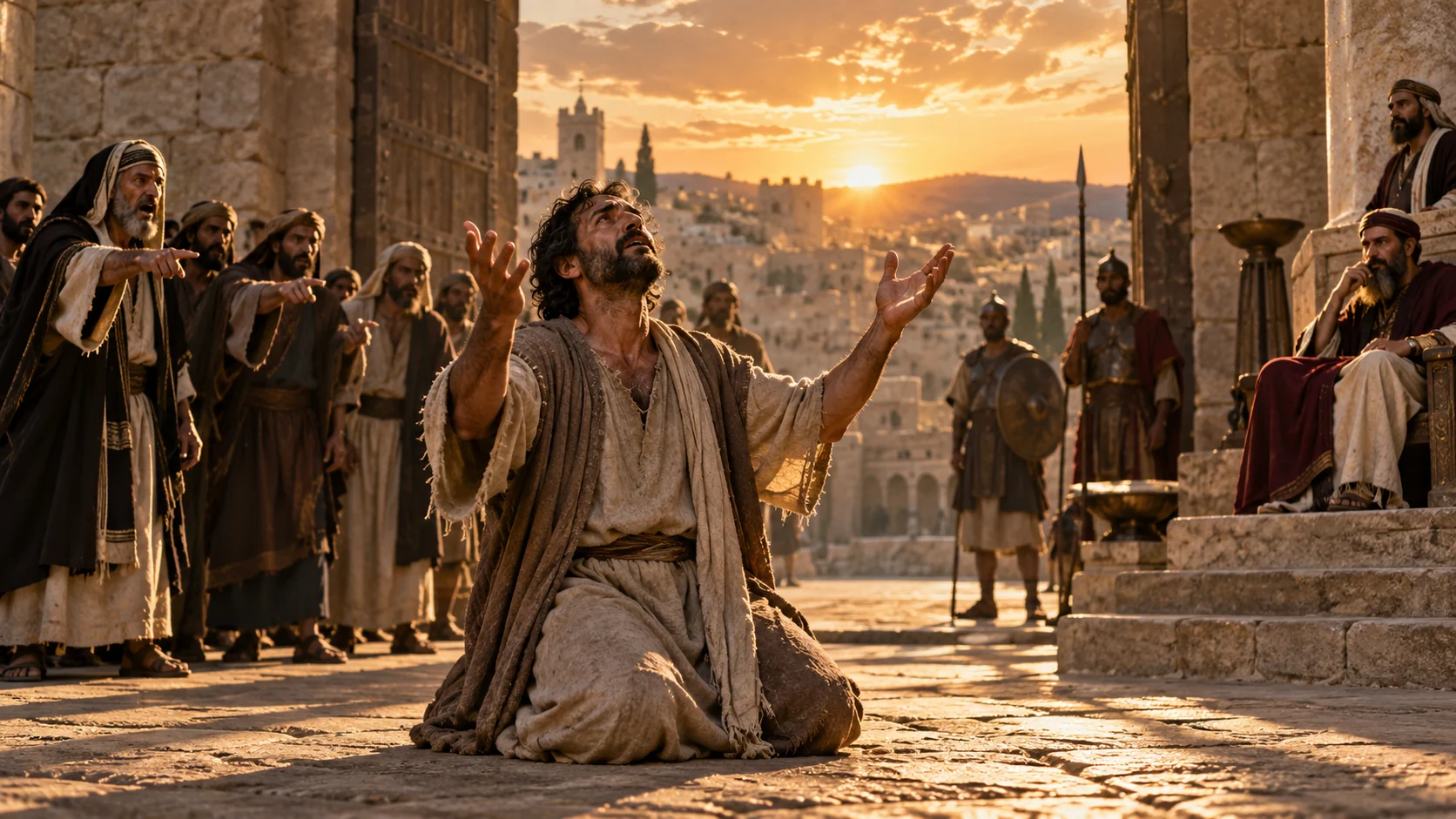
The man who once poured out speeches like floodwater now speaks only a few lines. The man who once wanted to approach God like a prince now says, “Behold, I am small; what shall I answer you? I lay my hand on my mouth” [Job 40:4].
This is not yet full repentance. It is humbled silence. Job does not retract everything. He does not confess to the crimes his friends invented. He does not say, “Eliphaz was right.” But he recognizes that before the Lord of creation, he has reached the limit of his case. He can add nothing.
Yet God is not finished.
The whirlwind speaks again.
This time the question cuts deeper: “Will you even put me in the wrong? Will you condemn me that you may be in the right?” [Job 40:8]. God now names the danger beneath Job’s lawsuit. Job’s insistence on his own innocence has begun to imply that God must be unjust. God does not deny Job’s integrity, but he challenges the path by which Job has tried to defend it.
Then God asks whether Job has an arm like God, whether he can clothe himself with majesty, humble the proud, crush the wicked, and save himself by his own right hand [Job 40:9–14]. If Job wants to challenge divine rule, can he exercise divine rule?
Finally, God points to Behemoth.
This strange, massive creature eats grass like an ox, yet its strength is in its loins, its bones like bronze, its limbs like iron. It lies under lotus plants, sheltered by reeds and marsh. The river may rage, but Behemoth does not tremble [Job 40:15–23]. It is the first of God’s works, yet only its Maker can approach it with the sword [Job 40:19].
Job 40 is a turning point.
The first divine speech has humbled Job before creation’s vastness.
The second divine speech begins to humble Job before power he cannot subdue.
Job 40 teaches that we may be right about our innocence and still wrong to condemn God in order to defend it.
02
2. Historical and Literary Context: Job’s First Answer and Yahweh’s Second Speech
Job 40 stands at the hinge between Yahweh’s first and second speeches.
The first divine speech began in Job 38 and continued through Job 39. There God questioned Job about creation’s architecture, weather, stars, wilderness, and wild animals. The purpose was not to humiliate Job as worthless, but to reveal the limits of Job’s knowledge and the vastness of God’s wise governance.
Now, in Job 40:1–5, the first speech formally closes and Job gives his first response. It is brief, almost breathless. This brevity matters. Job has been the great speaker of the book. He has argued with friends, accused God, lamented his birth, longed for death, demanded vindication, and signed an oath of innocence. But after the first divine speech, he says he is small and lays his hand on his mouth.
Then, in Job 40:6, Yahweh answers Job again from the whirlwind. The repetition mirrors the beginning of the first divine speech [Job 38:1]. God again commands Job to dress for action like a man [Job 40:7], but now the focus shifts. The first speech addressed Job’s limited knowledge of creation. The second speech addresses Job’s challenge to divine justice and power.
The second speech begins with a moral confrontation [Job 40:8–14]. God asks whether Job will nullify divine justice, condemn God, and justify himself. If Job is capable of ruling better than God, then let him clothe himself with glory, bring down the proud, tread down the wicked, and save himself.
The logic is profound. God is not saying justice does not matter. He is saying that justice requires more than moral protest. It requires sovereign power, complete wisdom, and the ability to govern the proud, wicked, violent forces of the world. Job can identify injustice, but can he rule the world justly?
Then the speech turns to Behemoth [Job 40:15–24]. This creature has been interpreted in many ways: often as a hippopotamus, sometimes as a mythic chaos creature, sometimes as a literary blending of known and symbolic features. Whatever the precise zoological identity, the literary point is clear: Behemoth is immense, powerful, untamable, and under God’s governance. It is beyond Job’s mastery, yet not beyond God’s creative order.
Behemoth prepares for Leviathan in Job 41. Together, these creatures symbolize forces of creation that are not safe, simple, or domesticated. God’s world is good, but it includes powers that human beings cannot control. The BibleProject summary captures this larger point well: Behemoth and Leviathan represent dangers in God’s world, showing that creation is beautiful, wild, and dangerous, not always operating according to human assumptions.
Job 40 therefore deepens the divine answer. The issue is no longer only, “Job, do you understand creation?” The issue becomes, “Job, can you govern creation? Can you judge evil? Can you humble pride? Can you master Behemoth? Can your right hand save you?”
God does not silence Job’s cry for justice; he asks whether Job has the wisdom and power required to administer the justice he demands.
03
3. Walking Through the Text: From Smallness to Behemoth
04
3.1 The Almighty Questions the Faultfinder (40:1–2)
The Lord says to Job: “Shall a faultfinder contend with the Almighty? He who argues with God, let him answer it” [Job 40:2].
The word “faultfinder” is sharp. Job has not merely asked questions. He has pressed a case. He has implied that God’s governance is morally defective. He has wanted God to answer as defendant.
Now God asks whether Job will continue.
This is not the angry outburst of a fragile deity. God is not threatened by Job’s questions. He has allowed Job to speak for many chapters. He has heard the lament. He has entered the conversation. But now he names the posture that has grown inside Job’s protest: contention with the Almighty.
The question is merciful because it gives Job a chance to respond. God does not crush him. He invites him to answer.
There are moments in prayer when God’s question becomes more healing than our demand. We ask, “Why have You done this?” God may ask, “Do you see enough to judge Me?” We ask, “Why have You not answered?” God may ask, “Will you trust Me beyond what you can measure?”
The Lord does not condemn Job for bringing his pain; he confronts the pride that pain can grow when it tries to judge the Almighty.
05
3.2 “Behold, I Am Small”: Job’s First Response (40:3–5)
Job answers Yahweh: “Behold, I am small; what shall I answer you? I lay my hand on my mouth” [Job 40:4].
This is one of the most important silences in Scripture.
Job does not say, “I am wicked.” He says, “I am small.” That matters. God has not exposed him as the secret criminal the friends imagined. God has exposed him as a creature. Job’s smallness is not moral worthlessness; it is creaturely limitation.
To be small before God is not shame. It is truth. Job’s tragedy has been enormous to him, and rightly so. But the whirlwind has shown him that his knowledge is not enormous enough to judge the whole world.
Then Job places his hand over his mouth. Earlier in the book, Job told the friends to look at him and put their hands over their mouths in shock [Job 21:5]. Now Job does it himself before God. The gesture means restraint. He will not add to his case. He has spoken once, even twice, but he will proceed no further [Job 40:5].
This silence is not yet the full surrender of Job 42. It is the first bending of the soul. Job has been halted, not fully transformed. He is no longer arguing, but he has not yet confessed, “I spoke of things too wonderful for me.” That will come later.
Still, this is grace. The man who once feared that an encounter with God would crush him has discovered that divine presence can silence without annihilating.
Job’s hand over his mouth is not the erasure of his integrity; it is the beginning of wisdom before mystery.
06
3.3 The Whirlwind Speaks Again (40:6–7)
Then Yahweh answers Job out of the whirlwind again [Job 40:6]. The repetition signals a new movement. Job’s first response is not enough. Silence is a beginning, but God wants deeper transformation.
Again God commands: “Dress for action like a man; I will question you, and you make it known to me” [Job 40:7]. The same summons appeared at the beginning of the first divine speech [Job 38:3]. Job is not allowed to collapse into passive shame. God calls him to stand.
This is striking. God humbles Job, but does not belittle him. He addresses him as a responsible human being. The command is bracing, dignifying, and severe. Job must face God’s questions, not vanish beneath them.
In spiritual life, God’s correction often works this way. He does not flatter us. He does not crush us. He summons us to stand in truth.
The God who silences Job also dignifies him enough to question him.
07
3.4 “Will You Condemn Me to Justify Yourself?” (40:8)
Now God names the heart of the matter: “Will you even put me in the wrong? Will you condemn me that you may be in the right?” [Job 40:8].
This is the sharpest question Job has received.
Job is right that he has not committed the wickedness his friends accused him of. Job is right to reject false guilt. Job is right that suffering is not automatic evidence of personal sin. But in defending his own righteousness, Job has spoken as though God’s righteousness must be suspect.
God’s question exposes a dangerous exchange: to preserve his own innocence, Job has come close to condemning God.
This is painfully relevant. When we suffer unjustly, we may have to defend the truth about ourselves. False accusation must not be swallowed in the name of humility. But we must also beware of defending ourselves in a way that makes God unjust, absent, cruel, or morally inferior.
The cross gives the deepest light here. Jesus is the truly innocent sufferer. Yet he does not condemn the Father to justify himself. He entrusts himself to the One who judges justly [1 Pet 2:23]. His cry of abandonment is real [Matt 27:46], but his trust remains: “Father, into your hands I commit my spirit” [Luke 23:46].
The righteous sufferer may tell the truth about pain without putting God in the wrong.
08
3.5 Do You Have an Arm Like God? The Question of Power (40:9)
God asks: “Have you an arm like God, and can you thunder with a voice like his?” [Job 40:9].
In biblical imagery, the arm represents strength, action, deliverance, and judgment. God’s arm brought Israel out of Egypt. God’s voice thunders over the waters. To govern justice requires both righteous will and sovereign power.
Job has wanted justice. But can Job execute it? Can his arm save? Can his voice command creation? Can he thunder judgment across the world?
This question does not mock human longing for justice. It locates that longing properly. Human beings can and must practice justice within creaturely limits. But only God has the arm that can finally judge all evil and restore all things.
Modern people often feel the weight of injustice and cry, “If I were God, I would fix this.” God’s question stands: Do you have the arm? Do you have the knowledge? Do you know every hidden motive, every consequence, every sorrow, every creature, every age?
The desire for justice is holy, but the power to judge the whole world belongs to God alone.
09
3.6 Clothe Yourself with Glory: The Impossible Robe (40:10)
God continues: “Adorn yourself with majesty and dignity; clothe yourself with glory and splendor” [Job 40:10].
The language sounds royal. If Job would contend with God’s rule, then let him dress like a divine king. Let him put on the robe of cosmic sovereignty. Let him wear the splendor necessary to govern creation.
But Job cannot.
Earlier, Job lamented that God had stripped him of glory and removed the crown from his head [Job 19:9]. In Job 29, he remembered being clothed with honor in the community. In Job 31, he imagined wearing God’s indictment like a crown because it would vindicate him [Job 31:36]. Now God speaks of a far greater glory—majesty, dignity, splendor—that belongs to divine rule.
Job’s lost honor is real. But God’s honor is greater. Job cannot recover his dignity by climbing into God’s throne.
This speaks to wounded people. Suffering often strips dignity. False accusation can make us desperate to reclaim honor. But healing does not come by seizing divine control. It comes by receiving our creaturely dignity from God, not replacing God.
Human dignity is restored not by wearing God’s crown, but by standing honestly before God’s glory.
10
3.7 Bring Down the Proud: The Work Only God Can Complete (40:11–13)
God now challenges Job to pour out the overflowings of his anger, look on everyone who is proud and abase him, tread down the wicked where they stand, hide them in the dust, and bind their faces in the world below [Job 40:11–13].
This is judgment language.
Job has been angry at the moral disorder of the world. He has complained that the wicked prosper, the poor are oppressed, and God does not keep visible times of judgment [Job 21; 24]. God now says: if you can judge better, then judge. Bring down every proud person. Locate every wicked one. Humble them completely. Deal with evil wherever it stands.
Job cannot.
No human can. We can see pieces of injustice, but not all. We can judge some cases, but not every heart. We can restrain some evil, but not uproot pride from the earth. Even our anger at injustice is mixed with blindness, self-interest, fear, and partial knowledge.
God alone can finally humble pride without becoming proud. God alone can judge wickedness without injustice. God alone can bind evil without being corrupted by power.
To hate evil is human obedience; to finally humble all evil is divine kingship.
11
3.8 Can Your Right Hand Save You? (40:14)
God concludes this challenge: “Then will I also acknowledge to you that your own right hand can save you” [Job 40:14].
The right hand symbolizes strength and deliverance. If Job can rule like God, judge like God, humble the proud like God, and conquer wickedness like God, then God will admit that Job can save himself.
But Job cannot save himself.
This does not make Job worthless. It makes him human. Salvation is not self-achieved. The human right hand cannot carry the weight of final deliverance.
This line opens toward a deep biblical theme: salvation belongs to the Lord [Jonah 2:9]. God’s right hand saves [Ps 98:1]. In Christ, the one seated at God’s right hand becomes the Savior who conquers not by human domination but by cross and resurrection.
Job’s hand has covered his mouth. God’s right hand alone can save.
The hand that cannot answer must learn to trust the hand that can save.
12
3.9 “Behold, Behemoth”: A Creature Made Alongside Job (40:15)
God now says: “Behold, Behemoth, which I made as I made you; he eats grass like an ox” [Job 40:15].
The word “behold” invites contemplation. Job must look.
Behemoth is made by God, just as Job is made by God. This matters. The creature is not a rival deity. It is not an independent chaos power outside God’s authority. It is creature, not Creator.
Yet it is immense. Even the opening comparison is strange: it eats grass like an ox. It is peaceful in diet, yet overwhelming in power. It is herbivorous but terrifying. It does not need to be a predator to be beyond human control.
The phrase “which I made as I made you” humbles Job and dignifies Behemoth. Both Job and Behemoth are creatures. Both exist by God’s creative will. Job is not the only creature God considers. Behemoth also belongs in the Creator’s world.
God’s world is large enough for fragile sufferers and massive beasts, both held by the same Maker.
13
3.10 Strength in Loins, Bones Like Bronze: The Architecture of Power (40:16–18)
God describes Behemoth’s strength: power in its loins, might in the muscles of its belly [Job 40:16]. Its tail stiffens like a cedar; the sinews of its thighs are knit together [Job 40:17]. Its bones are tubes of bronze; its limbs like bars of iron [Job 40:18].
The imagery is architectural and metallic. Behemoth is built like a living fortress. Bronze and iron suggest durability, weight, and unyielding power. Cedar suggests majesty and strength.
This is not a creature Job can manage. Its body is a sermon against human mastery.
Yet Behemoth’s strength is not evil. God describes it with something like admiration. The creature’s power belongs to the goodness of creation. This again unsettles simplistic views. Something can be powerful, dangerous, and still part of God’s world.
Job has experienced power as pain. God’s power wounded him, or so he believed. Human power mocked him. Social power abandoned him. Now God shows him creaturely power that simply exists under divine delight.
Power must be judged by its place under God. Human power often becomes oppression. Divine power is righteous. Creaturely power can be wild without being wicked.
Strength is not evil because it is strong; it becomes evil when it refuses its place under God.
14
3.11 First of the Works of God: Only the Maker Can Approach (40:19)
God says Behemoth is “the first of the works of God” and that “he who made him can bring near his sword” [Job 40:19].
This is a majestic and mysterious line. “First” may indicate chief, greatest, or most impressive among God’s works in this category. Behemoth is a masterpiece of creaturely strength.
But only the Maker can approach it with the sword.
This means Behemoth is beyond Job’s conquest. Human beings cannot finally subdue this creature. Its power belongs to a scale Job cannot control. God alone, the Maker, can confront what he has made.
Here the theological point sharpens. If Job cannot master Behemoth, how can he master the whole moral order? If he cannot bring down one mighty creature, how can he bring down all the proud? If he cannot approach Behemoth with the sword, how can his right hand save?
The answer is obvious.
He cannot.
Only the Maker can master the masterpiece of untamable strength.
15
3.12 Mountains, Beasts, Lotus Plants: Behemoth at Peace in God’s World (40:20–22)
The mountains yield food for Behemoth, and the beasts of the field play there [Job 40:20]. It lies under lotus plants, hidden among reeds and marsh [Job 40:21]. The lotus trees cover it with shade; willows of the brook surround it [Job 40:22].
After the metallic imagery of strength, the scene becomes almost peaceful. Behemoth rests in shade. It is surrounded by vegetation and water. The mountains feed it. Other beasts play nearby.
This is not merely a monster rampaging through creation. It has a habitat. It belongs somewhere. It rests. It eats. It is shaded. It is sustained.
This matters for understanding God’s world. What terrifies humans may still have a place in creation’s order. The creature beyond our control is not beyond God’s care. God feeds and shelters Behemoth.
Job, too, needs to learn that what feels threatening is not necessarily outside divine order. His suffering remains grievous. Evil remains evil. But the world includes powers that are not organized around human safety and yet are held in God’s wise governance.
Even the creature we cannot control may rest beneath trees God has grown.
16
3.13 The Raging River and the Unshaken Beast (40:23)
God says that if the river is turbulent, Behemoth is not frightened; it is confident though Jordan rushes against its mouth [Job 40:23].
The image is one of fearlessness. Floodwaters that would terrify humans do not shake Behemoth. It faces the rushing river with calm strength.
Job has been overwhelmed by floods of suffering. He has felt swept away by divine force, social shame, physical pain, and grief. Behemoth stands as a creature unmoved by waters that would undo a human being.
Why show Job this?
Perhaps because Job must see strength that is not his own. He is not Behemoth. He cannot face the river with that kind of body. But God can govern both fragile Job and fearless Behemoth. God’s wisdom includes different creatures with different capacities. Job does not need to become Behemoth to trust God. He needs to know that Behemoth itself is not outside God’s care.
The river may rage, but God knows the creatures that can stand in it—and the creatures that need rescue from it.
17
3.14 Can Anyone Capture Him? The Final Question of Mastery (40:24)
The chapter ends with a question: can anyone take Behemoth by its eyes or pierce its nose with a snare? [Job 40:24].
The implied answer is no.
Human mastery fails. Behemoth cannot be captured by ordinary means. The creature remains beyond human control. Job cannot possess it, tame it, harness it, or defeat it.
This final question sets up the next chapter, where God will speak of Leviathan at even greater length. If Job cannot capture Behemoth, can he draw out Leviathan with a fishhook? Can he make a pet of chaos? Can he play with the dragon?
The lesson is growing sharper: the world contains powers Job cannot master. But God can.
Job’s healing requires more than knowing that he is innocent. It requires trusting the God who governs what Job cannot subdue.
Faith begins to mature when it stops confusing trust with control.
18
4. Theological Reflection: Justice, Power, and the Limits of Human Vindication
19
4.1 Job Is Corrected, Not Condemned as the Friends Condemned Him
God corrects Job sharply. Job has spoken beyond knowledge. He has come close to condemning God in order to justify himself. But God does not validate the friends’ accusations. He does not say Job is a hypocrite, oppressor, or secret wicked man.
This distinction is vital.
A person can be innocent of false charges and still need transformation. Job’s integrity is real. His lawsuit posture is flawed. His pain is real. His conclusions about God have gone too far.
God’s correction is therefore more precise than human accusation. He wounds only where healing is needed.
20
4.2 Human Justice Requires Humility Before Divine Governance
God does not tell Job to stop caring about justice. The challenge of Job 40:8–14 assumes that justice matters deeply. The proud should be humbled. The wicked should be brought low. Evil should be judged.
But God asks whether Job can carry the burden of final justice.
This is crucial for believers. We are called to do justice, love mercy, and walk humbly with God [Mic 6:8]. We must defend the vulnerable, resist oppression, and tell the truth. But we must do all this as creatures, not as gods. We do justice under God’s authority, not by seizing God’s throne.
The humble pursuit of justice says, “Lord, use my hands.” Proud judgment says, “Lord, move aside.”
21
4.3 Behemoth Reveals a World Good but Not Safe
Behemoth is not portrayed as evil. It is made by God. It eats, rests, and dwells in a habitat God provides. Yet it is also overwhelming, untamable, and beyond human capture.
This teaches that God’s creation is not designed merely to make humans feel safe. It is good, but wild. Ordered, but not domesticated. Full of life, but also full of power that can frighten us.
This challenges shallow expectations of faith. Trusting God does not mean the world becomes tame. It means God remains Lord over what is untameable.
22
4.4 The Right Hand That Saves Belongs to God
God’s question, “Can your own right hand save you?” reaches deep into Scripture’s theology of salvation. Human strength cannot finally rescue itself from death, evil, pride, chaos, or judgment.
This does not erase human responsibility. Job must answer. Job must humble himself. Job must choose trust over accusation. But salvation itself is divine work.
In the gospel, this becomes radiant. Jesus, seated at the right hand of God, saves not by crushing sufferers but by bearing sin, defeating death, and rising in power. The arm of the Lord is revealed in the suffering servant [Isa 53:1]. God’s saving power looks like crucified love before it looks like final judgment.
23
4.5 Christ Holds Together Innocence and Trust
Job’s struggle is that he is innocent of the accusations but tempted to condemn God to defend himself. Jesus shows the faithful path of innocent suffering. He is truly without sin. He is falsely accused. He suffers unjustly. Yet he entrusts himself to the Father.
This does not make his suffering easy. Gethsemane is agony. The cross is abandonment. But Jesus does not use his innocence to accuse the Father of injustice. He lives the mystery Job could not yet fully see: the righteous sufferer can tell the truth, cry out in pain, and still surrender to the wisdom of God.
In Christ, innocence does not need to become accusation; it becomes faithful trust unto resurrection.
24
5. Life Application: Putting a Hand Over the Mouth Without Losing the Heart
Job 40 calls us into a difficult spiritual practice: humble restraint.
There are times to speak. Job needed to speak. Silence before false accusation would not have served truth. The Bible gives us language for lament, protest, grief, and appeal.
But there are also times when speech must stop—not because pain is unreal, but because our words have reached the edge of our knowledge.
To put a hand over the mouth is not to deny suffering. It is to confess creaturehood. It is to say, “Lord, I have spoken what I know. Now keep me from speaking as though I know everything.”
This chapter also asks us to examine how we defend ourselves. When falsely accused, we may rightly say, “That is not true.” But we must beware of moving from “I am innocent of this charge” to “God is unjust.” The first may be faithful truth. The second becomes dangerous pride.
And Behemoth teaches us about control. Some realities cannot be harnessed. Some powers cannot be captured. Some parts of life remain wild. Faith does not mean we tame them. Faith means we entrust ourselves to the Maker who can govern what we cannot.
A practical exercise for this chapter:
Find a quiet place and pray through three gestures:
First, open your hands and name what you want God to answer.
Second, place one hand gently over your mouth and confess: “Lord, I do not know enough to judge all Your ways.”
Third, open your hands again and pray: “Your right hand saves. Teach me to trust You with what I cannot control.”
Then write down one “Behemoth” in your life—one reality too large for you to master. Under it, write: “Made by God. Known by God. Governed by God. Not mine to control.”
Humility is not the loss of voice; it is the surrender of final judgment to God.
25
6. Reflection Questions
Why is Job’s response in Job 40:3–5 so brief after so many chapters of speech?
What is the difference between Job saying “I am innocent” and Job implying “God is wrong”?
Why does God ask whether Job can clothe himself with glory and bring down the proud?
What does the question “Can your own right hand save you?” reveal about human limitation and divine salvation?
How does Behemoth challenge human assumptions about control, safety, and usefulness?
Why is it important that Behemoth is described as a creature God made, not as an independent rival to God?
How does Jesus help us understand innocent suffering without condemning God?
26
7. Response Prayer
Lord of the whirlwind, Almighty Judge, Maker of Job and Behemoth, we come before You with open hands and humbled hearts.
Forgive us for the times we have condemned You in order to defend ourselves. Forgive us for speaking beyond what we know. Forgive us for trying to wear glory that belongs only to You.
Teach us when to speak truth and when to put our hands over our mouths. Teach us to seek justice without seizing Your throne. Teach us to trust Your right hand when our own strength cannot save.
When Behemoth stands before us— the strong thing we cannot tame, the fear we cannot master, the grief we cannot command— remind us that You are Maker still.
Lead us to Jesus, the innocent sufferer, the faithful Son, the Savior at Your right hand, who trusted You through the cross and rose as the first light of new creation.
Amen.
27
8. Window into the Next Chapter: When Leviathan Rises from the Deep
Job 40 ends with Behemoth, the great beast of earth, a creature of massive strength that Job cannot capture or command.
But God is not finished.
In Job 41, the Lord will summon Job’s imagination toward an even more terrifying creature: Leviathan.
Can Job draw it out with a fishhook?
Can he make a covenant with it?
Can he play with it like a bird?
Can he put it on a leash for his daughters?
Leviathan will represent power even more untamable than Behemoth: armored, fiery, fearless, king over the proud. The imagery will carry echoes of sea monster and chaos creature, pressing Job to face the reality that God rules even what human beings fear most deeply.
The lesson will sharpen:
If Job cannot master Leviathan, can he master the world?
If Job cannot tame chaos, can he accuse the One who can?
Behemoth has stood on land.
Now Leviathan will rise from the deep.
The whirlwind continues.
28
9. Bibliography
Alter, Robert. The Wisdom Books: Job, Proverbs, and Ecclesiastes: A Translation with Commentary. New York: W. W. Norton, 2010.
BibleProject. The Book of Job Guide. BibleProject, accessed 2026.
Clines, David J. A. Job 1–20. Word Biblical Commentary 17. Dallas: Word Books, 1989.
Hartley, John E. The Book of Job. New International Commentary on the Old Testament. Grand Rapids: Eerdmans, 1988.
Walton, John H., and Tremper Longman III. How to Read Job. Downers Grove: IVP Academic, 2015.

Be the first to leave a comment.