

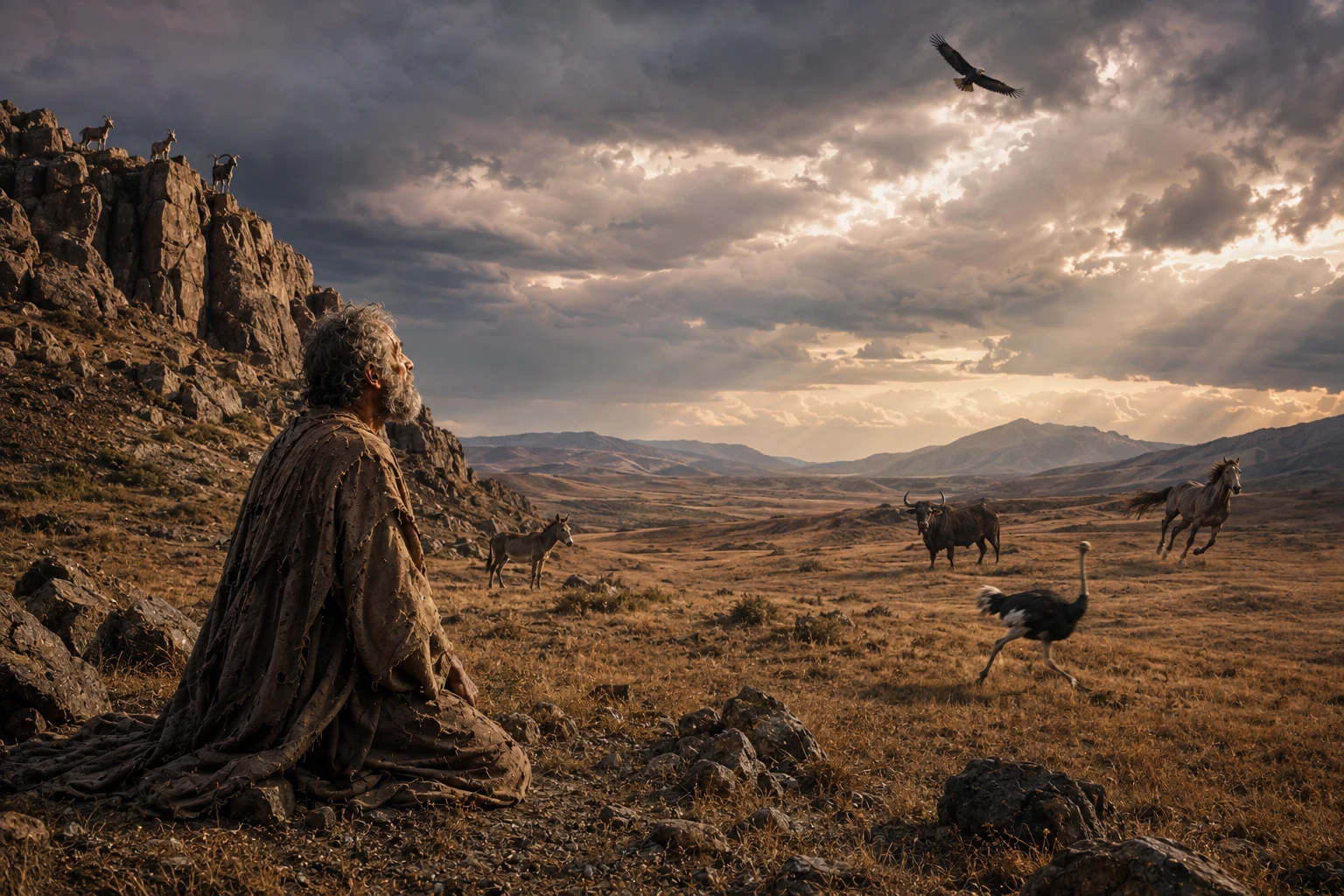
God leads Job away from the courtroom and into the wilderness, where mountain goats give birth unseen, wild donkeys laugh at city noise, oxen refuse the plow, ostriches run with strange glory, horses thunder toward battle, and eagles nest beyond human reach.
01
1. Introduction: When God Teaches Through the Untamed
Some lessons come from books.
Some lessons come from wounds.
And some lessons come from watching a creature that has no interest in being useful to us.
Job 39 is God’s classroom of wildness.
In Job 38, the Lord answered Job from the whirlwind and opened the cosmos. Job had wanted a courtroom. God gave him foundations of the earth, boundaries of the sea, dawn shaking wickedness from the world, gates of death, storehouses of snow, rain falling where no human lives, constellations moving in season, clouds, lightning, lions, and ravens.
Now the divine tour continues, but the lens narrows. God brings Job face to face with animals—mostly wild animals, creatures outside ordinary human control. These are not the sheep, camels, oxen, and donkeys Job once owned. These are the mountain goat, the deer, the wild donkey, the wild ox, the ostrich, the war horse, the hawk, and the eagle.
God does not use them merely as decorations in a nature poem. Each animal becomes a question.
Do you know when the mountain goats give birth?
Who set the wild donkey free?
Will the wild ox serve you?
Did you give the horse its might?
Is it by your wisdom that the hawk soars?
At one level, the questions humble Job. He does not manage these creatures. He does not attend the birth of mountain goats on hidden cliffs. He does not command the wild donkey’s freedom. He cannot harness the wild ox for his plow. He did not design the strange mixture of foolishness and speed in the ostrich. He did not create the courage of the war horse. He did not teach the eagle where to build its nest.
At a deeper level, the questions heal Job’s imagination. Job’s suffering has narrowed the world into a dispute about justice: if God governs rightly, why has this happened to me? God does not dismiss the question. But he widens the world in which the question lives. The Creator governs a reality full of beauty, danger, freedom, strangeness, wastefulness, humor, terror, and wisdom beyond human usefulness.
The wild ones preach a sermon Job did not expect:
God’s world is not tame.
God’s wisdom is not small.
God’s care reaches places no human eye sees.
God’s joy includes creatures that do not fit our systems.
And if God governs these untamed corners of creation with wise generosity, then Job is invited to trust that his own wild grief has not escaped the Creator’s counsel.
Job 39 teaches that God’s wisdom is not proven only in what serves human life; it is also displayed in what runs free beyond our control.
02
2. Historical and Literary Context: Yahweh’s First Speech Continues
Job 39 continues Yahweh’s first speech from the whirlwind, which began in Job 38 and concludes in Job 40:1–2. The speech is part of the climactic divine response after the long debates among Job, the three friends, and Elihu.
The Lord’s answer does not proceed like the arguments of the human speakers. The friends tried to explain Job’s suffering by retribution. Elihu tried to explain suffering as possible discipline and divine instruction. Job tried to summon God into court so that his innocence could be vindicated.
God answers differently.
He questions Job through creation.
In Job 38, the focus moved from cosmic architecture to divine governance: earth, sea, dawn, death, light, weather, stars, rain, lions, and ravens. In Job 39, the focus rests on animal life. The animals chosen are significant. They are mostly outside human domestication and control. They live in deserts, mountains, skies, battlefields, and high cliffs. Their habits are mysterious or inconvenient to human expectation.
This matters because Job’s old life had been filled with domesticated wealth: sheep, camels, oxen, donkeys, servants, and household order [Job 1:3]. He knew the economy of useful animals. But God now displays creatures that do not fit neatly into Job’s former world of possession and productivity. These animals are not presented as tools for human prosperity. They exist before God.
The chapter unfolds in six animal portraits:
First, the mountain goats and deer give birth beyond human supervision [Job 39:1–4].
Second, the wild donkey lives free from the city and searches the wilderness for food [Job 39:5–8].
Third, the wild ox refuses domestication and cannot be trusted to plow or bring home grain [Job 39:9–12].
Fourth, the ostrich appears foolish in her treatment of eggs and young, yet God has given her astonishing speed [Job 39:13–18].
Fifth, the war horse displays strength, fearlessness, and terrible eagerness for battle [Job 39:19–25].
Sixth, the hawk and eagle soar, migrate, nest on heights, and find prey by a wisdom not given by humans [Job 39:26–30].
The movement is important. God begins with birth, then freedom, then untamable strength, then strangeness, then battle courage, then soaring vision. Job is not being given a neat solution to suffering. He is being re-schooled in the complexity of God’s world.
The chapter also presses against human-centered assumptions. God cares for births no human midwife attends. God grants freedom that resists human profit. God makes creatures whose habits seem inefficient or foolish to us. God delights in strength that terrifies us. God gives wisdom to wings above us.
In other words, divine wisdom is not measured by human control.
Job 39 is a wilderness liturgy, teaching Job that the Creator’s wisdom extends beyond the fences of human usefulness.
03
3. Walking Through the Text: God’s Sermon Through the Wild Creatures
04
3.1 Mountain Goats and Deer: Births No Human Sees (39:1–4)
God begins with hidden birth: “Do you know when the mountain goats give birth? Do you observe the calving of the deer?” [Job 39:1].
The questions are intimate. God is not only asking about stars and seas. He is asking about labor pains on remote cliffs. The mountain goat gives birth in places Job cannot reach. The deer crouches in the wild, away from the village, away from human hands.
God asks whether Job counts the months of their pregnancy or knows the time when they give birth [Job 39:2]. The answer is no. Job does not manage their calendar. He does not supervise their labor. He does not ensure their survival.
Yet the young are born. They grow strong in the open. They go out and do not return [Job 39:3–4]. Life continues beyond human management.
This is a tender beginning. After so much death in Job’s story, God opens Job 39 with birth. Job has lost children. His house has become a place of bereavement. God does not speak directly to that loss here, and we should not pretend this removes the ache. But he shows Job that hidden births still happen under divine care. Life is still being brought forth in places Job cannot see.
There is pastoral mercy here. When grief convinces us that death is the only story, God may direct our attention to hidden births—small beginnings, unseen mercies, quiet growths in wilderness places. Not all life announces itself in the city square. Some life begins on cliffs.
God attends births in places no human eye can bless, because his care is deeper than our supervision.
05
3.2 The Wild Donkey: Freedom in the Wilderness (39:5–8)
God asks, “Who has let the wild donkey go free? Who has loosed the bonds of the swift donkey?” [Job 39:5].
The answer is God.
The wild donkey lives outside the city. God has given the wilderness as its home, the salt land as its dwelling place [Job 39:6]. It scorns the noise of the city and does not hear the shouts of the driver [Job 39:7]. It ranges the mountains as pasture and searches after every green thing [Job 39:8].
This animal represents freedom—but costly freedom. The domesticated donkey may have food at the trough, but it also bears burdens and hears commands. The wild donkey has no driver, but it must search for food in harsh places.
God is the giver of that freedom.
This is remarkable. Human beings might value animals according to usefulness: Can it carry loads? Can it serve the farm? Can it be controlled? God values a creature that refuses the driver’s shout. Its freedom belongs to the goodness of creation.
For Job, this may be unsettling. He once owned donkeys [Job 1:3]. He knew the world of managed animals and productive wealth. God now points to an animal that will not be owned. The Creator delights in what human economy cannot easily harness.
Spiritually, the wild donkey reminds us that not every good thing is convenient. Freedom may come with hunger. Wildness may come with risk. A life not controlled by human systems may look wasteful to the city but beautiful to God.
The God who gives food also gives freedom, and some freedoms are too wild for the marketplace to price.
06
3.3 The Wild Ox: Strength That Will Not Serve the Plow (39:9–12)
God turns to the wild ox: “Is the wild ox willing to serve you? Will he spend the night at your manger?” [Job 39:9].
The wild ox is strong, but strength does not equal usefulness. God asks whether Job can bind it in the furrow or make it harrow the valleys after him [Job 39:10]. Can Job trust it because its strength is great? Can he leave his labor to it? Will it bring grain to the threshing floor? [Job 39:11–12].
Again, the implied answer is no.
This creature has power, but not obedience to Job. It could transform agriculture if harnessed, but it will not submit. Its strength remains outside the farm’s economy.
The lesson is subtle. Human beings often assume that strength exists to serve human purposes. If something is powerful, we want to use it. If something is beautiful, we want to possess it. If something is intelligent, we want to employ it. But God’s world includes strength that refuses our harness.
The wild ox challenges Job’s desire for a manageable world. Job wants God’s governance to be legible, reliable, morally harnessed to his understanding. But creation itself contains forces God made good that do not fit human control.
This does not mean God’s world is chaotic. It means God’s order is not identical to human manageability.
Not every strength God creates is meant to pull our plow.
07
3.4 The Ostrich: Strange Foolishness and Surprising Glory (39:13–18)
The ostrich is perhaps the strangest portrait in the chapter. Its wings flap joyfully, yet they are not like the pinions of the stork [Job 39:13]. It leaves eggs on the ground and lets them be warmed in the dust, forgetting that a foot may crush them or a wild animal trample them [Job 39:14–15]. It deals cruelly with its young, as if they were not its own, and does not fear that its labor may be in vain [Job 39:16].
Then comes the explanation: God has made it forget wisdom and given it no share in understanding [Job 39:17]. Yet when it rouses itself to flee, it laughs at horse and rider [Job 39:18].
The ostrich is comic, unsettling, and glorious at once.
It seems foolish. It lacks the nurturing wisdom one expects in other birds. It cannot fly properly. Its habits appear careless. And yet it runs with astonishing speed. The creature that seems ridiculous can outrun the horse.
This portrait stretches Job’s categories. God’s wisdom includes a creature marked by what looks like foolishness and yet crowned with unexpected excellence. Creation is not uniform. Some creatures are graceful. Some are useful. Some are frightening. Some are odd. Some seem almost humorous. All belong.
This matters for theology. We often assume divine wisdom must look like efficiency, symmetry, and obvious usefulness. The ostrich says otherwise. God’s world includes holy strangeness. Not everything makes sense by our standards. Not every design conforms to our preferences. Yet even the odd creature has glory.
For human life, this is deeply encouraging. Some people feel like ostriches—awkward, misunderstood, missing capacities others have. Yet God may have given them a glory others cannot see. The absence of one kind of wisdom does not mean the absence of all gift.
The God of the eagle also made the ostrich, and even strangeness has a place in divine joy.
08
3.5 The War Horse: Courage That Smells the Battle (39:19–25)
God now turns to one of the most majestic animals in the chapter: the horse.
“Do you give the horse his might? Do you clothe his neck with a mane?” [Job 39:19].
The horse is strength in motion. It leaps like the locust, snorts with majesty, paws in the valley, rejoices in strength, and goes out to meet weapons [Job 39:20–21]. It laughs at fear and is not dismayed; it does not turn back from the sword [Job 39:22]. The quiver rattles, the spear flashes, the javelin gleams, and the horse swallows the ground with fierceness and rage [Job 39:23–24]. At the sound of the trumpet, it says, “Aha!” and smells the battle from afar [Job 39:25].
This is not a gentle portrait. The horse is magnificent and terrifying. It embodies courage, speed, beauty, and warlike energy.
Why would God show Job a war horse?
Perhaps because Job has accused God of being a warrior against him [Job 16:12–14]. Perhaps because the world includes forces that are beautiful and dangerous at once. Perhaps because Job must see that fearlessness itself is a divine gift, even when it appears in the context of battle.
The horse does not explain suffering. It evokes awe. It shows that God’s creation contains power that surges toward danger rather than away from it. The horse’s courage is not human invention. Job did not give it might. God did.
This is a hard truth. God’s world is not safe in the way Job wants it to be. It is ordered, but not tame. It contains battle, thunder, wild strength, and creatures whose glory is inseparable from risk.
Christian readers must hold this carefully. The Bible’s final hope is peace—swords beaten into plowshares, war learned no more [Isa 2:4]. Yet until then, courage remains necessary in a world where danger is real. The war horse’s power points beyond itself to the need for faithful endurance, not bloodlust.
God’s world contains courage fierce enough to run toward the trumpet, and wisdom asks how such strength may serve life rather than death.
09
3.6 The Hawk: Soaring by a Wisdom Not Ours (39:26)
God asks: “Is it by your understanding that the hawk soars and spreads his wings toward the south?” [Job 39:26].
The question lifts Job into the sky.
The hawk migrates. It knows when to spread its wings southward. Its flight follows instincts and patterns Job did not teach. Human beings may observe migration, but they did not write the wisdom in the bird’s body.
This is a quiet but profound form of divine wisdom. Not all wisdom is verbal. Some wisdom is embodied. It is in wings, seasons, currents, direction, timing, and movement. The hawk does not hold a scroll, yet it knows the path.
Job has been demanding knowledge. God shows him a creature that lives by knowledge Job did not give and may not fully understand.
There is humility here for all human learning. We can study creation, and that study is good. But the more we know, the more wonder should deepen. The bird’s flight is not less miraculous because we can describe migration. Description should become praise.
The hawk’s wings remember a wisdom no human hand wrote.
10
3.7 The Eagle: Heights, Nests, Vision, and Blood (39:27–30)
The final animal portrait is the eagle or vulture-like bird of prey. God asks whether it is at Job’s command that the eagle mounts up and makes its nest on high [Job 39:27]. It dwells on the rock, on the crag of the rock and the stronghold [Job 39:28]. From there it spies out prey; its eyes behold from far away [Job 39:29]. Its young suck up blood, and where the slain are, there it is [Job 39:30].
This is a severe ending.
The eagle is noble in height and vision. It lives above human reach. Its nest is secure on the cliff. Its eyes see what others cannot. But it also feeds on death. Its young drink blood. It is drawn to the slain.
God does not sanitize creation. The world includes predation. Life feeds on life. Beauty and death are entangled in ways that trouble human moral imagination.
For Job, this is crucial. He has wanted the world to make moral sense in terms of righteous reward and wicked punishment. God’s creation tour reveals a world more complex than that. The eagle is not wicked because it feeds where the slain are. The lion is not evil because it hunts. The wild order contains realities that cannot be judged by human courtroom categories.
This does not erase moral evil among humans. Murder, injustice, oppression, and cruelty remain evil. But God is showing Job that not all pain, death, and danger in creation can be interpreted as moral failure.
The eagle also symbolizes vision. It sees from far away. Job cannot. God can.
The eagle’s nest is higher than Job’s sight, reminding him that some wisdom belongs to the heights.
11
4. Theological Reflection: The Wisdom of the Wild God
12
4.1 God’s Care Reaches Where Human Care Cannot
God attends the mountain goat’s hidden birth and the raven’s hunger. He gives the wild donkey its wilderness, the hawk its migration, the eagle its high nest. The Creator is present in places beyond human witness.
This means God’s care is not limited by our awareness. We often assume that what we do not see is unattended. Job’s world has collapsed, and he feels unseen. God responds by showing him unseen care everywhere.
If God knows the time of wild births, he knows the timing of human tears.
13
4.2 God’s World Is Good Without Being Tame
Job 39 is not a sentimental nature chapter. The animals are free, strange, strong, dangerous, careless, courageous, hungry, and predatory. God calls Job to behold a world that is good but not domesticated.
This helps correct shallow faith. We sometimes imagine that if God is good, his world should feel safe and predictable to us. But Scripture’s creation theology is richer. God’s world is ordered, meaningful, and sustained, yet also wild, risky, and beyond human control.
Faith is not trust in a tame universe. Faith is trust in the wise Creator of an untamed universe.
14
4.3 Divine Wisdom Is Not Measured by Human Usefulness
The wild donkey refuses the city. The wild ox refuses the plow. The ostrich seems foolish. The eagle lives far above human reach. These creatures do not exist primarily to serve Job’s needs.
God’s question to Job challenges utilitarian theology. Creation has value because God made it and delights in it, not only because humans can use it. This is a deeply biblical corrective in a world that often treats land, animals, and even people as resources.
A creature’s worth is not exhausted by its usefulness to us.
15
4.4 Wisdom Includes Freedom, Limits, Strangeness, and Risk
Job wants to understand the moral order of the world. God shows him freedom in the wild donkey, limits in the unreachable mountain birth, strangeness in the ostrich, risk in the horse, and height in the eagle.
These are not random images. They form a theology of wisdom that is wider than control. God’s wisdom makes room for creatures that are not efficient, not safe, not domesticated, and not explainable by immediate human benefit.
This challenges our spiritual lives. We often want God to govern us by eliminating risk, answering every question, and making every process efficient. But God’s wisdom may include seasons of wilderness, hidden growth, strange gifts, courageous endurance, and vision that comes only from the heights.
16
4.5 Christ, the Creator, Comes Among the Wild and Wounded
The New Testament declares that all things were created through Christ and for Christ [Col 1:16]. That includes mountain goats and wild donkeys, ostriches and eagles, horses and hawks. The wild world belongs to the Son.
Yet Christ does more than create the wild ones. He enters the human wilderness. He is born among animals, driven by the Spirit into the wilderness, tempted among wild beasts, and ministered to by angels [Mark 1:13]. He teaches through birds and lilies [Matt 6:26–30]. He compares God’s care for disciples to God’s care for ravens [Luke 12:24].
At the cross, he enters the most untamed place of human history: innocent suffering, violence, shame, and death. In resurrection, he reveals that the Creator’s wisdom can bring life even from the place where human wisdom sees only defeat.
The Lord of the wild creatures is also the wounded Savior, and his resurrection is the promise that no wilderness lies outside God’s redeeming wisdom.
17
5. Life Application: Trusting God Beyond the Fences of Control
Job 39 speaks to anyone whose life has become unmanageable.
We like fenced fields. We like predictable animals. We like plans that obey us. We like strong things harnessed to our purposes. But suffering often throws us into a wilderness where the old tools do not work.
This chapter invites us to practice trust beyond control.
When you cannot see what God is doing, remember the mountain goat giving birth unseen.
When life feels costly and exposed, remember the wild donkey whose freedom comes with wilderness.
When strength refuses your plans, remember the wild ox that will not pull your plow.
When you feel strange or poorly fitted to others’ expectations, remember the ostrich who cannot fly but can outrun the horse.
When danger must be faced, remember the war horse’s courage—but surrender that courage to the Prince of Peace.
When you need wisdom beyond your sight, remember the hawk and eagle lifted by knowledge not their own.
A practical exercise for this chapter:
Choose one animal from Job 39 that speaks to your present season. Write its name at the top of a page. Under it, answer three questions:
What does this creature reveal about God’s wisdom?
What does it expose about my desire for control?
What invitation might God be giving me through it?
Then pray: “Creator God, teach me to trust You in the wild places I cannot manage.”
Faith grows when we stop demanding that all of God’s wisdom fit inside our fences.
18
6. Reflection Questions
Why does God focus so much attention on wild animals in Job 39?
What does the hidden birth of mountain goats and deer teach about God’s unseen care?
How do the wild donkey and wild ox challenge human assumptions about usefulness and control?
What can the strange portrait of the ostrich teach us about divine wisdom and unexpected glory?
Why might God describe the war horse in such majestic and frightening detail?
How do the hawk and eagle reveal wisdom beyond human instruction?
How does Job 39 help us trust God in parts of life that feel wild, strange, dangerous, or beyond our control?
19
7. Response Prayer
Creator of the wild ones, Lord of hidden births and high nests, Giver of freedom to the donkey, strength to the ox, strange glory to the ostrich, courage to the horse, and wisdom to the wings of hawk and eagle, teach us to trust Your world again.
Forgive us for measuring Your wisdom only by what serves our plans. Forgive us for wanting every strength harnessed, every mystery explained, every wilderness fenced.
Open our eyes to Your care in unseen places. Give us courage in danger, humility before mystery, and freedom from the need to control everything.
When our grief feels wild, show us that it is not outside Your governance. When our lives feel strange, show us that You give unexpected glory. When our sight is low, lift us by the wisdom of Your Spirit.
Lead us to Jesus, Creator and Redeemer, Lord of the wilderness, Savior of the wounded, whose resurrection tells us that even the wildest sorrow can be held within Your new creation.
Amen.
20
8. Window into the Next Chapter: When Job Puts His Hand Over His Mouth
God’s first speech has led Job through foundations, seas, dawn, stars, weather, lions, ravens, mountain goats, wild donkeys, wild oxen, ostriches, horses, hawks, and eagles.
Now, in Job 40, the first divine speech will reach its formal close. The Lord will ask whether the faultfinder will contend with the Almighty and whether the one who argues with God will answer [Job 40:1–2].
Job will finally speak—but only briefly.
He will not defend himself again.
He will not repeat his oath.
He will say, “Behold, I am small; what shall I answer you? I lay my hand on my mouth” [Job 40:4].
But the conversation will not end there.
The Lord will speak again from the whirlwind. This time the question will sharpen: Will Job condemn God in order to justify himself? Then God will point to Behemoth, the great beast of earth, a creature of overwhelming strength that no human can master.
The wild ones have prepared Job for deeper surrender.
The hand that signed the oath will soon cover the mouth.
The whirlwind is not finished.
21
9. Bibliography
Alter, Robert. The Wisdom Books: Job, Proverbs, and Ecclesiastes: A Translation with Commentary. New York: W. W. Norton, 2010.
BibleProject. The Book of Job Guide. BibleProject, accessed 2026.
Clines, David J. A. Job 1–20. Word Biblical Commentary 17. Dallas: Word Books, 1989.
Hartley, John E. The Book of Job. New International Commentary on the Old Testament. Grand Rapids: Eerdmans, 1988.
Walton, John H., and Tremper Longman III. How to Read Job. Downers Grove: IVP Academic, 2015.
Be the first to leave a comment.