

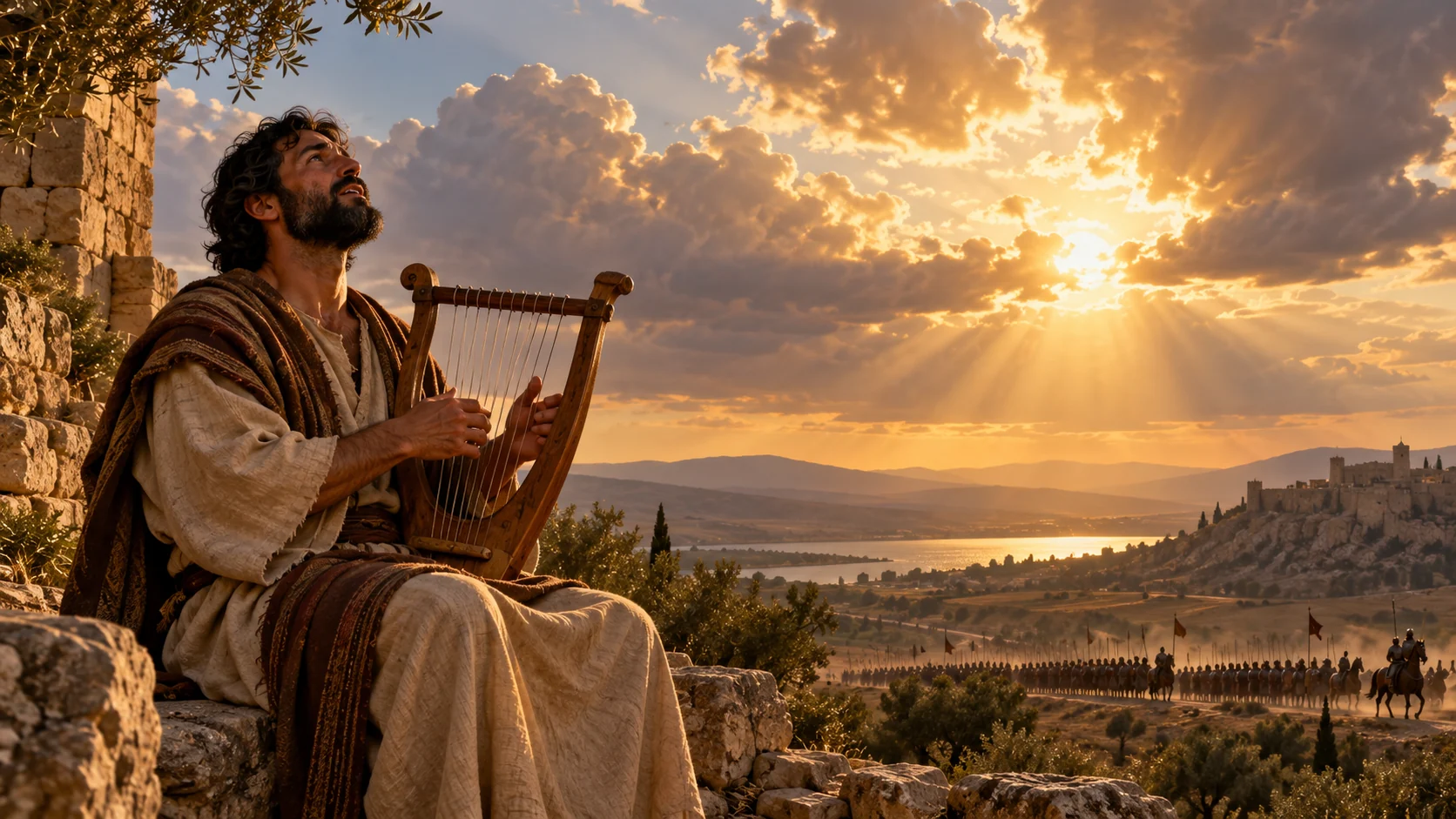
The world counts armies, horses, plans, and power. Psalm 33 listens for a deeper sound: the word that made the heavens. When the machinery of fear grows loud, faith answers with a new song and waits beneath God’s watchful eye.
Introduction: What Can We Trust When Power Looks Impressive?
Human beings easily confuse what is visible with what is ultimate. Ancient kingdoms counted soldiers and war horses; we count money, influence, technology, and networks. The instruments change, but visible resources still feel like control over tomorrow.
Psalm 33 interrupts that instinct with worship. It begins with music, widens into creation, confronts national plans and military strength, and ends with a community waiting for Yahweh. It refuses to let any created resource become the final ground of confidence.
This text is about praise becoming political trust, because worship teaches a community to measure reality not by the size of its armies but by the reliable word, searching gaze, and steadfast love of Yahweh.
Historical and Literary Context
Psalm 33 has no heading in the Hebrew text, and no single historical event can be securely attached to it. Its language about nations, armies, famine, and deliverance can therefore travel across Israel’s story.
It belongs to Book 1 and Psalms 25–34, where David’s deliverance becomes a paradigm for Israel’s redemption. Its opening echoes Psalm 32:11: private confession and forgiveness now widen into congregational praise.
Goldingay notes that its twenty-two verses give the feel of a comprehensive hymn, though not an alphabetic acrostic. Verses 1–3 summon praise; 4–7 celebrate creation; 8–12 address nations; 13–19 expose military false confidence; 20–22 become hope and prayer. Kidner aptly calls it a hymn to the “Maker and monarch.”
Walking Through the Text
Psalm 33:1–3 — When Forgiven People Learn a New Song
The psalm opens noisily: rejoice, praise, give thanks, make melody, sing, play skillfully, shout. Worship is embodied; voice, breath, hands, instruments, skill, and gladness are recruited into praise.
The “new song” need not make older songs useless. It can name fresh recognition of Yahweh’s acts. Kidner notices freshness, skill, and fervor together: worship need not choose between excellence and sincerity.
The link with Psalm 32 matters. The mouth that stopped hiding sin now sings; forgiveness restores a person to the worshiping community.
Psalm 33:4–7 — When God’s Word Becomes a World
Why sing? Because Yahweh’s word is upright and his work is faithful. Word and deed belong together. God does not promise one thing and act as another kind of God.
Verse 5 adds righteousness, justice, and hesed—steadfast covenant love. “The earth is full” of that commitment. Even with death and famine still named later, the Creator’s faithfulness remains the deeper reality.
Verses 6–7 echo Genesis 1. By Yahweh’s word the heavens are made; by his breath their host appears. Threatening waters are gathered as though oceans were water in a vessel. Creation is not a contest Yahweh barely wins; terrifying forces remain under the Creator.
Psalm 33:8–12 — When the Plans of Nations Meet a Longer Counsel
The whole earth is summoned to reverence. The Creator continues to act in history. Nations devise plans; Yahweh can frustrate them. Peoples form intentions; his counsel stands through generations.
This does not authorize rulers to call every political outcome divine approval. It relativizes every human agenda: no empire owns history.
Verse 12 calls Israel blessed because Yahweh is its God and has chosen it as his possession. Election means belonging, not permission to boast; the chosen people must not define greatness by the nations’ machinery.
Psalm 33:13–19 — When the Watching Eye Exposes False Security
From heaven Yahweh sees all humanity. The repeated “all” resists our narrow judgments. God sees beyond borders, propaganda, and appearances; as maker, he knows hearts and deeds.
Then comes the sharp contrast. A king is not saved by a great army. A warrior is not rescued by great strength. A war horse is a false hope for salvation. The repeated language of greatness is deliberately deflated. The point is not that armies never win; it is that force cannot guarantee salvation.
Against the war horse stand those who fear Yahweh and wait for his hesed. His eye is covenant care, not surveillance. Goldingay highlights the tension: reverence submits to God; waiting expects him to act. The God who sees all bends toward those threatened by death and famine.
Psalm 33:20–22 — When Praise Becomes Patient Waiting
The final movement becomes communal: “Our soul waits for Yahweh.” Noisy praise becomes quiet confidence; worship has deepened, not disappeared.
Yahweh is “our help and our shield.” Hearts rejoice because they trust his holy name—his revealed character. Then confession becomes prayer: may your hesed rest upon us according to our hope in you.
Waiting is not a technique for forcing God. The community places itself beneath the steadfast love it has spent the psalm describing. The new song ends with open hands.
Theological Reflection
God’s Word and Work Belong Together
Psalm 33 roots trust in God’s moral coherence. Yahweh’s word is upright because his work is faithful. Biblical faith is not confidence that God will do whatever we imagine; it is confidence that he remains true to his righteous and covenant character.
Creation Is a Theology of Hope
The God who contains the waters is not intimidated by chaos. Creation does not erase present danger, but it places danger inside a larger story. The world is neither self-created nor finally abandoned; it lives under the word and hesed of its Maker.
Divine Kingship Judges False Security
King, warrior, and horse expose the temptation to turn means into masters. Money, medicine, technology, institutions, and government can be gifts. Idolatry begins when a gift becomes what we believe cannot fail us. Psalm 33 calls for reordered trust.
Worship Forms People Who Can Wait
The psalm moves from shouting to waiting without contradiction. Mature worship has room for loud praise and quiet endurance because Yahweh’s steadfast love remains over his people.
Canonical and Christological Horizon
Psalm 33 reaches back to Genesis 1 and the exodus, where God orders creation and restrains threatening waters. Isaiah 40–48 likewise declares that imperial plans cannot overturn Yahweh’s purpose. Deuteronomy 17:16 warns Israel’s king not to multiply horses; Psalm 33 names the danger: military abundance can become misplaced confidence.
Christians should resist turning Psalm 33:6 into a shortcut proof of the Trinity. Goldingay warns that this can bypass the psalm’s own message about Yahweh’s creative word and breath. Yet John 1:1–3 and Colossians 1:15–17 later speak of creation through the Word and the Son, deepening Christian wonder without erasing the psalm’s original claim.
Jesus also redefines kingship. He does not establish God’s kingdom by accumulating war horses or imitating coercive nations. He gives his life and is raised. The cross exposes the limits of violent power; resurrection announces that even death does not possess final sovereignty.
The church therefore sings Psalm 33 neither as escapism nor triumphalism, but as people trained to hope in the crucified and risen Lord.
Life Application
- Audit your “war horses.” Name the resource you most trust to guarantee your future: money, health, position, reputation, technology, or institutional power.
- Use ordinary means without worshiping them. Plan carefully, seek competent help, receive care, and build good systems—but refuse to call any of them your savior.
- Let worship enlarge your vision. When anxiety narrows life, rehearse Psalm 33’s claims about creation, history, and God’s character.
- Practice skill and sincerity together. Bring preparation, excellence, truthfulness, and wholehearted participation into worship.
- Refuse political idolatry. No nation, leader, party, army, or ideology owns God’s counsel; measure power by justice, truth, mercy, and service.
- Learn reverence and waiting together. Obey what God has made clear while continuing to ask him to act where danger, hunger, injustice, or uncertainty remain.
- Build communities of hopeful patience where prayer, practical aid, testimony, and song carry people who are still waiting.
Reflection Questions
- What visible strength has become too important to my sense of safety?
- Where do my plans need greater humility under the conviction that Yahweh’s counsel stands beyond mine?
- Does my worship train me to trust God’s character, or mainly express the mood I already brought?
- How can I combine responsible action with genuine waiting rather than control or passivity?
- How does Jesus’ crucified and risen kingship reshape my understanding of power, victory, and security?
Response Prayer
Creator and King, your word is upright and your works faithful. You gather the waters and remain Lord over plans larger than ours. Expose the war horses we have trusted as saviors. Teach us to use your gifts without bowing to them. Put a new song in forgiven mouths, courage in our waiting, and mercy in our power. Be help and shield to those who hunger and fear. Let your hesed rest over us as we hope in you, through Jesus the crucified and risen King. Amen.
Window into What Comes Next
Psalm 33 ends with a congregation waiting beneath Yahweh’s steadfast love. Psalm 34 returns testimony to individual lips: “I will bless Yahweh at all times.” The God whose eye watches those who fear him will be invited to be “tasted and seen.” Public hymn becomes the afflicted person’s testimony of deliverance.
Bibliography
- BibleProject. The Book of Psalms: Study Notes. Portland, OR: BibleProject, 2020.
- Goldingay, John. Psalms, Volume 1: Psalms 1–41. Baker Commentary on the Old Testament Wisdom and Psalms. Grand Rapids: Baker Academic, 2006.
- Kidner, Derek. Psalms 1–72. Kidner Classic Commentaries. Downers Grove, IL: IVP Academic, 2008.
- Wright, N. T. How God Became King: The Forgotten Story of the Gospels. New York: HarperOne, 2012.
Be the first to leave a comment.