

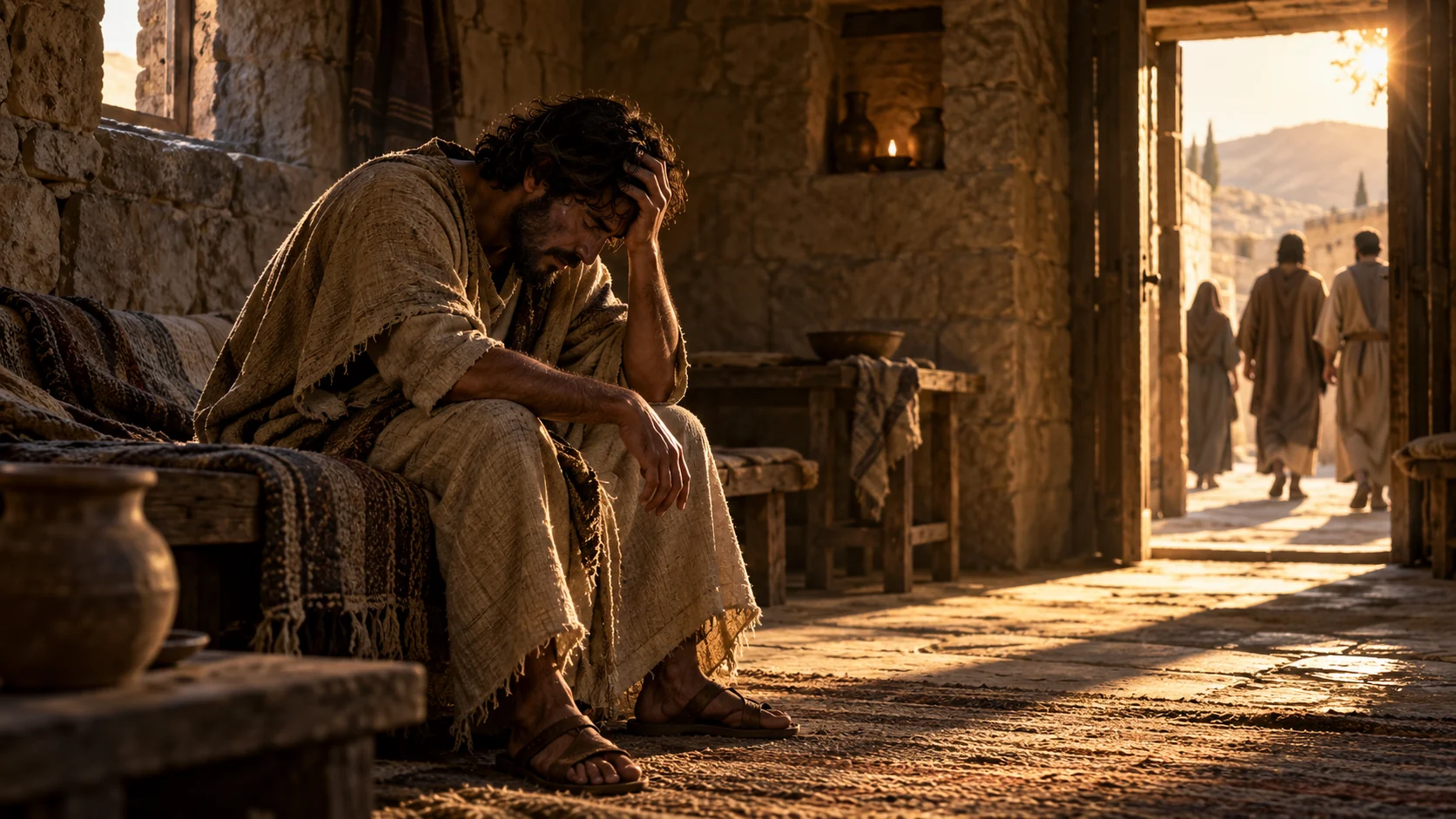
This text is about vulnerability becoming doxology, because the person who attends to the weak discovers that Yahweh attends to the weak, sustains them in suffering, hears confession, exposes betrayal, and establishes the rescued person in his presence.
01
1.0 Introduction: Who Are We When Someone Else Is Down?
Psalm 41 begins with a beatitude: “Blessed is the one who considers the poor.” The Hebrew word can describe someone weak, helpless, or brought low. The question is larger than charitable giving: have we learned to notice the person whose health, strength, or social protection has collapsed?
The speaker has been sick. Enemies wait for his death. Visitors speak politely while gathering material for gossip. People whisper, declare his condition final, and even a trusted companion who shared his bread turns against him. Weakness reveals the moral world around the bed.
This text is about vulnerability becoming doxology, because the person who attends to the weak discovers that Yahweh attends to the weak, sustains them in suffering, hears confession, exposes betrayal, and establishes the rescued person in his presence.
02
2.0 Historical and Literary Context: The Last Psalm of Book One
Psalm 41 is attributed to David, though Scripture gives no clear narrative of this illness. Goldingay treats it as testimony David or later Davidic kings could use. Verses 1–3 announce the good fortune of the one who attends to the weak; verses 4–10 recall prayer during sickness, hostility, and betrayal; verses 11–12 testify that Yahweh answered; verse 13 is the doxology closing Book One.
Kidner describes the movement as “the chance to help” followed by “the chance to hurt.” The same vulnerability creates both possibilities: one person becomes thoughtful; another imagines advantage.
BibleProject groups Psalms 35–41 as poems in which David’s patience and hope through suffering become a model for future generations waiting for deliverance. Psalm 41 also reaches back to Psalm 1. Both begin with “Blessed,” but Psalm 1 celebrates attention to Yahweh’s instruction while Psalm 41 celebrates wise attention to the weak. Torah-shaped faith becomes mercy toward fragile people.
03
3.0 Walking Through the Text
04
3.1 Psalm 41:1–3 — When Wisdom Bends toward the Weak
“Blessed is the one who considers the poor.” The verb means more than noticing. Kidner connects it with practical wisdom: the faithful person studies the situation carefully enough to respond well. Mercy does not rush past suffering with slogans or assume that one kind of help fits every wound.
The blessing is not a mechanical bargain in which helping someone guarantees immunity from trouble. The psalm testifies to Yahweh’s character: he rescues, protects, sustains, and “turns” the sickbed. The image is almost domestic. God attends the place where the sufferer lies.
Weak people are often treated as burdens. Psalm 41 says: pay attention here; their story can teach the community what God is like.
05
3.2 Psalm 41:4 — When Confession and Healing Share One Breath
The testimony recalls the prayer: “Yahweh, be gracious to me; heal me, for I have sinned against you.” The speaker does not claim moral perfection. Yet the psalm does not permit a simplistic equation between a particular sickness and a particular sin. Goldingay notes that human sickness belongs broadly to a world damaged by sin, but this does not authorize us to diagnose every illness as punishment for hidden wrongdoing.
Two truths stand together: the worshiper is a sinner who needs grace, and a sufferer who may rightly ask for healing. Confession does not cancel lament. Grace is needed precisely because the person praying is not perfect.
06
3.3 Psalm 41:5–8 — When a Sickroom Becomes a Marketplace for Rumor
The enemies ask, “When will he die, and his name perish?” A visitor enters, speaks emptiness, gathers harm in the heart, and carries it outside. The sickroom becomes a place where information is collected and weaponized.
A visit can look compassionate while functioning as surveillance. Churches can turn prayer requests into gossip or private weakness into public conversation. The enemies even interpret the illness as final: he has gone down and will not rise.
The speaker has confessed sin, but his enemies are still wrong to feast on his weakness. Repentance does not require surrendering dignity to malicious observers.
07
3.4 Psalm 41:9–10 — When Betrayal Comes from the Table
The deepest wound comes from “my close friend in whom I trusted, who ate my bread.” Shared bread signifies trust, hospitality, and relationship. Betrayal hurts differently when it comes from someone who knew the room from the inside.
The prayer turns: “But you, Yahweh, be gracious to me; raise me up.” The enemies say he will never rise; the worshiper asks God to contradict their verdict. The final clause about repaying them is difficult. Kidner reads it within Davidic judicial authority and notes the contrast with Jesus’ response to enemies. Goldingay explores whether the Hebrew may point toward restoring right relations rather than revenge. Either way, the psalm permits raw desire for justice to be carried to God instead of disguised as spiritual calm.
08
3.5 Psalm 41:11–13 — When the Last Word Is Presence and Praise
The worshiper knows Yahweh has been pleased with him because the enemy has not triumphed: “You have upheld me because of my integrity and set me in your presence forever.” This does not contradict verse 4. Biblical integrity is not sinless perfection. The speaker can be a sinner before God and still be innocent of his enemies’ accusations.
The deepest gift is presence: “You set me before you.” The psalm began with a person noticing the weak; it ends with the weak person secure under God’s gaze.
Then Book One closes: “Blessed be Yahweh, the God of Israel, from everlasting to everlasting. Amen and Amen.” Human blessedness opened Psalm 41; divine blessedness closes it. After Torah, kingship, enemies, sin, tears, rescue, and waiting, the last word is praise.
09
4.0 Theological Reflection
First, mercy is wisdom. Psalm 41 praises careful attention that asks what protection, presence, truth, medicine, advocacy, privacy, or companionship the weak person actually needs.
Second, weakness reveals character. Some bring bread; others gather stories. Some protect dignity; others calculate advantage.
Third, confession and integrity can coexist. Christian spirituality is distorted when confession becomes total self-condemnation. We can own real wrongs without accepting false accusations.
Fourth, God’s rescue aims at presence. The psalm moves beyond “make me better” toward “set me before you.” Communion with God is the larger horizon.
10
5.0 Canonical and Christological Horizon
Psalm 41:9 receives an explicit New Testament echo in John 13:18. During the final meal Jesus quotes the line about the one who ate his bread lifting his heel against him, interpreting Judas’s betrayal within the scriptural pattern of the betrayed righteous sufferer.
The connection must be handled carefully. Jesus is not claiming every line as a direct prediction about himself. The psalmist confesses personal sin in verse 4; the New Testament does not portray Jesus as sinful. Jesus takes up the betrayal pattern and carries it to its climactic expression: the trusted table companion turns against the Messiah.
The contrast also matters. Jesus washes his disciples’ feet, shares the table in the shadow of betrayal, refuses a kingdom built by retaliation, and goes through death toward resurrection. The verdict “he will not rise again” is overturned. God raises the betrayed Son.
Psalm 41 helps us see the cross as God entering betrayal, shame, hostility, and apparent defeat. Resurrection is vindication, and the risen Jesus forms a community called to recognize him among “the least of these” rather than exploiting weakness (Matt. 25:31–46).
11
6.0 Life Application
1. Practice thoughtful mercy. Listen long enough to learn what the vulnerable person actually needs.
2. Guard the sickroom. Treat illness, counseling disclosures, family crises, and prayer requests as sacred trusts rather than conversational currency.
3. Do not diagnose suffering casually. Never assume sickness proves a particular secret offense.
4. Let confession be truthful, not totalizing. Admit what is yours without accepting every hostile accusation.
5. Name betrayal without surrendering to revenge. Bring anger to God and pursue safe, truthful, lawful boundaries.
6. Measure recovery by more than strength. Ask whether suffering is deepening communion with God and compassion toward others.
7. Let the ending shape the story. Book One contains tears and unresolved tension, yet it closes with “Amen and Amen.”
12
7.0 Reflection Questions
1. Who around me is weak, overlooked, ill, grieving, or socially exposed, and what would wise attention look like?
2. Have I ever disguised curiosity or gossip as concern for someone vulnerable?
3. Where do I need to confess real sin without accepting a false verdict about my whole identity?
4. What betrayal tempts me toward revenge, and what boundaries would entrust justice to God without calling evil good?
5. How does Jesus’ betrayal and resurrection reshape my understanding of weakness, vindication, and hope?
13
8.0 Response Prayer
Yahweh, God of Israel, teach me to notice the person who has been brought low. Make my mercy thoughtful, my speech trustworthy, and my presence safe. When I am weak, keep me from despair. Give me courage to confess what is mine and reject what is falsely laid upon me. Heal what is wounded, guard me from those who exploit weakness, and meet me in betrayal. Through Jesus, the betrayed and risen King, teach me to seek justice without becoming cruel and to desire above every other gift the joy of standing in your presence. Blessed are you from everlasting to everlasting. Amen and Amen.
14
9.0 Window into What Comes Next: From the Sickbed to a Thirsting Exile
Psalm 41 closes Book One with a double Amen, but the Psalter continues. Psalm 42 opens Book Two with another form of weakness: a worshiper far from the sanctuary, thirsty for God “as a deer pants for streams of water.” The sickbed gives way to exile. The struggle remains: Where is God when life is diminished? Psalm 41 answers with presence—“you set me before you.” Psalms 42–43 will teach the soul to keep hoping for that presence when it feels painfully far away.
15
10.0 Bibliography
BibleProject. The Book of Psalms: Study Notes. Portland, OR: BibleProject, 2020.
BibleProject. Book of Psalms: Guide with Key Information and Resources. BibleProject.
Goldingay, John. Psalms, Volume 1: Psalms 1–41. Baker Commentary on the Old Testament Wisdom and Psalms. Grand Rapids: Baker Academic, 2006.
Kidner, Derek. Psalms 1–72. Kidner Classic Commentaries. Downers Grove, IL: IVP Academic, 2008.
Wright, N. T. How God Became King: The Forgotten Story of the Gospels. New York: HarperOne, 2012.


Be the first to leave a comment.