

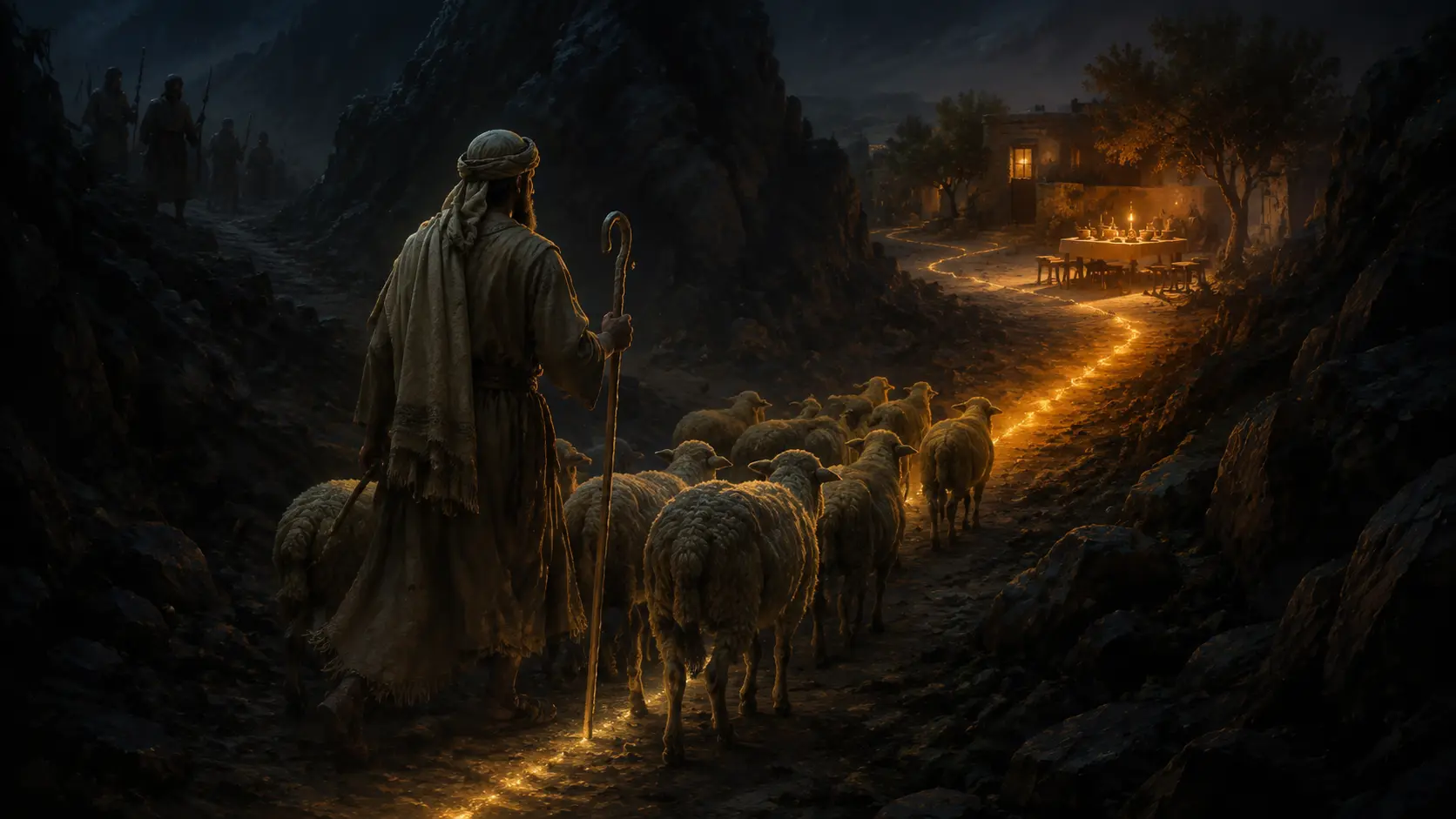
Learning to Hope When God Feels Far Away
01
1.0 Introduction: What Do You Do When You Miss God?
A deer searches for running water. A worshiper searches for the living God. Between thirst and praise stands a soul learning to speak hope to itself.
Some absences are felt in the body. A familiar voice is gone, a doorway stays closed, a congregation sings somewhere without you. Psalm 42 begins there—not with an argument about God, but with thirst for God.
“As a deer pants for streams of water, so my soul pants for you, my God” (Ps. 42:1). The image is beautiful because the need is severe. Water is not decoration for a thirsty animal. God is not an accessory to the psalmist’s life.
The worshiper remembers entering God’s house with a festive crowd, but now lives at a distance. Tears have become daily food, enemies keep asking, “Where is your God?” and even memory hurts (42:3–4). Yet the psalm refuses two easy answers: it neither denies sorrow nor lets sorrow have the final word.
The heart-question is: How can faith keep speaking when God feels absent and the soul feels overwhelmed?
Psalm 42 answers by teaching the wounded worshiper to thirst, remember, lament, and hope—all in the same prayer.
02
2.0 Historical and Literary Context: Book Two Opens Far from Home
Psalm 42 opens Book Two of the Psalter (Pss. 42–72). Its heading associates it with the sons of Korah, a Levitical family connected with temple worship (see 1 Chr. 6:31–38; 9:19; 2 Chr. 20:19). The shift is striking: Book One closes with blessing in Psalm 41:13, but Book Two begins with longing.
Psalm 42 is also closely joined to Psalm 43. The same refrain appears in 42:5, 42:11, and 43:5: “Why, my soul, are you downcast? … Put your hope in God.” The pair moves through three waves of lament and hope. Psalm 43 continues the desire to reach God’s altar (43:3–4), suggesting that the two psalms should be heard together even while Psalm 42 has its own movement.
The geography of 42:6 points northward—to the Jordan region and the heights of Hermon—far from Jerusalem. Whether every place-name can be identified with certainty is less important than the emotional geography: the singer is away from the sanctuary and longs for the place where communal worship made God’s presence tangible.
In the larger Psalter, this is a fitting doorway into Book Two. Psalms 42–43 begin with hope for return to God’s presence in Zion, while Psalm 72 will close the book with hope for the righteous reign of the royal son. Personal exile and kingdom hope belong to the same story.
03
3.0 Walking Through the Text
04
3.1 Psalm 42:1–2 — When God Himself Is the Water
The psalm does not begin, “I thirst for relief.” It begins, “My soul thirsts for God, for the living God.”
The Hebrew nephesh, often translated “soul,” can speak of the whole living person. The psalmist’s longing is therefore not merely an inward religious feeling. His whole life aches for God.
The phrase “living God” sharpens the contrast. The worshiper does not need an idea, memory, or religious atmosphere. He longs for the God who lives and acts.
“When can I go and meet with God?” (42:2) turns thirst into pilgrimage. The sanctuary matters because it is the appointed place where Israel gathers before Yahweh. The psalmist’s hunger for worship is finally hunger for the One worshiped.
05
3.2 Psalm 42:3–5 — When Memory Makes the Tears Deeper
“My tears have been my food day and night” (42:3). The image reverses the opening thirst: the only water immediately available is sorrow.
Then comes the taunt: “Where is your God?” The question presses on the wound. If God is living, why does the worshiper feel abandoned?
Memory intensifies the pain. He remembers moving with the multitude toward God’s house amid shouts of joy and thanksgiving (42:4). Yesterday’s worship makes today’s distance more visible.
But memory also becomes a bridge. In verse 5 the psalmist turns and addresses himself: “Why, my soul, are you downcast? … Put your hope in God.”
This is not positive thinking. He does not tell himself that circumstances are harmless. He tells his wounded self that present experience is not the whole story: “I will yet praise him.”
Biblical hope speaks to pain without pretending pain has disappeared.
06
3.3 Psalm 42:6–8 — When Deep Calls to Deep
The refrain does not instantly cure the sorrow. Verse 6 admits it again: “My soul is downcast within me.” Faith can confess hope in one breath and grief in the next.
Now the landscape becomes water again, but no longer a quiet stream. “Deep calls to deep” as waterfalls thunder and breakers and waves pass over the singer (42:7). The thirsty person now feels drowned.
Significantly, he calls them “your” breakers and “your” waves. The chaos has not escaped God’s sovereignty. The psalmist does not yet understand what God is doing, but he continues speaking to God from inside the flood.
Then verse 8 opens a window: by day Yahweh directs his steadfast love, and at night his song is with the worshiper. Earlier, night and day were filled with tears (42:3); now night and day are also held within divine covenant love.
The circumstances have not yet changed. The interpretation of the night is beginning to change.
07
3.4 Psalm 42:9–11 — When Faith Asks God “Why?”
“I say to God my Rock, ‘Why have you forgotten me?’” (42:9).
The sentence deliberately holds tension together. God is “my Rock,” yet the worshiper feels forgotten. Biblical lament does not require us to choose between trust and bewilderment. It brings bewilderment to the God still addressed as “my.”
The enemies repeat their question: “Where is your God?” (42:10). Their words feel like a mortal wound. Yet the psalmist answers them indirectly by speaking once more to his own soul.
“Put your hope in God, for I will yet praise him, my Savior and my God” (42:11).
Nothing in the final verse says the journey is over. The victory is smaller and deeper: despair has not been allowed to become the only voice in the room.
08
4.0 Theological Reflection
09
4.1 Spiritual Thirst Is Not Spiritual Failure
Psalm 42 does not shame the person who longs for a God who seems distant. The longing itself reveals relationship. The psalmist hurts because God matters.
10
4.2 Lament and Hope Can Occupy the Same Prayer
The repeated refrain does not erase the lament; it interrupts its claim to finality. Biblical faith can say, “Why have you forgotten me?” and “I will yet praise him” without hypocrisy.
11
4.3 Memory Can Wound—and Memory Can Carry Us
The remembered procession first deepens grief, but remembrance eventually becomes a discipline of hope. Scripture repeatedly calls God’s people to remember his acts when the present is confusing (Deut. 8:2; Ps. 77:11–12).
12
4.4 God’s Presence Is the Gift Beneath Every Gift
The psalmist longs for temple worship, but his deepest thirst is for “the living God.” Buildings, songs, gatherings, and rituals matter because they point beyond themselves toward communion with God.
13
5.0 Canonical and Christological Horizon
Psalm 42’s thirst joins a long biblical river. Israel thirsts in the wilderness and receives water from God (Exod. 17:1–7). Psalm 63 again describes a person seeking God in a dry land. Isaiah invites the thirsty to come to the waters of God’s renewed covenant (Isa. 55:1).
In the New Testament, Jesus meets a thirsty Samaritan woman and speaks of “living water” (John 4:10–14). At the feast in Jerusalem he cries, “Let anyone who is thirsty come to me and drink” (John 7:37–39). These texts do not flatten Psalm 42 into a prediction. They place its longing within the wider biblical story in which God comes to dwell with, renew, and give life to his people.
Jesus himself enters the language of abandonment in his suffering (Mark 15:34; Ps. 22:1). Christian hope therefore does not answer the downcast soul from a safe distance. In the crucified Messiah, God meets human anguish; in resurrection, the promise “I will yet praise him” receives a horizon beyond death.
Revelation finally pictures the Lamb shepherding his people to springs of living water and God wiping away every tear (Rev. 7:17). Psalm 42’s tears and thirst are not the last scene.
14
6.0 Life Application
1. Name the thirst beneath the problem. Ask whether you are seeking only changed circumstances or God himself within them.
2. Give lament a vocabulary. Pray the painful question instead of hiding it: “Why?” “How long?” “Where are you?”
3. Speak to your soul, not only from it. Feelings deserve attention, but they need not become the final interpreter of reality.
4. Use memory carefully. Do not romanticize yesterday, but remember concrete ways God has sustained you and his people.
5. Stay connected to worshiping community where possible. Psalm 42 shows that shared worship is not trivial; isolation can deepen spiritual pain.
6. Expect hope to require repetition. The refrain returns because one confession may not settle a troubled heart.
15
7.0 Reflection Questions
1. What am I truly thirsting for beneath my present prayers?
2. Which memory currently brings both gratitude and pain?
3. What does my inner voice say when circumstances ask, “Where is your God?”
4. How might I practice speaking biblical hope to myself without denying grief?
5. Where can I recognize God’s steadfast love in the middle of a night that has not yet ended?
16
8.0 Response Prayer
Living God, my whole life thirsts for you. When tears become my food and old songs make me ache for what seems far away, keep me speaking to you. When deep calls to deep and the waves pass over me, command your steadfast love by day and keep your song with me by night. Teach me to remember without living in the past, to lament without surrendering to despair, and to tell my downcast soul that I will yet praise you. Lead me again into the joy of your presence, through Jesus, the giver of living water. Amen.
17
9.0 Window into What Comes Next
Psalm 42 ends with the soul still waiting. Psalm 43 takes up the same refrain and turns longing into a direct request: “Send me your light and your faithful care; let them lead me” (43:3). The thirsty worshiper now asks for a road home—to God’s altar, to praise, and to the presence for which the whole person has been longing.
18
10.0 Bibliography
BibleProject. The Book of Psalms: Study Notes.
BibleProject. The Book of Psalms: Guide with Key Information and Resources.
Goldingay, John. Psalms, Volume 2: Psalms 42–89. Baker Commentary on the Old Testament Wisdom and Psalms. Grand Rapids: Baker Academic, 2007.
Kidner, Derek. Psalms 1–72. Kidner Classic Commentaries. Downers Grove, IL: IVP Academic, 2008.
Be the first to leave a comment.