


Job asked for a courtroom; God gives him a universe. The voice from the storm does not hand him an indictment, but leads him through foundations, seas, dawn, death, snow, stars, rain, lions, and ravens—until the sufferer begins to see that wisdom is wider than his wound.
01
1. Introduction: When the Voice Finally Comes
For thirty-seven chapters, the reader has waited.
Job has waited too.
He has sat in ashes while friends turned comfort into accusation. He has cursed the day of his birth. He has asked why the wicked prosper and why the righteous suffer. He has searched for an arbiter, a witness, a redeemer. He has remembered the days when God’s friendship rested over his tent, lamented the present shame that swallowed his honor, and finally signed his oath of innocence before heaven.
Then Elihu came like wind before the storm. He spoke of God’s justice, God’s discipline, God’s instruction, God’s thunder, God’s clouds. His final words ended at the edge of awe: the Almighty is beyond reach, abundant in justice, great in power, and therefore to be feared [Job 37:23–24].
Then the storm speaks.
“Then the LORD answered Job out of the whirlwind” [Job 38:1].
This is the moment Job demanded and feared. God breaks silence. But he does not answer in the way Job expected. He does not explain the heavenly council. He does not mention the satan. He does not tell Job, “Here is why your children died.” He does not give a philosophical essay on suffering. He does not accuse Job of the hidden crimes imagined by the friends.
Instead, God asks questions.
Where were you when I laid the foundations of the earth?
Who shut in the sea with doors?
Have you commanded the morning?
Have you entered the springs of the sea?
Have the gates of death been revealed to you?
Where is the way to the dwelling of light?
Have you entered the storehouses of snow?
Can you bind the chains of the Pleiades?
Can you send lightning?
Can you feed the lion?
Can you provide food for the raven?
God answers Job’s wound by opening the world.
This is not avoidance. It is revelation. Job’s complaint has been that God’s governance of the world seems morally broken. God responds by taking Job on a tour of divine governance. He shows that the world is not a small courtroom arranged around human visibility. It is a vast, ordered, wild, generous, dangerous, beautiful creation sustained by wisdom Job has not mastered.
Job does not receive the answer he asked for.
He receives the God who answers.
Job 38 teaches that God’s wisdom is not smaller than our questions; it is larger than the world in which our questions ache.
02
2. Historical and Literary Context: The First Speech of Yahweh Begins
Job 38 begins the climactic section of the book: the speeches of Yahweh [Job 38:1–42:6]. After the long debate among Job, the friends, and Elihu, God himself speaks. This changes everything.
The structure of the book has moved from prose narrative [Job 1–2], to poetic dialogue [Job 3–37], and now to divine speech [Job 38–41], followed by Job’s responses and the final epilogue [Job 42]. Job 38 is the opening chapter of the first divine speech, which continues through Job 39 and concludes in Job 40:1–2.
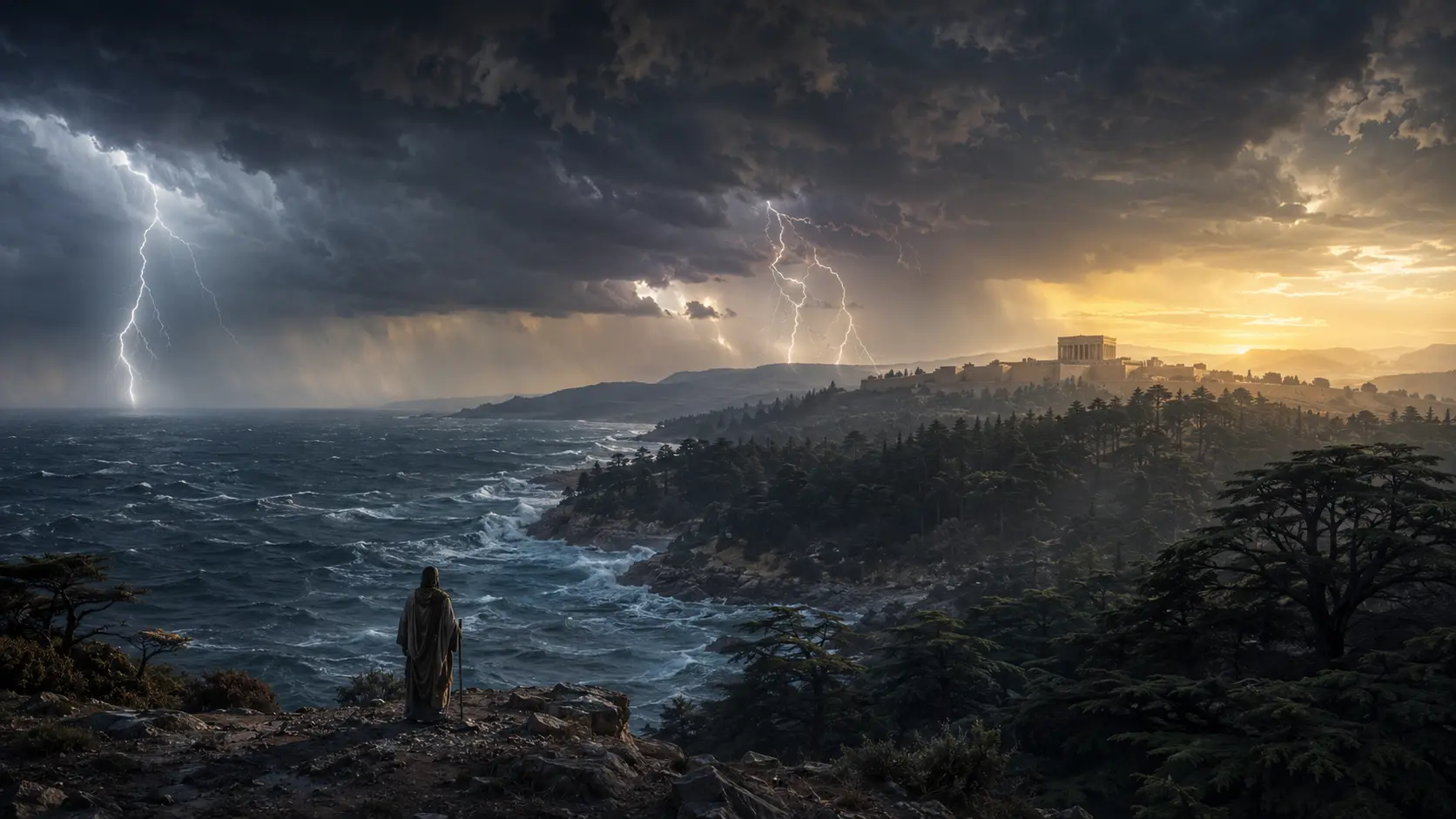
The first speech begins with a theophany: Yahweh answers from the whirlwind [Job 38:1]. The storm is not merely dramatic background. In Scripture, storms often accompany divine presence—thunder, cloud, fire, trembling earth, and holy dread. Elihu has just described storm and thunder, and now the storm becomes the place of revelation.
The opening challenge sets the tone: “Who is this that darkens counsel by words without knowledge?” [Job 38:2]. Then God commands Job to brace himself like a man: “I will question you, and you make it known to me” [Job 38:3]. Job had summoned God to answer. Now God summons Job.
The chapter unfolds as a series of rhetorical questions about creation and divine governance.
First, God asks about the foundations of the earth [Job 38:4–7]. Was Job there when the earth was measured, founded, and celebrated by morning stars and heavenly beings?
Second, God asks about the sea [Job 38:8–11]. Who shut it behind doors, wrapped it in clouds, and set boundaries saying, “Thus far shall you come, and no farther”?
Third, God asks about morning and dawn [Job 38:12–15]. Has Job commanded the morning or caused the dawn to seize the edges of the earth and shake the wicked from it?
Fourth, God asks about hidden regions: the sea’s springs, the recesses of the deep, the gates of death, the expanse of earth, and the dwellings of light and darkness [Job 38:16–21].
Fifth, God asks about the storehouses of snow and hail, the paths of lightning and east wind, and the channels of rain and thunderbolt [Job 38:22–30].
Sixth, God asks about the constellations and heavenly ordinances: Pleiades, Orion, Mazzaroth, the Bear, and the rule of the heavens over the earth [Job 38:31–33].
Seventh, God asks about weather and wisdom: clouds, lightning, and the wisdom given to hidden places of creation [Job 38:34–38].
Finally, the chapter turns from cosmic order to animal provision: lions hunting prey and ravens crying to God [Job 38:39–41]. This prepares for Job 39, where God will lead Job deeper into the lives of wild creatures.
The chapter is not a lecture. It is an interrogation wrapped in poetry, a creation hymn cast as a disputation, a divine answer that instructs by wonder. God does not deny Job’s pain. He does not explain it directly. He relocates it inside a larger reality.
The Lord’s first answer does not solve Job’s suffering by shrinking it; it surrounds Job’s suffering with a wisdom too vast for accusation to master.
03
3. Walking Through the Text: The Courtroom Becomes Creation
04
3.1 The Lord Answers from the Whirlwind (38:1)
The chapter begins with the sentence the whole book has been moving toward: “Then the LORD answered Job out of the whirlwind” [Job 38:1].
The word “answered” matters. God is not absent. He has heard. Job’s cries have not vanished into empty sky. The Lord answers.
But he answers from a whirlwind. Not from a quiet study. Not from a courtroom bench. Not from the friends’ theology. Not from a written indictment. The answer arrives clothed in storm.
The whirlwind reveals and conceals. It announces presence but does not make God manageable. It is near enough to be heard and wild enough to remind Job that God is not domesticated. Job wanted access to God; he receives encounter with God.
This matters for prayer. God’s answer may come, but not in the form we imagined. We may ask for explanation and receive presence. We may ask for a map and receive a voice. We may ask for a verdict and receive a vision.
When God answers from the whirlwind, he comes near without becoming small.
05
3.2 “Who Is This?”: Words Without Knowledge (38:2–3)
God’s first question cuts through the storm: “Who is this that darkens counsel by words without knowledge?” [Job 38:2].
It is severe, but it is not the same as the friends’ accusation. The friends said Job must be morally wicked. God says Job has spoken beyond his knowledge. Job’s problem is not that he secretly oppressed widows, worshiped gold, or exploited the poor. His problem is that his suffering has led him to draw conclusions about God’s governance that exceed what he knows.
Words can darken counsel. They can make reality seem more confused than it is. This is not because questions are evil. Job’s questions mattered. God is answering them. But when human beings speak as though their limited sight is total sight, words become fog.
Then God commands: “Dress for action like a man; I will question you, and you make it known to me” [Job 38:3]. The courtroom reverses. Job had questioned God. Now God questions Job.
This reversal is not humiliation for humiliation’s sake. It is healing through proper creaturely placement. Job must stand as a human being before the Creator, not as a rival judge above him.
God does not condemn Job for crying; he confronts Job for turning limited pain into total judgment.
06
3.3 Foundations of the Earth: Were You There? (38:4–7)
God begins at the beginning: “Where were you when I laid the foundation of the earth?” [Job 38:4].
The image is architectural. The earth is pictured like a vast building. It has measurements, a foundation, bases, and a cornerstone [Job 38:5–6]. God speaks as Master Builder. Creation is not accident. It is ordered, measured, founded, held.
Then the scene becomes worship: the morning stars sang together, and all the sons of God shouted for joy [Job 38:7]. Creation began not with human observation but with cosmic praise. Before Job’s grief, before human history, before the ash heap, there was song.
The question “Were you there?” is not meant to mock Job’s smallness. It invites him to recognize that reality is older and wider than his suffering. The world did not begin with his pain, and it will not end there. Creation is built on wisdom Job did not witness and cannot supervise.
There is comfort hidden inside the humbling. If God laid the foundations of the earth, then Job’s world, though shattered, is not ultimate chaos. The universe is not falling through emptiness. It rests on divine wisdom.
Before there was lament on the ash heap, there was song at the foundation of the world.
07
3.4 The Sea as a Newborn Monster: Boundaries for Chaos (38:8–11)
God next speaks of the sea. In ancient imagination, the sea often symbolized chaos, danger, and forces beyond human control. God asks who shut in the sea with doors when it burst from the womb [Job 38:8].
The imagery is astonishing. The sea is both dangerous and newborn. It bursts forth with wild energy, but God swaddles it with cloud and thick darkness [Job 38:9]. Then he sets bars and doors, declaring, “Thus far shall you come, and no farther, and here shall your proud waves be stayed” [Job 38:10–11].
God is not threatened by chaos. He midwives it, clothes it, limits it, and assigns it place.
This speaks directly into Job’s world. Job’s life has felt like floodwaters breaking boundaries. Death has entered his house. Shame has covered his name. Pain has surged like waves. God does not explain why those waves reached Job, but he reveals himself as the One who sets limits even to the sea.
In the biblical story, this theme continues. God divides waters in creation [Gen 1:6–10], opens the sea for Israel [Exod 14], stills stormy waters [Ps 107:29], and in Jesus rebukes wind and sea with sovereign authority [Mark 4:39]. The sea is wild, but not ultimate.
The waves may be proud, but they still stop where God says, “No farther.”
08
3.5 Commanding the Morning: Dawn as Moral Order (38:12–15)
God asks Job whether he has commanded the morning since his days began or caused the dawn to know its place [Job 38:12].
Morning is not only beautiful; it is obedient. Day after day, light returns. Dawn takes hold of the earth’s edges like a cloth and shakes the wicked out of it [Job 38:13]. As light spreads, the earth is changed like clay under a seal, and its features stand out like a garment [Job 38:14].
The imagery is moral. Darkness shelters the wicked; dawn exposes them. Light does not merely illuminate landscapes; it participates in judgment. The arms of the wicked are broken [Job 38:15].
Job has accused God of failing to bring timely justice. God points to the dawn as one daily sign that creation itself has an order that resists darkness. This does not mean all wickedness is immediately punished. But it does mean that God has woven exposure, rhythm, and moral witness into the fabric of the world.
Every sunrise is a quiet sermon: darkness does not own the earth.
Morning is God’s daily protest against the arrogance of night.
09
3.6 Springs of the Sea and Gates of Death: Hidden Regions Beyond Human Reach (38:16–18)
God asks whether Job has entered the springs of the sea or walked in the recesses of the deep [Job 38:16]. Has the gate of death been revealed to him? Has he seen the gates of deep darkness? [Job 38:17]. Has he comprehended the expanse of the earth? [Job 38:18].
These questions move downward and outward. The springs beneath the sea, the recesses of the deep, the gates of death, the expanse of earth—these are regions beyond human mastery.
Job has spoken much about death. He has longed for it, feared it, described it, and felt its nearness. But God asks whether Job has actually seen death’s gates. Job knows death as sufferer; God knows it as Lord.
This distinction matters. Human beings experience realities we do not rule. We suffer death, but we do not map its gates. We feel darkness, but we do not govern its boundaries. We walk on the earth, but we do not comprehend its whole expanse.
In Christ, this becomes even more luminous. Jesus not only speaks of death; he enters it and breaks its gates from within [Rev 1:18]. The God who questioned Job about death’s doors is the God who, in the risen Christ, holds the keys.
We may stand near the shadow of death, but only God knows the gates—and only God can open them toward life.
10
3.7 The Dwelling of Light and Darkness: Can You Escort Them Home? (38:19–21)
God continues: where is the way to the dwelling of light, and where is the place of darkness? Can Job take each to its territory? Does he know the paths to their home? [Job 38:19–20].
Then comes divine irony: “You know, for you were born then, and the number of your days is great!” [Job 38:21].
The irony is tenderly severe. Job is old enough to suffer deeply, but not old enough to have witnessed creation. He has lived long enough to lament, but not long enough to supervise light and darkness.
Light and darkness here are almost personified as residents with homes and paths. God knows their dwellings. He knows where they belong. He can summon them and send them back.
Job’s experience has been dominated by darkness. God does not deny that. But he reveals that darkness has a place. It is not sovereign. It is not homeless chaos wandering beyond God’s knowledge. Even darkness has boundaries known to God.
The darkness that feels endless to us still has an address known to God.
11
3.8 Storehouses of Snow and Hail: Weather Reserved for God’s Purposes (38:22–24)
God asks whether Job has entered the storehouses of snow or seen the storehouses of hail [Job 38:22]. These are reserved for times of trouble, for the day of battle and war [Job 38:23]. Then God asks about the way light is distributed and the east wind scattered over the earth [Job 38:24].
Weather is pictured as stored, released, distributed, and governed by God. Snow and hail are not random ornaments. They are part of God’s arsenal and economy. They can nourish, disrupt, judge, and reveal.
This imagery appears elsewhere in Scripture. Hail becomes an instrument of judgment in Egypt [Exod 9:22–26] and in Israel’s battles [Josh 10:11]. Snow becomes a sign of cleansing and divine purity [Isa 1:18; Ps 51:7]. The east wind can bring judgment or change [Exod 10:13; Jonah 4:8].
The point is not that every weather event has a simple moral meaning. Job 37 already taught that storms may serve multiple purposes. The point is that creation’s forces are not outside God’s governance.
The weather we cannot store, God can summon; the forces we cannot master, God can use with wisdom.
12
3.9 Rain Where No Human Lives: God’s Generosity Beyond Utility (38:25–30)
God now asks who has cut a channel for torrents of rain and a way for the thunderbolt [Job 38:25]. Who brings rain on a land where no human lives, on the desert where there is no one, to satisfy the waste and desolate land and make grass sprout? [Job 38:26–27].
This is one of the most important turns in the chapter.
God sends rain where no human being is watching.
This breaks open a human-centered view of creation. The world does not exist only where humans can use it. God delights to water wilderness. He nourishes places that do not produce immediate human profit. The desert, the waste, the desolate land—these too receive divine attention.
This is a deeply healing and humbling word. Job’s world has shrunk around his suffering. The friends’ theology has shrunk the universe into a moral payment system. God opens a wider world where divine care spills into uninhabited places.
Grass grows where no human applause rises.
Then God asks whether rain has a father, who has begotten drops of dew, from whose womb ice came, and who gave birth to the frost of heaven [Job 38:28–29]. Waters become hard like stone, and the face of the deep is frozen [Job 38:30].
Creation is alive with divine mystery. Rain, dew, ice, frost, and frozen waters are not merely processes; they are gifts born from God’s governance.
God waters deserts no one visits, because creation is loved before it is useful.
13
3.10 Pleiades, Orion, Mazzaroth, and the Bear: Can You Govern the Stars? (38:31–33)
God lifts Job’s eyes higher. Can he bind the chains of the Pleiades or loosen the cords of Orion? Can he bring forth Mazzaroth in its season or guide the Bear with its children? [Job 38:31–32]. Does he know the ordinances of the heavens? Can he establish their rule on the earth? [Job 38:33].
The night sky becomes a classroom. The constellations move with order. Seasons come. Stars appear and vanish. Their patterns affect earth’s rhythms, agriculture, navigation, and timekeeping. But Job does not command them.
The images of binding and loosening are powerful. Humans may name constellations, tell stories about them, watch them, and calculate their appearance. But they cannot bind or release them. Naming is not ruling.
This humbles all human knowledge. Science can observe and describe, and that is good. But observation is not sovereignty. Measurement is not mastery. The heavens still declare a wisdom beyond human control.
We may read the stars like letters, but only God writes their seasons across the sky.
14
3.11 Clouds, Lightning, and the Wisdom of Hidden Things (38:34–38)
God asks whether Job can lift his voice to the clouds so that a flood of waters may cover him [Job 38:34]. Can he send lightning so that it goes and says, “Here we are”? [Job 38:35]. Who has put wisdom in the inward parts or given understanding to the mind? [Job 38:36]. Who can number the clouds by wisdom, or tilt the waterskins of heaven when dust runs into a mass and clods stick together? [Job 38:37–38].
These questions bring heaven down to the dry earth. Rain does not fall because Job commands clouds. Lightning does not report to him. Wisdom itself is a gift, not a human possession. Clouds are numbered by divine wisdom. The cracked, dry ground waits until God tips the waterskins of heaven.
The imagery is earthy and beautiful. Dust becomes mud. Clods cling. Dryness receives rain. Creation is fragile and dependent.
So is Job.
He cannot make rain fall on his life. He cannot command lightning to answer him. He cannot number the clouds of God’s purposes. But he can learn that the world is full of divine wisdom operating beyond his control.
The clouds answer to God with “Here we are”; wisdom begins when we learn to answer the same way.
15
3.12 Lions and Ravens: God Feeds the Wild and the Crying (38:39–41)
The chapter ends by turning from cosmic structures to hungry creatures. Can Job hunt prey for the lion or satisfy the appetite of young lions when they crouch in dens or lie in wait? [Job 38:39–40]. Who provides for the raven its prey, when its young cry to God and wander for lack of food? [Job 38:41].
This transition is stunning. The God who laid earth’s foundations also hears baby ravens.
Divine wisdom is not only grand architecture; it is daily provision. God governs stars and stomachs, seas and nests, dawn and dens.
The raven is especially striking because ravens were unclean birds in Israel’s later ritual classification [Lev 11:15]. Yet God feeds them. Their young cry to God. Creation’s marginal creatures are not outside divine care.
Jesus later echoes this vision: “Consider the ravens: they neither sow nor reap… and yet God feeds them” [Luke 12:24]. If God feeds ravens, how much more does he care for his children?
For Job, this matters deeply. He feels unfed by answers, abandoned in the ashes. God’s question does not say, “You matter less than ravens.” It says, “If I hear the raven’s cry, do you think your cry has been unheard?”
The Lord of the stars is also the feeder of crying ravens.
16
4. Theological Reflection: Wisdom Wider Than the Wound
17
4.1 God Answers with Presence Before Explanation
Job 38 is not the answer many readers expect. God does not explain the heavenly council. He does not tell Job the reason for each loss. He does not solve suffering as an abstract problem.
He comes.
That presence is itself an answer—not because explanations do not matter, but because the deepest need of the sufferer is not information alone. Job has longed for God. Now God is there.
In pastoral life, this matters. We often want to give explanations when what wounded people need first is presence. God himself models a strange mercy: he does not begin by explaining pain; he begins by speaking to Job.
18
4.2 God Corrects Job Without Condemning Him Like the Friends Did
God’s opening rebuke is real: Job has spoken words without knowledge [Job 38:2]. Yet God does not say what the friends said. He does not call Job a secret oppressor. He does not validate their accusations. He corrects Job’s posture before divine wisdom, not his integrity against the friends’ charges.
This distinction is essential. A sufferer may be innocent of the accusations people place upon them and still need correction in how pain has shaped their view of God.
God’s correction is not rejection. It is the mercy of truth.
19
4.3 Creation Is Larger Than Human Utility
Rain falls where no human lives [Job 38:26–27]. Lions hunt. Ravens cry. Stars move. Seas surge. Dawn spreads. Snow waits in storehouses. The world is not arranged only around human usefulness.
This is a major theological reorientation. Human beings are honored in Scripture as image-bearers, but we are not the center around which every creature exists. God delights in wildness, wilderness, and creatures beyond our management.
This widens Job’s vision and ours. God’s care is more spacious than our interests. His wisdom includes places we never visit and creatures we never notice.
20
4.4 Wisdom Is Trusting God’s Governance Without Mastering It
God’s questions expose the gap between human experience and divine governance. Job can suffer truly without knowing totally. He can lament honestly without ruling rightly. He can trust God without understanding all the hidden architecture of the world.
This is not anti-intellectual. The Bible honors wisdom. But wisdom begins with fear of the Lord [Job 28:28]. It receives the limits of creaturehood as a gift rather than an insult.
The question is not whether Job knows anything. He knows much. The question is whether Job knows enough to judge God’s rule over everything.
21
4.5 Christ Is the Creator Who Enters the Wound
Job 38 reveals God as Creator: founder of earth, ruler of sea, commander of dawn, giver of rain, governor of stars, feeder of ravens.
The New Testament declares that this same creative wisdom is revealed in Christ: all things were made through the Word [John 1:3], all things hold together in the Son [Col 1:16–17], and the Lord who feeds ravens tells anxious disciples that the Father knows their needs [Luke 12:24–32].
But the gospel goes further. The Creator does not remain above suffering. In Jesus, the Maker enters the world he made. The One through whom the morning was commanded endures darkness at noon. The One who set boundaries for the sea is overwhelmed by the flood of human violence. The One who feeds ravens thirsts on the cross.
Then resurrection dawns.
This means Job 38 is not merely about power. It is about wisdom that will finally be revealed as cruciform love. The Creator who questions Job is the Redeemer who enters Job’s pain and brings new creation.
The God who laid the foundations of the earth also lays a foundation of hope in the wounds of the risen Christ.
22
5. Life Application: Letting God Widen the World Again
Suffering shrinks the world.
Pain makes the room smaller. Grief narrows the horizon. Anxiety turns the future into a locked door. In such seasons, we may begin to believe that our wound is the whole truth.
Job 38 does not tell us to deny the wound. It tells us to let God widen the world around it.
Look at foundations: your life rests on more than what has collapsed.
Look at the sea: chaos has limits, even when waves are loud.
Look at dawn: darkness is real, but it is not final.
Look at death’s gates: God knows what you fear but cannot map.
Look at rain in the wilderness: God’s care reaches places no one applauds.
Look at the stars: God’s order is older than your confusion.
Look at ravens: the cries of small, hungry creatures reach heaven.
A practical exercise for this chapter:
Read Job 38 outdoors if possible. Pause after each section and let creation become prayer. When you see sky, say: “Lord, You are wider than my understanding.” When you see light, say: “Lord, command morning again in me.” When you hear birds, say: “Lord, You hear small cries.” When you feel overwhelmed, say: “Thus far, and no farther—set boundaries to what threatens me.”
Then write down one area where you have been asking for explanation. Beneath it, write this prayer: “Lord, while I wait for what I do not know, give me Yourself.”
Faith is not pretending the wound is small; faith is discovering that God is larger.
23
6. Reflection Questions
Why is it significant that God answers Job from the whirlwind rather than through a calm explanation?
How does God’s rebuke of Job differ from the accusations of Job’s friends?
What does the image of God setting boundaries for the sea teach about chaos, suffering, and divine rule?
Why does God mention rain falling in a wilderness where no human lives?
How do the questions about stars, clouds, lightning, lions, and ravens widen Job’s vision of God’s wisdom?
What is the difference between receiving God’s presence and receiving a full explanation?
How does Christ deepen our understanding of the Creator who speaks in Job 38?
24
7. Response Prayer
Lord of the whirlwind, Creator of earth and sea, Commander of dawn, Keeper of snow, Guide of stars, Feeder of lions and ravens, we stand before You with small knowledge and great need.
Forgive us for speaking beyond what we know. Forgive us for shrinking Your wisdom to the size of our pain. Forgive us for mistaking silence for absence and mystery for neglect.
Teach us to receive Your presence when explanation has not yet come. Set boundaries to the waves that threaten us. Command morning over our darkness. Water the deserts in us that no one else sees. Feed the hungry places of our souls.
Lead us to Jesus, the Word through whom all things were made, the Lord of storm and stillness, the crucified Creator, the risen dawn of new creation.
Give us Yourself, and in Your presence teach us wisdom.
Amen.
25
8. Window into the Next Chapter: When God Shows Job the Wild Ones
Job 38 begins with foundations, sea, dawn, death, light, snow, stars, rain, lions, and ravens. God has opened the cosmos and shown Job a world governed by wisdom beyond human command.
In Job 39, the tour continues—but the focus shifts more fully to animals.
God will ask Job about mountain goats giving birth, wild donkeys roaming free, the wild ox refusing domestication, the ostrich laughing at danger, the war horse charging into battle, and the hawk and eagle soaring by wisdom not given by human hands.
This next chapter will deepen the lesson of wildness.
God’s world is not tame.
Not every creature serves human convenience.
Not every strength can be harnessed.
Not every form of wisdom looks safe to us.
Job will be invited to see that the Creator delights in creatures beyond human control. And perhaps, slowly, Job will begin to understand that if God wisely governs the wild ones, he may also wisely govern the wild grief Job cannot understand.
The whirlwind has opened.
The questions have begun.
Creation is now preaching.
26
9. Bibliography
Alter, Robert. The Wisdom Books: Job, Proverbs, and Ecclesiastes: A Translation with Commentary. New York: W. W. Norton, 2010.
BibleProject. The Book of Job Guide. BibleProject, accessed 2026.
Clines, David J. A. Job 1–20. Word Biblical Commentary 17. Dallas: Word Books, 1989.
Hartley, John E. The Book of Job. New International Commentary on the Old Testament. Grand Rapids: Eerdmans, 1988.
Walton, John H., and Tremper Longman III. How to Read Job. Downers Grove: IVP Academic, 2015.
Be the first to leave a comment.