

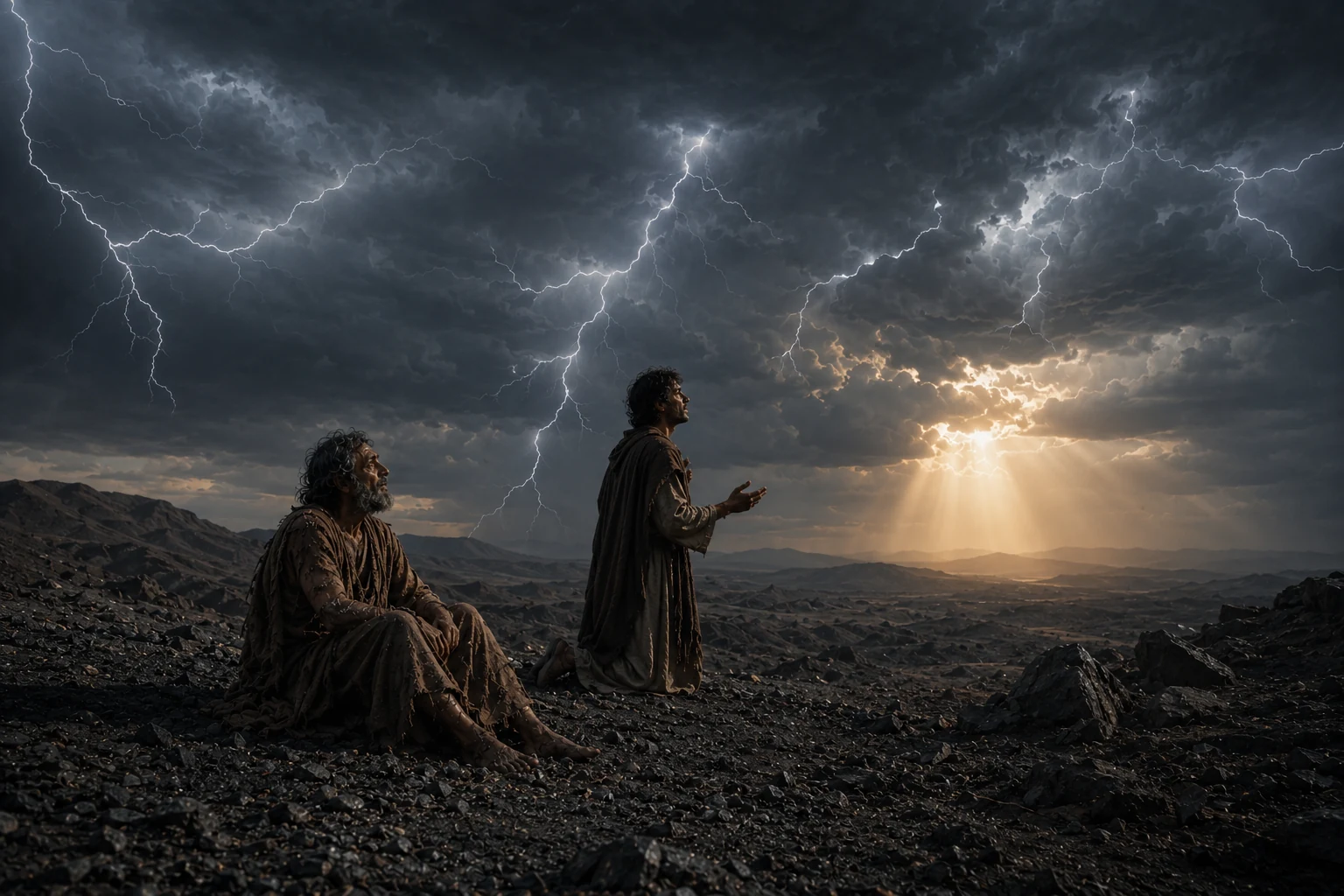
Elihu’s heart trembles as the storm gathers; thunder becomes almost a voice, lightning crosses the sky like a divine command, and Job is told to stand still before wonders he cannot govern.
01
1. Introduction: When Human Speech Runs Out Beneath the Storm
There are moments when argument must give way to awe.
Words have marched across the ash heap for many chapters. Job has lamented. Eliphaz has warned. Bildad has defended tradition. Zophar has accused. Job has protested, cursed the day of his birth, asked for a mediator, accused God of treating him like an enemy, and finally signed his oath of innocence. Elihu has entered with youthful fire, defending God’s justice, warning Job, and interpreting suffering as a possible place of divine instruction.
Now, in Job 37, the last human speech in the book reaches its end.
Elihu is no longer merely debating. He is trembling.
The storm he began describing at the end of Job 36 now fills the horizon. Thunder rolls. Lightning flashes beneath the whole heaven. Snow and rain obey God’s command. Animals retreat to their dens. Cold comes from the breath of God. Clouds turn by divine guidance, fulfilling God’s purposes—whether for discipline, for the land, or for mercy [Job 37:5–13].
Then Elihu turns to Job with a final summons: “Hear this, O Job; stop and consider the wondrous works of God” [Job 37:14].
That sentence is the heart of the chapter.
Stop.
Consider.
Wonder.
Job has wanted a courtroom. Elihu points him to the sky. Job has wanted an indictment. Elihu points him to thunder. Job has wanted God to answer his legal case. Elihu asks whether Job can even understand how God hangs the clouds, makes lightning flash, or spreads out the sky like a hard molten mirror [Job 37:15–18].
Finally, Elihu confesses the darkness of human speech before God: “Teach us what we shall say to him; we cannot draw up our case because of darkness” [Job 37:19].
This is perhaps the most fitting close to all human speeches in Job. We cannot prepare our case because of darkness. Human beings do not know enough. We cannot arrange the universe into neat moral formulas. We cannot explain every storm. We cannot see the full counsel of God.
And yet Elihu does not end in despair. He ends in reverence. The Almighty is beyond reach, exalted in power, abundant in justice and righteousness, and therefore people should fear him [Job 37:23–24].
Job 37 is the threshold.
Behind us lies the long human debate.
Before us stands the whirlwind.
Elihu’s final word teaches that before God answers our questions, he may first teach us to tremble at the wonders we cannot command.
02
2. Historical and Literary Context: The Final Human Speech Before Yahweh Speaks
Job 37 concludes Elihu’s fourth speech, which began in Job 36. It is also the final speech from any human character before the Lord answers Job from the whirlwind in Job 38.
This placement is crucial.
Elihu has been introduced after Job’s final oath of innocence and before God’s response. His speeches have functioned like a bridge between the arguments of the friends and the speeches of Yahweh. He is not simply one more friend, though he sometimes sounds like them. He is also not God’s official mouthpiece, though he often speaks as if defending God’s honor. He stands in a complicated place: more insightful than the friends in some respects, still limited in others.
Job 37 is especially important because it moves from theology about God to awe before God’s works. Elihu’s earlier speeches centered on God’s speech through suffering [Job 33], God’s justice [Job 34], the limits of human righteousness before God [Job 35], and God’s teaching through affliction and nature [Job 36]. Now the focus falls almost entirely on the storm.
The chapter has three main movements.
First, Elihu describes the storm as a manifestation of God’s voice and power [Job 37:1–5]. His heart trembles. He commands the listeners to hear the roar of God’s voice. Lightning and thunder are presented as signs of divine majesty.
Second, Elihu describes the ordered variety of weather under God’s command [Job 37:6–13]. Snow, rain, cold, ice, clouds, lightning, and wind all obey. Human beings are stopped in their work. Animals retreat. The storm serves God’s purposes, whether discipline, provision, or covenant mercy.
Third, Elihu directly admonishes Job to stop and consider God’s wonders [Job 37:14–24]. He asks whether Job understands the workings of clouds, lightning, heat, and sky. He admits humans cannot prepare their case before God because of darkness. He ends with a confession of God’s unreachable majesty, power, justice, righteousness, and the proper human response of fear.
The chapter therefore prepares us for Job 38. The imagery of storm is not accidental. Elihu speaks about thunder; soon God will speak from the whirlwind. Elihu asks Job whether he knows the works of God; soon God will ask Job a cascade of questions about creation: earth, sea, dawn, death, snow, hail, stars, rain, animals, and wild creatures.
Elihu says, “Be still and consider.”
Yahweh will say, “Where were you?”
Job 37 stands like lightning before sunrise: not the full light yet, but enough to make the landscape tremble.
03
3. Walking Through the Text: The Storm That Silences the Courtroom
04
3.1 Elihu’s Trembling Heart: Awe Before the Voice (37:1–2)
Elihu begins with his own body: “At this also my heart trembles and leaps out of its place” [Job 37:1].
The storm is not an abstract argument to him. It shakes him. His theology has entered his chest. The thunder does not remain outside as a phenomenon to analyze; it comes inside as fear, wonder, and trembling.
This is important. True theology must eventually become trembling. It is not enough to arrange correct sentences about God. The heart must feel the weight of the One being named. Elihu may have been wordy, confident, and severe, but here he is at least not casual. The storm has humbled his body.
Then he calls the others to listen: “Keep listening to the thunder of his voice and the rumbling that comes from his mouth” [Job 37:2]. Thunder becomes the voice of God—not in the sense that every thunderclap is verbal revelation, but in the sense that creation communicates divine majesty. The storm is wordless speech.
The Bible often hears God’s voice in thunder [Ps 29:3–9]. At Sinai, thunder accompanied covenant revelation [Exod 19:16–19]. In the Gospels, when a voice from heaven spoke, some thought it had thundered [John 12:28–29]. Thunder stands at the edge where creation sound becomes divine summons.
The first lesson of the storm is not explanation but trembling attention.
05
3.2 Lightning Under the Whole Heaven: God’s Reach Across the Earth (37:3–5)
Elihu says God lets lightning loose under the whole heaven and sends it to the corners of the earth [Job 37:3]. Then comes the roar: after the lightning, God thunders with his majestic voice [Job 37:4].
The order is familiar: first light, then sound. The flash crosses the horizon; the roar follows. Elihu sees in this sequence not mere weather but divine majesty. God’s power is swift, bright, far-reaching. No corner of the earth lies outside the theatre of his works.
Then comes the summary: “God thunders wondrously with his voice; he does great things that we cannot comprehend” [Job 37:5].
This line is one of the central confessions of the chapter. God does great things beyond human knowing. The world is not irrational, but it is more than rationality can master. There are wonders that can be observed but not controlled, admired but not exhausted.
Job has wanted to understand. Elihu does not mock that desire. But he insists that not all divine greatness can be brought inside human comprehension.
This prepares the way for Yahweh’s speeches. The Lord will not answer Job by giving a neat explanation of the heavenly council. He will take Job into the vastness of creation, where human knowledge becomes small enough to begin becoming wise.
Wonder begins where control ends.
06
3.3 Snow and Rain Under Command: Creation Obeys the Word (37:6)
Elihu turns from thunder to weather’s variety: “For to the snow he says, ‘Fall on the earth,’ likewise to the downpour, his mighty downpour” [Job 37:6].
Snow and rain are not independent powers. They receive command. God speaks, and the weather obeys.
This line carries deep biblical echoes. In Genesis, God speaks and creation responds: light appears, waters separate, land emerges, vegetation grows [Gen 1]. In Isaiah, rain and snow descend from heaven and do not return empty, just as God’s word accomplishes what he purposes [Isa 55:10–11]. Creation is responsive to divine speech.
For human beings, rain can be blessing or disruption. It waters fields. It fills cisterns. It can also halt travel, flood paths, and force people indoors. Snow, rare and wondrous in the biblical landscape, becomes a sign that even unusual weather belongs to God’s command.
This is humbling. We can plan, labor, plant, build, and travel, but we do not command the sky. Creation is not our servant. It is God’s servant.
The snowflake and the storm cloud both teach obedience better than human pride does.
07
3.4 God Seals Every Human Hand: When Work Must Stop (37:7)
Elihu says God seals up the hand of every human being, so that all people may know his work [Job 37:7].
The image is striking. Weather stops human activity. The farmer cannot plow. The traveler cannot continue. The builder cannot build. The merchant cannot move goods. The strong hand is sealed, closed, restrained.
This is not merely inconvenience. It is revelation. When God halts human work, people are forced to recognize that the world is not held together by their productivity. There are moments when the most spiritual thing a person can do is stop.
Job has been stopped. His wealth, work, public service, family life, and social authority have all been halted. Elihu may not fully understand Job’s case, but his words touch a real truth: forced stillness can reveal God’s work where human activity once filled the horizon.
Modern life resists this fiercely. We measure worth by output. We fear interruption. Illness, loss, weather, waiting, and weakness feel like enemies because they seal the hand. But perhaps some sealed hands are invited to become open hands.
When God closes the hand of activity, he may be opening the eyes of worship.
08
3.5 Animals in Their Dens: Creation Knows Its Limits (37:8)
The animals enter their lairs and remain in their dens [Job 37:8]. Even wild creatures withdraw before the storm.
This simple image is full of wisdom. Animals do not argue with the weather. They do not file a complaint against the clouds. They recognize danger and retreat. Their limitation becomes a form of practical wisdom.
Human beings often resist limits more than animals do. We confuse dominion with control. We imagine courage means never retreating. But creatures survive by honoring the order of creation. There are seasons for movement and seasons for shelter.
In the book of Job, wild animals will soon become central to God’s speeches. God will speak of lions, ravens, mountain goats, wild donkeys, ostriches, horses, hawks, eagles, Behemoth, and Leviathan [Job 38–41]. Elihu’s passing mention of animals in their dens is a small doorway into that wider world.
The storm teaches that creation has rhythms humans did not invent.
Wisdom sometimes looks like knowing when to enter the den and wait.
09
3.6 Chambers of the South and Breath of Ice: Weather from God’s Storehouses (37:9–10)
Elihu describes the tempest coming from its chamber and cold from the scattering winds [Job 37:9]. By the breath of God ice is given, and the broad waters are frozen fast [Job 37:10].
The imagery is ancient and poetic. Winds come from chambers, as though God has storehouses for storm and cold. Ice comes from divine breath. The waters, normally fluid and moving, become hard and still.
Here again creation is both beautiful and humbling. God’s breath can animate clay [Gen 2:7], part the sea [Exod 15:8], bring ice, and later give life to dry bones [Ezek 37:9–10]. Breath is life-giving, but also powerful, ordering, and sovereign.
The frozen waters show that even what seems untamable can be restrained by God. Water spreads, floods, flows, and escapes human grasp. Yet God’s breath can make it stand still.
Job has felt his life frozen. Movement stopped. Joy stiffened. Hope trapped. Elihu sees the natural sign: God can still govern what has become rigid, cold, and immovable.
The breath that freezes the waters is also the breath that can raise dry bones.
10
3.7 Clouds by His Guidance: Weather as Servant of Divine Purpose (37:11–13)
Elihu says God loads the thick cloud with moisture, scatters lightning through the cloud, and makes the clouds turn around by his guidance to accomplish all he commands on the face of the inhabited world [Job 37:11–12].
Clouds are not random to Elihu. They are guided. They turn like servants under command. They carry blessing, warning, judgment, and mercy according to divine purpose.
Then he gives three possible purposes: “Whether for correction, or for his land, or for love, he causes it to happen” [Job 37:13].
This is a key verse.
The storm may come for correction or discipline. It may come for the land, simply to water and sustain creation. It may come for steadfast love or mercy. One event in nature can serve different purposes in God’s governance.
This helps us resist simplistic interpretation. A storm is not always punishment. Rain may be discipline, provision, or mercy. God’s works are multi-layered. Human beings often see only one surface.
This is deeply relevant to Job. His friends saw his calamity and assigned one meaning: punishment. Elihu sees more possibilities, yet he still tends to press Job toward correction. The verse itself is wiser than any single application. God may be doing more than one thing.
The same rain can warn, water, and bless; God’s purposes are wider than our first interpretation.
11
3.8 “Stand Still and Consider”: Elihu’s Final Charge to Job (37:14)
Now Elihu turns: “Hear this, O Job; stop and consider the wondrous works of God” [Job 37:14].
This is the last direct summons Job receives from a human speaker.
Stop.
Consider.
The Hebrew idea suggests stillness, attention, a pause before wonder. Job has spoken many words. He has questioned, argued, lamented, and sworn innocence. Elihu now calls him to contemplative silence before God’s works.
There is wisdom here, though it must be handled gently. Sufferers should not be silenced by force. Job’s speech has been necessary. His lament has been faithful in ways his friends could not understand. But there also comes a time when speech must become stillness, not because questions are foolish, but because the human soul needs wonder as much as argument.
To consider God’s wondrous works is not to deny pain. It is to place pain inside a world larger than pain.
Stillness is not the death of faith; sometimes it is the doorway through which awe enters.
12
3.9 Do You Know? Clouds, Lightning, and Perfect Knowledge (37:15–16)
Elihu asks Job: “Do you know how God lays his command upon them and causes the lightning of his cloud to shine?” [Job 37:15]. Then: “Do you know the balancing of the clouds, the wondrous works of him who is perfect in knowledge?” [Job 37:16].
The questions anticipate the divine interrogation in Job 38–41. Elihu asks about clouds and lightning. Yahweh will ask about foundations, seas, dawn, depths, death, snow, stars, and animals.
The point is limitation. Job does not know how God governs clouds. He does not control lightning. He cannot explain the balance and movement of the sky. The One who does is “perfect in knowledge.”
Earlier Elihu used a similar phrase in a way that may have sounded like self-reference [Job 36:4]. Here the phrase clearly belongs to God. God alone has perfect knowledge. Creation’s complexity is not confusion to him.
For Job, this is humbling. If he cannot understand the balancing of clouds, how can he fully understand the moral government of the universe? This does not mean his suffering is meaningless. It means the meaning lies within a wisdom larger than his reach.
The clouds move by a wisdom we cannot weigh; so too may God’s hidden purposes move above our understanding.
13
3.10 Hot Garments and the Molten Sky: Human Frailty Beneath the Heavens (37:17–18)
Elihu continues: Job’s garments grow hot when the earth is still because of the south wind [Job 37:17]. Then he asks, “Can you, like him, spread out the skies, hard as a cast metal mirror?” [Job 37:18].
The images contrast human weakness with divine craftsmanship. Job cannot control the heat pressing against his own clothing. He cannot govern the wind that makes his body uncomfortable. How then could he spread out the sky?
The sky is pictured as something vast, firm, shining, and crafted. Elihu is not giving modern meteorology; he is using ancient poetic cosmology to awaken wonder. The point is not the material structure of the sky but the disproportion between creature and Creator.
Human beings are affected by weather; God commands it. Human beings sweat beneath the south wind; God spreads the heavens. Job feels heat on his garments; God shapes the cosmic canopy.
This is not meant to humiliate Job into worthlessness. It is meant to relocate him as a creature. Creatureliness is not shame. It is truth. We are not God, and peace begins when we stop trying to stand where only God can stand.
To be human is not to hold up the sky, but to live faithfully beneath it.
14
3.11 “Teach Us What We Shall Say”: The Darkness of Human Litigation (37:19–20)
Elihu now speaks with surprising humility: “Teach us what we shall say to him; we cannot draw up our case because of darkness” [Job 37:19].
This is one of the most important lines in the chapter.
After all the arguments, all the accusations, all the defenses, all the theological claims, Elihu admits: we do not know how to speak to God properly. Darkness surrounds the human case. We cannot organize our lawsuit before the Almighty with full clarity.
This is an appropriate ending to human wisdom. It does not deny that humans can speak truth. It denies that humans can master the whole truth.
Then Elihu asks, “Shall it be told him that I would speak? Did a man ever wish that he would be swallowed up?” [Job 37:20]. To demand speech before God is dangerous. To rush into divine presence with a legal case may be like stepping into consuming brightness without preparation.
Job has longed to speak with God. Elihu warns that such speech is not small. But the wonder of the book is that God will indeed speak—not to destroy Job, but to answer him in a way that humbles and restores.
Before God, the wisest human sentence may be: teach us what to say.
15
3.12 Light Too Bright to Look At: The Wind That Clears the Sky (37:21–22)
Elihu describes a moment after the storm: people cannot look at the light when it is bright in the skies, when the wind has passed and cleared them [Job 37:21]. From the north comes golden splendor; God is clothed with awesome majesty [Job 37:22].
The scene is breathtaking. Clouds have passed. Wind has swept the sky clean. Light pours out, too brilliant for the eyes. Golden brightness arrives from the north. Majesty fills the horizon.
This image functions as a transition from storm to revelation. The storm is not merely chaos; it clears the air for glory. Darkness, thunder, and rain give way to unbearable brightness.
There is pastoral beauty here. Some storms leave destruction. But some storms also clear the sky. They reveal light that had been hidden behind thick clouds. In Job’s story, the storm of argument is about to yield to divine speech. The sky is clearing, but the light will be too great to control.
The storm does not have the final word; beyond it there is a brightness no human eye can master.
16
3.13 The Almighty Beyond Reach: Power, Justice, and Fear (37:23–24)
Elihu concludes: “The Almighty—we cannot find him; he is great in power; justice and abundant righteousness he will not violate” [Job 37:23].
This is Elihu’s final theological confession.
God is beyond reach. Not absent, but ungraspable. Not unknowable in every sense, but beyond human capture. He is great in power. He is abundant in justice and righteousness. He does not violate what is right.
Then Elihu gives his final line: “Therefore people fear him; he does not regard any who are wise in their own conceit” [Job 37:24].
The fitting response is fear—not terror alone, but reverent awe, humble surrender, creaturely worship. Human beings must not approach God as though their wisdom were sufficient to judge him.
This last sentence can be heard as aimed at Job. Elihu thinks Job has been wise in his own heart. But it also reaches beyond Job to every speaker in the book, including Elihu. All human wisdom must bow. The friends must bow. Job must bow. Elihu must bow. The reader must bow.
The human speeches end not with a solution but with awe.
Then the Lord answers Job out of the whirlwind.
When human wisdom reaches its limit, holy fear becomes the threshold of revelation.
17
4. Theological Reflection: Storm, Silence, and the Fear of the Lord
18
4.1 Creation Is a Form of Divine Speech
Elihu hears the voice of God in thunder, sees the command of God in snow and rain, and discerns the governance of God in clouds and lightning. Creation is not silent. It speaks without syllables.
This does not replace Scripture or direct revelation. But it does mean the world is charged with witness. The heavens declare the glory of God [Ps 19:1]. Rain speaks generosity. Thunder speaks majesty. Snow speaks obedience. Clouds speak mystery. Animals in dens speak creaturely limits.
The problem is not that creation says nothing. The problem is that humans often move too fast, speak too much, and listen too little.
19
4.2 God’s Purposes Are Often Multi-Layered
Job 37:13 is vital: the storm may serve correction, the land, or mercy. One event can carry more than one divine purpose.
This protects us from cruel simplifications. We should be careful about saying, “This happened because of that.” God’s actions are not always single-threaded. Rain can discipline, water, bless, warn, cleanse, and sustain.
Likewise, suffering may expose sin, deepen compassion, reveal hidden faith, confront false theology, strengthen endurance, or remain mysterious to us. Only God sees all the layers.
20
4.3 Human Limitation Is Not Humiliation but Wisdom
Elihu repeatedly asks, “Do you know?” The answer is no.
But not knowing everything does not mean knowing nothing. It means we are creatures. We can receive revelation, practice wisdom, do justice, pray honestly, and love faithfully while admitting that we cannot govern clouds or decode every sorrow.
Modern people often fear limitation because we confuse control with dignity. Scripture teaches that dignity comes from being made by God, not from being God.
Peace begins when we accept creaturehood.
21
4.4 The Fear of the Lord Is the End of Argument and the Beginning of Wisdom
Elihu ends with fear of God. The wisdom hymn in Job 28 ended similarly: the fear of the Lord is wisdom, and turning from evil is understanding [Job 28:28].
Fear of the Lord does not silence honest lament. Job has lamented, and the book has allowed it. But fear of the Lord does prevent lament from becoming mastery over God. It teaches the sufferer to bring pain into God’s presence without claiming God’s throne.
Holy fear is not the enemy of intimacy. It is the atmosphere in which true intimacy breathes.
22
4.5 Christ Reveals the God Beyond Reach by Coming Near
Elihu says, “The Almighty—we cannot find him” [Job 37:23]. This is true. Human beings cannot climb to God by intelligence, morality, suffering, or religious argument.
But the gospel announces the astonishing reversal: the God we cannot find has come to find us.
In Jesus Christ, the unreachable God becomes near without ceasing to be holy. The Word through whom clouds, rain, and stars exist becomes flesh and dwells among us [John 1:1–14]. The Lord of the storm walks on water, stills wind, and sleeps in a boat while disciples tremble [Mark 4:35–41]. At the cross, darkness covers the land; at resurrection, new creation light breaks through.
Christ does not make God manageable. He makes God known.
The God beyond reach has reached for us in Jesus, not to shrink his majesty, but to bring us trembling and beloved into his presence.
23
5. Life Application: Learning to Stand Still Before God’s Wonders
Job 37 calls us to recover the spiritual discipline of wonder.
Many of us know how to argue, plan, explain, complain, and analyze. Fewer of us know how to stop and consider. We can speak quickly about God while rarely standing still before God.
This chapter invites us to slow down under the sky.
When thunder sounds, remember that you are not the center of the universe.
When rain falls, remember that mercy often arrives drop by drop.
When work is interrupted, ask whether God is sealing your hand so your eyes may open.
When you cannot understand the movement of your life, remember that you cannot govern the movement of clouds either.
When you feel tempted to demand that God explain everything, pray, “Teach me what to say.”
A practical exercise for this chapter:
Choose one moment this week to go outside and stand still for five minutes. Do not use the time to produce, solve, or plan. Look at the sky. Notice clouds, wind, heat, light, or rain. Then pray Job 37:14 in your own words: “Lord, help me stop and consider Your wondrous works.”
After that, write one sentence beginning with: “I am not God, and today that means…” Let the sentence become an act of surrender.
Wonder does not erase suffering, but it widens the soul until suffering is no longer the only thing we can see.
24
6. Reflection Questions
Why is it significant that Elihu’s final speech ends with storm imagery rather than a neat explanation of Job’s suffering?
What does Elihu mean when he describes thunder as God’s voice?
How does Job 37:13 help us avoid simplistic interpretations of suffering or natural events?
What might it mean for God to “seal up” human hands so that people may know his work?
Why does Elihu tell Job to “stop and consider” God’s wondrous works?
How does admitting human limitation become a path toward wisdom rather than despair?
How does Jesus reveal the God whom Elihu calls beyond reach?
25
7. Response Prayer
Almighty God, Lord of thunder and whisper, Maker of clouds, snow, rain, and light, teach us to stand still before Your wonders.
When our hearts tremble, turn fear into reverence. When our hands are sealed, open our eyes to Your work. When our words are too many, teach us what to say—and when to be silent.
Forgive us for thinking we can govern the sky, decode every sorrow, or summon You into our courtroom. Give us humble wisdom. Give us holy fear. Give us courage to trust Your justice when Your ways are beyond our reach.
And lead us to Jesus, the Word made flesh, the Lord of the storm, the crucified and risen One, in whom Your unreachable majesty has come near with mercy in wounded hands.
Amen.
26
8. Window into the Next Chapter: When God Answers from the Whirlwind
The human speeches are finished.
Eliphaz, Bildad, and Zophar have fallen silent. Job has made his final appeal. Elihu has trembled before the storm and called Job to stand still before God’s wonders.
Now, in Job 38, the voice Job has long demanded will finally come.
But God will not answer as Job expected.
The Lord will not begin with an explanation of the heavenly council. He will not tell Job about the satan’s challenge. He will not give a philosophical lecture on evil. He will not hand Job the indictment he requested.
Instead, God will answer out of the whirlwind with questions:
Where were you when I laid the foundations of the earth?
Who shut in the sea with doors?
Have you commanded the morning?
Have you entered the storehouses of snow?
Can you bind the chains of the Pleiades?
Can you feed the lion or provide for the raven?
Job wanted a courtroom.
God will give him a cosmos.
Job wanted an answer.
God will give him Himself.
The storm is no longer approaching.
The whirlwind speaks.
27
9. Bibliography
Alter, Robert. The Wisdom Books: Job, Proverbs, and Ecclesiastes: A Translation with Commentary. New York: W. W. Norton, 2010.
BibleProject. The Book of Job Guide. BibleProject, accessed 2026.
Clines, David J. A. Job 21–37. Word Biblical Commentary 18A. Nashville: Thomas Nelson, 2006.
Hartley, John E. The Book of Job. New International Commentary on the Old Testament. Grand Rapids: Eerdmans, 1988.
Walton, John H., and Tremper Longman III. How to Read Job. Downers Grove: IVP Academic, 2015.


Be the first to leave a comment.