

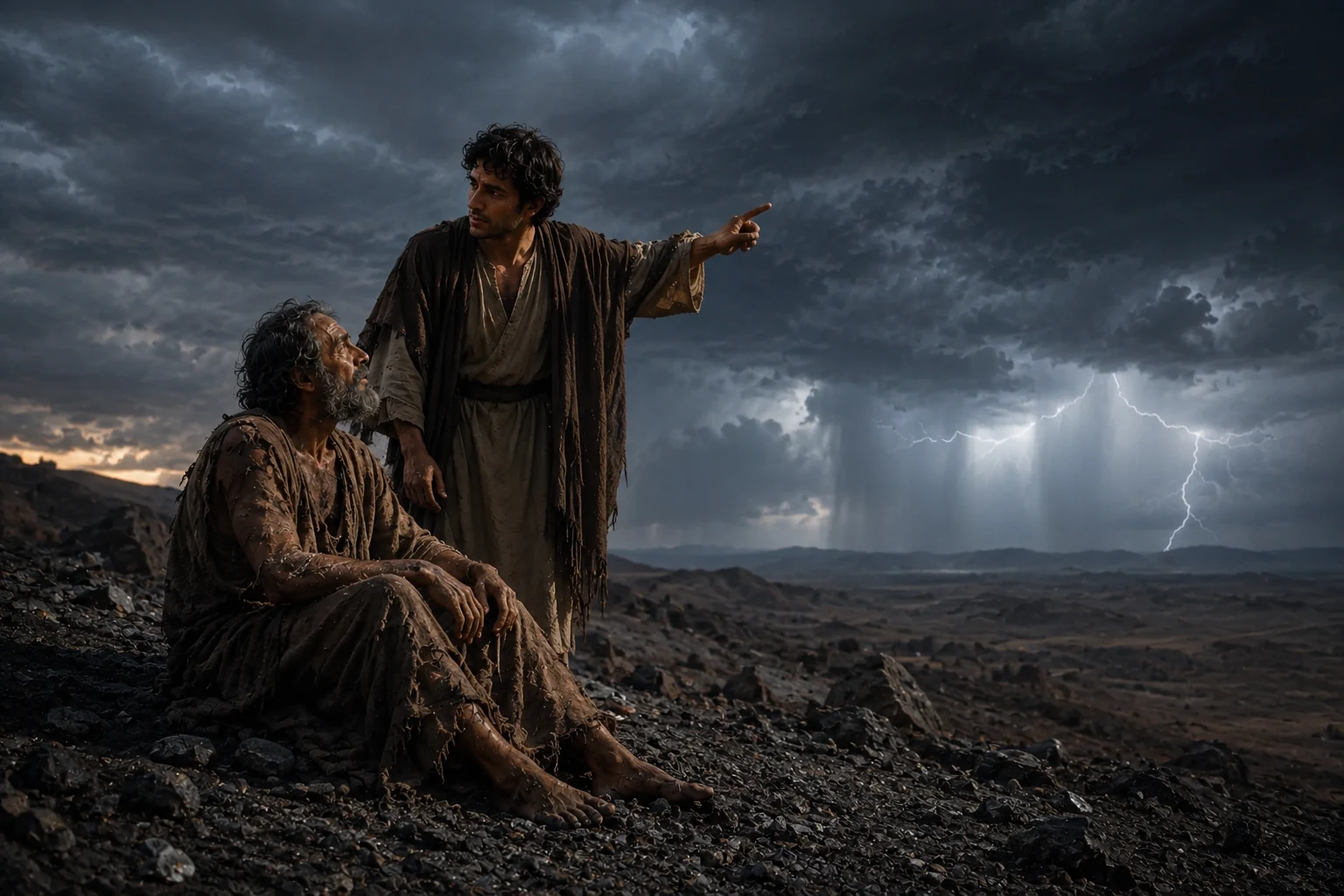
Elihu asks for a little more patience, reaches far for knowledge, and points Job from the cords of affliction to the wide sky, where rain, lightning, and thunder preach that God is mighty, just, and never finished teaching his creatures.
01
1. Introduction: When Pain Becomes a Classroom at the Edge of Storm
There are lessons we choose.
We open the book. We sit at the table. We light the lamp. We ask the question.
But there are other lessons that choose us.
They arrive through closed doors, hospital rooms, dry seasons, unanswered prayers, and nights when sleep refuses to come. They come not as friendly tutors but as severe visitors. They bind the hands, slow the body, silence the noise, and ask the soul to listen.
Job 36 stands inside that hard classroom.
Elihu has spoken three times already. He has argued that God speaks in more ways than Job has noticed [Job 33], that God cannot pervert justice [Job 34], and that righteousness is not a bargain by which human beings purchase God’s favor [Job 35]. Now he begins his fourth and longest speech, a speech that will continue into Job 37.
He asks Job to bear with him a little longer. He claims there are still words to say on God’s behalf. He says he will fetch knowledge from afar and ascribe righteousness to his Maker [Job 36:2–3]. Once again Elihu is bold—perhaps too bold. He says one “perfect in knowledge” is with Job [Job 36:4]. The young man who began by honoring the elders now speaks as a man convinced that heaven has placed insight on his tongue.
Yet Job 36 contains some of Elihu’s most important theological claims.
God is mighty, but he does not despise [Job 36:5].
God does not preserve the wicked forever, but gives justice to the afflicted [Job 36:6].
God keeps his eyes on the righteous [Job 36:7].
If they are bound with cords of affliction, God opens their ear to discipline and commands them to turn from iniquity [Job 36:8–10].
God delivers the afflicted through their affliction and opens their ear by adversity [Job 36:15].
Then Elihu turns directly to Job. God is luring him from the mouth of distress into a broad place [Job 36:16]. But Job must beware. Anger, wealth, longing for escape, and resistance to discipline may turn him toward evil [Job 36:17–21].
Finally, Elihu lifts Job’s eyes to God as Teacher. “Behold, God is exalted in his power; who is a teacher like him?” [Job 36:22]. Then the sky becomes Elihu’s blackboard. Clouds gather. Rain falls. Lightning spreads. Thunder announces God’s presence [Job 36:26–33].
The chapter is beautiful and dangerous.
Beautiful, because Elihu sees God as compassionate teacher, not merely punishing judge.
Dangerous, because he still assumes too confidently that Job’s suffering is corrective discipline aimed at some hidden fault.
So we must walk carefully. Elihu gives us a real truth: God can use affliction to open the ear. But the book of Job gives us a larger truth: not all affliction can be explained by the sufferer’s sin, and even truthful theology can wound when spoken without full knowledge.
Job 36 teaches that God is mighty enough to govern the storm and merciful enough to teach through pain—but we must never turn that mystery into a weapon against the wounded.
02
2. Historical and Literary Context: Elihu’s Fourth Speech Begins
Job 36 begins Elihu’s fourth speech, which continues through Job 37. This speech is the final human speech before the Lord answers Job from the whirlwind in Job 38. That placement is crucial.
The book is moving from human debate to divine encounter.
The three friends have fallen silent. Job has signed his oath of innocence. Elihu has stepped forward as a younger voice, first explaining why he must speak, then addressing Job’s claims. Now his final speech begins to shift the atmosphere. The language moves from courtroom argument toward creation hymn, from disputation toward thunderstorm, from moral reasoning toward wonder.
The chapter has three main movements.
First, Elihu introduces his final speech and claims to speak on God’s behalf [Job 36:1–4]. He asks for patience, says his knowledge comes from afar, and announces his intent to vindicate God’s righteousness.
Second, he presents God’s disciplinary ways [Job 36:5–25]. God is mighty but not contemptuous. He judges the wicked, gives justice to the afflicted, watches the righteous, and uses affliction to open ears. Elihu then warns Job personally not to resist God’s discipline or turn toward evil.
Third, Elihu begins a hymn-like meditation on God’s greatness in nature [Job 36:26–33]. God is beyond knowing. The rain cycle, clouds, lightning, thunder, and storm reveal both his power and his governance.
This speech is a bridge to the Yahweh speeches. Elihu’s focus on God’s power in creation anticipates God’s own tour of the cosmos in Job 38–41. Yet the difference is important. Elihu speaks about God’s creation as an argument to correct Job. God will speak from creation as revelation that humbles and enlarges Job.
Elihu says, “Look at the storm and learn that God is just.”
God will come in the storm and show Job a world wider than his litigation.
Job 36 also deepens Elihu’s distinctive contribution to the debate. The three friends largely interpreted suffering as punishment for past sin. Elihu interprets suffering as discipline, warning, and instruction. This is an advance. He sees pain not only as consequence but as communication. God is not merely paying sinners back; God is opening ears.
Yet Elihu still presses this truth too directly onto Job. The reader knows from the prologue that Job’s suffering is not explained by hidden wickedness. Job is not being punished because he secretly oppressed the poor. Nor is the whole meaning of his suffering exhausted by correction. Job’s case is larger, stranger, and more mysterious.
This means Job 36 must be read as both theological treasure and pastoral caution.
Elihu sees that affliction may become instruction, but only God can say what a particular affliction means.
03
3. Walking Through the Text: The God Who Opens Ears and Commands the Clouds
04
3.1 “Bear with Me a Little”: Elihu’s Final Appeal to Speak (36:1–4)
Elihu begins: “Bear with me a little, and I will show you, for I have yet something to say on God’s behalf” [Job 36:2].
He knows he has spoken at length. The speeches of Elihu are marked by self-conscious introductions. He keeps explaining why he must continue. Yet here, standing near the end of all human speech in the book, his request has dramatic weight. A little longer. One more stretch of argument. One more attempt to defend God before the storm breaks.
He says, “I will get my knowledge from afar and ascribe righteousness to my Maker” [Job 36:3]. The phrase “from afar” suggests depth, distance, perhaps heavenly perspective. Elihu does not want to speak small village wisdom. He wants to bring truth from the far horizon, from beyond ordinary human sight.
His goal is clear: he wants to vindicate God. He wants to show that God acts rightly. The Maker must not be accused of injustice.
Then comes the troubling confidence: “For truly my words are not false; one who is perfect in knowledge is with you” [Job 36:4]. Elihu may mean that his knowledge is sound and complete for the matter at hand. But the phrase sounds dangerous in the book of Job. Human beings do not possess perfect knowledge. The Lord will soon expose the limits of every human speaker.
Elihu’s zeal for God is admirable. His confidence should make us cautious.
Every preacher, teacher, counselor, and theologian should feel the tremor here. We may speak on God’s behalf, but we never speak as God. We may carry true words, but we do not carry exhaustive knowledge.
The servant of truth must speak boldly, but never forget that only God is perfect in knowledge.
05
3.2 Mighty but Not Despising: The Character of God (36:5–7)
Elihu’s first major claim is one of his best: “Behold, God is mighty, and does not despise; he is mighty in strength of understanding” [Job 36:5].
Power often despises. Human strength easily becomes contempt. Kings ignore peasants. The rich overlook the poor. The healthy misread the sick. The successful assume the struggling are foolish.
But God is not like that.
God is mighty, yet he does not despise. His power does not make him cruel. His greatness does not make him indifferent. His exaltation does not erase his compassion. The God who sits above the clouds also sees the afflicted in the dust.
Elihu continues: God does not keep the wicked alive forever, but gives justice to the afflicted [Job 36:6]. He does not withdraw his eyes from the righteous; he sets them with kings on the throne, and they are exalted [Job 36:7].
This is Elihu’s vision of moral order. God’s eyes are fixed on the righteous. The afflicted are not forgotten. The wicked do not finally triumph.
The truth is good, but Job’s experience complicates its timing. Job is righteous, yet not exalted. He is afflicted, yet not delivered. The wicked, as Job has argued, often live long and prosper [Job 21:7–13]. Elihu states the final truth of God’s justice, but Job is living in the painful interval before that justice becomes visible.
Christian faith knows this interval well. The cross stands between promise and resurrection. Holy Saturday sits between death and vindication.
God’s eyes do not leave the righteous, even when the righteous cannot see the light of his face.
06
3.3 Cords of Affliction: When God Opens the Ear (36:8–10)
Elihu now addresses a specific situation: if the righteous are bound in chains and caught in cords of affliction [Job 36:8].
This is not the punishment of the wicked only. Elihu imagines righteous people who nevertheless become bound. They may have sinned through arrogance or hidden rebellion. God then declares to them their work and transgressions, opens their ear to discipline, and commands them to turn from iniquity [Job 36:9–10].
The phrase “opens their ear” is central. Affliction can become an awakening. Pain can break through the crust of self-sufficiency. The heart that would not listen in ease may begin to hear in distress.
This is not because pain is good in itself. Chains are chains. Cords are cords. Affliction is not romantic. But God can turn the place of constriction into the place of instruction.
There is deep biblical resonance here. Israel learned in the wilderness what it could not learn in Egypt’s routines [Deut 8:2–3]. The psalmist says, “Before I was afflicted I went astray, but now I keep your word” [Ps 119:67]. Hebrews speaks of discipline that is painful in the moment but later yields peaceful fruit [Heb 12:11].
Yet Job’s story warns us not to apply this too quickly. Job’s affliction is not explained by some known arrogance. Elihu’s principle is true in many lives, but it is not the whole map for every wound.
Affliction may open the ear, but only humility can keep us from claiming to know exactly what God is saying through another person’s pain.
07
3.4 Obedience, Refusal, and the River of Death (36:11–12)
Elihu describes two possible responses to divine discipline.
If the afflicted obey and serve God, they will complete their days in prosperity and their years in pleasantness [Job 36:11]. If they do not listen, they will perish by the sword or pass away without knowledge [Job 36:12].
The moral urgency is clear. Discipline calls for response. God’s instruction is not information only; it demands turning, obedience, service, and renewed allegiance.
Elihu’s view is hopeful: affliction does not have to end in ruin. It can become the doorway to restoration. But his promise of prosperity again sounds too simple for Job’s lived reality. Job has obeyed and served, yet his days are bitter. The righteous do not always experience immediate pleasantness.
This is where the Bible’s full witness must deepen Elihu’s words. Obedience truly leads to life, but that life may not always appear as present prosperity. Sometimes obedience leads through prison, exile, persecution, and cross before resurrection. The reward of faithfulness is real, but the path may wind through shadow.
In the gospel, pleasantness is not reduced to comfort; prosperity is not reduced to possessions. The deepest prosperity is life with God, formed into Christ, made fruitful in love, and held for resurrection.
Obedience is always the road to life, but sometimes that road passes through a valley before it reaches the broad place.
08
3.5 God Saves the Afflicted Through Affliction (36:13–15)
Elihu contrasts the godless in heart with the afflicted who are teachable. The godless cherish anger; they do not cry for help when God binds them [Job 36:13]. They die in youth, their life ending in shame [Job 36:14].
Then comes one of the key verses of the chapter: “He delivers the afflicted by their affliction and opens their ear by adversity” [Job 36:15].
This is Elihu’s theology in one sentence.
God does not merely deliver the afflicted from affliction. Sometimes he delivers them by affliction. The very thing that wounds becomes, in God’s hands, a severe medicine. The prison becomes a school. The thorn becomes a warning. The night becomes a place where the soul learns to listen.
This is a difficult truth. It can be life-giving when spoken as testimony: “God met me in my suffering and taught me there.” It can be harmful when imposed as explanation: “This is why God made you suffer.”
The difference is love and humility.
The cross helps us hold this carefully. God did not call the suffering of Jesus good in itself. Betrayal, false trial, torture, and crucifixion were evil. Yet God used that evil as the means of redemption. The Son was delivered through suffering, and through his wounds healing flowed to the world [Isa 53:5; Acts 2:23–24].
So we may say: God can redeem through affliction. We must not say: every affliction is easily explained.
The God of resurrection can turn wounds into windows, but he alone knows the path from pain to glory.
09
3.6 Lured from the Mouth of Distress: Elihu’s Hope for Job (36:16)
Elihu now speaks directly to Job: “He also allured you out of distress into a broad place where there was no cramping, and what was set on your table was full of fatness” [Job 36:16].
This is tender, at least in intention. Elihu believes God is not trying to destroy Job. God is luring him from the mouth of distress. The image is vivid: distress is a devouring mouth, a narrow throat, a place of constriction. God wants to bring Job into a broad place, open and free.
The “broad place” is a biblical image of deliverance [Ps 18:19]. Salvation is spaciousness. Sin and suffering constrict; God opens room to breathe.
Elihu also imagines Job’s table restored, full of rich food. This recalls Job’s former abundance and anticipates, in some ways, the epilogue where Job’s fortunes are restored [Job 42:10–17].
But Elihu’s route to that restoration is repentance from the fault he assumes Job has. The reader knows the matter is more mysterious. Still, the hope itself is good: God’s desire is not the pit but deliverance.
Many sufferers need this word. Distress feels like a mouth. It feels as though pain will swallow everything. But God can still lead into wide spaces. Sometimes slowly. Sometimes after long silence. Sometimes in ways we did not expect.
God’s mercy is not content to leave the soul in the narrow throat of distress; he knows the road to the broad place.
10
3.7 Beware the Turn Toward Evil: Anger, Escape, and False Security (36:17–21)
Elihu warns Job that he is full of the judgment due to the wicked and that judgment and justice hold him fast [Job 36:17]. Then he warns against being enticed by wealth or a great ransom [Job 36:18], against trusting in riches or strength [Job 36:19], and against longing for the night when peoples vanish from their place [Job 36:20].
The details are difficult, but the pastoral thrust is clear: suffering places a person at a crossroads.
Pain can open the ear, but it can also harden the heart. Affliction can lead to humility, but it can also lead to bitterness. When life becomes unbearable, the sufferer may be tempted by escape, anger, false security, or moral compromise.
Elihu ends the warning plainly: “Take care; do not turn to iniquity, for this you have chosen rather than affliction” [Job 36:21]. He fears Job may prefer sinful resistance to submissive suffering.
This is a severe word. It may overstate Job’s condition. Job has not chosen wickedness in the way Elihu implies. Yet the warning itself has truth. Suffering can become a doorway to sin. People in pain may justify cruelty, despair, revenge, addiction, manipulation, or unbelief because they have been hurt.
The Bible never mocks pain. But neither does it let pain become permission for evil.
Christ shows another way. He suffered without threatening. He entrusted himself to the One who judges justly [1 Pet 2:23]. He did not let injustice turn him into an agent of injustice.
Pain explains many wounds, but it does not have to become the master of our choices.
11
3.8 Who Is a Teacher Like Him? God as Instructor (36:22–25)
Elihu now lifts the argument again: “Behold, God is exalted in his power; who is a teacher like him?” [Job 36:22].
This is the theological center of the chapter.
God’s power is not brute force. It teaches. Creation teaches. Discipline teaches. Rain teaches. Thunder teaches. The moral order teaches. The hidden and visible works of God instruct those who have ears to hear.
Elihu asks: Who has prescribed God’s way? Who can say to him, “You have done wrong”? [Job 36:23]. God is not a student in our classroom. He is the Teacher. He is not answerable to human standards as though we see the whole curriculum.
Then Elihu tells Job to remember to magnify God’s work, of which people have sung [Job 36:24]. All humanity has looked on it from afar [Job 36:25]. God’s works invite praise, not only litigation.
This does not mean Job’s questions are meaningless. But Elihu is trying to relocate Job. The sufferer must stand not only in the courtroom but also in the sanctuary of creation. He must not only argue his case; he must also behold the Teacher whose works are sung by generations.
There is wisdom here. When pain narrows our world to the size of our wound, creation can widen us again. The sky does not erase grief, but it reminds us grief is not the whole universe. The thunder does not explain everything, but it tells us we are not the measure of all things.
God teaches not only through answers but through wonder.
12
3.9 God Is Great, and We Do Not Know Him Fully (36:26)
Elihu declares: “Behold, God is great, and we know him not; the number of his years is unsearchable” [Job 36:26].
This is a crucial confession. After claiming strong knowledge, Elihu now admits the incomprehensibility of God. God is known truly, but never exhaustively. His years cannot be counted. His greatness cannot be contained.
This prepares the way for the Lord’s speeches. Job’s deepest healing will not come from receiving a full explanation of the heavenly council, the satan’s challenge, or the logic of his suffering. It will come from encountering the living God whose wisdom exceeds Job’s grasp.
Theology must always live inside this tension: we know God because he reveals himself, and we do not know God because he remains greater than our understanding. Faith speaks, but faith also bows.
The more truly we know God, the more humbly we confess that God is greater than what we know.
13
3.10 Rain from the Vapors: The Generosity of God in the Water Cycle (36:27–29)
Elihu turns to rain. God draws up drops of water; they distill his mist in rain, which the skies pour down abundantly on humanity [Job 36:27–28]. He asks whether anyone can understand the spreading of the clouds or the thunderings of God’s pavilion [Job 36:29].
The scene is ordinary and magnificent. Rain falls. Crops grow. Rivers fill. Animals drink. Human life continues. What many people call weather, Elihu calls divine generosity and mystery.
The rain cycle becomes theology. God draws up, distills, spreads, pours, and nourishes. The world is not abandoned to accident. Every shower is a mercy falling from a wisdom beyond our control.
This resonates deeply with Scripture. God sends rain on the earth [Job 5:10]. He waters the mountains from his chambers [Ps 104:13]. Jesus says the Father sends rain on the just and unjust [Matt 5:45]. Rain is common grace, mercy that falls even where it is not deserved.
For Job, who has been scorched by loss, the rain imagery matters. God’s world still includes abundance. The skies still pour. The Maker still gives.
Rain is grace with a thousand small footsteps on the roof of the world.
14
3.11 Lightning, Sea, and Judgment: The Storm as Revelation (36:30–33)
The chapter closes with storm imagery. God scatters lightning around him and covers the roots of the sea [Job 36:30]. By these he judges peoples and gives food in abundance [Job 36:31]. He covers his hands with lightning and commands it to strike the mark [Job 36:32]. Thunder declares his presence; even the cattle announce his rising [Job 36:33].
The storm reveals both provision and judgment. Rain feeds. Lightning warns. Thunder announces. The same sky that waters the field can shake the heart with fear.
Elihu sees God’s governance in this: the weather is not mere spectacle. It is a theater of divine rule. God gives food and executes judgment. He commands lightning as an archer commands an arrow. Thunder becomes herald.
The storm is also literary preparation. The Lord will soon answer Job “out of the whirlwind” [Job 38:1]. Elihu is speaking about the storm while the storm seems to be gathering around him. His words move toward thunder, and then thunder will become the place of divine speech.
There is a holy irony here. Elihu says, “God teaches through the storm.” Soon God will teach from the storm.
Before the whirlwind speaks, the thunder is already clearing its throat.
15
4. Theological Reflection: Discipline, Wonder, and the God Who Teaches
16
4.1 God’s Power Is Not Cruelty
Elihu’s line, “God is mighty and does not despise,” is a bright flame in this chapter [Job 36:5]. Human power often becomes domination. Divine power remains joined to wisdom and compassion.
This matters for sufferers. Pain can make God feel like overwhelming force. Job has experienced God as hunter, warrior, and watcher. Elihu insists that divine might is not contempt. God does not look at human frailty with disgust.
The cross confirms this. In Jesus, God’s power is revealed not as contempt for weakness but as self-giving love within weakness [1 Cor 1:18–25]. The mighty God does not despise the afflicted; he comes near enough to bear affliction.
17
4.2 Affliction Can Open the Ear, but It Does Not Explain Everything
Elihu’s theology of discipline is important. God can use suffering to awaken, warn, correct, and save. Many believers can testify that pain stripped away illusions and opened them to God.
But Job’s story prevents us from turning this into a universal explanation. Job’s affliction is not simply divine correction for known sin. It is part of a larger mystery involving heavenly accusation, tested integrity, and the limits of human wisdom.
So the right pastoral posture is humble hope: “God can meet you and teach you here.” Not arrogant certainty: “I know why this happened to you.”
18
4.3 God Is the Teacher No One Can Replace
Elihu asks, “Who is a teacher like him?” [Job 36:22]. The answer is none.
Human teachers can explain Scripture, counsel souls, and speak wisdom. But God alone teaches through creation, conscience, providence, discipline, Scripture, Spirit, and ultimately Christ. God’s classroom is wider than our institutions. His curriculum includes wilderness and rain, silence and song, loss and restoration.
The goal of divine teaching is not information only. It is transformation. God opens ears so that hearts may turn.
19
4.4 Creation Is Not Background; It Is Witness
Elihu’s turn to clouds, rain, lightning, and thunder anticipates the Lord’s speeches. Creation is not scenery behind the human drama. Creation is witness, teacher, and theater of divine wisdom.
Modern readers often treat weather scientifically but not doxologically. We can describe evaporation and condensation but forget wonder. Elihu would not deny the processes; he would ask us to see through them. Rain is not less God’s gift because we understand the cycle. Lightning is not less God’s wonder because we can measure electricity.
Creation invites knowledge and praise.
20
4.5 Christ Is the Final Teacher in Affliction
Elihu sees God as the teacher who opens ears through affliction. In the New Testament, Jesus becomes the teacher who enters affliction himself.
He does not teach suffering from a distance. He teaches from Gethsemane, from the trial, from the cross, from the tomb emptied by resurrection. He is the Word who speaks in flesh. He is the Son who learned obedience through what he suffered [Heb 5:8], not because he was sinful, but because his faithful obedience passed through the deepest human trial.
Therefore, Christian reflection on affliction must always pass through Jesus. We do not say pain is good. We say Christ is present. We do not say every wound is easily decoded. We say every wound can be brought to the wounded and risen Lord.
In Christ, God is not only the Teacher above the storm; he is the Savior who walks into the storm with us.
21
5. Life Application: Listening for God in the Narrow Place
Job 36 invites us to practice three disciplines.
First, listen in affliction. Not every pain is a lesson, and not every lesson is obvious. But suffering can make us attentive. Ask, “Lord, is there anything You are opening my ear to hear?” This is not self-condemnation. It is humble availability.
Second, beware the temptations of pain. Elihu’s warning is sober: suffering can turn us toward evil if we let bitterness govern us. Pain may tempt us to revenge, despair, manipulation, numbing habits, or spiritual pride. The question is not whether pain is real. The question is whether pain will become lord.
Third, recover wonder. Look at the rain. Watch the clouds. Listen to thunder. Let creation widen the soul. The God who governs the sky is not trapped inside your present distress. He is near you there, but he is also greater than it.
A practical exercise for this chapter:
Take a quiet walk outside or sit where you can see the sky. Read Job 36:22–33 slowly. Then pray three short prayers:
“Lord, teach me what my pain has made me unable to hear.”
“Lord, keep me from turning my wound into sin.”
“Lord, widen my heart with wonder.”
Then name one concrete act of obedience you can take this week—not to bargain with God, but to remain teachable before him.
The narrow place does not have to become a prison; in God’s hands it can become a doorway to a wider obedience.
22
6. Reflection Questions
1. Why is Elihu’s claim that God is “mighty and does not despise” so important for sufferers?
2. What does it mean for God to “open the ear” through affliction?
3. How can we affirm that suffering may teach without claiming to know exactly why someone else is suffering?
4. What temptations can arise in seasons of pain, and how does Job 36 warn against them?
5. Why does Elihu describe God as a Teacher, and how does creation become part of that teaching?
6. How do rain, clouds, lightning, and thunder prepare the reader for God’s speech from the whirlwind?
7. How does Jesus deepen and correct our understanding of divine teaching through suffering?
23
7. Response Prayer
Mighty God who does not despise, Teacher above the clouds, Keeper of the afflicted, open our ears in the narrow place.
When pain makes us angry, keep us from turning toward evil. When distress feels like a mouth ready to swallow us, lead us into the broad place of Your mercy. When we cannot understand Your ways, teach us to trust Your character.
Give us humility where we need correction, comfort where we are falsely accused, patience where we must wait, and wonder where our world has become too small.
Let the rain remind us of Your generosity. Let thunder remind us of Your majesty. Let lightning remind us that Your word reaches its mark.
And lead us to Jesus, the true Teacher, the afflicted Savior, the risen Lord, who entered our storm and opened the way to life.
Amen.
24
8. Window into the Next Chapter: When Thunder Becomes Almost a Voice
Job 36 ends with clouds, lightning, rain, and thunder. Elihu’s speech has moved from moral argument to storm-wonder. The atmosphere is changing. The air feels charged.
In Job 37, Elihu will continue this meditation on the storm. His heart trembles at the thunder of God’s voice. He will describe snow, rain, whirlwind, cold, clouds, lightning, and the golden brightness that comes from the north. He will ask Job to stop and consider the wondrous works of God.
The chapter will be Elihu’s final word.
After that, the Lord will answer Job out of the whirlwind.
The human speeches are nearly finished.
The storm is no longer only an illustration.
It is becoming the place where God will speak.
25
9. Bibliography
Alter, Robert. The Wisdom Books: Job, Proverbs, and Ecclesiastes: A Translation with Commentary. New York: W. W. Norton, 2010.
BibleProject. The Book of Job Guide. BibleProject, accessed 2026.
Clines, David J. A. Job 21–37. Word Biblical Commentary 18A. Nashville: Thomas Nelson, 2006.
Hartley, John E. The Book of Job. New International Commentary on the Old Testament. Grand Rapids: Eerdmans, 1988.
Walton, John H., and Tremper Longman III. How to Read Job. Downers Grove: IVP Academic, 2015.

Be the first to leave a comment.