


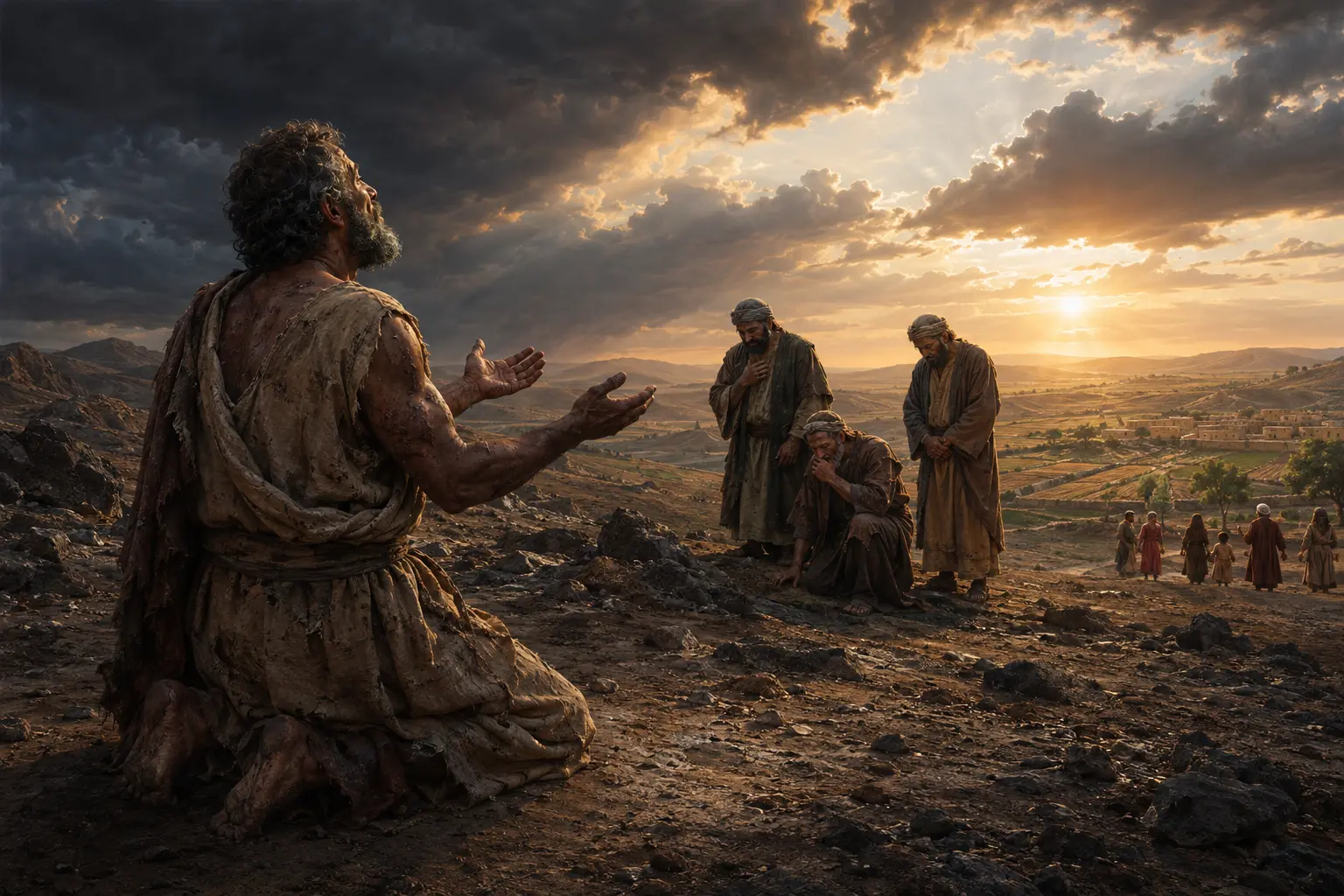
Elihu lifts Job’s eyes above the ash heap to the clouds and asks a piercing question: Does human righteousness enrich God, or does it bless the neighbor beneath the same sky?
01
1. Introduction: When Faith Asks, “What Is the Profit?”
There are questions that rise from curiosity.
There are questions that rise from rebellion.
And there are questions that rise from pain so deep that even faith begins to tremble.
Job 35 listens to one of those painful questions: What is the profit of righteousness? If a person prays, obeys, gives bread to the hungry, keeps clean hands, refuses evil, and still ends up in ashes, what difference has righteousness made? If the wicked can prosper and the righteous can bleed, why choose the narrow path at all?
Elihu hears this question in Job’s speeches. He believes Job has gone too far. In Elihu’s reading, Job has not merely defended his innocence; Job has spoken as though his righteousness is greater than God’s. Job has not merely asked why he suffers; Job has implied that avoiding sin brings no real gain [Job 35:2–3].
So Elihu answers.
His answer is short, sharp, and theologically rich. He tells Job to look up at the heavens and behold the clouds high above him [Job 35:5]. God is not like a human patron who becomes richer when servants obey or poorer when they rebel. Human sin does not damage God as though the Almighty were fragile. Human righteousness does not add wealth to God as though heaven needed our coins [Job 35:6–7].
Instead, human wickedness wounds human beings, and human righteousness benefits human beings [Job 35:8]. The moral life is not a transaction by which we purchase God’s favor. It is the way human beings participate in the order of God’s world for the sake of one another.
Then Elihu turns to unanswered cries. Oppressed people cry out under the arm of the mighty, yet many do not truly seek God their Maker, the One who gives songs in the night and teaches humans more than beasts and birds [Job 35:9–11]. Empty cries, proud cries, cries that want relief without God may go unanswered [Job 35:12–13]. Elihu applies this to Job: if Job says he cannot see God yet keeps waiting for his case, he must beware of empty words and speech without knowledge [Job 35:14–16].
There is truth here. Righteousness is not bargaining. God is not manipulated by our obedience. Prayer is not magic. Suffering can expose whether we want God himself or only the benefits we hoped God would secure.
But there is also danger. Elihu speaks a true word in a way that may not fully honor Job’s actual faith. Job has not been a man who wants gifts without God. Job has been desperate for God, even when God seems hidden. His cry may be anguished, but it is not empty.
So Job 35 stands like a narrow bridge. On one side is a necessary warning against transactional religion. On the other side is a pastoral warning against judging the prayers of the wounded too quickly.
Job 35 teaches us that righteousness is not a wage we demand from God, but a witness we offer under God’s sky for the life of our neighbor.
02
2. Historical and Literary Context: Elihu’s Third Speech
Job 35 is Elihu’s third speech within the larger Elihu section [Job 32–37]. The three friends have fallen silent, Job has completed his final oath, and Elihu has stepped into the space between Job’s appeal and God’s whirlwind.
His speeches move with a developing logic.
In Job 33, Elihu argued that God is not silent in the way Job has claimed. God speaks through dreams, warnings, suffering, and a mediator who rescues from the pit [Job 33:14–30].
In Job 34, Elihu defended God’s justice. God cannot do wickedness. The Almighty cannot pervert what is right. God sees every human path, shows no partiality to princes, and hears the cry of the afflicted [Job 34:10–28].
Now in Job 35, Elihu addresses the question of moral profit. What does righteousness accomplish? Does sin hurt God? Does obedience enrich God? Is the value of holiness measured by what we receive in return?
The chapter has two main parts.
First, Elihu presents what he thinks is Job’s position [Job 35:1–4]. He accuses Job of saying, in effect, “I am more righteous than God,” and of asking, “What profit do I gain by not sinning?”
Second, Elihu responds with a speech about God’s transcendence and sovereign justice [Job 35:5–16]. He tells Job to look upward to the heavens. God is high above human manipulation. Human sin and righteousness affect other people more immediately than they affect God. Then Elihu explains why some cries from oppression may not receive an answer: they cry out because of pain, but they do not truly seek God as Maker, teacher, and giver of songs in the night.
This chapter is brief, but its themes reach deep into the whole book of Job. The satan’s original accusation was that Job served God because righteousness was profitable [Job 1:9–11]. Strip away the blessings, the accuser said, and Job will curse God. Job 35 returns to that question from another angle. Is piety only worthwhile when it pays? Is righteousness still meaningful when no reward is visible?
Elihu’s answer, though incomplete, cuts into the heart of transactional religion. God is not a market. Obedience is not a contract that forces heaven’s hand. Righteousness is good because God is good, and because human beings are called to reflect God’s justice and mercy toward one another.
Yet Elihu’s tone remains severe. He hears Job’s lament as empty and proud. The reader must remember that Job’s suffering is not rooted in hidden rebellion. Job is not a merchant angry that a business deal with God failed. He is a righteous sufferer wrestling with a world that seems morally disordered.
Elihu sees the danger of bargaining with God, but he does not fully see that Job’s deepest hunger is not profit but presence.
03
3. Walking Through the Text: Looking Beyond the Ashes
04
3.1 “Is This Your Right?”: Elihu Challenges Job’s Moral Claim (35:1–2)
Elihu begins directly: “Do you think this to be just? Do you say, ‘My righteousness is more than God’s’?” [Job 35:2].
The accusation is strong. Job has never said those exact words. He has never formally declared himself morally superior to God. Yet Elihu believes this is the implication of Job’s speeches. If Job insists on his own innocence while accusing God of denying him justice, does that not place Job’s righteousness above God’s?
This is where Elihu’s concern is understandable. When sufferers speak from agony, their words can approach dangerous territory. Job has said things about God that tremble at the edge of accusation. He has described God as an enemy, a hunter, a warrior against him, one who has blocked his path and torn him down [Job 16:9–14; 19:8–12]. Elihu hears these words and fears that Job’s moral protest has become moral superiority.
But Elihu’s summary is also risky. Lament often sounds more absolute than it is. A person crying, “God has abandoned me,” may not be making a cold doctrinal claim. They may be describing the terrible weather of the soul. Elihu hears Job’s storm and turns it into a proposition.
This is a lesson in pastoral discernment. We must take words seriously, but we must also understand the form of wounded speech. Lament is not a textbook. It is prayer with blood on it.
When pain speaks wildly, wisdom must correct carefully, not caricature quickly.
05
3.2 “What Do I Gain?”: The Crisis of Transactional Righteousness (35:3–4)
Elihu continues: “For you ask, ‘What advantage have I? How am I better off than if I had sinned?’” [Job 35:3].
This question touches the nerve of the book. The satan’s opening challenge was that Job’s righteousness was profitable. Job feared God because God had placed a hedge around him, blessed his work, and filled his life with abundance [Job 1:9–10]. Remove the profit, the accuser said, and the worship will disappear.
Now Job’s misery raises the same question from the inside. If righteousness has not protected him from disaster, what has it gained?
Elihu says he will answer Job and his friends with him [Job 35:4]. This is important. He believes the issue belongs not only to Job but also to the whole debate. The friends assumed righteousness profits by producing blessing and wickedness harms by producing suffering. Job’s experience has shattered that simple arrangement. Elihu wants to reframe the matter.
The question remains alive for every believer. Do we obey because obedience guarantees comfort? Do we pray because prayer guarantees outcomes? Do we serve because service secures recognition? What happens when faithfulness brings no visible reward, when the field remains dry, when the prayer remains unanswered, when righteousness costs more than it pays?
Job 35 presses us to ask whether we love the God of righteousness or merely the wages we expected righteousness to bring.
Faith matures when obedience stops asking, “What will this buy me?” and begins asking, “What reflects the God I love?”
06
3.3 “Look at the Heavens”: God Is Higher Than Human Bargaining (35:5)
Elihu now lifts Job’s gaze: “Look at the heavens and see; behold the clouds, which are higher than you” [Job 35:5].
This is one of the great gestures in the Elihu speeches. Job has been looking at sores, dust, accusers, lost children, broken status, and divine silence. Elihu says, “Look up.” The clouds become a sermon. The sky stretches beyond human reach. The heavens are not moved by human bargaining. God is higher still.
This upward look anticipates the Lord’s speeches, where God will take Job on a tour of creation: foundations of the earth, sea doors, morning light, snow storehouses, stars, lions, ravens, mountain goats, wild donkeys, ostriches, horses, hawks, Behemoth, and Leviathan [Job 38–41]. Elihu begins to prepare Job for a theology learned from the created world.
But the point here is not simply that God is powerful. It is that God is transcendent. He is not trapped inside human economies of exchange. He is not dependent on us in the way we are dependent on him. He is not bribed by good deeds or injured by sin as though his being could be diminished.
This can feel humbling, even frightening. But it is also liberating. If God were needy, religion would become manipulation. If God could be bought, the rich would own heaven. If God were diminished by human rebellion, evil would threaten the throne. But God remains God—free, full, holy, generous.
The clouds above us preach that God is not a customer in our moral marketplace.
07
3.4 Sin Does Not Wound God as It Wounds People (35:6)
Elihu asks, “If you have sinned, what do you accomplish against him? If your transgressions are multiplied, what do you do to him?” [Job 35:6].
Elihu is not saying sin does not matter to God. Scripture is clear that sin grieves, angers, and offends the holy God. The point is different: sin does not weaken God’s being. It does not subtract from his glory as though God were a fragile lamp flickering in the wind of human rebellion.
Human sin cannot dethrone God. It cannot make the Almighty less almighty. It cannot reduce his holiness or limit his life.
This truth corrects a childish view of God. God is not an insecure ruler whose honor depends on constant human applause. He is not a wounded ego in the sky. He is the living God, full in himself.
Yet sin is still terrible because it violates God’s will and destroys what God loves. It wounds the neighbor, corrupts the self, disorders creation, and despises the good order of the Maker. Sin may not damage God’s essence, but it damages the world under God’s care.
Sin cannot make God less God, but it can make human life less human.
08
3.5 Righteousness Does Not Enrich God as Though He Were Poor (35:7)
Elihu then asks, “If you are righteous, what do you give to him? Or what does he receive from your hand?” [Job 35:7].
Again, the point is not that God is indifferent to righteousness. God delights in justice, mercy, faithfulness, humility, and truth. But our righteousness does not supply a deficiency in God. We do not feed God by our virtue. We do not make God wealthy by obedience.
This echoes a deep biblical theme. God does not need sacrifices because he is hungry [Ps 50:12–13]. He does not dwell in temples made by human hands as though he needed anything [Acts 17:24–25]. He is the giver of life, breath, and all things.
So righteousness cannot be used as leverage. We cannot place our obedience on the table and say, “Now, Lord, You owe me.” We are always recipients before we are servants. Even when we obey, we are returning what grace first gave.
This humbles spiritual pride. The obedient person has no grounds for boasting over God. The faithful servant does not become heaven’s creditor.
Righteousness is not a loan we give to God; it is the fruit of life received from God.
09
3.6 Wickedness and Righteousness Reach the Neighbor (35:8)
Elihu now brings the argument down from the clouds to the street: “Your wickedness concerns a person like yourself, and your righteousness a child of man” [Job 35:8].
This is the ethical heart of the chapter.
Human actions matter horizontally. Wickedness wounds people. Righteousness blesses people. Oppression bends backs. Honesty builds trust. Greed empties tables. Generosity fills them. Lust breaks homes. Faithfulness shelters them. Violence spills blood. Justice guards life.
Elihu is not reducing righteousness to human benefit only. He is reminding Job that the moral life is not primarily a mechanism for extracting reward from God. It is the way human beings live before God in relation to one another.
This connects strongly with Job 31. Job’s oath of innocence was not abstract piety. He spoke of eyes, servants, widows, orphans, strangers, enemies, gold, land, and labor. His righteousness had neighbors in view. Elihu’s point, even if spoken against Job, confirms something Job’s own life had already embodied.
In the New Testament, this truth becomes central in the command to love God and love neighbor [Mark 12:29–31]. We cannot claim devotion to God while despising those made in God’s image [1 John 4:20].
Righteousness rises toward God as worship, but it walks toward the neighbor as love.
10
3.7 The Cry of the Oppressed: Pain That Calls for Help (35:9)
Elihu turns to oppressed people: “Because of the multitude of oppressions people cry out; they call for help because of the arm of the mighty” [Job 35:9].
He acknowledges real injustice. People are crushed by power. The strong use their arm against the weak. The world is not presented as tidy or fair. Cries rise from beneath the weight of oppression.
This is important because Elihu is not naive about evil. He knows there are victims. He knows the mighty can become violent. He knows human beings cry out when power becomes a fist.
But he is interested in why some cries are not answered. That is dangerous ground. Many sufferers have been harmed by explanations for unanswered prayer. Elihu will argue that some cries are cries for relief but not cries for God. They come from pain, but not from humble seeking.
There is truth in this distinction. The cry, “Get me out of this,” is not always the same as, “God my Maker, I seek You.” Desperation can be spiritual awakening, but it can also be self-preservation without surrender.
Still, we must handle this carefully. The Bible also shows God hearing cries before people have perfect theology. Israel groaned in Egypt, and God heard [Exod 2:23–25]. Mercy often comes before maturity.
The cry of pain may be the beginning of prayer, but God desires it to become a seeking of his face.
11
3.8 “Where Is God My Maker?”: The Missing Question (35:10–11)
Elihu says that no one asks, “Where is God my Maker, who gives songs in the night, who teaches us more than the beasts of the earth and makes us wiser than the birds of the heavens?” [Job 35:10–11].
This is the most beautiful moment in the chapter.
God is named as Maker. The sufferer is not an orphan in a meaningless universe. The One who formed humanity is still the One to seek. God is also the giver of songs in the night. Not merely songs after the night. Songs in the night. Praise born not after pain has passed, but while darkness still sits by the bed.
This image does not romanticize suffering. Night remains night. But God can place music where circumstances offer none. He can give a psalm before the dawn. Paul and Silas singing in prison at midnight become a living echo of this truth [Acts 16:25].
God also teaches humans more than beasts and birds. Humanity is endowed with wisdom, reflection, moral discernment, and the capacity to seek God. We are not merely creatures crying from instinct. We can ask, “Where is my Maker?” We can interpret pain, repent, hope, worship, and wait.
Elihu’s critique is that many oppressed people cry out from pain but do not ask this deeper question. They want relief from the mighty, but not necessarily relationship with the Maker.
Again, the truth must be applied humbly. But the invitation is precious: in the night, ask not only “Where is relief?” but “Where is God my Maker?”
The deepest prayer in the night is not only “remove the darkness,” but “give me Yourself until dawn comes.”
12
3.9 Empty Cries and the Silence of God (35:12–13)
Elihu continues: “There they cry out, but he does not answer, because of the pride of evil men” [Job 35:12]. Then he adds, “Surely God does not hear an empty cry, nor does the Almighty regard it” [Job 35:13].
This is one of the hardest parts of the chapter.
Elihu says some prayers are unanswered because they are proud and empty. The Hebrew idea behind “empty” suggests vanity, nothingness, unreality. A cry may be loud but hollow. It may seek rescue without repentance, relief without God, blessing without surrender.
Scripture elsewhere says similar things. The prophets warn that God does not delight in worship divorced from justice [Isa 1:11–17; Amos 5:21–24]. The psalmist says that if he cherishes iniquity in his heart, the Lord would not listen [Ps 66:18]. James says some ask and do not receive because they ask wrongly, to spend it on passions [Jas 4:3].
Yet we must not turn this into a cruel rule: “If God has not answered, your prayer must be empty.” Job’s story forbids that. Job’s cries have not received the answer he wants, but they are not empty. They are filled with anguish, faith, confusion, protest, and longing for God.
The silence of God can have many meanings. It may expose pride. It may deepen trust. It may conceal purposes beyond our knowledge. It may create space for an answer that arrives in a form we did not expect.
Some cries are empty, but not every unanswered cry is empty.
13
3.10 Job’s Waiting Before the Hidden God (35:14)
Elihu now applies his argument to Job: “How much less when you say that you do not see him, that the case is before him, and you are waiting for him” [Job 35:14].
This line reaches back to Job’s longing in chapter 23. Job looked forward, backward, left, and right, but could not perceive God [Job 23:8–9]. Yet he still believed his case was before God. He was waiting, even if trembling.
Elihu thinks Job’s waiting is flawed because Job’s complaint is flawed. If God does not answer empty cries, how much less will he answer someone who claims not to see him while accusing him of injustice?
But here Elihu misreads something precious. Job’s waiting is not unbelief only. It is faith under eclipse. He cannot see God, but he has not stopped addressing God. He cannot understand God, but he has not abandoned the court of heaven. His waiting is painful, but it is still waiting before God.
There are believers who live here. They cannot see God clearly. They cannot trace his hand. Yet they keep the case before him. They keep praying, even if the prayer sounds like groaning. They keep waiting, even if waiting feels like standing in fog.
Faith sometimes looks like singing in the night; sometimes it looks like waiting when no song will come.
14
3.11 Elihu’s Final Charge: Words Without Knowledge (35:15–16)
The chapter closes with Elihu’s sharp conclusion. He says that because God’s anger does not seem to punish and because God seems to pay little attention to wickedness, Job opens his mouth in empty talk and multiplies words without knowledge [Job 35:15–16].
This anticipates the Lord’s later question: “Who is this that darkens counsel by words without knowledge?” [Job 38:2]. Elihu sees Job’s speech as excessive, empty, and uninformed.
Again, Elihu is partly right. Job does not know the heavenly scene from chapters 1–2. He does not know the full architecture of God’s wisdom. His speeches contain claims that must be humbled before the Creator.
But Elihu is also too quick to reduce Job’s words to emptiness. Job’s words have carried lament, truth, courage, and moral protest. He has spoken from limited knowledge, but not from a hollow heart.
The chapter ends unresolved. Elihu has warned Job against treating righteousness as profit and prayer as a demand. He has called him to look upward, beyond the immediate return of obedience. But Job remains silent, waiting for the only voice that can finally answer.
Human words may be without full knowledge, but God hears the ache beneath what even our words cannot hold.
15
4. Theological Reflection: Beyond Transactional Faith
16
4.1 God Is Transcendent, Not Transactional
Elihu’s upward gesture is essential: look at the heavens, behold the clouds. God is higher than human bargaining [Job 35:5].
This does not mean God is distant in the sense of uncaring. It means God is free. He is not controlled by religious performance. He is not obligated by our obedience as though righteousness were a receipt and blessing were the purchased item.
Transactional religion says, “I did this; therefore God must do that.” Biblical faith says, “God is good; therefore I will trust and obey even when I cannot manage outcomes.”
This is the battlefield of Job. The satan suggested that Job’s faith was transactional. Job’s continued struggle, grief, and refusal to curse God prove that faith can be deeper than profit.
17
4.2 Human Righteousness Matters Horizontally
Elihu’s claim that wickedness and righteousness affect other humans [Job 35:8] is a needed corrective to privatized spirituality.
We may ask, “What does my sin do to God?” Elihu answers, “Look also at what it does to your neighbor.” We may ask, “What does my righteousness give to God?” Elihu answers, “Look also at what it gives to the person beside you.”
Holiness is never merely private. A righteous life becomes bread, shelter, honesty, safety, justice, patience, and mercy in the world. Sin becomes betrayal, violence, neglect, corruption, and harm.
God does not need our righteousness to complete himself, but our neighbor may need our righteousness to survive.
18
4.3 Prayer Must Seek God, Not Only Relief
Elihu’s critique of empty cries is severe, but it raises a vital question. In distress, do we seek God or only escape? Do we want the Maker, or only the removal of pain?
Biblical prayer includes requests for relief. The Psalms are full of them. Jesus himself teaches us to ask for daily bread and deliverance from evil [Matt 6:11–13]. But prayer becomes distorted when God is treated merely as a tool for relief.
The deepest prayer asks, “Where is God my Maker?” It seeks the face of the Giver, not only the gifts of his hand.
19
4.4 God Gives Songs in the Night
This phrase is a jewel in Elihu’s speech. God gives songs in the night [Job 35:10]. He gives worship where circumstances seem to forbid it. He gives courage in prison, hope in grief, and melody beneath tears.
This does not mean every night will feel musical. Sometimes the song is only a sigh. Sometimes it is silence held before God. Sometimes it is the borrowed song of the church when our own voice fails.
But the promise remains: God is able to give a song before morning comes.
The night is not lord. God is Maker even there.
20
4.5 Christ Frees Righteousness from Bargaining
Jesus exposes and heals transactional religion. He teaches us to give without seeking applause, pray without performance, fast without display, and love enemies without expecting return [Matt 6:1–18; Luke 6:35]. Righteousness becomes participation in the Father’s generous character, not a strategy for securing status.
At the cross, Jesus embodies perfect righteousness without immediate visible profit. He obeys unto death. He is mocked, stripped, pierced, and abandoned. If righteousness were judged by short-term reward, the cross would look like failure.
But resurrection reveals the truth. Faithful love is not wasted. Obedience is not empty. God vindicates righteousness, but not always on the timetable of visible profit.
In Christ, righteousness stops bargaining and becomes self-giving love.
The cross is the place where righteousness loses everything and yet becomes the seed of new creation.
21
5. Life Application: Serving God When It Does Not Seem to Pay
Job 35 speaks directly to the hidden places of our motives.
Many believers begin with a quiet assumption: if I do right, life should go right. If I pray, doors should open. If I give, I should receive. If I serve, I should be honored. If I avoid sin, I should be protected from sorrow.
But life often breaks that equation.
The righteous can be ignored. The generous can be betrayed. The prayerful can suffer. The faithful can bury children, lose work, endure illness, or sit in silence.
When that happens, Job 35 asks: Will righteousness still be worth doing when it does not seem profitable?
A mature answer sounds like this: Yes, because God is worthy. Yes, because my neighbor matters. Yes, because goodness is not wasted even when it is not rewarded immediately. Yes, because Jesus walked the path of costly righteousness before me.
This chapter also invites us to examine our prayers. Are we asking only for relief, or are we asking for God? Are we crying from pain only, or seeking the Maker who can give songs in the night?
A practical exercise for this chapter:
This week, choose one act of righteousness that offers no obvious return. Serve someone who cannot repay you. Pray without announcing it. Give quietly. Tell the truth when it costs you. Forgive without being celebrated. Then pray: “Lord, free my obedience from bargaining. Let my righteousness become love.”
Also, in a dark moment, ask the question Elihu says people forget: “Where is God my Maker?” Sit with that question. Let it become prayer before it becomes explanation.
The soul grows strong when it learns to obey without bargaining and to seek God without reducing him to relief.
22
6. Reflection Questions
1. Why does Elihu accuse Job of asking whether righteousness has any profit?
2. How does Job 35 challenge transactional views of faith and obedience?
3. What does Elihu mean when he says human sin and righteousness affect other people?
4. Why is the question “Where is God my Maker?” important in seasons of oppression or pain?
5. What might “songs in the night” look like in real life, especially when suffering has not yet ended?
6. How can we distinguish between an empty cry for relief and a humble cry for God?
7. In what ways does Jesus free us from obeying God merely for visible reward?
23
7. Response Prayer
God our Maker, High above the clouds, nearer than our breath, teach us to seek You for who You are, not only for what we hope to receive.
Free us from bargaining faith. Free us from obedience that keeps accounts. Free us from prayers that want relief but not Your face.
Make our righteousness a gift to our neighbor, our justice a shelter for the weak, our mercy a song in somebody else’s night.
When we suffer and cannot see You, teach us to wait without despair. When our prayers feel unanswered, search our hearts without crushing us. When night surrounds us, give us songs only You can give.
Lead us to Jesus, who obeyed without bargaining, loved without repayment, suffered without sin, and rose as the promise that faithful love is never wasted.
Amen.
24
8. Window into the Next Chapter: When Elihu Ranges Far for Knowledge
Job 35 asked whether righteousness profits and whether cries in pain truly seek God. Elihu lifted Job’s eyes to the clouds and reminded him that God is not manipulated by human virtue, yet human righteousness deeply matters for the neighbor.
In Job 36, Elihu will ask Job to bear with him a little longer. He will claim to fetch knowledge from afar and ascribe righteousness to his Maker [Job 36:2–3]. His speech will return to God’s justice, but with a stronger focus on God’s disciplinary ways. God is mighty, yet he does not despise. He preserves the righteous, opens ears through affliction, and warns people not to turn toward evil because of suffering.
Then Elihu’s words will begin to move toward the storm.
Clouds will gather.
Thunder will roll.
The God who gives songs in the night will soon speak out of the whirlwind.
25
9. Bibliography
Alter, Robert. The Wisdom Books: Job, Proverbs, and Ecclesiastes: A Translation with Commentary. New York: W. W. Norton, 2010.
BibleProject. The Book of Job Guide. BibleProject, accessed 2026.
Clines, David J. A. Job 21–37. Word Biblical Commentary 18A. Nashville: Thomas Nelson, 2006.
Hartley, John E. The Book of Job. New International Commentary on the Old Testament. Grand Rapids: Eerdmans, 1988.
Walton, John H., and Tremper Longman III. How to Read Job. Downers Grove: IVP Academic, 2015.

Be the first to leave a comment.