

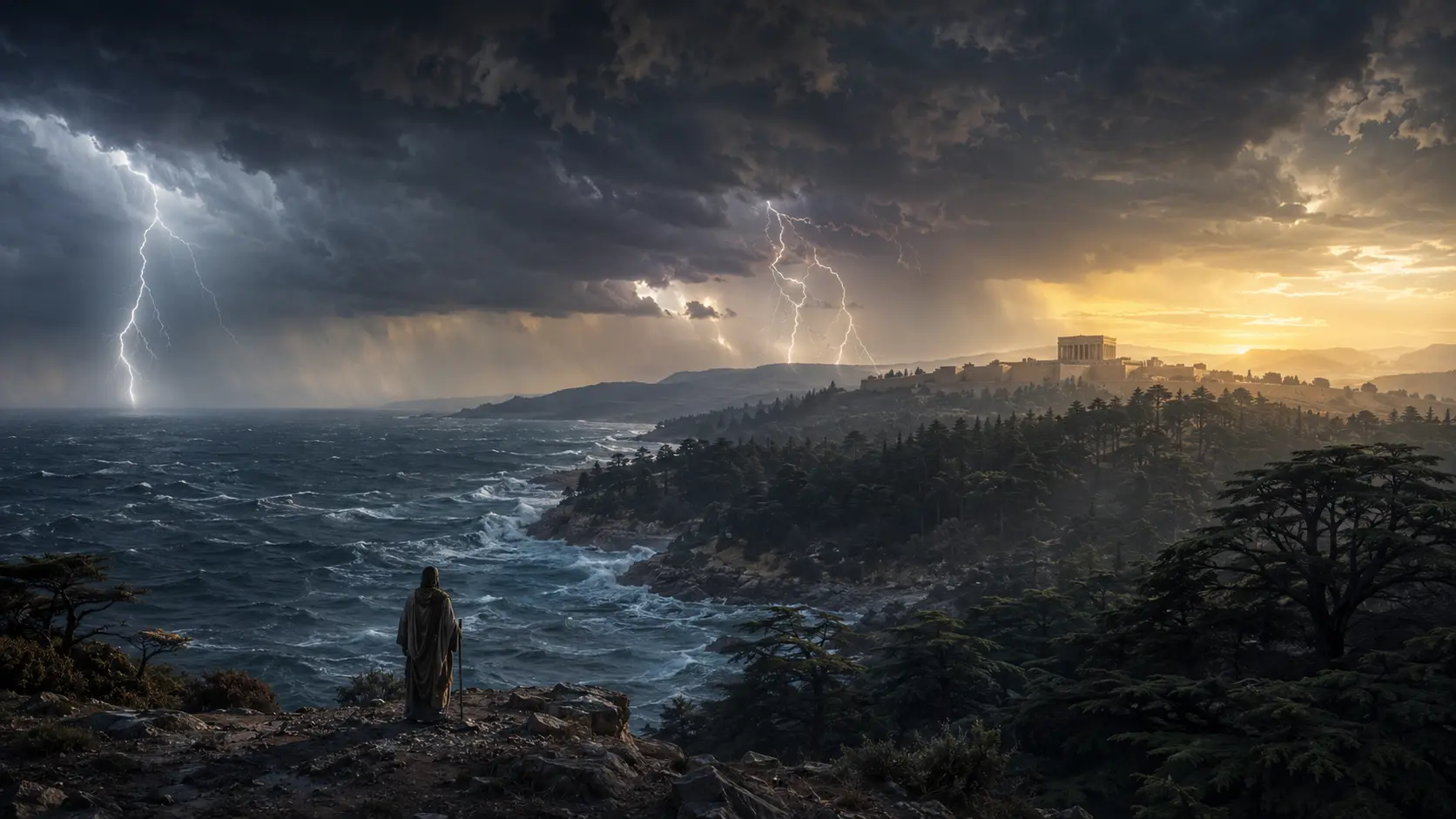
Psalm 28 feared that heaven might remain silent. Psalm 29 hears the answer roll across the waters. Forests tremble and wilderness shakes, yet the last word over God’s people is peace.
01
1.0 Introduction: What Do We Do with Power We Cannot Control?
A storm can remind us that we are not in charge. Thunder shakes walls, wind strips branches, and human plans suddenly look small. Political upheaval, illness, violence, and other forces can do the same. Fear grows when power appears to have no master.
Psalm 29 does not make the storm smaller; it makes God larger. The poem begins in heaven, follows thunder across the land, and ends with Yahweh enthroned and his people receiving strength and peace. Repeatedly, “the voice of Yahweh” turns thunder into testimony. Creation becomes a witness: even what terrifies us exists beneath Yahweh’s kingship.
This text is about overwhelming power becoming worship, because biblical faith does not deny the forces that shake the world; it relocates them beneath the voice, throne, and peace of Yahweh.
Psalm 28 asked the Rock not to remain silent. Psalm 29 answers with a liturgy: heaven bows, creation trembles, the heavenly court cries “Glory,” and the King turns strength toward blessing.
02
2.0 Historical and Literary Context: A Storm in a World of Rival Powers
Psalm 29 is a Davidic hymn. BibleProject places it inside Psalms 25–34, where David’s deliverance becomes a paradigm for Israel’s redemption. After Psalms 26–28 focus on David’s longing for Yahweh’s presence and rescue, Psalm 29 widens the camera to heaven, sea, mountains, forests, wilderness, animals, and the divine council. The God who hears one person’s prayer is King of the cosmos.
Goldingay describes a stepped structure: heavenly beings are summoned to acknowledge Yahweh’s honor and strength (vv. 1–2); Yahweh asserts sovereignty over the waters (vv. 3–4); his voice shakes the world (vv. 5–9b); the heavenly court recognizes his reign (vv. 9c–10); and the poem ends by turning divine strength toward Yahweh’s people (v. 11). The divine name appears eighteen times, giving the poem its pounding rhythm.
The language resembles ancient Canaanite storm poetry associated with Baal/Hadad, though Goldingay cautions that direct borrowing cannot be proved. The poem’s present confession is clear: rival powers stand beneath Yahweh.
Kidner calls Psalm 29 “The King above the storm.” He traces the storm from the sea through Lebanon and Sirion in the north to Kadesh in the south, then notes the serene ending: nature is in uproar, but God’s people receive peace.
03
3.0 Walking Through the Text
04
3.1 Psalm 29:1–2 — When Heaven Is Told Where Glory Belongs
The opening addresses “heavenly beings,” literally “sons of gods.” Yahweh is not one deity among equals; every heavenly power is summoned to acknowledge the unmatched King.
Three times they are told to give Yahweh glory and strength. Goldingay sees more than polite recognition: creatures must surrender the illusion that honor or strength is self-originating. Worship relocates glory to its source.
Then they bow before Yahweh in holy splendor. Kidner notes that worship joins understanding and will: we name God’s greatness and take the posture of servants.
05
3.2 Psalm 29:3–4 — When the Voice Sounds over the Waters
“The voice of Yahweh” moves over the waters. Thunder becomes the poem’s central metaphor for divine speech. The waters are mighty, evoking biblical forces that can feel untamed and threatening.
The language reaches toward creation, where God orders the waters, and the exodus, where the sea cannot prevent liberation. Goldingay says the storm echoes Yahweh’s sovereignty at the Beginning. Psalm 28 feared divine silence; Psalm 29 insists that chaos, however loud, has not gained the throne.
06
3.3 Psalm 29:5–9b — When the Storm Crosses the Land
The voice breaks Lebanon’s cedars, makes Lebanon and Sirion leap, flashes like fire, shakes Kadesh, convulses living creatures, and strips forests bare. The geography stretches from north to south. Yahweh’s authority is not local or tribal.
Goldingay sees a pattern—trees, animals, wilderness, animals, trees. Humanity is almost absent. Like Job 38–40, the poem remembers that creation is larger than human usefulness and belongs first to God.
Verse 9 has a textual difficulty: the traditional reading pictures deer convulsing; some translations read “oaks.” Either way, the world trembles, and the next line pictures forests stripped bare.
Goldingay warns against treating the storm automatically as punishment. Psalm 29 celebrates sovereignty, not a formula for explaining disasters. We should not tell sufferers that every cyclone, flood, drought, or earthquake reveals a specific sin.
07
3.4 Psalm 29:9c–10 — When the Temple Answers, “Glory!”
At the storm’s height, everyone in Yahweh’s palace says, “Glory!” Kidner allows the earthly sanctuary to remain in view; Goldingay emphasizes the heavenly palace. Either way, worship interprets the storm by recognizing the King.
Yahweh sits enthroned “over the flood.” Kidner notes that this Hebrew word is otherwise used for Noah’s Flood in Genesis 6–11. Even over waters unleashed in judgment, Yahweh is not swept away; he sits as King forever.
The throne is the interpretive center. Waters roar, cedars fall, wilderness shakes—but nothing dethrones Yahweh. The world may be unstable without the King becoming unstable.
08
3.5 Psalm 29:11 — When Strength Becomes Peace
The final verse is startlingly gentle: Yahweh gives strength to his people and blesses them with peace. The psalm does not end with broken trees. It ends with shalom.
This closes the circle. Verse 1 ascribed strength to Yahweh; verse 11 turns that strength toward the community. Divine power becomes endurance, protection, wholeness, and peace.
Kidner compares the closing peace to a rainbow over the psalm. The King who rules forces beyond us can sustain his people within them.
09
4.0 Theological Reflection
10
4.1 Yahweh’s Kingship Relativizes Every Rival Power
Psalm 29 exposes every rival claim—divine, political, economic, technological, or military. No created power is ultimate; even heavenly beings bow.
11
4.2 Creation Is Witness, Not a Machine for Religious Control
The storm witnesses to God’s majesty, but the psalm does not teach believers to command weather or decode disasters. Reverence should produce humility, care, and prayer—not manipulation.
12
4.3 Divine Strength Aims at Shalom
The voice that shakes wilderness gives strength to the people. Biblical peace is life ordered under righteous kingship, not divine weakness.
13
4.4 Worship Names Reality before Circumstances Feel Safe
The cry “Glory!” comes while the storm still fills the poem. Worship is not postponed until every branch stops moving. It is the act of naming the throne correctly while the world still shakes.
14
5.0 Canonical and Christological Horizon
Psalm 29 belongs to the Bible’s theology of God over the waters. Genesis 1 places the deep beneath God’s ordering word; Exodus 15 celebrates Yahweh’s kingship after the sea cannot stop rescue; Sinai joins thunder, fire, holiness, and covenant presence. The prophets also use storm imagery for Yahweh’s coming.
The Gospels do not quote Psalm 29 when Jesus calms the storm, so we should not claim a direct citation. Yet Mark 4:35–41 places Jesus in a biblical pattern where wind and sea obey a word. The scene naturally resonates with Israel’s confession that Yahweh rules the waters; in the Gospel story, that authority is revealed through Israel’s Messiah.
Revelation 4–5 gives another echo: heavenly beings surround the throne and ascribe glory and power to God and the Lamb. Creation is reordered around the throne.
Jesus also clarifies divine strength: his kingship moves through service, cross, resurrection, and peacemaking. The King above the storm is known in the crucified and risen Lord who forms a people of peace.
15
6.0 Life Application
1. Name the forces you cannot control without granting them the throne. Fear can be honest without becoming worship.
2. Audit where you ascribe glory. Money, governments, leaders, technology, success, and spiritual personalities are never ultimate powers.
3. Do not interpret every disaster as God’s punishment. Respond with compassion, practical help, wise preparation, and prayer before offering explanations Scripture has not given.
4. Let creation teach humility. Receive storms, mountains, forests, and seas as reminders that the world belongs to God, and care responsibly for it.
5. Use strength to create peace. In homes, churches, workplaces, and leadership, let authority protect the vulnerable rather than magnify control.
6. Practice worship before the storm is over. Gather, pray, sing, and speak truth together even when circumstances have not yet become quiet.
7. Become a carrier of shalom. Ask where your words, money, influence, or presence can reduce fear and help another person stand.
16
7.0 Reflection Questions
1. What power in my life has become so large that I have begun to treat it as ultimate?
2. Where am I tempted to invent spiritual explanations for suffering instead of serving the sufferer?
3. What would it mean for my worship to include both awe before God’s power and humility before his holiness?
4. How am I using the strength or authority entrusted to me: to dominate, impress, or create peace?
5. What storm is still active around me, and what would it look like to say “Glory” without pretending the danger is unreal?
17
8.0 Response Prayer
Yahweh, King above the waters, when the world is louder than my faith, teach me where glory belongs. Break my allegiance to powers I have feared, envied, or worshiped. Give me humility before creation and compassion toward those struck by disaster. Keep me from calling every storm a judgment when you have not spoken. Let your voice reorder my heart, your strength steady my feet, and your holiness cleanse the way I use power. While the branches still move, teach your people to worship. And when the thunder passes, make us carriers of your shalom. Through Jesus the crucified and risen King, amen.
18
9.0 Window into What Comes Next
Psalm 29 ends with the King giving strength and peace. Psalm 30 brings that confidence into a single life: mourning turns toward dancing, and the God enthroned above the storm lifts one person from the pit. Thunder has become liturgy; next, rescue becomes song.
19
10.0 Bibliography
BibleProject. The Book of Psalms: Study Notes. Portland, OR: BibleProject.
Goldingay, John. Psalms, Volume 1: Psalms 1–41. Baker Commentary on the Old Testament Wisdom and Psalms. Grand Rapids: Baker Academic, 2006.
Kidner, Derek. Psalms 1–72. Kidner Classic Commentaries. Downers Grove, IL: IVP Academic, 2008.
Wright, N. T. How God Became King: The Forgotten Story of the Gospels. New York: HarperOne, 2012.
Be the first to leave a comment.