

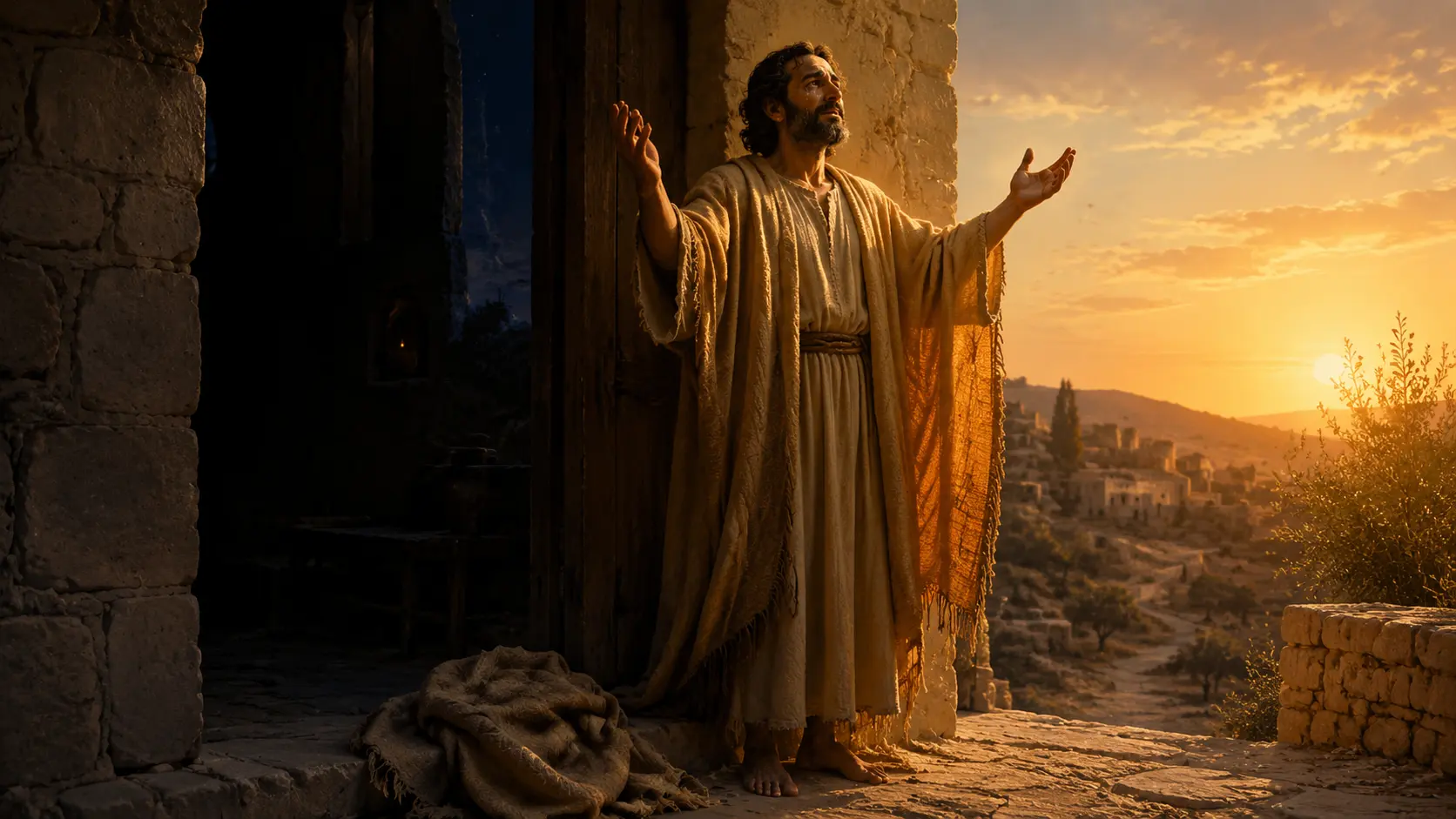
Night may enter carrying tears like luggage. Morning does not deny that the visitor came. Psalm 30 watches God loosen the cords of sackcloth and dress a rescued life for praise.
01
1.0 Introduction: What Do We Do after the Night Has Passed?
Some prayers are spoken while the wound is open. Others come after danger loosens its grip, when a person can finally ask, “What happened, and what does it reveal about God?” Psalm 30 belongs to that second moment. The worshiper cried, was healed, and was brought up from near the Pit. Now rescue becomes testimony.
Yet this is chastened joy. Life had felt stable; then Yahweh hid his face, and the speaker was terrified. He learned that flourishing is gift, not possession.
This text is about mourning becoming testimony, because biblical thanksgiving does not erase the night; it tells how God met the worshiper there and turns rescued life into public praise.
The controlling image is clothing. Sackcloth gives way to joy. Grace does not deny the mourning garment; it changes what the rescued person can now wear and sing.
02
2.0 Historical and Literary Context: A Dedication Song Built from Personal Rescue
Psalm 30 is attributed to David and titled “A song for the dedication of the house.” Kidner notes that the “house” could be God’s or David’s own; without the heading, the poem sounds like thanksgiving after life-threatening sickness or injury. Goldingay therefore reads it primarily as individual testimony later reused in communal dedications, including in Jewish tradition at Hanukkah.
BibleProject places Psalm 30 within Psalms 25–34, where David’s individual sufferings and deliverances become a paradigm for Israel’s redemption. The “I” teaches the “we” how to remember God.
Goldingay notices links with Psalm 6—healing, terror, remembrance, and the fear that death will silence praise. Psalm 30 almost sounds like Psalm 6 after an answer. It also follows Psalm 29 naturally: the King above the storm now lifts one worshiper from the Pit.
Kidner sees two outbursts of praise surrounding verses 6–10. Goldingay hears a testimony told twice—distress, prayer, deliverance, praise—because some rescues are too important to tell only once.
03
3.0 Walking Through the Text
04
3.1 Psalm 30:1–3 — When God Pulls a Life Up from the Well
“I will exalt you, Yahweh, for you have lifted me up.” The verb can picture drawing a bucket from a well. Kidner emphasizes the vivid upward movement. Verse 3 deepens it into Sheol and the Pit. Death had come close enough to shadow the story.
Goldingay notices that Yahweh increasingly becomes the subject: you did not let enemies rejoice, you healed, you brought me up, you preserved or restored life. Testimony begins with “I,” but its grammar gradually hands the story to God.
“Healed me” may refer to sickness or injury, yet the poem leaves the condition open. That gives pastoral breadth without making one rescue a promise that every crisis ends in physical healing. Rescue re-centers the singer on Yahweh rather than the opponents.
05
3.2 Psalm 30:4–5 — When Weeping Becomes an Overnight Guest
Testimony opens outward: “Sing to Yahweh, you his faithful ones.” One deliverance reveals the God the community shares.
Then comes the famous contrast: anger is “for a moment,” favor for life; weeping may lodge for the night, but joy comes in the morning. Kidner notes that “lodge” pictures weeping as an overnight visitor. Goldingay hears tears lying down at evening while morning rises with a shout.
This poetry must not become a deadline for sufferers. Some nights last months, years, or a lifetime. Psalm 30 speaks from the far side of one rescue. It does not promise happiness by sunrise; it declares that grief is not the final ruler of God’s covenant story. Morning gives the night a limit within God’s larger purpose.
06
3.3 Psalm 30:6–7 — When a Strong Mountain Suddenly Shakes
“When I was secure, I said, ‘I will never be shaken.’” Kidner hears a warning about prosperity and careless confidence: ease can whisper that stability is permanent. Goldingay resists calling the speaker obviously self-reliant, because verse 7 says Yahweh’s favor had made the mountain strong.
Both readings expose a danger: a gift can come from God and still become a guarantee in our imagination. Health, ministry, income, family, reputation, or influence can feel permanent simply because they have lasted.
Then comes the reversal: “You hid your face, and I was dismayed.” God’s hidden face names blessing and protection becoming inaccessible. Yet the psalm gives no detailed confession explaining why. We should not tell sufferers that illness or collapse automatically proves punishment. The shaking mountain reveals how dependent security always was.
07
3.4 Psalm 30:8–10 — When Prayer Argues from the Edge of Dust
The testimony quotes the old prayer. The worshiper called to Yahweh and pleaded for grace: “What profit is there in my death? Will the dust praise you? Will it proclaim your faithfulness?”
This is desperate covenant reasoning. Kidner says the argument begins with God’s interests: what glory will God receive if this voice is silenced? Yet argument soon yields to dependence: “Hear, Yahweh, and be gracious to me; Yahweh, be my helper.”
Faith may reason with God and name what seems at stake, but prayer finally rests on grace, not rhetorical skill: “Be gracious to me.”
The speaker wants embodied life in which God can be confessed among the living. Later Scripture deepens hope beyond Sheol, but Psalm 30 first values life as a place of worship and witness.
08
3.5 Psalm 30:11–12 — When God Unties the Sackcloth
The answer is pictured as a change of clothing: “You turned my mourning into dancing; you removed my sackcloth and clothed me with joy.” Goldingay imagines God personally loosening the mourning garment and dressing the worshiper for celebration. Kidner hears the exuberant spirit of David dancing before Yahweh.
Mourning and dancing are bodily, public practices. Restoration returns the worshiper to communal life; the mouth that feared silence now sings.
Verse 12 gives the purpose: rescue becomes witness, not self-congratulation. The psalm closes with enduring gratitude growing out of remembered terror. The night has not been edited out of memory; it has been given a new ending.
09
4.0 Theological Reflection
10
4.1 Thanksgiving Is Testimony, Not Religious Amnesia
Psalm 30 remembers Pit, terror, sackcloth, and tears. Praise is credible because it tells the truth about the night; suffering need not be minimized to magnify God.
11
4.2 Stability Is Gift, Not Ownership
The “strong mountain” stands by God’s favor. Security is good but not self-sustaining. Gratitude receives stable seasons without worshiping them.
12
4.3 God’s Favor Has a Larger Horizon than Grief
Verse 5 gives grief a boundary, not a timetable. For Christians that horizon reaches resurrection and new creation, where death loses the final word.
13
4.4 Rescue Creates Responsibility to Praise
The worshiper is not restored merely to resume private life. The community sings, and the rescued person becomes a witness. Grace produces memory, humility, worship, and testimony.
14
5.0 Canonical and Christological Horizon: From Morning Joy to Resurrection Morning
Psalm 30 belongs to a biblical pattern of life from death-like places. Hannah sings that Yahweh brings down to Sheol and raises up (1 Sam. 2:6); the exodus turns bondage into song; Ezekiel 37 imagines a dead community receiving breath.
No New Testament writer identifies Psalm 30 as a direct prediction of Jesus, so the connection should not be forced. Yet its movement from threatened death to praise fits the story that climaxes in Jesus’ death and resurrection. Resurrection morning does not deny crucifixion; it reveals that death’s verdict was not final.
Jesus tells his disciples that sorrow will turn to joy (John 16:20–22), and resurrection embodies that promise. Paul places affliction within a larger “weight of glory” (2 Cor. 4:17). Christian praise can remember wounds without surrendering to them.
Revelation 21:4 completes the horizon: God wipes away real tears because death is gone. Psalm 30’s changed clothing anticipates mourning finally displaced by life in God’s presence.
15
6.0 Life Application
1. Tell the rescue story accurately. Name what happened, what you feared, what help came, and what remains unresolved.
2. Let joy remember the night. Do not shame people who still tremble; gratitude and vulnerability can coexist.
3. Audit your “strong mountain.” Which gift—health, money, ministry, family, status—has begun to feel immovable?
4. Pray when God seems hidden. Hiddenness is a reason to call, not to stop praying.
5. Do not weaponize “joy comes in the morning.” Sit with long-night sufferers and offer presence, practical help, and patient hope.
6. Make restoration communal. Let healing, provision, reconciliation, or renewed strength widen into generosity.
7. Wear joy as vocation. Let restored life make God’s faithfulness visible to others.
16
7.0 Reflection Questions
1. What “night” can I now describe more truthfully than while I was inside it?
2. Which stable gift has become a guarantee in my imagination?
3. When God seems hidden, do I withdraw or bring my fear to him?
4. Have I used Psalm 30:5 to hurry grief? What would patient hope look like?
5. How can I tell my rescue story so that God, not I, becomes central?
17
8.0 Response Prayer
Yahweh my God, you know the nights I would forget and the securities I would control. When I mistake gifts for guarantees, teach me humility. When your face seems hidden, keep my prayer alive. Be gracious to those whose night is long; guard us from easy promises. Where you bring healing, let gratitude become testimony. Untie the sackcloth when the time comes and clothe us with joy that remembers mercy. Through Jesus, the crucified and risen Lord, make our lives witnesses that mourning does not have the final word. Amen.
18
9.0 Window into What Comes Next
Psalm 30 ends dancing, but one answered prayer does not end all trouble. Psalm 31 returns to pressure, grief, and refuge. Its prayer, “Into your hand I commit my spirit,” later reaches Jesus’ lips at the cross. Psalm 30 teaches testimony after rescue; Psalm 31 teaches trust when another crisis arrives. The morning song becomes strength for the next night.
19
10.0 Bibliography
BibleProject. The Book of Psalms: Study Notes. Portland, OR: BibleProject.
Goldingay, John. Psalms, Volume 1: Psalms 1–41. Baker Commentary on the Old Testament Wisdom and Psalms. Grand Rapids: Baker Academic, 2006.
Kidner, Derek. Psalms 1–72. Kidner Classic Commentaries. Downers Grove, IL: IVP Academic, 2008.
Wright, N. T. Surprised by Hope: Rethinking Heaven, the Resurrection, and the Mission of the Church. New York: HarperOne, 2008.

Be the first to leave a comment.