


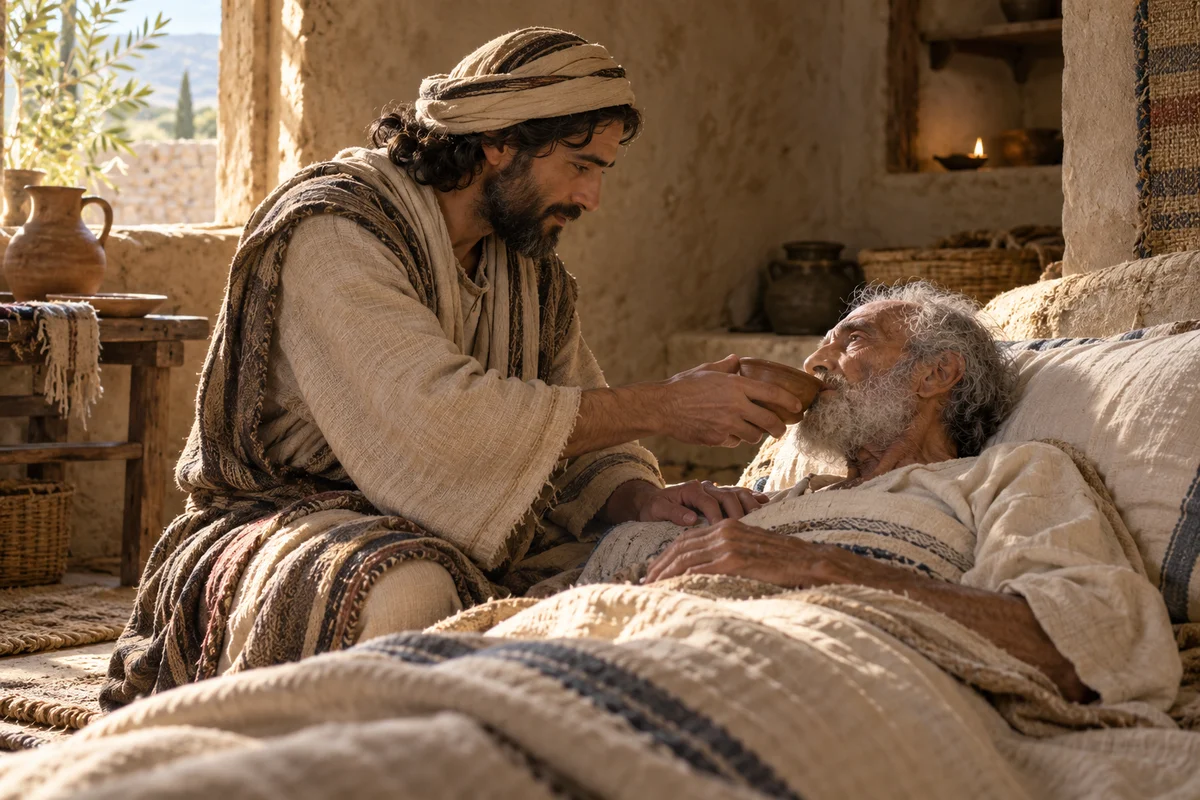
The prayer rises toward the holy room, afraid that silence will sound like the grave. Then the Rock answers: strength becomes song, and rescue becomes shepherding.
01
1.0 Introduction: What If God’s Silence Feels Like the Edge of the Grave?
Psalm 27 ended with the command to wait for Yahweh. Psalm 28 begins from inside that waiting: “To you, Yahweh, I call.” The speaker has not abandoned faith, but neither has he turned waiting into spiritual numbness. He calls, lifts empty hands toward the sanctuary, asks for justice, and fears what divine silence might mean.
Yahweh is “my rock,” yet the worshiper pleads that the Rock not be deaf. The question is not whether God exists, but whether the God who has been refuge will act before the worshiper is swept toward the Pit. Silence feels dangerous because a God who does not answer would leave the sufferer looking no different from those going down to death.
This text is about feared silence becoming communal shepherding, because answered prayer does not end with private relief; it turns the rescued worshiper toward justice, praise, and the care of God’s whole people.
The psalm moves from plea to protest, assurance, song, and intercession, teaching us to let rescue widen into prayer for God’s people.
02
2.0 Historical and Literary Context: David’s Cry inside a Larger Story of Redemption
Psalm 28 is a Davidic prayer combining petition, judgment, thanksgiving, and corporate intercession. Goldingay notes that it reverses Psalm 27’s profile: Psalm 27 begins with confidence and later pleads; Psalm 28 begins with plea and then moves into praise. Kidner calls it “The suppliant answered.”
BibleProject places Psalms 25–34 in a frame where David’s individual deliverance becomes a paradigm for Israel’s redemption. Psalms 26–28 especially emphasize desire for God’s temple presence. Thus the “I” of verses 1–7 naturally widens into “your people” in verse 9.
Verses 1–2 ask God to hear. Verses 3–5 ask him to distinguish the worshiper from violent hypocrites and judge justly. Verses 6–7 celebrate that the plea has been heard. Verse 8 speaks of Yahweh as strength and deliverance for his anointed, and verse 9 closes with prayer for the covenant community. The movement is from threatened isolation to covenant belonging.
03
3.0 Walking Through the Text
04
3.1 Psalm 28:1–2 — When Empty Hands Reach toward the Holy Place
“To you, Yahweh, I call.” Prayer begins not with technique but with address. The worshiper names Yahweh “my rock,” a metaphor of stability and refuge, then asks him not to be silent.
Goldingay observes that “do not be deaf” and “do not keep silence” intensify the same fear. If God does not answer, the speaker will become “like those who go down to the Pit.” Kidner stresses the fear of death under undeserved disgrace, as though the righteous and the violent belonged to the same moral story.
Verse 2 gives prayer a bodily posture. The worshiper lifts hands toward Yahweh’s “holy room,” the innermost sanctuary. Empty hands become the language of dependence: I cannot manufacture the answer; I can only ask and receive. The sanctuary represents divine presence, while the lifted hands confess need.
05
3.2 Psalm 28:3–5 — When Peaceful Words Hide Violent Hearts
The prayer turns toward injustice: “Do not drag me away with the wicked.” The wicked “speak peace” to neighbors while evil is in their hearts. Their mouths offer shalom while their inward plans manufacture harm.
Then comes the difficult prayer: “Give to them according to their deeds.” Goldingay pictures their evil almost as labor receiving its wages; Kidner insists that this is not mere vindictiveness but the protest of a healthy conscience against a world where wrongdoing cannot have the last word.
The worshiper asks God to judge rather than taking vengeance personally.
Verse 5 reaches beneath their actions: they do not consider “the works of Yahweh” or “the work of his hands.” They are absorbed in their own works and ignore both God’s moral pattern and his judgment. What they build through deceit will not finally stand.
06
3.3 Psalm 28:6–7 — When the Cry Is Heard before the Battle Is Finished
Suddenly the grammar changes: “Blessed be Yahweh, for he has heard the voice of my pleas for mercy.” The circumstances of the answer are not described; the psalm emphasizes what being heard does to the worshiper.
“Yahweh is my strength and my shield; in him my heart trusts.” Strength is capacity; shield is protection. The heart that feared silence now rests in God. Goldingay notes that the emphasis falls not mainly on how intensely one trusts but on whom one trusts: “in him.”
“My heart exults, and with my song I give thanks.” Prayer becomes praise without pretending the earlier fear was unreal. The song is born from the cry.
07
3.4 Psalm 28:8–9 — When Private Rescue Becomes a Shepherd’s Prayer
Verse 8 widens the horizon: Yahweh is strength and saving refuge “for his anointed.” The word enters Israel’s royal world. Kidner notes that David is more than a private citizen; as the Lord’s anointed, his life is bound to the people.
Then the psalm moves fully into the plural: “Save your people and bless your inheritance; shepherd them and carry them forever.” The rescued worshiper turns outward.
Goldingay connects these verbs with the exodus and wilderness: God saves, blesses, claims a people as his possession, shepherds them, and carries them. Rescue is not merely extraction from one crisis; it is sustained covenant care. The psalm began with one person fearing silence and ends with prayer for God to carry a whole people through time.
08
4.0 Theological Reflection
09
4.1 God’s Silence May Be Felt without Becoming the Final Verdict
Psalm 28 legitimizes the fear, “What if God does not answer?” but refuses to make that fear the last theological word. Faith can speak from perceived silence without concluding that silence reveals God’s true character.
10
4.2 Justice Is Part of Love, Not Its Opposite
A world where peaceful words conceal predatory hearts needs judgment. Forgiveness must not become indifference to victims. The psalm desires accountability while leaving final recompense with God.
11
4.3 Answered Prayer Creates Worship, Not Self-Importance
The speaker does not celebrate spiritual skill; he blesses Yahweh. Grace moves the center away from the rescued person toward the Rescuer.
12
4.4 Covenant Rescue Is Meant to Become Shepherding
Verse 9 is the climax. The person who receives help becomes an intercessor. The desired future is not only dramatic rescue but ongoing blessing, shepherding, and carrying.
13
5.0 Canonical and Christological Horizon: From the Exodus Shepherd to the Anointed Shepherd-King
Psalm 28 gathers Israel’s foundational memories. Exodus 15 celebrates Yahweh as strength, song, and salvation after the sea. Exodus 19:4 remembers God carrying Israel “on eagles’ wings.” Later Scripture portrays Yahweh as Shepherd who gathers, feeds, and carries the flock (Isa. 40:11; Ezek. 34).
The justice prayer also belongs to the larger canon. Jesus’ persistent widow cries for justice until the judge acts, and Jesus assures his hearers that God hears those who cry to him (Luke 18:1–8). The New Testament commands enemy-love while insisting that vengeance belongs to God (Rom. 12:19). Mercy does not require pretending exploitation is harmless.
Psalm 28 is not a detailed prediction of Jesus, but “the anointed” and the shepherd imagery create a natural messianic horizon. Jesus is confessed as Messiah—Anointed One—and calls himself the good shepherd who gives his life for the sheep (John 10:11).
At the cross, the faithful King enters the apparent silence of death; resurrection is God’s public answer that the Pit does not have final authority. The risen Shepherd forms a people of faithful witness, justice, forgiveness, prayer, and protection of the vulnerable.
14
6.0 Life Application
1. Bring God the fear beneath your polished prayer. If silence feels like abandonment, say so without pretending mature faith never trembles.
2. Lift empty hands. Ask for help from God and trustworthy people instead of hiding need behind competence.
3. Refuse false peace. Do not use kind language to conceal manipulation, resentment, exploitation, or plans that harm another person.
4. Seek justice without becoming vengeance. Report abuse, establish boundaries, use lawful accountability, protect the vulnerable, and leave ultimate judgment with God.
5. Study God’s works before trusting your own. Ask whether your plans resemble God’s justice, mercy, truth, and faithfulness—or merely magnify the work of your hands.
6. Turn answered prayer into testimony. Let gratitude become communal courage rather than private nostalgia.
7. Let rescue widen your prayers. After asking, “Help me,” learn to pray, “Save your people … shepherd them and carry them.”
15
7.0 Reflection Questions
1. Where does God’s apparent silence tempt me to make a final conclusion about his character?
2. Where do my words say “peace” while my heart is planning something less loving?
3. What injustice must I name clearly without taking vengeance into my own hands?
4. How has an answered prayer equipped me to strengthen or protect someone else?
5. What would it look like this week to participate in God’s shepherding care?
16
8.0 Response Prayer
Yahweh, my Rock, do not let silence become the only sound I hear. Receive the empty hands I lift toward you. Separate me from deceit, especially what I excuse in myself. Bring hidden violence into the light, protect the vulnerable, and judge with wisdom cleaner than my anger. Be my strength and shield until fear becomes song. Then do not let your answer end with me: save your people, bless your inheritance, shepherd the weary, carry the weak, and teach us to become signs of your faithful care. Through Jesus the risen Shepherd-King, amen.
17
9.0 Window into What Comes Next
Psalm 28 fears that Yahweh may remain silent. Psalm 29 answers with thunder. The voice of Yahweh rolls over the waters, breaks cedars, shakes the wilderness, and finally gives strength and peace to his people. The worshiper who begged the Rock to speak is about to hear a storm become God’s voice.
18
10.0 Bibliography
BibleProject. The Book of Psalms: Study Notes. Portland, OR: BibleProject.
Goldingay, John. Psalms, Volume 1: Psalms 1–41. Baker Commentary on the Old Testament Wisdom and Psalms. Grand Rapids: Baker Academic, 2006.
Kidner, Derek. Psalms 1–72. Kidner Classic Commentaries. Downers Grove, IL: IVP Academic, 2008.
Wright, N. T. How God Became King: The Forgotten Story of the Gospels. New York: HarperOne, 2012.

Be the first to leave a comment.