

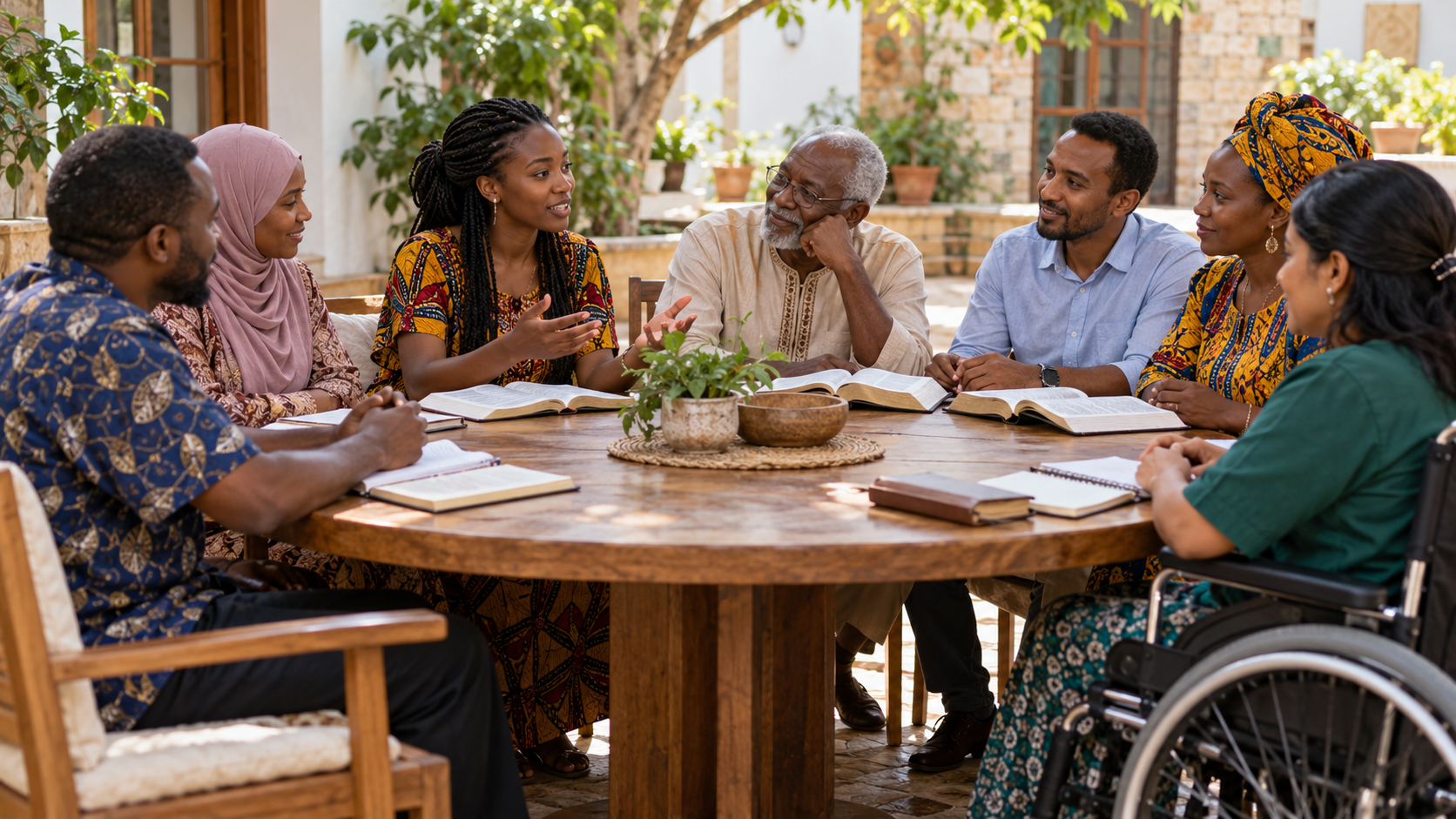
Are we inviting people to become one in Christ, or quietly requiring everyone to resemble the group with the strongest voice?
Primary Scriptures and translation
Primary Scriptures: Ephesians 2:11–22; 4:1–16; 1 Corinthians 12:12–27; Acts 6:1–7
Supporting Scriptures: Galatians 2:11–14; Revelation 7:9–17
Introduction: One Table, Unequal Seats
Consider this fictional example. A city church committee meets to plan its youth ministry. Everyone has been invited. Yet the conversation is filled with specialized language, two younger participants are never asked for their views, and a woman who travels from an outlying community cannot follow some of the instructions. At the end, the chairperson celebrates the group's unity. But only those confident enough to speak have actually shaped the agreement. The others were merely present.
The same pattern appears in classrooms, businesses and households. We like the image of a shared table, but do we let everyone contribute? Differences of language, age, experience or ability can enrich us—or expose neglected patterns of exclusion.
Having considered truthful peacemaking in the preceding article, we now face another question: how can people belong without hiding everything that makes them different? Christian unity does not turn every voice into an echo. It teaches different people to live as one family under the lordship of Jesus.
Listening to Scripture in Its Setting
Ephesians 2 addresses Gentiles welcomed into God's covenant family alongside Jews. Their histories and hostility were real. Through Christ's cross, both have access to the Father by one Spirit (2:11–22). Paul pictures a new household and temple with Christ as cornerstone, not one group absorbing the other.
In Ephesians 4, Paul moves from this shared identity to a shared way of life. There is one Lord and one body, while Christ gives different gifts so that believers can be equipped for service and mature in truth and love (4:1–16). Unity and diversity belong together.
First Corinthians 12 addresses a divided congregation tempted to rank spiritual gifts and people by importance. Paul's picture of the body challenges any member who believes another is unnecessary. Acts 6:1–7 adds an uncomfortable but practical episode: Greek-speaking Jewish believers complain that their widows are being overlooked in daily food distribution. The apostles do not dismiss the concern as disloyalty. They involve the community in organizing a response.
These texts first concern the church. Other institutions can learn from their principles of dignity and fair participation without claiming to embody God's kingdom.
Christ Is the Center; Our Culture Is Not the Standard for Everyone
In Ephesians 2:14–18, Paul does not begin by asking Gentiles to adopt every Jewish cultural practice. He begins with Christ, who reconciles both groups to God. The cross breaks down hostility and creates a new fellowship. Therefore, a church should not mistake the language of its largest group, its favored worship style, or its particular history for the only faithful expression of following Jesus.
Not every teaching is equally valid. Scripture tests doctrine and distinguishes gospel foundations from preferences. Yet what we learned first is not automatically a divine command.
Sinek's Golden Circle asks WHY a community exists. For the church, Christ's call—not a dominant group's ambitions—supplies the answer. HOW names truthful relationships; WHAT, the work itself. This Christian application is ours, not Sinek's theology.
For example, a Bible class with several language groups can explain unfamiliar terminology, leave room for questions and arrange interpretation where possible. An accent should never become a reason to humiliate a learner.
Examine yourself: Am I testing faithfulness to Christ, or simply measuring how much people resemble me?
Different Gifts Are Contributions, Not Rankings of Human Worth
In 1 Corinthians 12:12–27, Paul uses the human body to show why one member cannot dismiss another. In Ephesians 4:7–16, different gifts help the whole community grow. A leader is not the entire body. A leader serves by helping others do their part.
Maxwell's The 5 Levels of Leadership emphasizes developing people and leaders. This challenges leaders who hoard responsibility. Yet people are not talent reserves for our projects. Their worth does not depend on productivity; children, elders, disabled people and those needing care belong in Christ's body.
Imagine a ministry team that applauds the preacher with the microphone but barely notices those who welcome newcomers, care for children, maintain facilities or sit with grieving families. Distributing recognition, training opportunities and resources more fairly makes a statement about whose contribution matters.
In a workplace, a comparable application is to respect staff whose work happens behind the scenes. This is an ethical application, not a claim that every employee's function is a spiritual gift.
Examine yourself: Whose essential work do we depend on while overlooking the person doing it?
Unity That Pursues Justice Listens to the Margins
Acts 6 is not a portrait of a flawless congregation. Growth exposed a distribution problem that affected some widows. Differences of language and social connection had consequences for daily food. The complaint required a response. The leaders clarified responsibilities, engaged the congregation, and created a more reliable structure for service.
Equality means little when systems exclude some. At Antioch, Paul challenged Peter's withdrawal from shared meals because it contradicted the gospel's fellowship (Galatians 2:11–14).
A school might review whether students with disabilities can enter learning spaces and take part. A church might examine whether new members, lower-income families and young people are heard when decisions affect them. A business might ask whether junior employees can raise concerns without retaliation.
Abuse or serious discrimination demands safeguarding, proper investigation and lawful reporting. Unity never justifies forced reconciliation. Forgiveness, reconciliation, trust and return to leadership are distinct.
Examine yourself: When we say everyone is welcome, who still carries a burden others cannot see?
Create Conversations in Which Truth Can Travel Both Ways
Ephesians 4:1–3 connects humility, patience and love with preserving the unity given by the Spirit. Verses 15–16 add truthfulness and the contribution of each member. Unity does not mature by shutting down difficult conversations. It deepens when people learn to speak without contempt and listen without immediately defending themselves.
Sinek's work on trust helps us ask whether people can question leaders. But comfort is not enough: claims need examination, whistleblowers need protection, and leaders need accountability.
At home, parents can hear teenagers' needs without shifting adult responsibility onto them. A church chair can invite quiet voices, rotate speaking opportunities, and accept private feedback. Never force sensitive disclosures in public.
Christian unity can sustain genuine disagreement about methods while maintaining firm boundaries around truthful teaching, justice and safety. People are not required to think alike in every respect before they can work together.
Examine yourself: Which question might someone be afraid to ask in my presence, and what have I done to create that fear?
Let Differences Serve the Mission Rather Than Competing Groups
Paul presents gifts as means by which the church grows toward maturity in Christ (Ephesians 4:11–16). The point is not for every department to advertise its importance. People are being equipped to live out the gospel. N. T. Wright, reflecting on Ephesians, describes the church as a community called to model new creation in the Spirit's power. Applying that insight here, the way people of different backgrounds work together should bear witness to Jesus as Lord.
In East Africa, young adults may bring digital skills, elders mediation experience, and different generations insights into neighborhood needs. Instead of competing for recognition, they can visit isolated patients or support children's learning together.
Participation must remain voluntary and respect time and rest. Outside the church, diverse skills may serve education or fair business, but these goals are not identical to the church's mission.
Examine yourself: Are our differences helping us bless neighbors, or simply giving us new reasons to compete?
See Unity Through the Promise of New Creation
Revelation 7:9–17 portrays worshipers before God and the Lamb from different nations, peoples and languages. This is a vision of hope, not an administrative blueprint. Yet it offers a horizon: the final worship of God is centered on the Lamb without treating human histories and languages as meaningless.
Christian hope holds already and not yet together. Jesus' resurrection inaugurates new creation, yet hostility still needs repair. The church is not God's completed kingdom; growth statistics and unity events prove little by themselves. The Spirit transforms us; policies support accountability but cannot replace grace.
Ask whether former rivals can serve together, critics are heard, and neighbors benefit. These assess our witness; they do not earn God's acceptance.
Examine yourself: If we were to offer one small sign of God's promised future this week, which dividing wall would we begin to remove?
A Difficult Question: Doesn't Respecting Differences Mean Letting Everyone Do Whatever They Want?
No. Christian unity does not mean that every claim, behavior or doctrine is acceptable. Ephesians 4 speaks of a shared faith, maturity in truth and resistance to deception. The church can uphold doctrinal and ethical boundaries while listening seriously to those who ask honest questions. Leaders must distinguish reasonable differences in culture or practice from conduct that harms others.
Decisions still have to be made. Explain reasons, address unfairness, allow review, and respect dissenters. Unity means commitment to truth, love and Christ's mission—not agreement on everything.
Life Application
- Examine your instincts. Name a group whose views you dismiss too quickly. Ask what assumptions you bring before listening.
- Notice who is missing. Review meetings, ministries and decision-making: who is not invited, cannot attend or fears speaking?
- Separate convictions from customs. In the church, clarify essential teaching and ethical standards without elevating a dominant group's preferences to the same level.
- Make participation accessible. Use understandable language, accessible communication and more than one way to offer feedback where feasible.
- Share recognition and resources. Review how time, funds, training and responsibility are distributed; correct demonstrated unfairness.
- Protect those who speak up. Establish appropriate independent routes for reporting abuse or harm. Never use appeals to unity to block fair investigation.
- Combine gifts in service. Choose a concrete community need and invite people with varied experience to respond together, without pressuring anyone to volunteer.
Weekly Exercise: From Shared Seating to Shared Participation
Goal: Identify one barrier to belonging and begin removing it.
- Choose a group or ministry with people of different backgrounds and abilities. Write its shared purpose in one clear sentence.
- Invite voluntary, safe feedback: what helps each person participate, and what gets in the way? Offer a private way to respond.
- Choose one barrier you can address this week, such as unclear language, meeting times, accessibility or unequal speaking opportunities.
- Ask two people with different experiences to propose a change. Agree who will follow it through.
- At week's end, ask those affected whether the change helped. Record lessons without exposing anyone's private information.
Learning partner: Invite someone whose perspective differs from yours to help you notice when you truly listened and when you became defensive. Measure: Do not ask only whether the meeting remained peaceful; ask whether someone previously left at the margins gained a meaningful opportunity to contribute.
Reflection and Discussion Questions
- What hostility stood between Jews and Gentiles in Ephesians 2, and how does Christ change the relationship?
- Why does Paul speak of one body and many gifts in Ephesians 4 and 1 Corinthians 12?
- What does the complaint in Acts 6 teach us about fairness, service and unity?
- How can we distinguish a gospel conviction from a cultural preference?
- Whose contributions attract recognition in our organization, and whose work remains invisible?
- What safeguards allow people to raise concerns without retaliation?
- How could our differences in gifts and experience improve service to the community around us?
- What small barrier to belonging will I take responsibility for removing this coming week?
Conclusion: A Table With Room to Belong
Return to that committee: every chair was occupied, but some voices were absent. A better leader offers a real place, corrects unfair procedures, and points everyone toward Christ.
Jesus does not call his people to abandon their histories or become identical. He calls them to be reconciled to God and one another, to grow in love, and to take part in his mission. When that happens, our small table can become a sign of the coming feast—not because we have reached perfection, but because the Lamb is faithful.
Prayer: Lord Jesus, free us from the pride that treats our ways as the standard for everyone. Teach us to listen, honor different gifts, and protect those overlooked. By your Spirit, shape us into one body that speaks truth in love and brings blessing to the world. Amen.
Bridge: Unity takes shape as people find room to live, grow, and serve. In A Better Leader – From Calling to Becoming a Blessing: Series Conclusion, we gather the lessons of this journey into practical commitments that help us become a blessing to others.
References
- The Holy Bible, New International Version (NIV): Ephesians 2; Ephesians 4; 1 Corinthians 12; Acts 6; Galatians 2; Revelation 7. Biblical passages are paraphrased rather than quoted verbatim.
- N. T. Wright, “Beginning to Think About the New Creation,” N. T. Wright Online. Wright's account of the church modeling new creation informs the argument; the suggested practices are this article's application.
- John C. Maxwell, “The 5 Levels of Leadership,” August 30, 2016. Used for the theme of developing people and leaders, subject to the gospel's understanding of dignity and grace.
- Simon Sinek / The Optimism Company, “The Golden Circle” and “The Circle of Safety”. Used for shared purpose and trust, not as sources of Christian doctrine.


Be the first to leave a comment.