

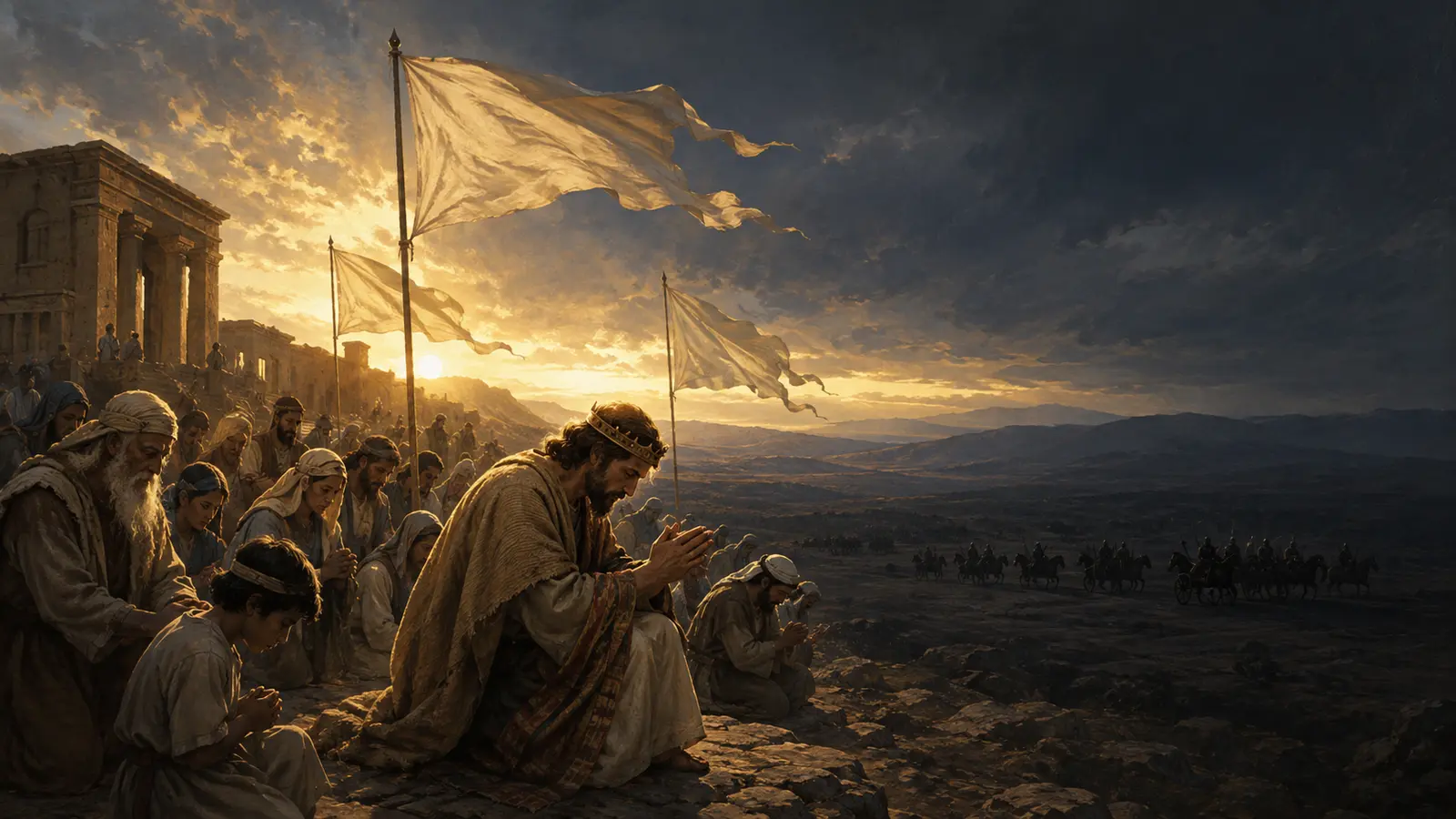
The battle has not begun, but the banners are already lifting. The king has plans, the enemy has horses, and the people have a name. Psalm 20 asks what we reach for when the day narrows around us— and teaches trouble to become a day of calling.
01
1.0 Introduction: What Do We Trust When the Stakes Become Real?
Faith is easiest to describe when nothing urgent is at risk. The sharper question comes when danger approaches and the future seems to depend on resources we can count. In such moments we discover what we actually trust.
Psalm 20 stands on the edge of such a moment. The king is preparing for conflict. Sacrifices have been offered, plans have been formed, and a community gathers around its leader. Yet the poem refuses to let strategy become savior. The people bless the king in Yahweh’s name; the king answers with confidence; and together they confess that some rely on chariots and horses, “but we remember the name of Yahweh our God.”
This text is about trouble becoming covenant confidence, because biblical faith does not deny planning, leadership, or material resources; it refuses to let them occupy the place that belongs to Yahweh alone.
02
2.0 Historical and Literary Context: A Royal Prayer on the Edge of Battle
Psalm 20 is a royal psalm set in what Kidner calls “the day of trouble,” apparently an impending battle, since verse 7 contrasts chariots and horses with Yahweh. The poem moves as a dialogue. Verses 1–5 are spoken by the community, or a representative, to the king. Goldingay emphasizes that these lines function less like direct prayer and more like blessing: “May Yahweh answer you… may he send you help… may he fulfill your plans.” Verse 6 shifts to a singular voice, likely the king: “Now I know.” Verses 7–9 return to the communal “we.” Blessing creates confidence, and confidence returns to prayer.
Within Psalms 15–24, BibleProject places Psalm 20 opposite Psalm 18. Psalm 18 remembers Yahweh’s deliverance of his anointed king; Psalm 20 asks for deliverance again. Psalm 19 stands at the center, showing that the king who seeks victory must first be Torah-shaped. Psalm 21 will celebrate the answer. Psalm 20 is therefore royal dependence placed under Torah and within Yahweh’s covenant purposes.
03
3.0 Walking Through the Text
04
3.1 Psalm 20:1–3 — When the Day of Trouble Is Carried into the Sanctuary
“May Yahweh answer you in the day of trouble; may the name of the God of Jacob protect you.” The king’s crisis is placed inside covenant memory. “The God of Jacob” recalls the God who met an endangered ancestor, heard him, and remained faithful through weakness.
The people ask that help come “from the sanctuary” and strength “from Zion.” Verse 6 will say the answer comes from God’s holy heavens. The point is not that God is confined to a shrine. Zion is the earthly sign of the heavenly King’s presence.
Verse 3 remembers the king’s offerings. Kidner and Goldingay resist reading sacrifice as a device for forcing God’s hand. Worship does not purchase protection; it locates the worshiper before the One from whom protection must come.
05
3.2 Psalm 20:4–5 — When Human Plans Are Placed Beneath Divine Fulfillment
“May he give you the desire of your heart and make all your plans succeed.” This is not a blank check for ambition. The heart making plans is the heart that has come to Zion and sought Yahweh. The psalm blesses plans submitted to God, not plans that recruit God afterward.
Then the people imagine the answer before battle is resolved: “May we shout for joy over your victory and lift up our banners in the name of our God.” Banners are military images, but the decisive phrase is “in the name of our God.” The banner must stand beneath the Name.
Biblical leadership is not as solitary as heroic myths suggest. A community bears its leaders through prayer, blessing, truth, and shared dependence.
06
3.3 Psalm 20:6 — When Blessing Becomes “Now I Know”
The poem suddenly changes voice: “Now I know that Yahweh saves his anointed.” No battlefield report has arrived. Confidence emerges in response to the blessing already spoken.
Goldingay notes the movement from Zion to “his holy heavens.” The help requested from the sanctuary is revealed as the action of the heavenly King. The human king is “his anointed,” but he is not salvation’s source. He is the one who needs saving.
Even the anointed king stands under another King. Authority is derivative. A leader may represent the people but cannot replace God.
07
3.4 Psalm 20:7–8 — When Chariots Become a Test of Worship
“Some trust in chariots and some in horses, but we trust in the name of Yahweh our God.” The ancient chariot represented speed, force, wealth, and military superiority. Deuteronomy 17:16 warned Israel’s king not to multiply horses, while Israel’s foundational memory included Yahweh overthrowing Pharaoh’s chariots at the sea.
The psalm does not claim equipment is evil. It exposes misplaced confidence. Technology becomes idolatrous when capability becomes ultimacy—when what we possess determines what we believe is possible.
“They collapse and fall, but we rise and stand upright.” Appearances are reversed. Those with impressive machinery may fall; those whose strength looks smaller may stand because the decisive actor is Yahweh.
08
3.5 Psalm 20:9 — When the Day of Trouble Becomes the Day We Call
The psalm closes urgently: “Yahweh, save the king! Answer us when we call.” The king is openly named, and the community returns to petition.
Goldingay notices a beautiful transformation. Verse 1 called it “the day of trouble.” Verse 9 speaks of “the day we call.” The circumstance may not yet have changed, but the day has acquired a new name. Trouble becomes prayer-space. Crisis becomes the place where covenant relationship is enacted.
09
4.0 Theological Reflection
10
4.1 Trust Is Revealed by What We Treat as Ultimate
Psalm 20 does not ask whether we have money, expertise, institutions, strategy, or technology. It asks whether we treat them as guarantees. Gifts become idols when we ask them to secure what only God can finally secure.
11
4.2 Blessing and Prayer Form a Community of Courage
The people strengthen the king by declaring God’s faithfulness; the king’s confidence strengthens the people; then all return to prayer. Communities can amplify panic, but they can also teach one another to remember the Name.
12
4.3 Worship Is Dependence, Not Manipulation
Sacrifice, prayer, and sanctuary are not mechanisms for controlling God. They are practices by which dependent people turn toward God. The living God cannot be bribed by religious performance.
13
4.4 God’s Anointed Is Saved Before He Saves
The royal figure carries the people’s hopes, yet he first receives help. Biblical kingship is never self-grounded. The king’s vocation depends on the heavenly King’s rescue and covenant purpose.
14
5.0 Canonical and Christological Horizon: From David’s Battlefield to the Messiah’s Victory
Psalm 20 belongs to Israel’s struggle to trust Yahweh rather than imperial power. The exodus remembers chariots swallowed by the sea. Deuteronomy warns kings against multiplying horses. Isaiah 31 later confronts those who run to Egypt because its horses are many rather than looking to Israel’s Holy One. Within the Psalter, the “anointed” reaches back to Psalm 2 and the Davidic promise. Jesus fulfills that royal hope unexpectedly. He does not establish God’s kingdom through superior chariots. He enters Jerusalem humbly, gives himself into the violence of the powers, and is vindicated through resurrection. The cross reveals messianic victory as faithful love that exposes evil, bears suffering, and defeats death.
It follows the risen King by praying, serving, telling truth, protecting the vulnerable, and refusing to confuse domination with victory. Psalm 20 teaches faithful action without turning our tools into our trust.
15
6.0 Life Application
1. Name your chariots. Identify the resource you instinctively treat as your guarantee—money, education, connections, technology, reputation, position, or control—and consciously place it beneath God.
2. Submit plans before asking God to bless them. Pray while plans are still forming. Let Scripture, wise counsel, and love of neighbor reshape strategy.
3. Bless people carrying heavy responsibility. Strengthen leaders with prayer and truthful encouragement without flattering them or placing them beyond accountability.
4. Refuse transactional worship. Do not treat giving, fasting, prayer, or service as leverage over God. Practice them as surrender and communion.
5. Turn panic into calling. When a “day of trouble” comes, ask what faithful calling looks like: whom to contact, what truth to remember, what action to take, and what prayer to pray.
6. Measure victory by God’s purposes. Ask whether success produces justice, humility, faithfulness, and praise rather than merely impressive results.
7. Stand together. Build relationships in which people pray for one another before the battle, not merely congratulate one another afterward.
16
7.0 Reflection Questions
1. What “chariot” most easily becomes a substitute for trust in God in my life or community?
2. Are my present plans submitted to God, or am I asking him to endorse a decision already made?
3. Who is carrying responsibility that I should strengthen through prayer, encouragement, and wise accountability?
4. How has a recent day of trouble exposed what I believe about security and control?
5. How does Jesus’ cross-shaped kingship challenge my definition of strength, leadership, and victory?
17
8.0 Response Prayer
Yahweh, God of Jacob, answer us in the day of trouble. Send help that our resources cannot manufacture and wisdom our plans cannot produce. Keep us from trusting in the chariots of our age. Receive our work, purify our motives, and teach us to lift every banner beneath your name. Strengthen those who lead, guard the vulnerable, and make our communities places where fear becomes prayer and prayer becomes faithful courage. Through Jesus, your anointed King, teach us to stand. Amen.
18
9.0 Window into What Comes Next
Psalm 20 leaves the banners raised and the prayer hanging over the battlefield. Psalm 21 opens on the other side of the crisis: the king rejoices because Yahweh has answered. The day of calling becomes a day of thanksgiving, and requested victory becomes received gift.
19
10.0 Bibliography
BibleProject. The Book of Psalms: Study Notes. Portland, OR: BibleProject.
Goldingay, John. Psalms, Volume 1: Psalms 1–41. Baker Commentary on the Old Testament Wisdom and Psalms. Grand Rapids: Baker Academic, 2006.
Kidner, Derek. Psalms 1–72. Kidner Classic Commentaries. Downers Grove, IL: IVP Academic, 2008.
Wright, N. T. How God Became King: The Forgotten Story of the Gospels. New York: HarperOne, 2012.
Be the first to leave a comment.