

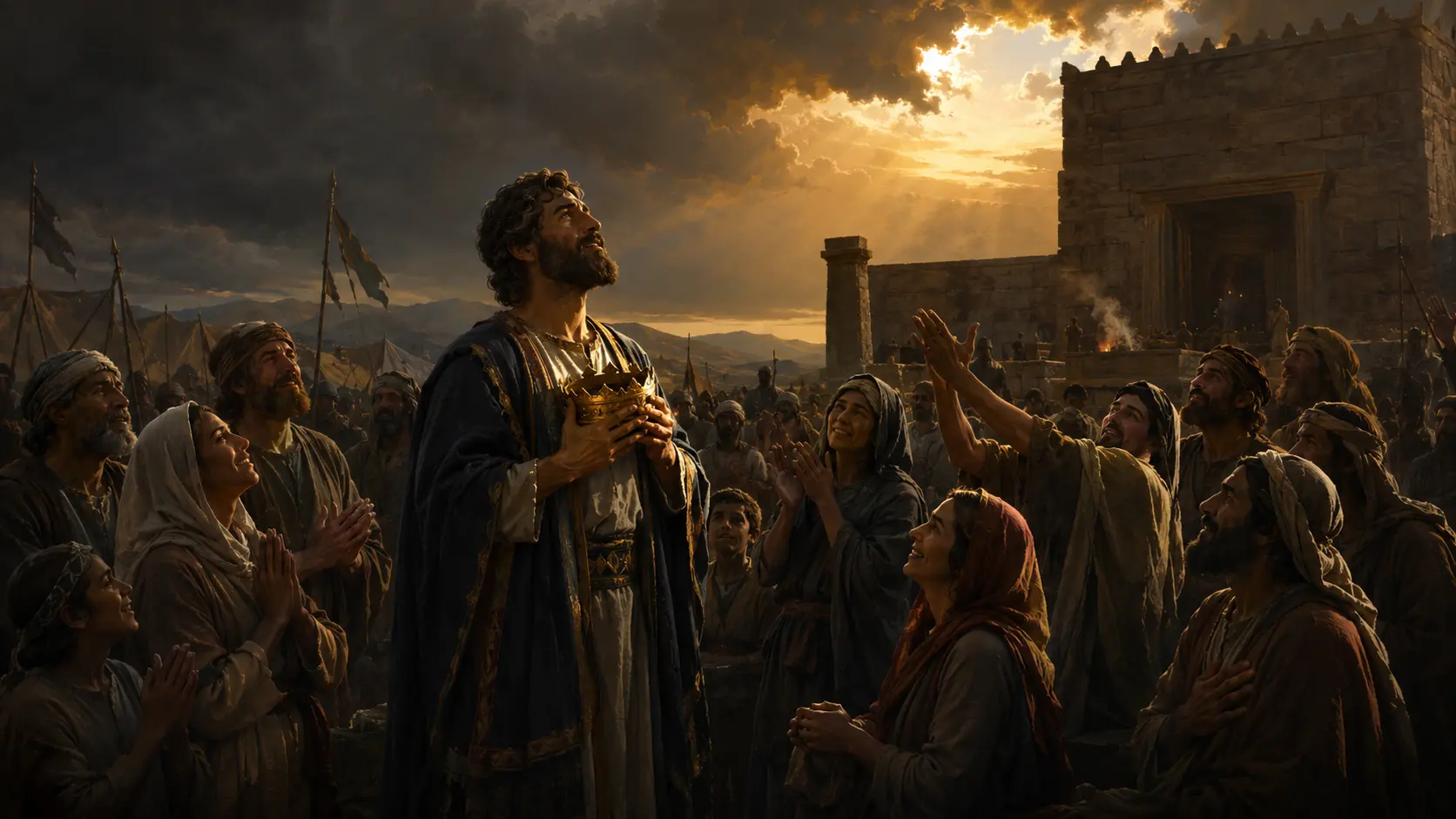
Yesterday the banners rose beneath a threatening sky. Today the king still stands, and the crown shines differently. Psalm 21 teaches victory to remember where it came from— and turns survival into worship before the face of God.
01
1.0 Introduction: What Happens After God Answers?
Many prayers are born in crisis. We know how to ask when danger closes in. The harder spiritual question comes afterward: what becomes of us when the danger passes? Does deliverance become a new way of seeing God, ourselves, and what we have received?
Psalm 21 is the song on the other side of Psalm 20. The previous psalm asked Yahweh to answer and save his anointed. Psalm 21 looks back: “He answered.” The king rejoices, the people remember, and the crown becomes testimony.
This text is about answered prayer becoming covenant-shaped praise, because biblical thanksgiving does more than celebrate escape; it traces life, vocation, joy, and future hope back to the steadfast love of Yahweh.
The psalm also contains severe language about enemies. We should neither erase it nor turn it into permission for religious violence. Read canonically, it points toward God’s defeat of evil, while followers of the crucified Messiah love human enemies and leave final vengeance to God.
02
2.0 Historical and Literary Context: The Answer to Psalm 20
Psalm 21 is a royal thanksgiving psalm. Kidner calls it “the day of rejoicing” and sees Psalms 20 and 21 as petition and answer. Psalm 20 asked that God grant the king according to his heart; Psalm 21 says the desire of his heart has been given. Psalm 20 prayed for salvation; Psalm 21 begins with the king rejoicing in Yahweh’s salvation.
Goldingay notes a balanced design: the king’s joy in verse 1, remembered deliverance in verses 2–7, implications for God’s enemies in verses 8–12, and the people’s praise in verse 13. Past deliverance becomes present trust and future hope.
Within Psalms 15–24, BibleProject places Psalm 21 beside Psalm 20 as answered royal prayer, with Psalm 19 at the center. The victorious king is Torah-shaped and under Yahweh. Psalm 22 then moves from triumph into mortal distress, preventing a theology of uninterrupted success.
03
3.0 Walking Through the Text
04
3.1 Psalm 21:1–2 — When the Answer Becomes Joy
The opening is God-centered: “In your strength the king rejoices.” His joy is not first in army, skill, popularity, crown, or outcome. It is in Yahweh’s strength made visible through deliverance. The language of salvation links directly back to Psalm 20.
Verse 2 remembers the request: God gave the desire of the king’s heart and did not withhold the petition of his lips. This is not a blank check for every private wish. The literary setting is a king praying within covenant vocation during danger. Psalm 20 had already placed his plans before God. Answered prayer here is not desire enthroned; it is desire brought into relationship with Yahweh.
The community remembers heart and lips. Prayer became speech; now the answer becomes worship. Faith learns to ask specifically and remember specifically.
05
3.2 Psalm 21:3–6 — When Rescue Becomes More Than Survival
The king asked for life; God gave length of days. He needed rescue; God met him with blessing and restored royal vocation, crown, honor, splendor, and majesty.
Goldingay emphasizes that Yahweh goes out to meet the king with blessing. Grace takes initiative and exceeds the size of the request. The king asked not to die; the answer became life with purpose.
The crown is not a trophy of self-congratulation. Kidner stresses that its worth lies in the Giver. The king serves beneath the true King.
Verse 6 goes deeper: God makes the king a blessing and gladdens him in the divine presence. The highest gift is not the crown but God’s face. The psalm’s deepest joy is relational before it is royal.
06
3.3 Psalm 21:7 — When Steadfast Love Becomes the Ground beneath the Throne
Verse 7 is the theological hinge: the king trusts in Yahweh, and through the steadfast love of the Most High he will not be shaken. Thrones fall, armies fail, bodies age, and public approval changes. The king’s stability does not come from kingship itself.
It comes from hesed—Yahweh’s covenant commitment. Trust is response to prior faithfulness. Yahweh is both the object of trust and the One whose commitment enables it.
This corrects a misuse of testimony. Answered prayer is not proof of superior faith. Psalm 21 directs attention to the Most High’s steadfast love, on which faith itself rests.
07
3.4 Psalm 21:8–12 — When Victory Opens toward Judgment
The tone sharpens. God’s hand finds his enemies; evil schemes fail; fire consumes opposition. Ancient royal language is severe because kings protected their people from violent enemies.
Verse 11 gives a moral frame: the enemies devise evil. Judgment answers rebellion that destroys life. Yet Christians must not identify personal opponents as God’s enemies and attack them. Jesus commands love of enemies and refuses to establish his kingdom by the sword.
The church can seek justice, protect the vulnerable, and still leave final judgment to God. Psalm 21 offers the oppressed not revenge but confidence that evil is not immortal.
08
3.5 Psalm 21:13 — When the King Steps Aside
The last verse removes the human king from center stage: “Be exalted, Yahweh, in your strength; we will sing and praise your might.” The psalm began with the king rejoicing in God’s strength and ends with the congregation praising that strength directly.
That is the destination of deliverance. Testimony should end not with our importance but with who God has shown himself to be. The crown becomes transparent; through it worshippers see Yahweh.
09
4.0 Theological Reflection
10
4.1 Answered Prayer Is Meant to Form Memory
Psalm 21 refuses spiritual amnesia. The community names what was asked and what was given. Gratitude becomes truthful remembering, especially when new fear tries to rewrite the past.
11
4.2 Grace Gives More Than Bare Survival
The king asks for life and receives vocation, blessing, and joy. Scripture does not promise prosperity on demand, but redemption consistently aims at restored vocation: rescued people are called to become a blessing.
12
4.3 Stable Leadership Requires a Deeper Throne
The king is unshaken because of Yahweh’s hesed, not because his institution is invincible. Healthy authority remains derivative, accountable, grateful, and dependent. When office becomes ownership, crowns become idols.
13
4.4 God’s Kingdom Includes the Defeat of Evil
A gospel with no judgment offers little hope to victims. Psalm 21 insists that destructive evil will not simply be managed forever. Yet the cross reveals that God’s people must not seize his final prerogative for themselves.
14
5.0 Canonical and Christological Horizon: From David’s Crown to the Risen King
Psalm 21 belongs to the Davidic world of 2 Samuel 7, where the royal future rests on God’s covenant faithfulness. Its language of crown, long life, glory, and defeated enemies exceeds any single mortal ruler. Kidner notes that life “forever and ever” becomes fully fitting in the Messiah.
The first level of meaning concerns real kings, dangers, prayers, and deliverances. Yet can any mortal king carry these hopes? Jesus does so by an unexpected road: he enters death and receives indestructible life in resurrection. Crowned with glory and honor, he remains the crucified King whose victory defeats sin and death through self-giving love.
Second Thessalonians 1 echoes Psalm 21’s imagery of divine presence and fiery judgment. Christian hope is not that believers crush personal enemies, but that the risen Jesus sets the world right. Until then, the church loves enemies, resists evil, and trusts God with the final verdict.
15
6.0 Life Application
1. Keep a record of answered prayer. Write what you asked, what happened, and what you learned about God so future fear does not erase past faithfulness.
2. Let rescue become vocation. Ask not only, “What did God bring me out of?” but, “What good am I now free to do for others?”
3. Hold crowns loosely. Titles, influence, money, education, and public honor are entrusted gifts, not proof of personal greatness.
4. Build leadership on covenant character. Measure stability by faithfulness, accountability, justice, and dependence on God rather than applause.
5. Refuse revenge spirituality. Seek justice and protect the vulnerable without baptizing hatred as holy zeal.
6. Seek the Giver above the gift. Continue worship after the crisis, not only prayer during it.
7. Turn testimony into communal courage. Tell your story in a way that strengthens others to trust God rather than making yourself the hero.
16
7.0 Reflection Questions
1. Which answered prayer have I enjoyed without allowing it to deepen gratitude or obedience?
2. What “crown” am I tempted to treat as possession rather than stewardship?
3. Is my confidence resting in God’s steadfast love or in stable-looking circumstances?
4. How can I seek justice against real evil without turning another human being into an object of hatred?
5. What would it mean for my testimony to end with God’s exaltation rather than my importance?
17
8.0 Response Prayer
Yahweh, strong and faithful King, teach us to remember the prayers you have answered and the dangers through which you have carried us. Keep us from wearing your gifts as though we crowned ourselves. Let every blessing become service and every position become stewardship. Root our confidence in your steadfast love. Guard us from hatred while we resist evil, and keep final judgment in your hands. Above every crown, victory, and testimony, be exalted in your strength. Through Jesus, the crucified and risen King, make us glad in your presence and faithful in your kingdom. Amen.
18
9.0 Window into What Comes Next
Psalm 21 ends with a rescued king, a shining crown, and a congregation singing Yahweh’s strength. Psalm 22 opens with a cry from darkness: “My God, my God, why have you forsaken me?” The movement is necessary. The Psalter will not let yesterday’s victory silence tomorrow’s lament. The king who rejoices in Psalm 21 will suffer in Psalm 22, and the meaning of messianic kingship will deepen again.
19
10.0 Bibliography
BibleProject. The Book of Psalms: Study Notes. Portland, OR: BibleProject.
BibleProject. Visual Commentary: Psalm 8—Study Notes. Portland, OR: BibleProject.
Goldingay, John. Psalms, Volume 1: Psalms 1–41. Baker Commentary on the Old Testament Wisdom and Psalms. Grand Rapids: Baker Academic, 2006.
Kidner, Derek. Psalms 1–72. Kidner Classic Commentaries. Downers Grove, IL: IVP Academic, 2008.
Wright, N. T. How God Became King: The Forgotten Story of the Gospels. New York: HarperOne, 2012.
Be the first to leave a comment.