

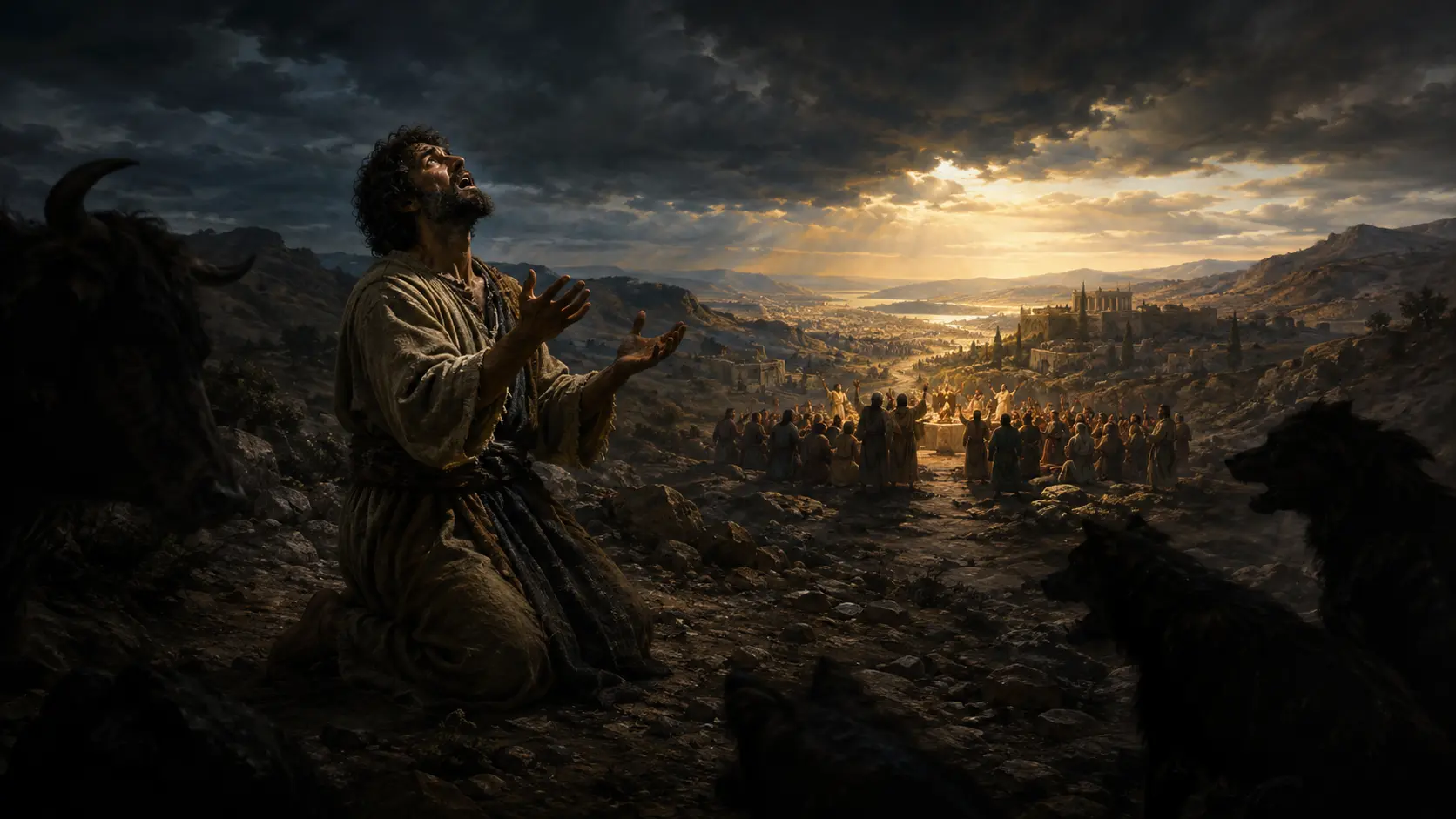
One voice asks why heaven has gone far. Bulls circle, dogs wait, and strength runs dry. Then the cry opens into a congregation, and the ends of the earth are taught to remember.
01
1.0 Introduction: What Do We Do When “My God” and “Forsaken” Occupy the Same Sentence?
Psalm 22 begins with words that seem unable to live together: “My God, my God” and “why have you forsaken me?” Relationship is named twice, yet the God who has been “my God” seems painfully far from where help is needed. The prayer enters one of faith’s hardest rooms: covenant trust when experience contradicts covenant memory.
The psalm does not rush toward cheerfulness. Mockery, bodily collapse, hostile crowds, thirst, and divided garments fill the poem. The worshiper receives language strong enough to carry pain toward God.
This text is about forsakenness becoming worldwide praise, because biblical lament does not solve suffering by denying its darkness; it keeps addressing God until the cry of one afflicted person becomes testimony for the congregation, food for the humble, and hope for generations not yet born.
Psalm 22 refuses two lies: that faithful people never feel abandoned, and that feeling abandoned means faith has ended. The same mouth can still say, “my God.”
02
2.0 Historical and Literary Context: A Lament That Opens into a Worldwide Song
Psalm 22 is a Davidic individual lament ending in expansive praise. Goldingay sees it holding two sets of facts together: the speaker is overwhelmed and apparently unanswered, yet remembers Yahweh’s faithfulness and expects God to hear. Kidner highlights the alternation between “I/me” and “you” sections before praise widens after verse 21.
Within Psalms 15–24, BibleProject places Psalm 22 opposite Psalm 17 as the king’s prayer in mortal distress. Psalm 19 centers the unit on Torah, while Psalms 20–21 portray royal prayer and deliverance. Psalm 22 presses royal trust toward death itself; Psalm 23 follows with the Shepherd who leads through deepest darkness.
At verses 21–22 the poem turns dramatically. Kidner hears “You have answered me!” Goldingay allows that praise may express confidence before visible rescue is complete. Either way, isolation opens toward community and the nations.
03
3.0 Walking Through the Text
04
3.1 Psalm 22:1–5 — When Abandonment Argues with Memory
The opening “Why?” is not mainly a request for explanation. It presses for action: Why are you not helping? Day and night the speaker cries without rest. Yet verse 3 begins, “But you.” Present silence is placed beside God’s holiness and history.
The ancestors trusted and were rescued. Memory can sharpen pain—if God answered them, why not me?—yet it prevents the present crisis from becoming the whole story. The sufferer borrows yesterday’s testimony when today gives little evidence.
Mature lament lets experience speak while memory also testifies.
05
3.2 Psalm 22:6–11 — When Mockery Attacks the Meaning of Trust
The speaker calls himself “a worm and not a man,” language of humiliation, not a doctrine of human worthlessness. Others mock, shake their heads, and turn trust into accusation: if Yahweh delights in him, let Yahweh rescue him.
Suffering is treated as proof of divine rejection. Religion becomes dangerous when it uses another person’s unanswered prayer as evidence against their faith or character.
The psalmist remembers God’s care from birth: Yahweh brought him from the womb and was “my God” from the beginning. The argument is relational: You carried me this far; do not remain far away now. Trouble is near and no human helper is enough.
06
3.3 Psalm 22:12–21 — When Human Violence Becomes a Circle of Beasts
The poem becomes nightmarish: bulls surround, a lion opens its mouth, dogs encircle, and wild oxen threaten. Violence has abandoned neighborliness. Goldingay sees a group closing around one vulnerable person—a pattern recognizable in scapegoating and public shaming.
The body tells the story: the speaker is poured out like water; bones loosen; the heart melts; strength dries; the tongue sticks to the mouth. Psalm 22 will not spiritualize suffering. Fear, exhaustion, thirst, and approaching death are embodied.
Verse 16 contains a textual difficulty concerning the hands and feet. Christian reading should not rest everything on one disputed phrase. The wider pattern is clear: mockery, encirclement, exposure, divided garments, and a sufferer crying to God.
The enemies cast lots for clothing, treating a living person as property. Against that dehumanization the prayer concentrates: “But you, Yahweh, do not be far away.” Save me from sword, dog, lion, and horn. At verse 21 the poem turns toward answer.
07
3.4 Psalm 22:22–31 — When One Answer Creates a Table for the Nations
The sufferer does not disappear into private relief. “I will declare your name to my brothers and sisters; in the congregation I will praise you.” Deliverance becomes testimony for others.
Verse 24 gives the reason for praise: Yahweh has not despised the weak, finally hidden his face, or ignored the cry. The opening hiddenness is not erased; it is answered by the confession that the afflicted person was never contemptible to God.
Worship becomes a meal: the humble eat and are satisfied. The ends of the earth remember Yahweh, families of nations bow because kingship belongs to him, and unborn generations hear what God has done.
The psalm begins by asking why God has not acted and ends with future people hearing that “he has acted.” The cry becomes a choir.
08
4.0 Theological Reflection
09
4.1 Lament Can Hold Contradictory Facts without Lying
Psalm 22 teaches a faith sturdy enough to say both “you have forsaken me” and “you are my God.” Spiritual maturity is not emotional censorship. It brings experience and covenant memory into the same prayer.
10
4.2 Violence Dehumanizes; God Hears the Afflicted
The crowd turns a person into a worm, prey, spectacle, and abandoned property. Yahweh’s answer reverses that verdict: he does not despise the afflicted. God’s justice refuses the contempt on which violence depends.
11
4.3 Deliverance Is Designed to Become Communion
The answer moves from individual rescue to congregation, table, poor, nations, and generations. Biblical testimony is not self-promotion. Grace makes what God has done for me nourishment for others.
12
4.4 Yahweh’s Kingship Is Larger Than the Circle of Enemies
“Kingship belongs to Yahweh.” The crowd may dominate the scene, but it does not own history. God’s reign opens a future beyond it.
13
5.0 Canonical and Christological Horizon: The Psalm Jesus Took onto His Lips
Psalm 22 belongs first to Israel’s prayer book and remains a prayer for afflicted people. Yet the New Testament unmistakably brings it into Jesus’ passion. At the cross Jesus prays its opening words (Mark 15:34; Matt. 27:46). Passersby mock and shake their heads; opponents turn trust in God into a taunt; soldiers divide his garments and cast lots. John 19:24 explicitly connects the clothing scene with Scripture.
These echoes are more than isolated predictions. Jesus inhabits the psalm’s grammar as the faithful Davidic sufferer: rejected by human powers, apparently unanswered, yet still addressing God. Goldingay’s caution against making Jesus the only original referent deepens the reading: Jesus joins Israel’s afflicted rather than canceling them.
Hebrews 2:12 places Psalm 22:22 on the Messiah’s lips: the lonely sufferer now stands in the congregation. Resurrection becomes decisive vindication, turning apparent defeat into testimony carried toward the nations.
In the kingdom horizon emphasized by N. T. Wright, Jesus does not reign by becoming another beast in the circle. He endures violence without surrendering to it and is raised into new creation. Psalm 22’s nations and future generations resonate with the mission of the risen Messiah’s people.
14
6.0 Life Application
1. Pray the sentence you fear to say. If God feels far away, bring that experience to God instead of performing certainty.
2. Borrow faithful memory when your own evidence feels thin. Rehearse Scripture and trustworthy testimony without turning someone else’s rescue into a timetable for yours.
3. Refuse the theology of mockery. Delayed healing, grief, poverty, persecution, or unanswered prayer does not prove that God rejects a sufferer.
4. Name mob dynamics early. When a group turns someone into a joke, label, threat, or spectacle, resist the dehumanizing circle and protect the vulnerable.
5. Care for embodied distress. Prayer belongs beside medical care, trauma support, safeguarding, food, rest, legal protection, and trustworthy community when needed.
6. Turn testimony into a table. Let answered prayer produce generosity, hospitality, shared worship, and practical nourishment rather than spiritual celebrity.
7. Tell the story forward. Let today’s faithfulness give language to children, disciples, and future congregations facing their own night.
15
7.0 Reflection Questions
1. Where do “my God” and “why have you forsaken me?” currently meet in my experience?
2. Whose suffering have I been tempted to interpret as evidence of weak faith or divine rejection?
3. What crowd, institution, family system, or online culture is dehumanizing someone I should help protect?
4. If God answers my present prayer, how could that deliverance become nourishment rather than merely private relief?
5. How does Jesus praying Psalm 22 reshape the way I understand both the cross and my freedom to lament?
16
8.0 Response Prayer
Yahweh, my God, when you feel far away, keep my cry turned toward you. When voices mock, keep me from borrowing their verdict. Remember those surrounded by violence, shame, illness, grief, and loneliness. Break the circle that treats people as prey. Hear the afflicted, and teach your church not to despise their pain. When you bring deliverance, turn it into bread for the humble, praise in the congregation, hope for the nations, and a story our children can carry. Through Jesus, the forsaken and risen King, make our lament faithful and our hope wide. Amen.
17
9.0 Window into What Comes Next: From the Circle of Beasts to the Shepherd’s Path
Psalm 22 ends with the nations hearing that Yahweh has acted. Psalm 23 changes the sound completely: the crowd recedes, and one voice says, “Yahweh is my shepherd.” Yet death has not vanished; a dark valley remains. The next psalm shows divine presence when danger is no longer pictured as beasts surrounding the sufferer but as a Shepherd walking beside the sheep.
18
10.0 Bibliography
BibleProject. The Book of Psalms: Study Notes. Portland, OR: BibleProject.
Goldingay, John. Psalms. Vol. 1, Psalms 1–41. Baker Commentary on the Old Testament Wisdom and Psalms. Grand Rapids: Baker Academic, 2006.
Kidner, Derek. Psalms 1–72. Kidner Classic Commentaries. Downers Grove, IL: InterVarsity Press, 2008.
Wright, N. T. The Day the Revolution Began: Reconsidering the Meaning of Jesus’s Crucifixion. New York: HarperOne, 2016.

Be the first to leave a comment.