

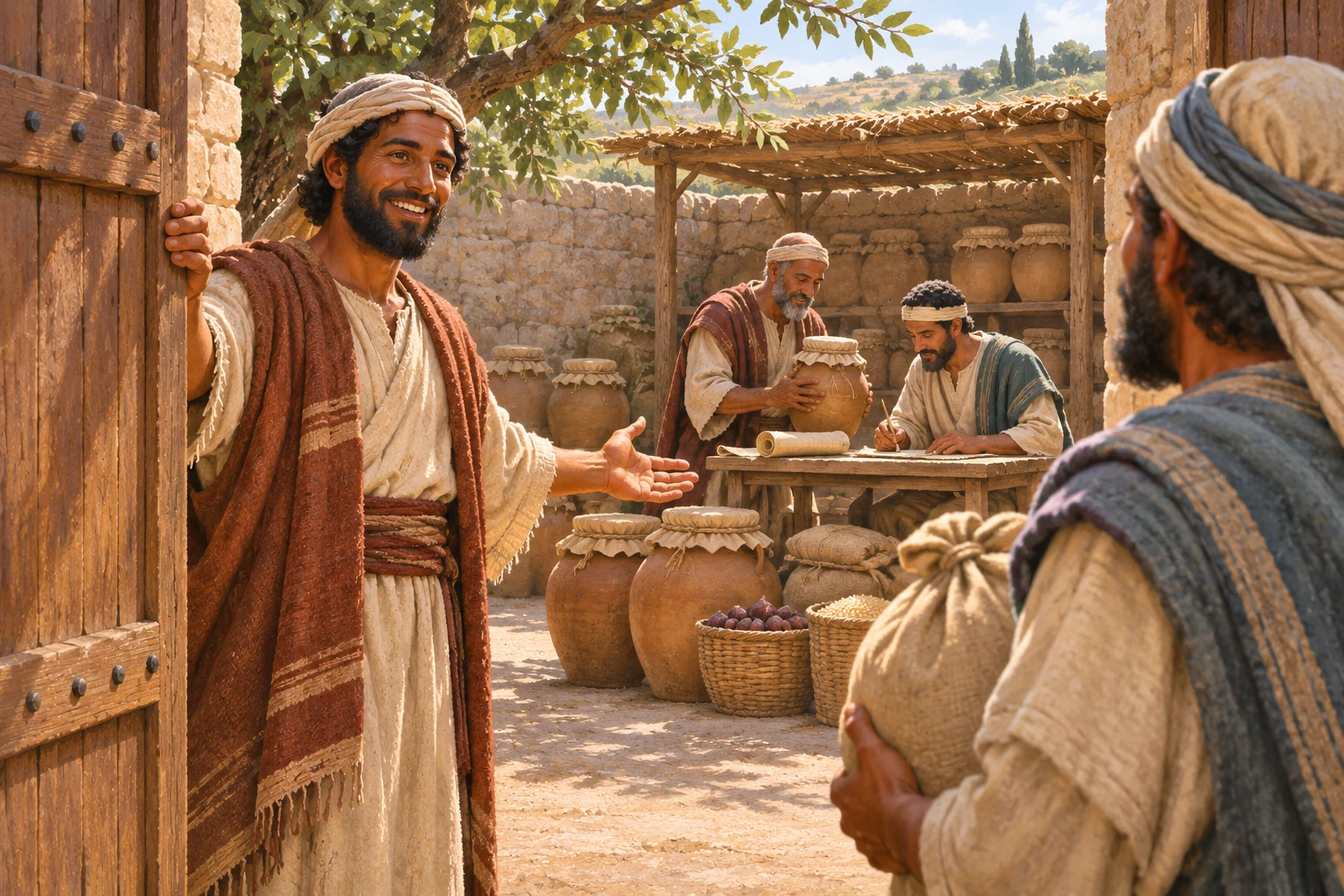
How can welcoming doors and transparent stewardship protect a worshiping community?
Study overview
Before the sanctuary fills with singing, someone watches the gate. Before a gift reaches the altar, someone counts and guards the treasure. The house of God has doors—and faithful hands must keep the doors worthy of the Lord.
Passage: 1 Chronicles 26:1–32
Controlling image: The threshold of God's house
Heart-question: Who safeguards a worshiping community when the singers have stopped singing and the congregation has gone home?
Introduction: The Work No One Notices
A church celebrates preaching and music. Few notice the early guard, honest treasurer, or administrator who hears an overlooked complaint. Yet worship rings hollow when its supporting structures lack integrity.
After organizing priests, Levites, and musicians (1 Chr 23–25), David appoints gatekeepers, treasurers, and officials. Behind the chapter’s lists and numbers stands a conviction: a beautiful temple needs trustworthy stewards.
This text is about overlooked responsibilities becoming sacred guardianship when every duty is carried out before the Lord. At the threshold, worship meets everyday faithfulness.
Historical and Literary Context: Preparing the House Before the Walls Rise
Chapters 1–9 preserve identity after exile; chapters 10–22 show David preparing the Lord’s house. Chapters 23–27 organize worship and government before Solomon builds the temple (22:7–10; 2 Chr 3:1). Chapter 26 assigns guards, treasurers, and officials.
The postexilic community knows destruction and rebuilding (2 Chr 36:19–23). Ordered worship requires not only priests but guardians, financial stewards, and administrators.
Unlike Samuel–Kings, Chronicles foregrounds David’s detailed organization of worship (Japhet 1993; Knoppers 2004). These are preparations, not activities in Solomon’s completed temple.
Walking Through the Text
When Blessing Takes Its Place at the Gate (26:1–12)
The first roster names gatekeepers from the Korahite line, beginning with Meshelemiah, and from the Merarite line, including Hosah (26:1–3, 10–11). A substantial section remembers Obed-edom's family: eight sons, grandsons with leadership capacity, and sixty-two able men associated with the household (26:4–8). Meshelemiah's relatives number eighteen; Hosah's thirteen (26:9, 11).
One phrase pauses the list: God blessed Obed-edom (26:5). The reader remembers the blessing on Obed-edom's house when the ark remained there after Uzzah's death (13:14). The recurrence invites a connection between divine blessing and faithful service, although the precise identification of every person bearing this name should not be assumed without qualification.
The Chronicler repeatedly describes the gatekeepers as capable or strong for their work (26:6–8, 12). In verse 10, Shimri receives firstborn standing despite not being born first. Suitability can inform responsibility.
Safeguarding entrances is sacred service; these families deserve remembrance.
When Every Gate Receives a Watch (26:13–19)
The assignments are determined by lots, for younger and older alike, according to families (26:13). Shelemiah receives the east; Zechariah, described as a wise counselor, the north; Obed-edom, the south, with his sons assigned the storehouses; and Shuppim and Hosah, the western entrances (26:14–16).
Daily positions include six on the east, four north, four south, paired storehouse guards, and guards on the western approach (26:17–18). The Hebrew term parbar in verse 18 is uncertain, variously rendered court, colonnade, or precinct. The exact architectural layout cannot be reconstructed confidently from this verse alone (Klein 2006).
Dependable arrangements matter. Lots allocate duties without granting ownership; Zechariah’s wisdom shows competence matters. The gate is a point of stewardship: access must be protected without turning guardians into owners of God's presence.
A church's doors should neither be carelessly unsecured nor deliberately closed against those who need prayer, welcome, and protection (Isa 56:7).
When the Treasures Are Entrusted, Not Owned (26:20–23)
Levites oversee the house’s treasures and dedicated gifts. Jehieli’s family, including Zetham and Joel, receives treasury duties (26:20–22). The next verse identifies further Levitical family branches: Amramites, Izharites, Hebronites, and Uzzielites (26:23).
Textual uncertainty affects verse 20’s overseer and verse 21’s family relationship. The central point remains: someone must answer for what has been entrusted.
Treasury service does not authorize private gain. The storeroom requires integrity beyond public scrutiny.
When Generations of Gifts Are Remembered (26:24–28)
Shebuel, descended from Gershom son of Moses, oversees treasuries (26:24). Another line leads to Shelomoth, entrusted with dedicated gifts given by David, family heads, commanders, and military officers (26:25–27).
Verse 28 remembers gifts from Samuel, Saul, Abner, and Joab. Complicated histories do not erase gifts entrusted to the Lord’s house.
The mention of spoils dedicated for the house (26:27) belongs to the ancient setting of Israel's warfare. It does not authorize violent fundraising or suggest that every source of wealth is morally acceptable for modern ministry. The theological emphasis is stewardship: dedicated resources must be preserved for the Lord's work, especially as David prepares the future temple (18:11; 22:14).
Gifts entrusted by one generation deserve protection by the next.
When Service Moves Beyond the Temple Doors (26:29–32)
Chenaniah and his sons receive outside duties as officers and judges (26:29). Hashabiah and 1,700 capable relatives oversee work west of the Jordan (26:30). In David's fortieth year, a review identifies capable Hebronites at Jazer in Gilead; Jerijah and 2,700 relatives receive responsibility for Reuben, Gad, and the half-tribe of Manasseh east of the Jordan (26:31–32).
The closing phrase embraces the work of God and the affairs of the king (26:32). Here the Chronicler refuses a narrow understanding of service. The Lord's purposes touch not only sanctuary ceremony but public decisions, administration, and judgments affecting ordinary people.
Ancient royal offices do not transfer directly into modern churches. But can trusted worship leaders also be trusted with records and justice?
Theological Reflection: What Does the Threshold Teach?
Holiness Requires Responsible Access
The same book that celebrates the ark's joyful entry also remembers the cost of disregarding divine instructions (1 Chr 13:7–10; 15:13–15). Gatekeepers provide a different expression of the same concern. Holiness is not mere religious emotion; holiness includes duties undertaken with care. In Christ, believers have access to God through grace (Heb 10:19–22). Such access must never become an excuse for careless, controlling, or unsafe community practices.
Stewardship Is Worship after the Music Ends
Dedicated gifts are held across generations (26:20–28). The temple treasury is not the property of its guardians. David later confesses that all gifts ultimately come from God's hand (1 Chr 29:14–16). In the New Testament, trustworthy administration protects both generosity and credibility (2 Cor 8:20–21). Financial accountability is spiritual faithfulness in visible form.
Gifts and Responsibilities Require Fairness
Gate assignments involve lots, named families, and recognized capability (26:8, 13–16). The Chronicler neither abolishes roles nor grants unlimited privilege to officeholders. Gifts serve the community, and responsibilities require discernment. The church's many members likewise receive distinct work for the common good (1 Cor 12:4–7, 22–26).
God's House Has a Public Horizon
The chapter ends with officials serving communities on both sides of the Jordan (26:29–32). Worship cannot be sealed behind sacred doors. Scripture repeatedly joins acceptable worship with justice and faithful treatment of neighbors (Isa 1:16–17; Mic 6:8). Jesus, the true Son of David, gathers a people whose worship of God overflows into truthful stewardship and neighbor-love (Mark 10:42–45; Eph 2:19–22).
Life Application: Faithful Hands at Every Door
- Make safeguarding real. Train greeters and security teams to protect children, vulnerable adults, and visitors without intimidation or favoritism.
- Audit the treasury. Use documented approvals, clear records, independent review, and public reporting appropriate to the congregation. Never entrust all financial decisions to one unchecked person.
- Recognize unseen service. Thank gate attendants, cleaners, records officers, storekeepers, and administrators. Pay fairly where work is employment, and protect volunteers from exhaustion.
- Assign by calling and competence. Explain selection criteria, provide training, rotate suitable duties, and establish avenues to challenge unfair appointments.
- Guard what previous generations gave. Maintain inventories, preserve records, repair facilities, and honor donor restrictions without treating donors as owners of the church.
- Extend integrity beyond worship. Expect just handling of disputes, transparent decisions, and respectful treatment of neighbors, including people with little influence.
- Keep the threshold welcoming. Review whether physical access, language, disability needs, and congregational customs make God's house harder to enter than necessary (Isa 56:7).
Reflection Questions
- Who keeps the congregation's doors open, and whose work has been overlooked?
- Where might inadequate controls allow entrusted money, property, or influence to be misused?
- Have appointments become privileges protected by relationships rather than responsibilities entrusted to capable servants?
- Are the vulnerable safer because the community worships, or merely impressed by the community's ceremonies?
- What concrete repair to security, accountability, or justice is needed before the next celebration?
Response Prayer
Lord of the house and every threshold, teach the church to honor work hidden behind the music. Give wisdom to gatekeepers, honesty to treasurers, courage to judges, and humility to leaders. Protect the small, the weary, and the stranger at the door. Keep gifts from becoming private treasure and offices from becoming private thrones. As the house is prepared for praise, prepare every faithful hand for service. Let the doors of the community open toward mercy, justice, and the presence of Jesus Christ, the true Son of David. Amen.
Window into What Comes Next
The gates have watches, the treasures have stewards, and responsibilities extend across the land. First Chronicles 27 will reveal the wider structure of royal service: military divisions, tribal officers, land managers, and counselors. The question continues beyond the threshold: how can a whole kingdom become an ordered community under God's authority?
Annotated Bibliography
- Hill, Andrew E. 1 & 2 Chronicles. NIV Application Commentary. Grand Rapids: Zondervan, 2003. Relates the Chronicler's ordered responsibilities to community life and ethical leadership.
- Japhet, Sara. I & II Chronicles: A Commentary. Old Testament Library. Louisville: Westminster John Knox, 1993. Explores temple personnel, kinship lists, and the Chronicler's vision of communal order.
- Klein, Ralph W. 1 Chronicles: A Commentary. Hermeneia. Minneapolis: Fortress, 2006. Helps assess textual uncertainties and the allocation of gatekeeping and treasury duties.
- Knoppers, Gary N. I Chronicles 10–29: A New Translation with Introduction and Commentary. Anchor Bible 12A. New York: Doubleday, 2004. Provides detailed examination of the temple administration and historical traditions behind the lists.
- Sailhamer, John. First and Second Chronicles. Everyman's Bible Commentary. Chicago: Moody Press, 1983. The supplied commentary highlights the gatekeepers, treasury guards, and officials as part of David's preparations for worship.
- Williamson, H. G. M. 1 and 2 Chronicles. New Century Bible Commentary. Grand Rapids: Eerdmans, 1982. Connects administrative service and covenant continuity within the Chronicler's postexilic outlook.
Be the first to leave a comment.