

How can schedules and records protect ministry from favoritism and ambition?
Study overview
The temple walls have not yet risen, but names are being called and duties entrusted. Before the altar receives its offerings, a people must learn that holy service is neither a private inheritance to exploit nor a privilege to seize.
Passage: 1 Chronicles 24:1–31
Controlling image: Names drawn and recorded for service at God's altar
Heart-question: How can a community honor sacred callings without allowing family privilege, personal ambition, or disorder to displace God's word?
Introduction: When Service Becomes a Contest
Religious service can become a contest: respected surnames open doors, while gifted workers are overlooked. Competition for proximity to the altar can divide a congregation.
First Chronicles 24 addresses this temptation without a dramatic battle or public miracle. David arranges twenty-four priestly divisions, with Zadok, Ahimelech, and a Levite scribe participating. Then the Chronicler records the remaining Levite families and the drawing of lots. Its names and procedures protect a crucial confession: God's house belongs to God.
This text is about inherited sacred responsibility becoming shared, accountable service before the Lord. Names are recorded for faithful worship beyond one generation.
Historical and Literary Context: Preparing Worship Before the Temple Exists
First Chronicles 1–9 gathers Israel's memory after the trauma of exile. Chapters 10–22 portray David as king, worshiper, covenant recipient, and preparer of the future temple. Chapter 23 begins the detailed organization of Levites, and chapter 24 orders the priestly families and other Levitical households. The temple has not yet been built; Solomon will undertake construction (1 Chr 22:5–10; 2 Chr 3:1).
The Torah distinguished Aaron's descendants, who served as priests, from other Levites assisting sanctuary worship (Num 3:5–10; 18:1–7). David does not create a priesthood from personal preference. The Chronicler presents David as organizing inherited responsibilities for the settled worship of the coming temple (Sailhamer 1983).
For postexilic readers, priestly identity mattered (Ezra 2:36–39, 61–63). Recalling ordered worship offered a way to rebuild without assuming that buildings guaranteed faithfulness (Japhet 1993; Williamson 1982).
Walking Through the Text
When the Altar Remembers a Broken Family (24:1–2)
The chapter opens with Aaron's four sons: Nadab, Abihu, Eleazar, and Ithamar. Nadab and Abihu died before their father and left no sons, so the priestly lines continued through Eleazar and Ithamar (24:1–2).
The notice recalls unauthorized fire in Leviticus 10:1–3 and Numbers 3:4. Without retelling the tragedy, these names connect priestly service with God's holiness.
The chapter moves from loss to continuity. Two priestly branches remain, and service must be arranged for another generation. A wounded history need not make future faithfulness impossible. But the past is not erased to make the present comfortable.
When Unequal Numbers Receive an Ordered Place (24:3–5)
David works with Zadok, descended from Eleazar, and Ahimelech, descended from Ithamar (24:3). The families are not numerically identical: Eleazar's branch supplies sixteen heads of ancestral houses, while Ithamar's supplies eight (24:4). The twenty-four divisions reflect unequal family numbers.
The divisions receive assignments by lot because sanctuary leaders exist in both lines (24:5). The lot limits royal preference: both branches serve.
The practice does not imply that everyone may exercise Aaron's priesthood: eligibility is already defined by the priestly line. Nor does drawing lots automatically make every decision just. Its significance here lies in a publicly recognized ordering of qualified families rather than a contest for influence (Klein 2006; Knoppers 2004).
When the Names Are Written Before Witnesses (24:6)
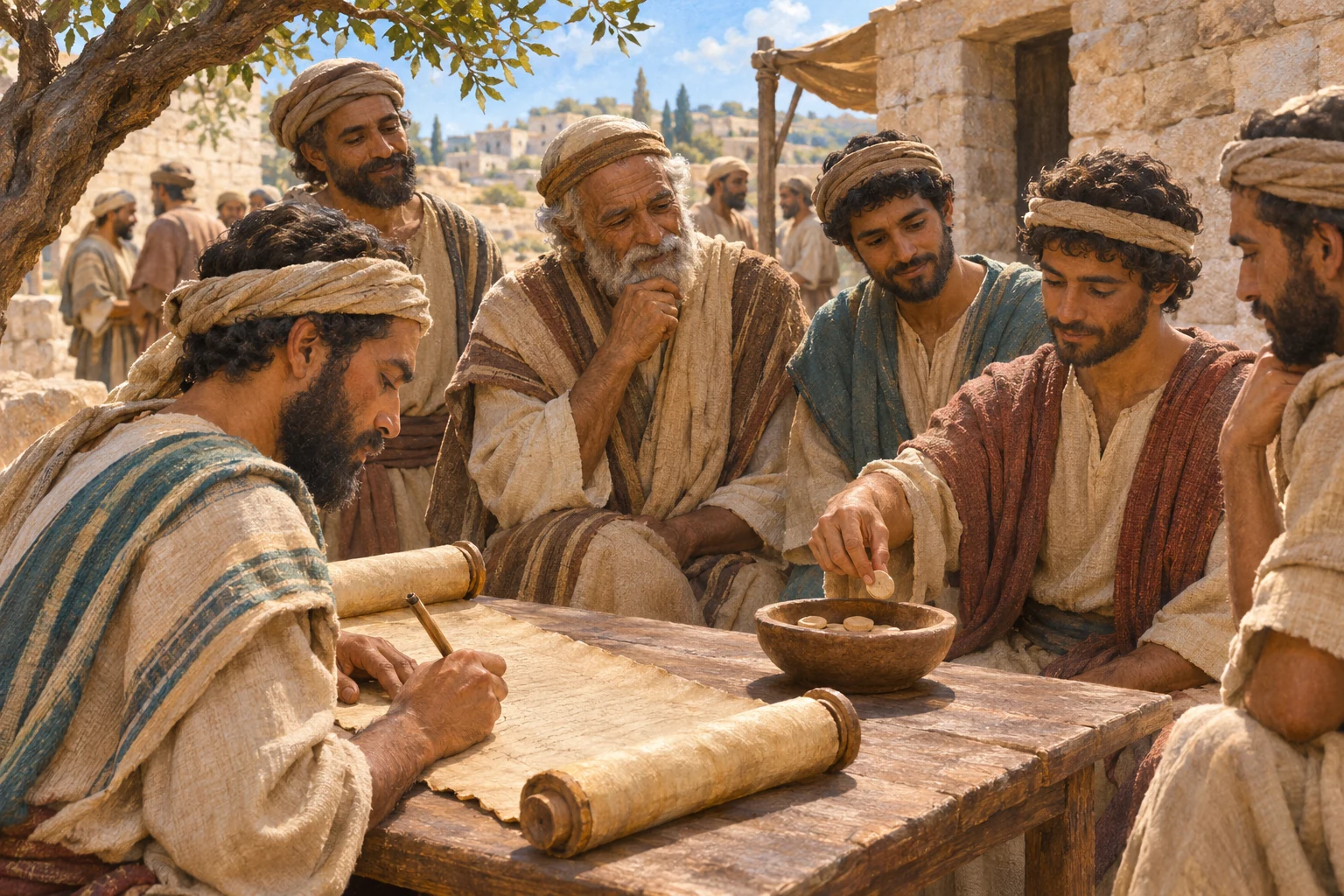
Shemaiah son of Nethanel, a Levite scribe, records the assignments in the presence of David, officials, Zadok, Ahimelech, and family heads. The detail is easy to pass over. Yet a spoken decision might be forgotten or disputed; a public record can be consulted and challenged.
The wording about the sequence of Eleazar's and Ithamar's houses is understood differently in translations. The verse establishes that both branches participated under witnessed procedure, but the precise mechanics of alternating draws remain difficult. The text does not authorize inventing an exact lottery system from uncertain wording.
A further difficulty should remain visible: verse 6 calls Ahimelech the son of Abiathar, whereas 1 Samuel 22:20 identifies Abiathar as the son of Ahimelech. Similar names across generations or textual transmission may help explain the difference, but no reconstruction is certain. Faithful interpretation can admit textual complexity without losing the chapter's central meaning.
When Twenty-Four Names Become Twenty-Four Responsibilities (24:7–19)
The record begins with Jehoiarib, followed by Jedaiah, Harim, and Seorim (24:7–8). The eighth division belongs to Abijah (24:10). The list continues through Bilgah and Immer (24:14), ending with Delaiah and Maaziah as the twenty-third and twenty-fourth divisions (24:18).
No single household monopolizes the future sanctuary. Duties are distributed and remembered. Verse 19 supplies the interpretive key: service is to follow the established ordinance associated with Aaron, as the Lord commanded. Organization is subordinate to revelation, not a substitute for it.
The later story of Zechariah, a priest belonging to Abijah's division, illustrates continuity of priestly courses into the New Testament period; Zechariah receives a temple duty by lot (Luke 1:5, 8–9). This does not prove uninterrupted institutional continuity for every name across every century. It does show why a seemingly unremarkable entry can matter long after David.
When the Levites Also Stand in the Record (24:20–31)
The closing section turns to the remaining Levites, not another list of Aaronic priests. Amram's descendants are recalled through Shubael and Jehdeiah; other names arise from Rehabiah, Izhar, Hebron, and Uzziel (24:20–25). The account then turns to the sons of Merari, including the families of Mahli and Mushi (24:26–30).
One detail echoes chapter 23: Eleazar of Mahli's line had no sons (24:28; cf. 23:21–22). Even this quiet genealogical limitation is remembered. A family need not become prominent to remain part of Israel's covenant memory.
The Levites, like the priestly families, cast lots before David and the leaders. Verse 31 expressly joins senior and junior ancestral households in the process. The procedure affirms participation across generations without erasing differences between priestly and Levitical offices. The altar needs ministers, but the house also needs assistants whose names are not forgotten.
Theological Reflection: Holiness Has a Communal Shape
Calling Is Received, Not Seized
Aaron's priesthood is rooted in God's instruction, not family boasting (Num 18:1–7; 1 Chr 24:19). Kinship determined eligibility in ancient Israel, yet kinship could never make disobedience safe; the memory of Nadab and Abihu forbids that conclusion (Lev 10:1–3). Modern Christian ministry likewise requires calling joined to tested character, not titles or inherited influence (1 Tim 3:1–13).
Fair Procedure Serves Faithful Worship
The twenty-four divisions, public witnesses, written register, and lots form a framework for ordered participation (24:3–19). Impartiality does not mean identical gifts or responsibilities; it means refusing favoritism in assignments appropriate to each calling. Scripture condemns partiality even within the worshiping community (Deut 16:19; Jas 2:1–9).
The Temple Needs More Than the Visible Priest
The passage remembers priests and Levites together (24:1–31). Service at the altar is inseparable from the supporting community that sustains worship. The New Testament uses the image of one body with many necessary members, refusing to measure a person's worth by public visibility (1 Cor 12:12–27). The community's shared responsibility must never become an excuse to neglect training, safeguarding, or fair treatment.
The Greater Priest Opens the Way to God's Presence
The twenty-four divisions show recurring service across human generations. Yet no succession of mortal priests could finally heal the rupture between humanity and God. Hebrews presents Jesus as the enduring high priest whose priesthood rests on indestructible life, not on membership in Aaron's line (Heb 7:11–17, 23–28). The distinction matters: the ancient divisions served Israel's covenant worship; Christ brings the deeper access those arrangements could anticipate but not themselves complete (Heb 10:19–22).
Life Application: Give Holy Service a Name
- Document responsibilities. Record ministry roles, rotation schedules, decision-making authority, and handover procedures so worship does not depend on one influential person.
- Refuse family favoritism. Appoint workers by biblical character, competence, availability, and clear processes—not surnames, friendships, donations, or social standing.
- Share the demanding work. Rotate heavy tasks fairly, provide rest, and prevent a small group of volunteers from carrying every Sabbath or public event.
- Welcome accountable participation. Include younger and older members appropriately, with training, supervision, and transparent opportunities to serve.
- Honor complementary ministries. Recognize prayer leaders, accountants, cleaners, musicians, teachers, stewards, and gatekeepers alongside those who speak from the pulpit.
- Repair broken systems. Audit neglected records, unsafe practices, unresolved complaints, and hidden imbalances in workload; make changes that can be verified.
- Keep worship above bureaucracy. Treat procedures as servants of reverence, justice, and shared praise. Ask regularly whether the arrangements truly help people seek the Lord.
Reflection Questions
- Where have inherited influence or personal connections begun to control ministry appointments?
- Which faithful workers remain unnamed while visible leaders receive the credit?
- What task requires a fairer rotation, better training, or written accountability?
- Are younger and less prominent members genuinely included without being given duties beyond their preparation?
- Does the present structure direct attention toward God's holiness—or toward institutional prestige?
Response Prayer
Lord of the altar, God of Aaron and the generations after Aaron, receive every name offered for service. Cleanse the desire to possess sacred work. Guard congregations from favoritism, ambition, and neglect. Give leaders wisdom to assign duties fairly, scribes courage to keep truthful records, and servants patience to carry unseen responsibilities. Remember the households whose labor is rarely applauded. Make the order of worship an expression of humility, justice, and joyful obedience. Through Jesus Christ, the everlasting High Priest, draw the whole church near to God's gracious presence. Amen.
Window into What Comes Next
The priestly names have been called, the lots drawn, and the altar's work entrusted. Now another kind of service comes into focus. First Chronicles 25 will gather singers and musicians under Asaph, Heman, and Jeduthun. The house being prepared will not merely receive offerings; the house will learn to proclaim God's truth in song.
Annotated Bibliography
- Hill, Andrew E. 1 & 2 Chronicles. NIV Application Commentary. Grand Rapids: Zondervan, 2003. Connects temple organization with communal responsibility and the practice of faithful leadership.
- Japhet, Sara. I & II Chronicles: A Commentary. Old Testament Library. Louisville: Westminster John Knox, 1993. Examines the Chronicler's literary shaping of priestly memory and postexilic worship.
- Klein, Ralph W. 1 Chronicles: A Commentary. Hermeneia. Minneapolis: Fortress, 2006. Addresses textual difficulties, genealogical distinctions, and the priestly courses.
- Knoppers, Gary N. I Chronicles 10–29: A New Translation with Introduction and Commentary. Anchor Bible 12A. New York: Doubleday, 2004. Offers historical and textual analysis of David's arrangements and priestly families.
- Sailhamer, John. First and Second Chronicles. Everyman's Bible Commentary. Chicago: Moody Press, 1983. The supplied commentary emphasizes the twenty-four priestly divisions, recurring temple service, and the Levitical families' participation by lot.
- Williamson, H. G. M. 1 and 2 Chronicles. New Century Bible Commentary. Grand Rapids: Eerdmans, 1982. Situates priestly organization within the Chronicler's concern for covenant continuity.
Be the first to leave a comment.