

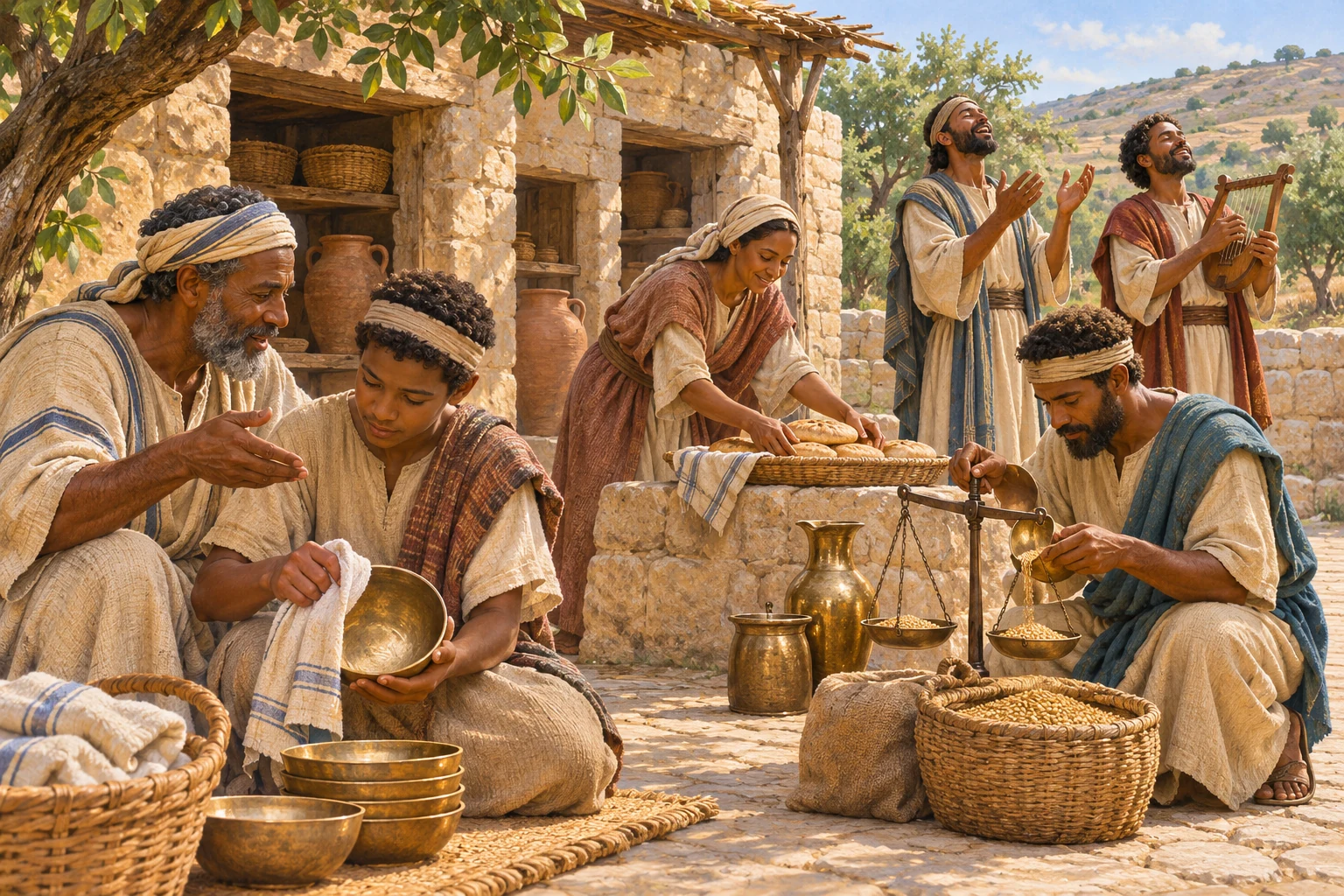
How can ordinary service sustain thankful worship and dignity for every worker?
Study overview
The stones are gathered, but the temple has not yet risen. An aging king counts names, appoints guardians, and sets a rhythm of morning and evening praise. Before the house has walls, the people learn how to serve within it.
Passage: 1 Chronicles 23:1–32
Controlling image: A house learning to sing before construction is complete
Heart-question: Can a community honor God through steady, ordinary service as faithfully as through dramatic achievements?
Introduction: When the Spotlight Moves Away
A building may attract admiration, but cannot pray. A sanctuary needs guardians, stewards, preparation, and teachers. Much life-giving work happens before anyone applauds.
Having gathered temple materials (1 Chr 22), David turns toward people. Chapter 23 names families and assigns ordinary tasks: gates, courts, measures, offerings, and daily praise. None is spiritually empty.
This text is about a traveling people's sacred responsibilities becoming an ordered, enduring ministry of worship. Israel's transition toward rest demands more than a permanent building. A community must learn how to live faithfully before God, day after day.
Historical and Literary Context: From Tent to Temple
Chapters 1–9 remember Israel after disaster; chapters 10–22 portray David seeking God, establishing worship, and preparing the temple. Chapter 23 introduces organized service (1 Chr 23–27).
Under Moses, the Levites were assigned to guard and carry the tabernacle and its furnishings as Israel journeyed (Num 3:5–9; 4:1–33). The house planned for Jerusalem changes the work without removing the calling. As Sailhamer (1983) observes, the Chronicler understands David's organization as an adaptation of responsibilities already rooted in the Torah, not the invention of a new priesthood.
The temple is not yet built: these are preparations for worship. Postexilic readers knew that covenant life needed teachers, singers, servants, and prayer (Ezra 3:8–11; Neh 12:27–47).
Walking Through the Text
When an Aging King Makes Room for Tomorrow (23:1–2)
Aging David makes Solomon king and assembles officials, priests, and Levites (23:1–2). The dying king prepares not merely an inheritance, but worship beyond David's lifetime.
Other biblical texts narrate the difficult politics of Solomon's succession (1 Kgs 1). Chronicles places those tensions outside this scene, concentrating instead on public continuity and worship (Japhet 1993; Knoppers 2004). The choice is theological: the enduring house is not simply a palace dynasty. Israel needs a community capable of serving the Lord when the founding king is gone.
When Thirty-Eight Thousand Receive a Calling (23:3–6)
The count includes 38,000 Levites aged thirty and above: 24,000 oversee the work of the Lord's house; 6,000 serve as officials and judges; 4,000 guard gates; and 4,000 lead praise with instruments David has provided (23:3–5). The groups total precisely 38,000.
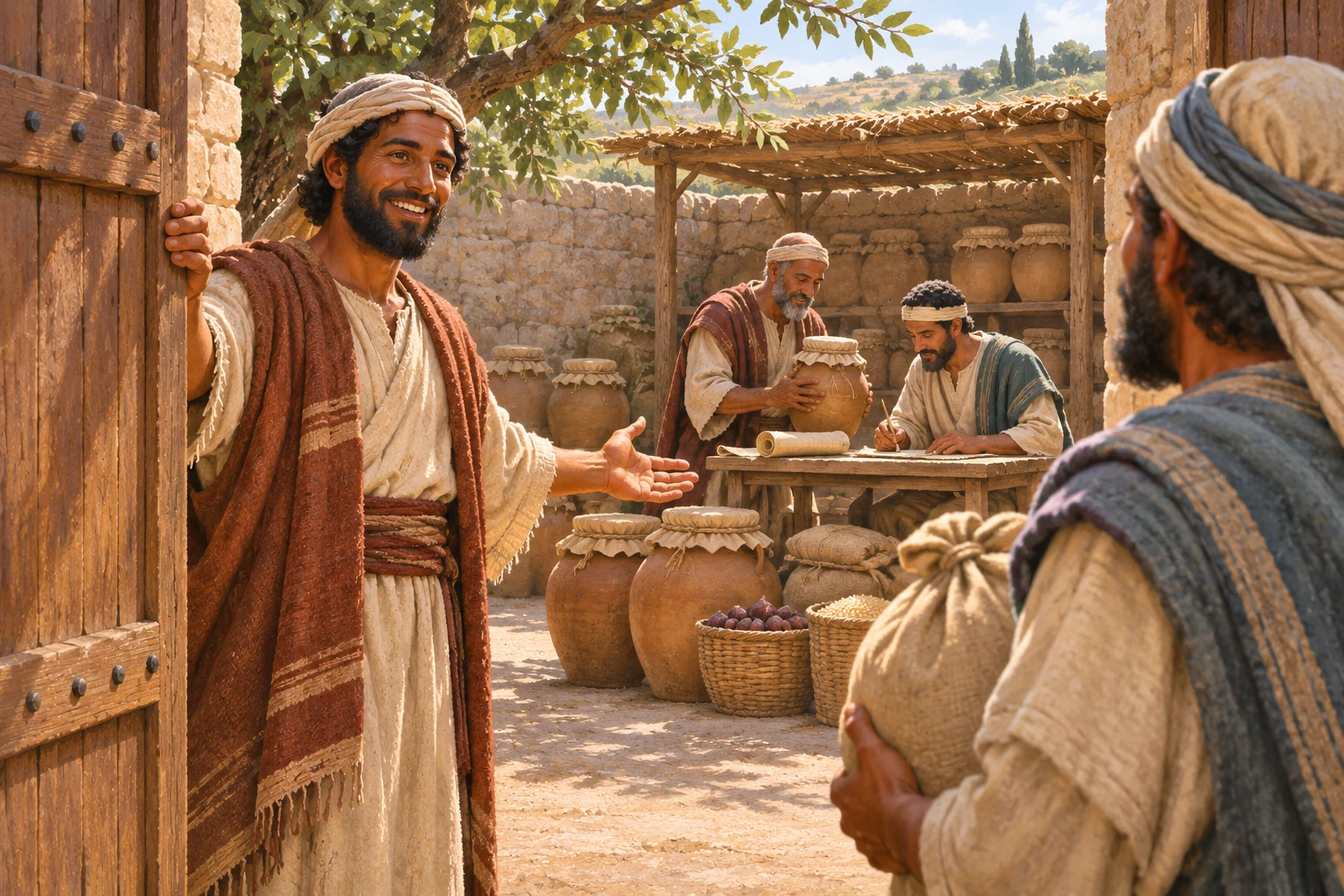
David then divides the Levites by the ancestral families of Gershon, Kohath, and Merari (23:6). Justice, protection, administration, and music all belong to worship. Gatekeepers matter alongside singers.
The substantial numbers belong to the Chronicler's account and should not be casually converted into a modern staffing model. Their narrative force is unmistakable: worship requires the participation and discipline of a whole community, not the charisma of a single king.
When the Gershonites Are Remembered by Name (23:7–11)
The record names Ladan and Shimei, then traces family heads and descendants. Even the note that Jeush and Beriah were grouped into one ancestral house because their families were small matters (23:11). The system accommodates unequal family sizes.
Since chapter 1, names resist erasure. God’s house is served by identifiable people, not anonymous labor.
When Moses' Family and Aaron's Priesthood Stand Together (23:12–23)
Kohath's descendants include Amram, Izhar, Hebron, and Uzziel. Through Amram come Aaron and Moses (23:12–13). The writer pauses to distinguish their descendants: Aaron's line is set apart for priestly acts—ministering before the Lord, making offerings, and blessing in God's name—while Moses' descendants remain counted among the Levites (23:13–17).
Even descent from Moses cannot confer Aaron’s priestly office (Num 18:1–7). Distinct callings deserve honor.
The lists continue through Izhar, Hebron, Uzziel, and Merari's families (23:18–23). Eleazar, a descendant of Merari, leaves daughters but no sons; the daughters marry their relatives from Kish's family (23:21–22). The passage preserves an ancient family arrangement without supplying a modern prescription for marriage or inheritance. Its immediate purpose is to record continuity in the Levitical households.
When the Bearers Lay Down Their Loads (23:24–27)
The concluding register includes Levites aged twenty and above (23:24, 27), whereas the opening count used thirty (23:3). Numbers 4 also emphasizes thirty for transporting sanctuary objects, while Numbers 8:24 mentions service beginning at twenty-five. The passages reflect differing service arrangements; the Chronicler explicitly connects the younger age in chapter 23 with David's later instructions. The differences should be recognized rather than silently flattened (Klein 2006).
David explains the change: the Lord has given Israel rest and has chosen to dwell in Jerusalem, so the Levites no longer need to carry the tabernacle and its equipment from place to place (23:25–26). The burden changes; the calling remains. In a season of settled worship, carrying gives way to sustained care.
Rest anticipates the coming temple, not a trouble-free age. God’s gift creates responsibility.
When Praise Becomes the Rhythm of the House (23:28–32)
Levites assist Aaron’s descendants through maintaining courts, purity, bread, offerings, and accurate measures (23:28–29).
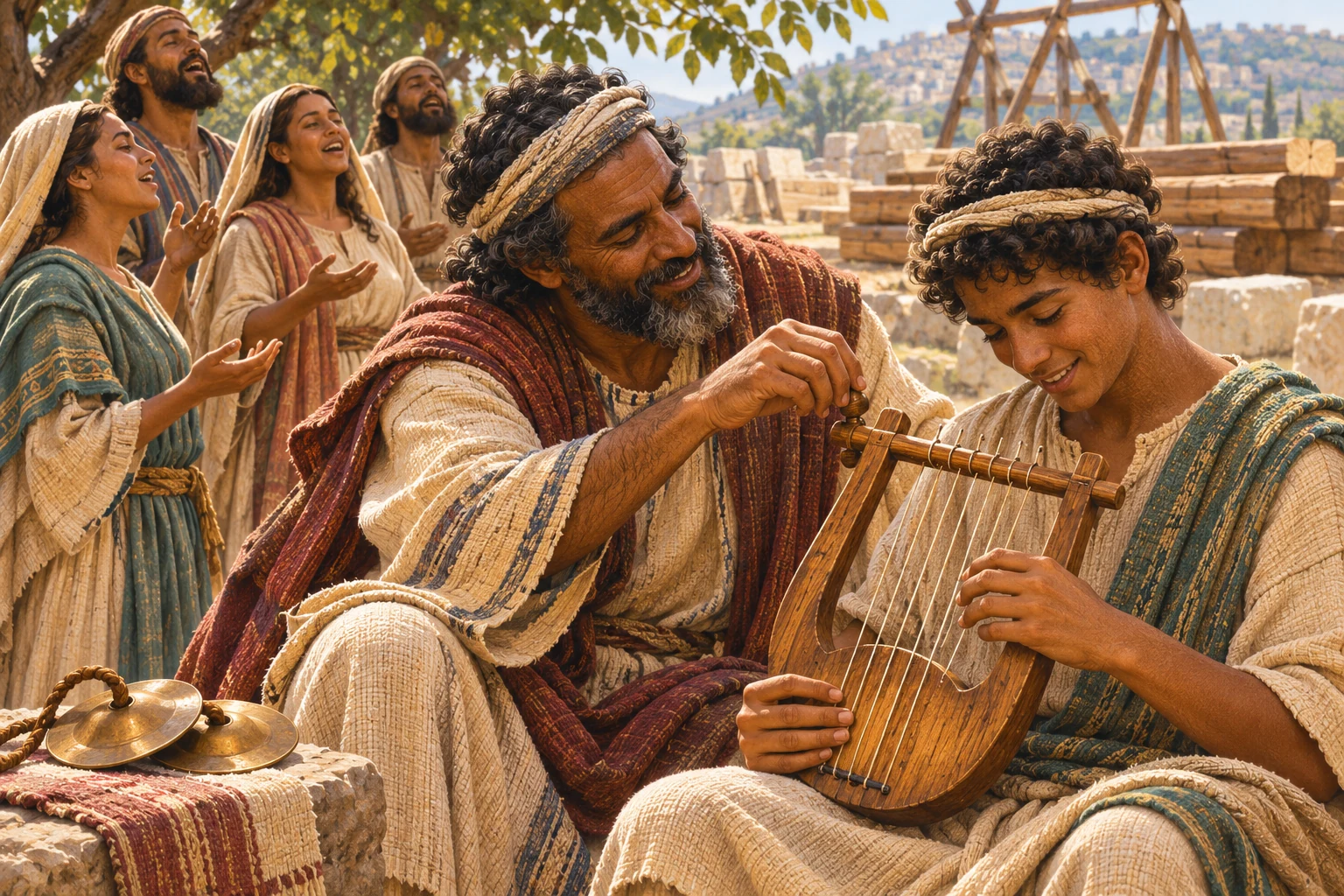
Then the chapter reaches its daily heartbeat: the Levites stand every morning and every evening to thank and praise the Lord (23:30). Service also follows the Sabbaths, new moons, and appointed festivals with prescribed offerings and assigned personnel (23:31; Num 28–29). The Levites carry out the charge entrusted to them under the priestly families (23:32).
The house learns its song through repetition. Morning praise does not replace careful work; careful work supports the place of praise. The Chronicler binds ordered service and gratitude into one vision of worship.
Theological Reflection: The Holy Shape of Ordinary Work
Rest Is Given for Faithful Service
God's rest ends one form of labor and opens another (23:25–28). From the wilderness tabernacle to Jerusalem's planned sanctuary, the Lord remains the giver of covenant life. Rest in Scripture is not abandonment of responsibility: it enables life rightly ordered around God (Exod 20:8–11; Deut 12:9–11).
Worship Requires Both Boundaries and Cooperation
Priests and Levites have different duties, yet both serve the same house (23:13, 28, 32). The distinction protects responsibilities rather than establishing degrees of human worth. Worship loses integrity when authority becomes privilege, while essential support workers are overlooked. The New Testament likewise describes differentiated gifts within one body (1 Cor 12:4–27).
Thanksgiving Needs a Daily Rhythm
The morning and evening pattern (23:30) shows that worship is formed by sustained practices. The Sabbath, monthly occasions, and festivals locate gratitude within shared time (23:31). Christians differ on how Israel's calendar relates to Christian practice, but the text's enduring challenge is clear: let sacred time cultivate faithful remembrance, not empty routine (Ps 92:1–2; Heb 10:24–25).
The Greater House Is Built around Christ
David prepares the temple; Solomon will build it. Yet the wider biblical story points beyond buildings and royal succession. Jesus, the Son of David, becomes the meeting place of God and humanity (John 2:19–22). In Christ, God's people are described as a spiritual house and a priestly people called to declare God's praises (1 Pet 2:4–10). This does not erase Israel's historical priestly structures; it shows how God's purpose to dwell with a people reaches wider fulfillment (Eph 2:19–22).
Life Application: Keep the House Singing
- Recognize hidden service. Thank cleaners, ushers, accountants, caretakers, musicians, and volunteers by name. Provide training, support, and adequate rest.
- Plan leadership transitions. Document responsibilities and train younger leaders before respected servants retire or relocate.
- Give different gifts honorable space. Do not demand that every capable person preach or sing. Administration, safeguarding, teaching, and hospitality also sustain worship.
- Make stewardship trustworthy. Review financial records, measurements, procurement, and workplace safety; carelessness in ordinary matters can wound the whole community.
- Establish daily thanksgiving. Practice short morning and evening prayers as individuals, households, and ministry teams, without turning the practice into another measure of superiority.
- Honor sacred rhythms. Prepare thoughtfully for Sabbath worship and congregational gatherings; combine celebration with rest, generosity, and care for those who carry the workload.
- Adapt without abandoning the calling. When conditions change, distinguish essential purposes from methods that once served but no longer fit.
Reflection Questions
- Whose quiet work keeps the congregation alive but seldom receives recognition?
- Which responsibilities need clearer boundaries, training, or accountability?
- What inherited method should change because the season of service has changed?
- Has worship become a performance instead of a daily practice of gratitude?
- How can the present generation prepare younger servants to sustain worship faithfully?
Response Prayer
Lord of Israel, teach the unfinished house to sing. Give wisdom to elders who must pass responsibility onward, courage to younger servants receiving the work, and dignity to every person who guards a door, prepares bread, keeps accounts, or raises a song. Guard the church from careless pride and empty routine. Let morning and evening bring thanksgiving; let Sabbath and gathered worship renew mercy, truth, and rest. Build a people whose ordinary faithfulness welcomes the presence of God, through Jesus Christ, the true Son of David. Amen.
Window into What Comes Next
The Levites have received their places, but the altar requires more precise ordering. First Chronicles 24 will name the priestly divisions and show how sacred duties are distributed through an accountable process. Before the house fills with incense and song, those who serve at the altar must learn their appointed turns.
Annotated Bibliography
- Hill, Andrew E. 1 & 2 Chronicles. NIV Application Commentary. Grand Rapids: Zondervan, 2003. Connects David's organization of worship with enduring community responsibilities.
- Japhet, Sara. I & II Chronicles: A Commentary. Old Testament Library. Louisville: Westminster John Knox, 1993. Explores the Chronicler's temple-centered literary and genealogical vision.
- Klein, Ralph W. 1 Chronicles: A Commentary. Hermeneia. Minneapolis: Fortress, 2006. Examines genealogical details, Levitical ages, and historical-textual questions.
- Knoppers, Gary N. I Chronicles 10–29: A New Translation with Introduction and Commentary. Anchor Bible 12A. New York: Doubleday, 2004. Analyzes the institutional and theological framing of David's arrangements.
- Sailhamer, John. First and Second Chronicles. Everyman's Bible Commentary. Chicago: Moody Press, 1983. The supplied commentary emphasizes continuity with Moses' instructions and the Levites' changed duties under settled worship.
- Williamson, H. G. M. 1 and 2 Chronicles. New Century Bible Commentary. Grand Rapids: Eerdmans, 1982. Situates worship order and priestly identity within the Chronicler's postexilic concerns.
Be the first to leave a comment.