

How can faithful preparation serve the next generation without claiming ownership of the outcome?
Study overview
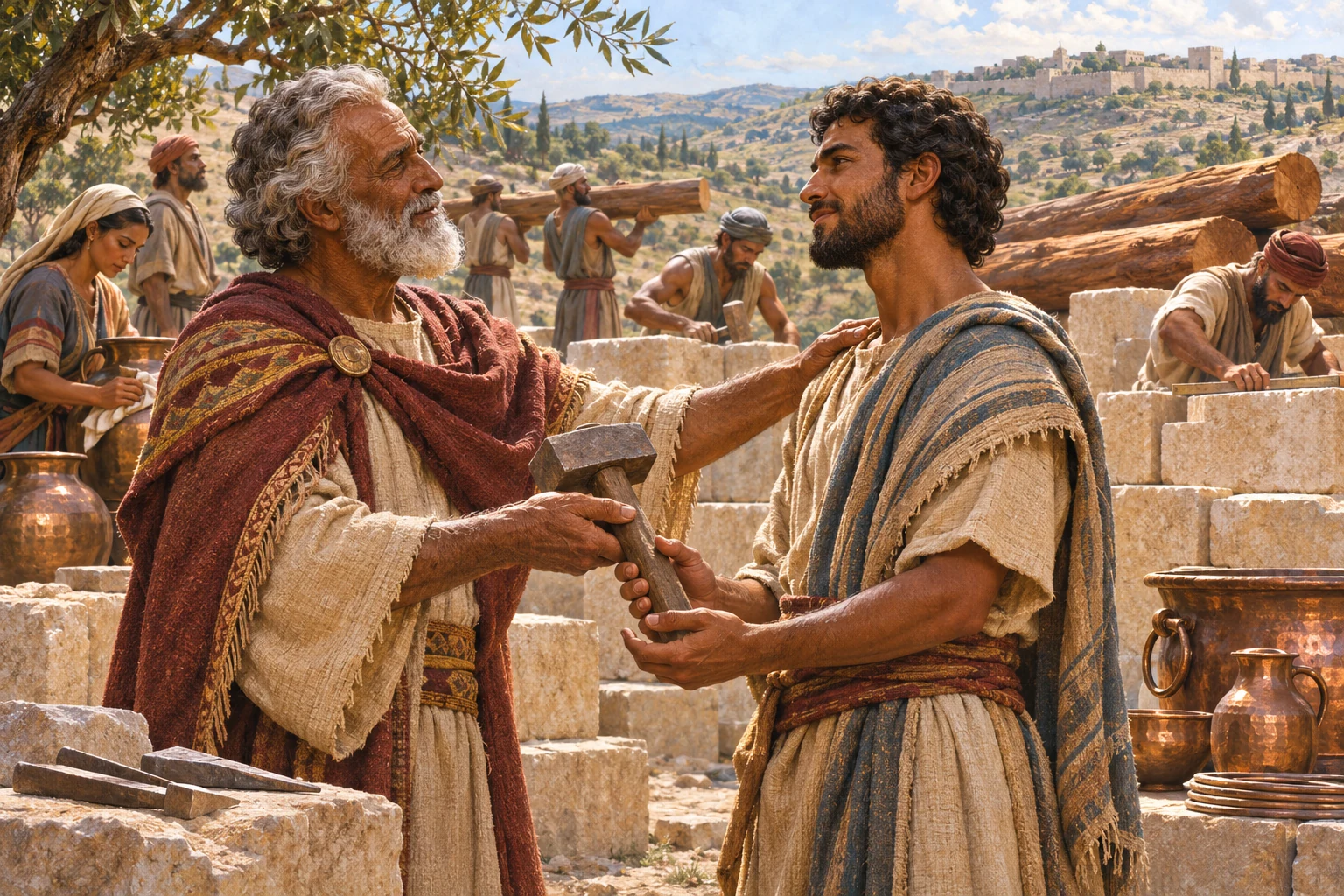
The sword has been sheathed above the threshing floor. Now iron is gathered, cedar arrives, and stone waits beneath the mason's hand. The king who cannot build the house must learn the holiness of preparing it.
Passage: 1 Chronicles 22:1–19
Controlling image: Stones prepared for another generation to raise
Heart-question: Can faithful leaders surrender the honor of finishing a sacred work while still carrying the costly responsibility of preparing it?
Introduction: When the Work Outlives the Worker
One hard obedience is accepting that someone else must finish a worthy project. Parents plant trees for grandchildren; teachers prepare students who will exceed their teachers. Church leaders sometimes leave foundations rather than finished buildings.
After the census, plague, and altar, David identifies the temple site (1 Chr 21:18–30; 22:1). Solomon, not David, must build. David responds with preparation: materials, workers, instruction, prayer, and communal support.
This text is about a frustrated royal ambition becoming generational covenant faithfulness. Serving God’s purpose outweighs receiving credit.
Historical and Literary Context: From Mercy's Altar to the House of God
First Chronicles 1–9 remembers Israel's identity after disaster. Chapters 10–21 portray David as the king who seeks the Lord, orders worship, receives the covenant promise, and learns through failure. At Ornan's threshing floor, God stopped the destroying angel and answered David's offering with fire (21:15, 26–27). Chapter 22 begins by identifying that site as the future sanctuary.
First Kings 5:3–5 stresses David’s warfare and Solomon’s rest; Chronicles expands David’s preparatory role and explains the restriction through bloodshed (22:7–10; 28:3). The emphases differ (Japhet 1993; Knoppers 2004).
For postexilic readers, temple construction concerned worship, covenant identity, and God’s presence after exile (Ezra 3:10–13; Hag 1:2–8). Would Israel seek the Lord together?
Walking Through the Text
When the Threshing Floor Receives a Future (22:1)
David announces that the place of Ornan's altar will become the Lord's house and Israel's altar of burnt offering. The statement points forward: the temple does not yet stand. A ground once overshadowed by the sword is now marked for prayer, sacrifice, and covenant worship (21:16–18, 26; 2 Chr 3:1).
The site follows God’s answer at the altar, not royal appetite for another building. Judgment and mercy mark a place for future prayers of forgiveness (2 Chr 6:24–39).
When Stones Are Cut for Hands Not Yet Ready (22:2–5)
David assigns resident foreigners to cut stones (22:2), gathers iron and bronze, and receives cedar from Sidon and Tyre (22:3–4). Preparation is international and costly.
David explains the urgency: Solomon is young and inexperienced, and the house of God must have significance beyond Israel (22:5). The father prepares so the son can undertake a demanding commission.
Yet the text records assigned labor, not working conditions. Foreigners also appear in later labor arrangements (2 Chr 2:17–18). A sanctuary built for God’s honor raises questions about the dignity of its workers.
When the Builder Is Chosen by Peace (22:6–10)
David tells Solomon that building the temple had been David's heartfelt desire. Yet the word of the Lord forbade David the task because David had shed much blood and waged great wars (22:7–8). The text presents a divine restriction; it does not declare every Davidic battle unjust, nor does it specify that the prohibition refers only to the murder of Uriah.
A different son will build. Solomon is called a man of rest, and God promises peace and quiet to Israel during Solomon's reign (22:9). The name Solomon resonates with shalom, peace. God also promises a father-son relationship with the Davidic heir and a throne established forever (22:10; cf. 17:11–14).
The warrior king must yield the sanctuary to a king of peace. God chooses the builder as surely as the site.
When Courage Takes the Shape of Obedience (22:11–13)
David commissions Solomon with a blessing: may the Lord be with the son and bring the building to completion (22:11). But David does not begin with technical expertise. The first request is for discretion and understanding so Solomon can govern Israel while keeping God's law (22:12).
The promise of success is tied to carefully observing the statutes and ordinances given through Moses (22:13). David's call to courage echoes Moses' charge to Joshua: strength is found in steadfast obedience, not bravado (Josh 1:7–9).
The Chronicler thus measures a future temple builder by inward faithfulness before outward magnificence. A leader capable of building a splendid sanctuary but unwilling to obey God's word would misunderstand the sanctuary's purpose.
When Abundance Becomes an Invitation to Work (22:14–16)
David describes immense stores of gold, silver, bronze, iron, timber, and stone accumulated with great effort (22:14). The extraordinary totals emphasize lavish preparation rather than supplying a modern budget ledger.
The king also names skilled stonecutters, carpenters, masons, and metalworkers (22:15–16). Resources have been gathered, but the work remains unfinished. David's instruction is urgent: arise and work, accompanied by the wish that the Lord be with Solomon.
Faithfulness provides resources, develops skills, and releases responsibility. David prepares a successor rather than keeping control.
When Every Leader Must Help Carry the Stones (22:17–19)
Finally, David charges Israel's leaders to help Solomon. The appeal begins with what God has already given: divine presence, rest from surrounding enemies, and a secured land (22:17–18). Peace is not merely permission to enjoy comfort; peace creates room for the work of worship.
Then comes the chapter's spiritual center: set heart and soul to seek the Lord (22:19). Only after that command does David call the leaders to rise and build the sanctuary, so the ark and holy furnishings may be brought into God's house.
The repeated sequence matters: seek the Lord, then build the house. Construction without devotion would reproduce the failure of a people who once neglected the ark (13:3). The project belongs not to Solomon alone but to a community sharing God's purpose.
Theological Reflection: What Outlasts a King's Lifetime?
God's House Begins with God's Initiative
The site follows divine mercy (21:15–27); the builder follows divine speech (22:8–10). The temple is not a human technique for summoning God's presence. Israel receives the privilege of responding to God's gracious choice (Deut 12:5–7; 2 Chr 6:18–21).
Peace Is a Calling, Not Merely an Absence of War
Solomon's promised rest carries responsibility: an environment of security must become an opportunity for worship and faithful life (22:9, 18–19). David's inability to build also cautions against confusing a successful career with unlimited spiritual permission. A calling has boundaries.
The Heart Must Be Prepared Alongside the Stones
Materials cannot compensate for disobedience. David asks for wisdom to keep the law before Solomon undertakes construction (22:12–13). The same chapter calls national leaders to seek God with heart and soul (22:19). The Chronicler refuses to separate the visible sanctuary from inward loyalty and public responsibility.
The Greater Son of David Builds Beyond Stone
Solomon fulfills the immediate role of temple builder, but the enduring promise presses beyond Solomon's reign (17:11–14; 22:10). Christians see Jesus as the greater Son of David, whose resurrection reveals a deeper temple reality (John 2:19–22). Through Christ, God's people become a dwelling built together by the Spirit (Eph 2:19–22; 1 Pet 2:4–5). This fulfillment does not erase the historical significance of Jerusalem's temple; it extends the promise of God's dwelling toward renewed creation (Rev 21:3).
Life Application: Prepare Stones for Another Generation
- Release ownership of the outcome. Identify a ministry or family responsibility another person should complete. Bless the successor rather than demanding permanent control.
- Prepare before handing over. Document procedures, share resources, teach skills, and provide honest information about unfinished problems.
- Honor boundaries to a calling. Accept that a good desire may not be an assigned task. Redirect energy toward work God has actually entrusted to the present season.
- Put character before construction. Evaluate leaders by integrity, Scripture-shaped judgment, and care for people—not fundraising ability or impressive projects alone.
- Protect the hands carrying the stones. Review the treatment, compensation, safety, and dignity of workers and volunteers, especially those with little institutional power.
- Invite the whole community. Give young leaders, artisans, administrators, teachers, and worshipers meaningful roles in shared decisions and preparation.
- Turn rest into service. Use seasons of peace to repair worship, train disciples, strengthen families, and build practices that can survive leadership transitions.
Reflection Questions
- Which unfinished work is difficult to surrender because another person may receive the credit?
- Where have visible resources grown faster than wisdom and obedience?
- What personal ambition must give way to God's particular assignment?
- Whose labor is making a ministry possible without receiving adequate respect or protection?
- How might a congregation prepare the next generation to seek the Lord before building anything?
Response Prayer
Lord of the altar and the promised house, teach faithful hands to prepare stones without demanding the privilege of laying every stone. Give leaders humility to accept divine limits and courage to bless successors. Grant the next generation wisdom, understanding, and love for God's word. Protect workers whose labor remains unseen; make peace a season of service rather than complacency. Turn every plan toward the seeking of God's face. Build among the people a living house where justice, mercy, and worship meet, through Jesus Christ, the greater Son of David. Amen.
Window into What Comes Next
The stones have been gathered, Solomon has received the charge, and Israel's leaders have been summoned to help. But who will tend God's house once the building stands? In 1 Chronicles 23, David turns to the Levites and organizes their service. The house of God will need not only walls and vessels but faithful people to guard, serve, pray, and sing.
Annotated Bibliography
- Hill, Andrew E. 1 & 2 Chronicles. NIV Application Commentary. Grand Rapids: Zondervan, 2003. Connects temple preparation and generational leadership with community faithfulness.
- Japhet, Sara. I & II Chronicles: A Commentary. Old Testament Library. Louisville: Westminster John Knox, 1993. Examines the Chronicler's distinctive emphasis on David as organizer and temple preparer.
- Klein, Ralph W. 1 Chronicles: A Commentary. Hermeneia. Minneapolis: Fortress, 2006. Discusses historical, textual, and theological questions in the preparations and royal charge.
- Knoppers, Gary N. I Chronicles 10–29: A New Translation with Introduction and Commentary. Anchor Bible 12A. New York: Doubleday, 2004. Analyzes the David–Solomon transition, temple ideology, and the language of rest.
- Sailhamer, John. First and Second Chronicles. Everyman's Bible Commentary. Chicago: Moody Press, 1983. The supplied commentary emphasizes the promised king of peace, practical preparation, and obedience as essential to kingship.
- Williamson, H. G. M. 1 and 2 Chronicles. New Century Bible Commentary. Grand Rapids: Eerdmans, 1982. Situates temple preparation in the Chronicler's postexilic theological vision.
Be the first to leave a comment.