

How can a leader’s repentance join confession, costly repair, and care for harmed people?
Study overview
An army is counted, and a nation trembles. A sword hangs above Jerusalem; a king falls upon his face. Where grain was once separated from chaff, God marks a place for prayer, sacrifice, and hope.
Passage: 1 Chronicles 21:1–30
Controlling image: The sword above Ornan's threshing floor
Heart-question: What happens when leadership measures security by visible strength rather than humble dependence on God?
Introduction: When Numbers Promise Safety
Numbers promise leaders security: attendance grows, funds accumulate, and reports sound like guarantees. Yet counts cannot measure faithfulness.
After victories (1 Chr 18–20), David orders a census. Joab objects, judgment follows, and Jerusalem stands beneath an angel’s sword. Yet the chapter ends with an altar and the beginnings of the temple’s story.
This text is about confidence in measured strength becoming humble dependence on God's mercy. Seventy thousand die (21:14): royal sin wounds a community. Yet God meets the confessing king where judgment is halted.
Historical and Literary Context: From Royal Victories to the Temple's Ground
David is chosen by God, supported by Israel, and concerned with the ark (1 Chr 11–16). God promises an enduring house (17:10–14), and victories display divine help (18:6, 13). Chapter 21 exposes misplaced confidence and leads to the temple site (22:1).
Second Samuel 24 also ends with an altar. Chronicles emphasizes the angel, heavenly fire, and the future worship site. Postexilic readers discover a temple founded on mercy, not royal brilliance (Japhet 1993; Knoppers 2004).
First Chronicles 21:1 says satan—“Satan” or “an adversary”—incited David; 2 Samuel 24:1 speaks of the Lord’s anger. Interpretations differ; neither account removes David’s responsibility (Klein 2006).
Walking Through the Text
When the King Counts What God Has Given (21:1–6)
An adversary—often understood as Satan—incites David (21:1). David orders a count from Beersheba to Dan. Joab warns that the Lord could multiply Israel and asks why David would incur guilt. The command prevails (21:2–4).
Joab reports 1,100,000 sword-bearing men of Israel and 470,000 of Judah (21:5). Levi and Benjamin are excluded because Joab considers the order abhorrent (21:6). The totals differ from 2 Samuel 24:9; their reconciliation remains uncertain.
A census is not intrinsically sinful: God commanded a census in Numbers 1:1–3. Here Joab recognizes wrongdoing, and God condemns the act. David’s motive is unstated, but counting warriors suggests misplaced military confidence.
When the King Confesses and Mercy Is Chosen (21:7–13)
God strikes Israel. David confesses sin and folly (21:7–8). Gad offers three years of famine, three months of enemy defeat, or three days of plague (21:9–12).
David chooses to fall into God's hands because God's mercies are abundant, rather than into human hands (21:13). David neither escapes consequences nor minimizes suffering; David appeals to God’s character.
The contrast between the king's census and the king's confession is stark. Earlier David wanted to know how many swords were available. Now the king can only trust the God whose compassion exceeds every count (Exod 34:6–7; Ps 51:1–4).
When the Sword Hangs Over Jerusalem (21:14–17)
A plague kills seventy thousand Israelites (21:14). The narrative does not say that each victim committed the particular sin of the census. Leaders’ decisions can wound people far beyond the palace.
When the destroying angel approaches Jerusalem, the Lord sees and relents, commanding the angel to stop (21:15). God's decision to halt destruction precedes the construction of the altar. Mercy is not a payment extracted from an unwilling God.
The angel stands between heaven and earth with a sword over Jerusalem. David and the elders fall facedown in sackcloth (21:16). David asks why the flock should suffer and offers David and the family of David’s father instead (21:17). The king who counted people now calls them sheep to protect.
When a Threshing Floor Becomes a Place of Response (21:18–23)
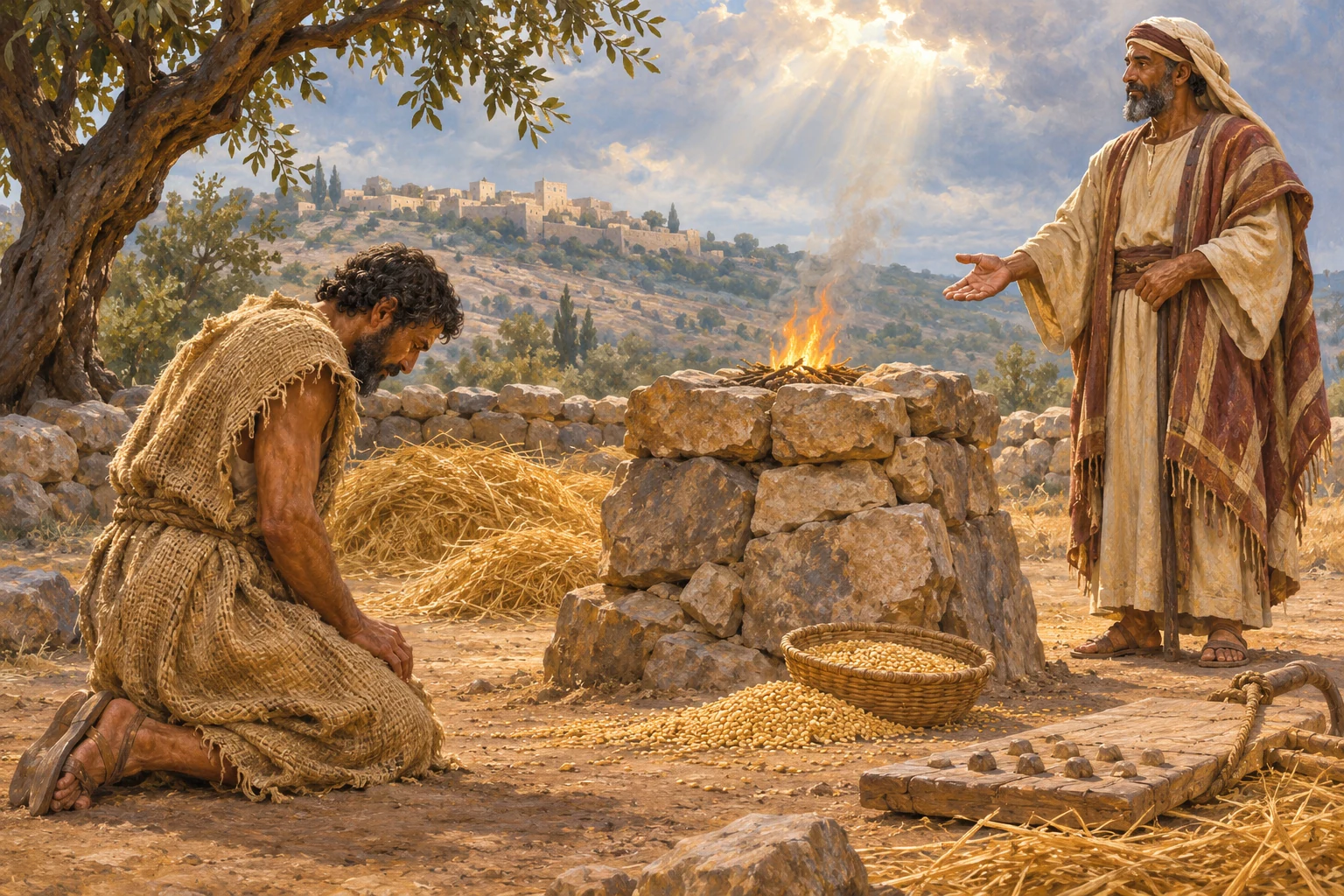
The angel directs Gad to tell David to build an altar on the threshing floor of Ornan the Jebusite (21:18). Ornan is working the harvest; Ornan's four sons hide when the angel appears (21:20). Ordinary work becomes a scene of holiness.
David approaches and requests the site for an altar so the plague may be stopped (21:21–22). Ornan offers the ground, oxen for sacrifice, threshing equipment for fuel, and wheat for an offering (21:23). A Jebusite contributes to Israel’s future worship center.
The agricultural setting invites reflection, though the text does not assign symbolic meaning to threshing.
When Worship Refuses to Cost Someone Else (21:24–27)
David rejects a free transfer and insists on paying the full price. The king refuses to bring God an offering that costs the king nothing or to take Ornan's property as though royal need erased another person's rights (21:24). David pays six hundred shekels of gold for the place (21:25). Second Samuel 24:24 reports fifty silver shekels for the floor and oxen; the difference remains unresolved.
David builds an altar, presents burnt and fellowship offerings, and calls upon the Lord. God answers with fire from heaven (21:26). The Lord then commands the angel to return the sword to its sheath (21:27). This sequence joins the Lord's prior compassion with an obedient, costly response at the divinely appointed place.
Confession now costs the king, not the landowner.
When the Old Sanctuary Points Toward a New Site (21:28–30)
Having seen God's answer, David continues to sacrifice at the threshing floor (21:28). Meanwhile, the Mosaic tabernacle and its altar stand at the high place in Gibeon (21:29; cf. 1 Chr 16:39–40). David cannot go there to inquire of God because of fear of the angel's sword (21:30).
The inherited sanctuary remains at Gibeon, but the new altar stands at Ornan’s floor. First Chronicles 22:1 will identify this place with the future house of the Lord; 2 Chronicles 3:1 will name Mount Moriah. Worship's future rises from the memory of judgment and mercy.
Theological Reflection: Where Mercy Marks the Ground
Security without Surrender Is a Dangerous Illusion
Joab's objection and God's verdict show that the issue is not statistics alone but a disordered confidence (21:3, 7). The king must not trust weapons above God (Deut 17:16–20; Ps 20:7).
Leadership Failure Has Communal Costs
People who never ordered the census die. David’s plea exposes the flock’s suffering through a shepherd’s failure (21:17). Repentance requires care for the harmed, not private regret alone.
Judgment Does Not Exhaust God's Character
God stops the angel before the altar is built (21:15), then answers prayer through fire and the sheathing of the sword (21:26–27). Holiness and mercy belong to the same God. The altar cannot manipulate mercy; it becomes a place of repentance and fellowship (Sailhamer 1983).
The Temple Begins with Mercy and Looks toward Christ
The future temple site is discovered in a crisis, not a victory parade (1 Chr 22:1; 2 Chr 3:1). Solomon will pray for forgiveness and return (2 Chr 6:24–39; 7:14). Jesus identifies the temple with the risen body of Christ (John 2:19–22). Through Christ, believers approach God by grace, not purchased immunity (Heb 9:11–14; 10:19–22).
Life Application: Put the Sword Down, Build the Altar
- Audit the numbers. Ask what a ministry counts and what the reporting misses: exhausted volunteers, neglected families, hidden debts, or people excluded from care.
- Welcome Joab's warning. Protect advisers who challenge unwise decisions. A leader who silences correction endangers the whole community.
- Name the harmed. When decisions injure people, investigate honestly, provide practical help, and make appropriate restitution rather than issuing vague apologies.
- Confess without shifting blame. Public leadership failures require clear ownership and structural change, not a search for scapegoats.
- Pay the real cost of repair. Do not make workers, donors, or vulnerable families finance a leader's restoration while the leader sacrifices nothing.
- Hold grief and hope together. Lament the seventy thousand rather than treating suffering as a decorative backdrop to a hopeful ending.
- Make worship a place of mercy. Strengthen prayer, transparent stewardship, protection for the vulnerable, and patient pathways of reconciliation.
Reflection Questions
- Which numbers have become a substitute for trusting and obeying the Lord?
- Whose warning has been dismissed because the leader preferred an impressive result?
- Who is bearing the cost of decisions made by people with greater power?
- What costly act of confession, restitution, or reform is overdue?
- Where might God be turning a painful interruption into a place of prayer and renewed service?
Response Prayer
Lord of Israel, when pride counts swords and forgets the flock, expose the false security of numbers. Give leaders courage to hear correction and to confess wrongdoing without excuses. Remember the people wounded by careless authority. Teach the church to lament honestly and repair what can be repaired. Where the sword has brought fear, show the mercy that stays destruction. Where the threshing floor bears memories of grief, raise an altar of prayer, justice, and costly obedience. Through Jesus Christ, the true meeting place of God and humanity, make the people whole and teach every generation to seek the Lord. Amen.
Window into What Comes Next
The angel's sword has entered its sheath. Fire has answered from heaven. But the threshing floor is not the end of the story. In 1 Chronicles 22, David will announce the site of God's house and begin preparing materials, workers, and Solomon for a temple David will not build. A place first marked by judgment and mercy will become the ground of Israel's remembered worship.
Annotated Bibliography
- Hill, Andrew E. 1 & 2 Chronicles. NIV Application Commentary. Grand Rapids: Zondervan, 2003. Connects the census and temple-site account with leadership, responsibility, and worship.
- Japhet, Sara. I & II Chronicles: A Commentary. Old Testament Library. Louisville: Westminster John Knox, 1993. Analyzes the Chronicler's distinctive shaping of David's sin, judgment, and the location of the temple.
- Klein, Ralph W. 1 Chronicles: A Commentary. Hermeneia. Minneapolis: Fortress, 2006. Examines the narrative's textual differences from Samuel and the issues surrounding satan and the census.
- Knoppers, Gary N. I Chronicles 10–29: A New Translation with Introduction and Commentary. Anchor Bible 12A. New York: Doubleday, 2004. Offers extensive literary, textual, and historical analysis of the temple-site narrative.
- Sailhamer, John. First and Second Chronicles. Everyman's Bible Commentary. Chicago: Moody Press, 1983. The supplied commentary connects royal self-reliance, God's great mercy, and the altar's future role as the temple site.
- Williamson, H. G. M. 1 and 2 Chronicles. New Century Bible Commentary. Grand Rapids: Eerdmans, 1982. Situates David's failure and the establishment of the worship site within the Chronicler's theology of covenant continuity.
Be the first to leave a comment.