

How can training, humility, and fair opportunities shape faithful musical service?
Study overview
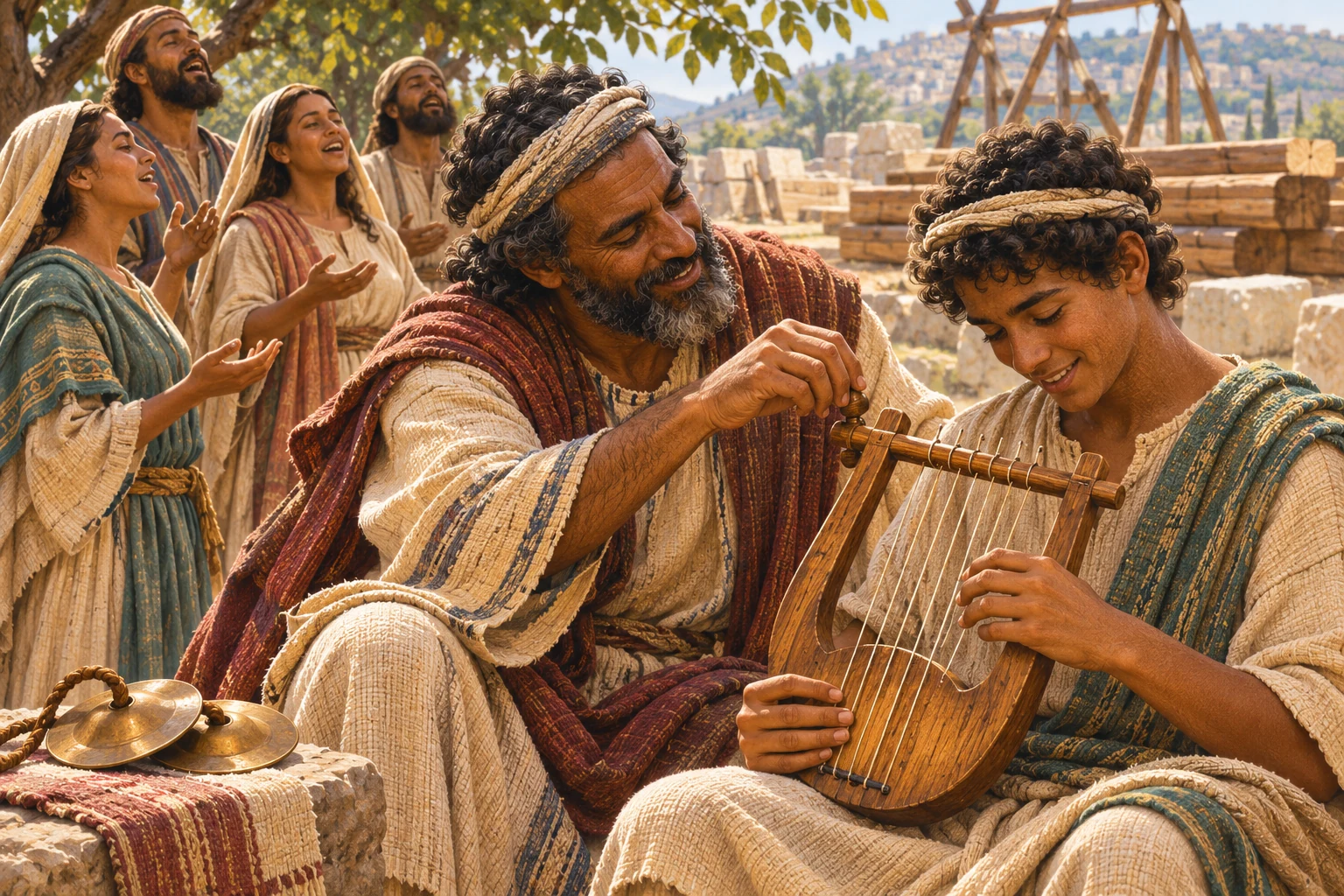
Before the temple walls rise, the instruments are being prepared. Families learn their places; teachers stand beside learners. The strings must carry more than melody: the song must remember whose house is being built.
Passage: 1 Chronicles 25:1–31
Controlling image: Strings tuned together for the worship of the Lord
Heart-question: When does beautiful music become faithful worship rather than an impressive performance?
Introduction: When the Song Is Louder Than the Message
A congregation may remember the melody long after the sermon. A choir can stir tears, lift tired hearts, and unite strangers in one voice. Yet a beautiful performance can also conceal shallow words, exhausted singers, or a hunger for applause.
After organizing priests and Levites (1 Chr 23–24), David now orders musical service through named families, training, and shared responsibilities. Most strikingly, the singers are described as prophesying with instruments (25:1–3). Worship is not entertainment added to the serious work of God's house. Worship is part of that work.
This text is about musical ability becoming disciplined, shared proclamation of God's truth. The strings must be tuned to the God being praised.
Historical and Literary Context: Preparing Songs for a House Not Yet Built
The Chronicler writes for a people learning covenant identity after the disaster of exile. Chapters 1–9 remember Israel's families; chapters 10–22 present David as a king who prepares the way for God's house. Chapter 23 organizes Levitical service, chapter 24 assigns priestly duties, and chapter 25 orders sacred music. Solomon, not David, will build the temple (1 Chr 22:8–10; 2 Chr 3:1).
Music has already accompanied the ark in Jerusalem (1 Chr 15:16–28), and Asaph has led thanksgiving before the Lord (16:4–7). Heman and Jeduthun are associated with the worship continuing at Gibeon (16:39–42). Chapter 25 provides an ordered vision of music for the coming house. As Sailhamer (1983) observes, the singers belong to the Levitical family traditions, and the Chronicler grounds musical service in David's preparations.
For postexilic worshipers, songs need covenant memory, training, truth, and dependable servants—not merely one gifted person.
Walking Through the Text
When the Strings Are Asked to Speak (25:1–3)
David and the commanders of the army set apart descendants of Asaph, Heman, and Jeduthun. Their involvement does not turn music into a weapon; the passage concerns worship. The musicians are to prophesy with lyres, harps, and cymbals (25:1). The verb is repeated for Asaph's ministry under the king's direction (25:2) and Jeduthun's ministry of thanksgiving and praise (25:3).
The language is striking. The music does not merely surround a message; song participates in declaring God's truth. Not every musical impression is therefore an infallible message from heaven. In this context, prophecy is closely linked to praise shaped by the Lord's word (Sailhamer 1983; cf. 1 Sam 10:5–6; 2 Kgs 3:15).
Asaph's sons are named; Jeduthun's sons are named. The Masoretic wording of verse 3 lists five names while speaking of six sons. Some ancient witnesses include Shimei, who appears among the later divisions (25:17). The textual difference should be acknowledged rather than concealed.
No lyrics are reproduced. The emphasis is who sings, for whom, and under what responsibilities.
When a Family Becomes a School of Praise (25:4–6)
Heman's fourteen sons are listed by name. Verse 5 calls Heman the king's seer, connecting musical leadership with the discernment of God's word. The verse also names three daughters, although the chapter does not clearly specify their musical assignments (25:4–5).
Heman's household is presented as a gift of God. The wording concerning the raising of a “horn” in verse 5 evokes strength or honor, but its precise interpretation is debated. It would be unwise to turn a difficult phrase into a detailed promise the text never explains (Klein 2006).
The families serve under parental direction, while Asaph, Heman, and Jeduthun remain accountable within David's royal arrangements (25:6). The imagery is not of isolated stars but of generations learning together. Teaching, supervision, and inherited memory make worship durable.
Ancient family organization does not justify modern nepotism. Churches must test character and welcome gifts beyond influential families.
When Skill Is Cultivated, Not Assumed (25:7–8)
The Chronicler counts 288 musicians trained in singing to the Lord, all described as skilled (25:7). Training matters; enthusiasm cannot replace rehearsal or biblical understanding.
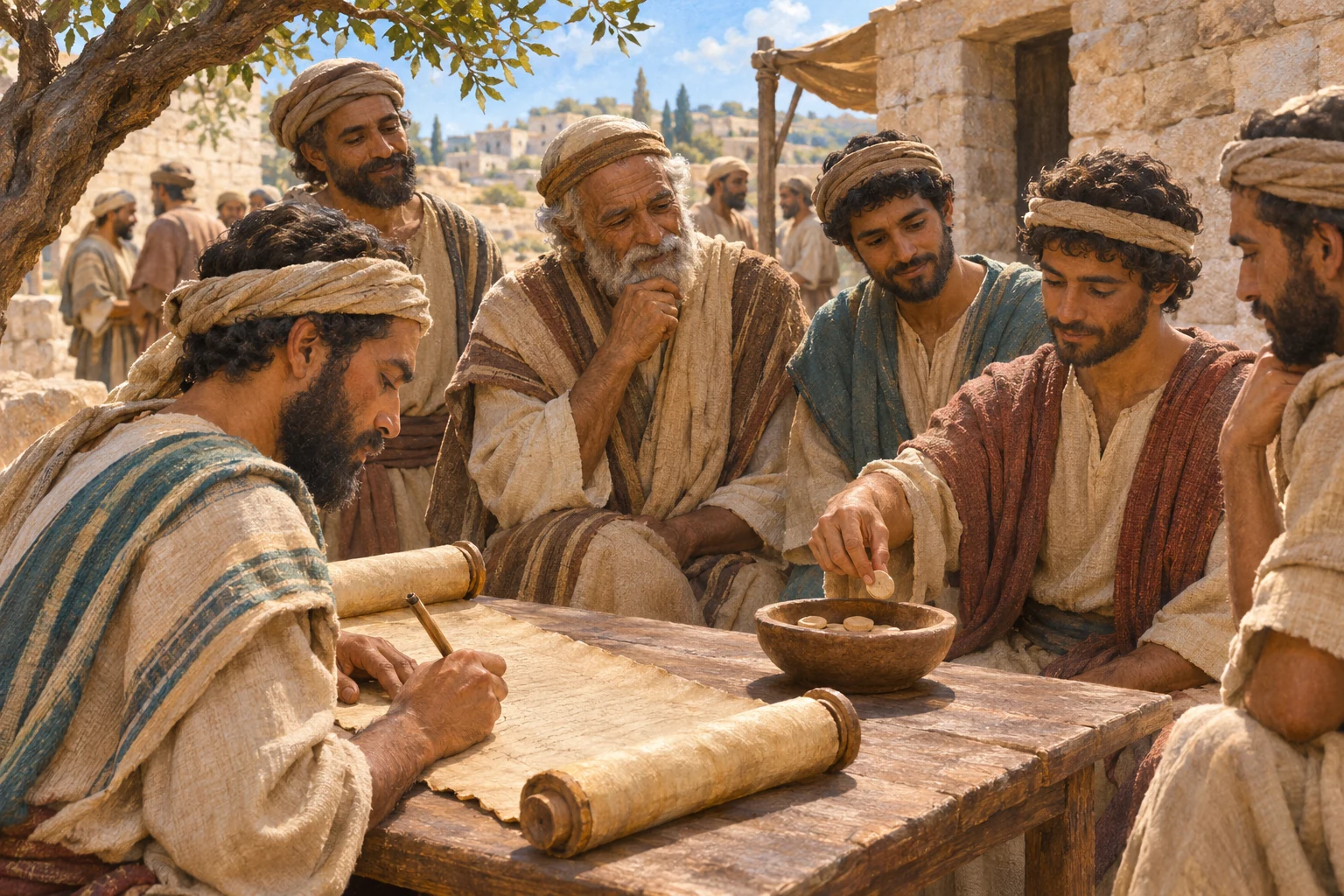
Then comes a counterweight to hierarchy: duties are assigned by lot, including young and old, teacher and student (25:8). The procedure does not erase experience; rather, it prevents seniority from becoming unlimited privilege. Experienced leaders and developing musicians both receive a place within ordered service.
Skill without humility becomes display. Humility without preparation can become carelessness. Here excellence and fairness are asked to stand together before God (Japhet 1993; Knoppers 2004).
When the First Voices Are Given Their Places (25:9–20)
The first lot falls to Joseph, from Asaph's family; the second to Gedaliah; the third to Zaccur (25:9–10). Later assignments include Nethaniah, Bukkiah, Jesharelah, Jeshaiah, Mattaniah, Shimei, and Hashabiah. Each listed course consists of twelve singers (25:9–20).
The structure recalls the priestly courses of chapter 24, though no complete performance timetable is supplied. The evident point is continuity: worship is shared through named, accountable groups rather than entrusted to one permanent ensemble.
Even rarely remembered singers have a place in Israel’s worship record. What seems administrative becomes theological: the Lord's praise deserves dependable people, not merely occasional inspiration.
When the Final Lot Completes the Choir (25:21–31)
The sequence continues through Mattithiah, Jeremoth, Hananiah, Joshbekashah, Hanani, Mallothi, Eliathah, Hothir, Giddalti, and Mahazioth. The twenty-fourth lot falls to Romamti-ezer (25:21–31). Twenty-four groups of twelve correspond to the total of 288 trained musicians.
Repetition serves a purpose: no group disappears behind a more celebrated singer. Worship remains larger than the reputation of any one musician.
The house is still waiting to be built. Already its future songs have guardians, students, teachers, and an orderly place in the life of Israel. A renewed people must learn to sing truthfully before the walls are finished.
Theological Reflection: What Makes a Song Holy?
Praise Is a Form of Remembering God's Word
The Chronicler's unusual language connects prophecy and music (25:1–3). Elsewhere, David's singers call Israel to remember God's covenant and announce divine deeds among the nations (1 Chr 16:8–24). Biblical worship is therefore more than religious atmosphere. Song carries truth from one generation to another (Deut 31:19–22; Ps 78:1–7).
The Temple Requires Both Beauty and Order
The musicians serve alongside priests and Levites. Their training and assignments reveal care for the holiness of worship (25:6–8). Order must not strangle joy, and joy must not dismiss preparation. The same Chronicles narrative that celebrates lively praise also insists on approaching God faithfully (1 Chr 13:7–10; 15:13–16).
No Gift Should Become a Private Throne
Teachers and students share the allocation of duties (25:8). Neither artistic excellence nor seniority makes anyone the owner of God's house. The New Testament portrays different gifts serving the one body (1 Cor 12:4–7, 12–27). Accountability, teaching, and opportunities for others help musical gifts become ministry instead of celebrity.
The Song Widens through Christ to the Nations
The later church is called to let Christ's word dwell richly through psalms, hymns, and spiritual songs (Col 3:16; Eph 5:18–20). In Revelation, worship expands beyond one sanctuary and people, gathering worshipers from every nation around the Lamb (Rev 5:9–10). The goal is not to reproduce Israel's ancient musical roster, but to let truthful praise form a people who bear witness to the true Son of David.
Life Application: Tune the Whole Community
- Examine the lyrics. Review congregational songs for biblical faithfulness, understandable language, and an honest picture of God. A moving melody cannot repair misleading theology.
- Train rather than merely recruit. Provide rehearsals, mentoring, Bible study, and practical instruction in voice and instruments. Help beginners grow without public humiliation.
- Share opportunities fairly. Use transparent schedules so established singers, younger musicians, and less visible members can contribute appropriately.
- Protect workers from exhaustion. Budget for preparation, reasonable hours, equipment, rest, and safeguarding; never treat unpaid service as limitless availability.
- Honor diverse voices. Encourage music understandable to the congregation, including local languages and musical gifts, while retaining theological discernment.
- Keep worship accountable. Invite careful feedback about song choices, conduct, finances, and leadership. Prevent a gifted musician from becoming untouchable.
- Carry songs beyond the sanctuary. Teach families and small groups psalms and biblically grounded hymns that sustain prayer, grief, gratitude, and hope throughout the week.
Reflection Questions
- Which songs are shaping the congregation's understanding of God, and are the words faithful to Scripture?
- Where has performance begun to overshadow participation and reverence?
- Who needs musical training, meaningful responsibility, or a fair opportunity to serve?
- Which unseen singers, instrumentalists, and caregivers carry an unsustainable burden?
- How can worship form a community that remembers God's promises and serves the world?
Response Prayer
Lord of Israel, tune the hearts of the church to the truth of God's word. Make every harp, drum, voice, and quiet prayer an offering of reverence, not a stage for vanity. Give teachers patience and learners courage. Protect those who labor behind the song; correct words that distort God's character. Let trained hands serve humble hearts, and let joy rise from obedience. Prepare the living house of Christ for praise that remembers mercy, speaks truth, and welcomes the nations. Through Jesus Christ, the Son of David. Amen.
Window into What Comes Next
The singers have received their places, and the imagined sound of worship fills a house not yet built. But sacred service involves more than music. First Chronicles 26 will turn toward gatekeepers, treasuries, and officials. The next chapter asks who guards the thresholds and stewards the gifts when the singing is over.
Annotated Bibliography
- Hill, Andrew E. 1 & 2 Chronicles. NIV Application Commentary. Grand Rapids: Zondervan, 2003. Connects temple worship with leadership, communal formation, and practical service.
- Japhet, Sara. I & II Chronicles: A Commentary. Old Testament Library. Louisville: Westminster John Knox, 1993. Explores the literary and theological role of Levitical singers and temple arrangements.
- Klein, Ralph W. 1 Chronicles: A Commentary. Hermeneia. Minneapolis: Fortress, 2006. Examines textual difficulties, family lists, and the organization of twenty-four musical divisions.
- Knoppers, Gary N. I Chronicles 10–29: A New Translation with Introduction and Commentary. Anchor Bible 12A. New York: Doubleday, 2004. Provides detailed critical analysis of David's worship administration and Levitical traditions.
- Sailhamer, John. First and Second Chronicles. Everyman's Bible Commentary. Chicago: Moody Press, 1983. The supplied commentary emphasizes the singers' Levitical identity and their role in prophetic praise with instruments.
- Williamson, H. G. M. 1 and 2 Chronicles. New Century Bible Commentary. Grand Rapids: Eerdmans, 1982. Places ordered musical service within the Chronicler's wider hope for restored covenant worship.
Be the first to leave a comment.