

How can victory be assessed through truth, justice, and the human cost of success?
Study overview
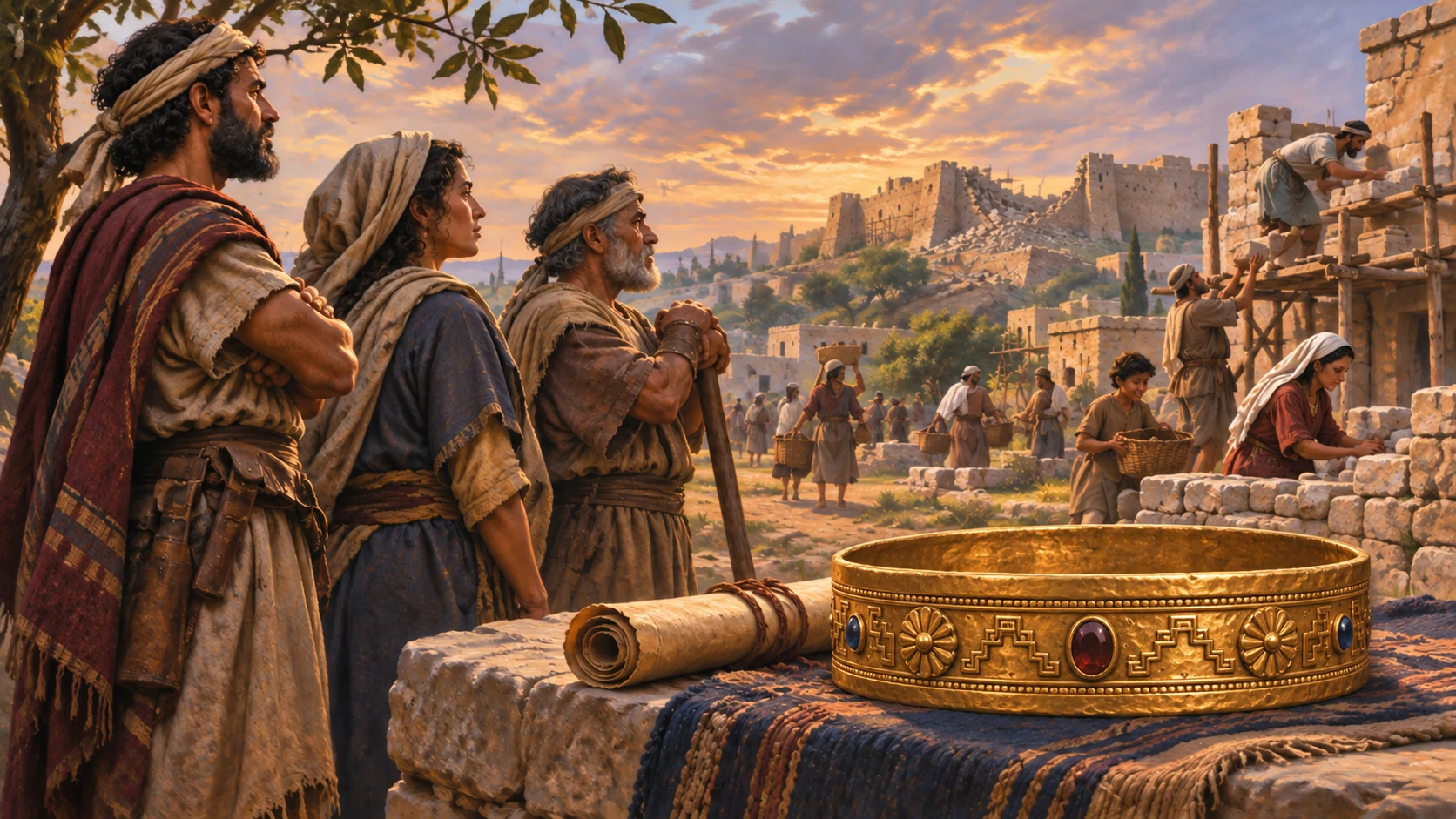
The gates of Rabbah fall; a heavy crown changes hands. Beyond the city, giants still rise, and other hands bring them down. But history asks more of a king than the number of enemies defeated.
Passage: 1 Chronicles 20:1–8
Controlling image: A heavy crown that cannot carry the moral weight of kingship
Heart-question: What does victory mean when public success and private responsibility must stand before the same God?
Introduction: When Winning Is Not the Whole Story
Communities can celebrate achievements while overlooking human costs. Victory reports are not complete moral biographies.
First Chronicles 20 is brief: Rabbah falls, a crown passes to David, and Philistine champions are defeated. The chapter follows God’s promise (17:8–10) and the Ammonite conflict (19:1–19), raising questions about conquest, captives, and parallel accounts.
This text is about royal victory becoming a test of covenant responsibility. The Chronicler remembers God's preservation of David's kingdom, but the wider biblical witness insists that strength must be governed by justice, truth, and obedience.
Historical and Literary Context: A Victory Report Beside a Difficult Silence
Chapters 18–20 form a cluster of David's military victories following God's covenant promise in chapter 17. The Lord helped David (18:6, 13), who was to administer justice (18:14). These claims frame the commanders’ victories.
The first three verses run parallel to 2 Samuel 11:1 and 12:26–31. The interval between those passages in Samuel contains David's abuse of Bathsheba, the arranged death of Uriah, Nathan's confrontation, and David's confession (2 Sam 11:2–12:25). Chronicles does not retell those episodes here. The omission’s precise motivation is unstated. Chronicles focuses on the kingdom and temple preparations (1 Chr 21–22). Reading Samuel alongside Chronicles prevents the silence from becoming moral approval (Japhet 1993; Klein 2006).
For postexilic readers, God’s promise endured surrounding threats. Covenant memory, however, must remain truthful about injustice.
Walking Through the Text
When Spring Brings an Army to Rabbah (20:1)
At the turn of the year, the season of military campaigns, Joab leads Israel's forces against Ammon, devastates its territory, and besieges Rabbah. David remains in Jerusalem. Joab captures and devastates the city (20:1).
This completes the conflict begun by Ammon’s humiliation of David’s envoys (19:1–9). David’s reason for remaining in Jerusalem is unstated.
The opening echoes 2 Samuel 11:1, where David's absence from the battlefield introduces the Bathsheba narrative. Chronicles passes directly to Rabbah's defeat. Remaining in Jerusalem is not itself called sinful here. Yet victory cannot erase David’s abuse of power in 2 Samuel 11–12. The theological historian chooses a focus; the biblical canon preserves the warning.
When the Crown Weighs More Than Gold (20:2–3)
David takes a crown of gold ornamented with precious stones. The crown weighs a talent of gold, an extraordinary weight, and is placed on David's head (20:2). Translations differ over whether the crown belonged to the Ammonite king or to Milcom, the Ammonite deity; the Hebrew wording permits debate. The narrative plainly portrays the transfer of royal prestige after Rabbah's defeat (Knoppers 2004).
David also takes extensive spoil. The next verse turns toward the defeated population. Many contemporary translations describe the inhabitants as being brought out and assigned hard labor with saws, iron picks, and axes. Some older translations instead describe violent treatment with such implements. The Hebrew’s ambiguity must remain visible (20:3; 2 Sam 12:31).
Either reading reveals conquest’s consequences, not a mandate for churches to imitate domination. A crown may symbolize authority, but no crown grants unlimited ownership of human lives. David's stated duty to administer justice (18:14) remains the standard by which royal power must be considered.
When Sibbecai Faces the Threat at Gezer (20:4)
The narrative shifts to renewed conflict with the Philistines at Gezer. Sibbecai the Hushathite kills Sippai, described as a descendant of the Rephaim, a group associated here with formidable warriors. The Philistines are subdued (20:4).
One verse honors Sibbecai. The Chronicler does not credit David’s sword with every triumph.
The account also echoes the earlier confrontation between David and Goliath (1 Sam 17:40–51). But the later victories belong to other servants. Faithfulness must not become the private legend of one celebrated leader; the next generation also bears responsibility.
When Elhanan's Victory Raises a Textual Question (20:5)
A second battle brings another named warrior: Elhanan son of Jair kills Lahmi, brother of Goliath of Gath. The opponent carries a spear with a shaft compared to a weaver's beam (20:5).
The parallel in the received Hebrew text of 2 Samuel 21:19 says Elhanan killed Goliath, creating a tension with both 1 Chronicles 20:5 and David's victory over Goliath in 1 Samuel 17. Scholars discuss textual transmission and differences involving Lahmi and Bethlehemite; the exact reconstruction is debated (Klein 2006; Knoppers 2004). The responsible approach is to state the difference, not invent certainty.
Israel’s preservation involved named servants. No past victory eliminated future threats.
When a Giant Falls and Servants Share the Victory (20:6–8)
Another battle occurs at Gath. A remarkably large warrior has six fingers on each hand and six toes on each foot—twenty-four digits altogether. The warrior taunts Israel, and Jonathan son of Shimea, David's brother, kills the challenger (20:6–7). Jonathan is therefore David's nephew.
The extra digits describe a physical trait, not moral wickedness. The taunt matters. Neither the number twenty-four nor the warrior's anatomy should become a basis for invented symbolic codes.
The concluding verse gathers the episodes into one statement: these descendants from Gath fell by the hand of David and by the hand of his servants (20:8). That formulation gives David responsibility as king while naming the wider company who acted. In the Chronicler's vision, royal strength is shared rather than solitary.
Theological Reflection: The King Beneath the Crown
God's Covenant Promise Survives External Threats
God promised to cut off David's enemies and establish a place for Israel (17:8–10). The victories of chapters 18–20 are narrated as part of that promise's unfolding (18:6, 13). Yet the promise is not permission to justify every action of a king. The same God who preserves Israel also commands justice and judges evil (Deut 17:18–20; Ps 89:30–33).
Conquest Must Never Be Confused with Moral Innocence
The crown and spoils display political dominance, but the fate of captives remains troubling (20:2–3). Samuel's account of Bathsheba and Uriah further exposes the danger of unrestrained authority (2 Sam 11–12). A theological reading must neither erase the Chronicler's emphasis nor let national success excuse oppression. God's people are commanded to do justice, defend the vulnerable, and confess wrongdoing (Isa 1:16–17; Mic 6:8).
Courage Belongs to a Community, Not a Celebrity
Sibbecai, Elhanan, and Jonathan appear by name (20:4–7). Scripture remembers many hands beneath one crown. The church similarly receives diverse gifts and ministries; no leader can claim to be the whole body (1 Cor 12:12–27). Faithful leaders cultivate successors rather than making every victory depend on personal fame.
The Son of David Brings a Different Kind of Victory
The Davidic promise points beyond its first kings toward the promised ruler of lasting righteousness (1 Chr 17:11–14; Isa 9:6–7). Jesus, the Son of David, does not establish God's kingdom by coercive conquest. Jesus overcomes evil through faithful service, the cross, and resurrection (Mark 10:42–45; Col 2:13–15). The crown of Christ exposes the limits of crowns won by war: true kingship gives life rather than treating others as expendable.
Life Application: Carry the Crown with Accountability
- Tell complete stories. Celebrate a ministry's achievements without suppressing credible accounts of harm, exploitation, or misconduct.
- Measure success by justice. Review how employees, volunteers, families, and vulnerable people are treated, not only budgets, attendance, or public recognition.
- Honor unseen contributors. Name and support the equivalent of Sibbecai, Elhanan, and Jonathan—workers whose faithful actions protect the community.
- Reject coercion. Never use spiritual authority, fundraising targets, or institutional success to justify unsafe labor, intimidation, or humiliation.
- Create safeguards for leaders. Establish independent financial review, transparent decisions, pastoral accountability, and safe reporting of abuses.
- Prepare future servants. Mentor emerging leaders and share meaningful responsibilities instead of building a ministry around one irreplaceable personality.
- Confess what victory cannot cover. Where previous success has hidden wrongdoing, seek truth, protect the harmed, and pursue appropriate restitution.
Reflection Questions
- Which visible success might be distracting the community from a neglected moral responsibility?
- Who paid a hidden human cost for a celebrated achievement?
- Which faithful servants remain unnamed or unsupported?
- Where has leadership mistaken power or popularity for divine approval?
- What truthful confession or structural reform must come before the next celebration?
Response Prayer
Lord of the covenant, the crown is heavy and every human throne is accountable before God. Keep success from hardening hearts. Teach leaders to honor those who serve, protect those who suffer, and hear the cries left outside victory songs. Where power has wounded people, grant courage for confession, justice, and repair. Remember the ordinary hands that guard the community. Give the church the humility of the true Son of David, whose authority is revealed in self-giving love. Prepare hearts not merely to win, but to worship and obey. Amen.
Window into What Comes Next
Rabbah has fallen, and the champions of Gath have been defeated. Yet the deepest danger to Israel does not always arrive with an enemy's spear. In 1 Chronicles 21, David will order a census, and the desire to measure strength will expose the weakness beneath the throne. The story will move from the army to an altar, where judgment and mercy prepare the ground for God's house.
Annotated Bibliography
- Hill, Andrew E. 1 & 2 Chronicles. NIV Application Commentary. Grand Rapids: Zondervan, 2003. Connects the Chronicler's narratives of kingship and community with the responsibilities of contemporary leaders.
- Japhet, Sara. I & II Chronicles: A Commentary. Old Testament Library. Louisville: Westminster John Knox, 1993. Explores literary selection and the shaping of David's victories within the postexilic narrative.
- Klein, Ralph W. 1 Chronicles: A Commentary. Hermeneia. Minneapolis: Fortress, 2006. Examines textual variations and relationships between Chronicles and Samuel, especially the giant-warrior traditions.
- Knoppers, Gary N. I Chronicles 10–29: A New Translation with Introduction and Commentary. Anchor Bible 12A. New York: Doubleday, 2004. Provides historical and text-critical discussion of Rabbah, the crown, captives, and Philistine battles.
- Sailhamer, John. First and Second Chronicles. Everyman's Bible Commentary. Chicago: Moody Press, 1983. The supplied source reads David's victories within God's promise to establish Israel's security and the approach to temple preparation.
- Williamson, H. G. M. 1 and 2 Chronicles. New Century Bible Commentary. Grand Rapids: Eerdmans, 1982. Situates military success within the Chronicler's covenant and temple-centered theological history.
Be the first to leave a comment.