

How can success and resources become a trust for worship, justice, and communal care?
Study overview
The swords fall silent, but the story is not finished. Gold enters Jerusalem; bronze waits for a house not yet built. At the kingdom’s heart, the question is whether victory will serve God and the people—or merely enlarge a crown.
Passage: 1 Chronicles 18:1–17
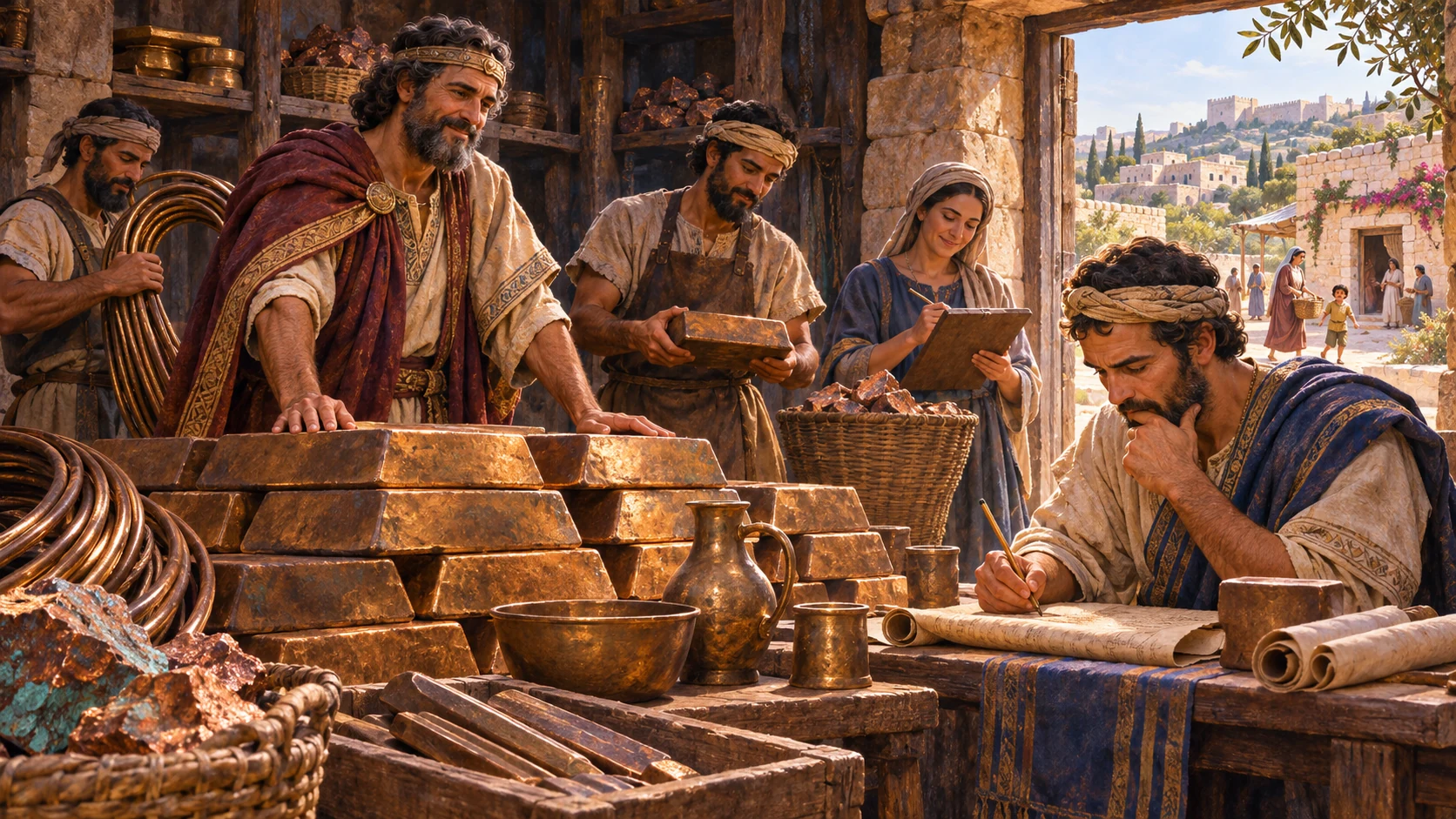
Controlling metaphor: Bronze taken from battle and set aside for God’s future house
Heart-question: What should leaders do with power, wealth, and success after God grants an opportunity to prevail?
Introduction: What Happens After the Victory?
Success can obscure a calling. A project begins by serving people, but growth, resources, and reputation can blur the original purpose.
First Chronicles 18 records victories over Philistia, Moab, Zobah, Damascus, and Edom. Twice the Lord gives David victory (18:6, 13). Gold and bronze become offerings and temple materials; government is charged with justice (18:8, 11, 14).
This text is about military success becoming stewardship accountable to God's worship and the people's well-being. War is neither painless nor automatically justified. The bronze awaiting the sanctuary tests the king’s priorities.
Historical and Literary Context: The Promise Enters History
In chapter 17 God promises to make David’s name great, subdue enemies, provide a secure place for Israel, and establish a lasting royal house (17:7–14). Chapter 18 begins the narrative demonstration of that promise. David’s authority expands, but God remains the principal actor behind Israel’s security.
The account closely parallels 2 Samuel 8. Chronicles, however, explicitly connects the bronze captured from Hadadezer’s cities with the furnishings Solomon would make for the temple (1 Chr 18:8; cf. 2 Sam 8:8). The Chronicler therefore reads military achievement through the unfinished story of God’s house (Knoppers 2004; Japhet 1993).
For postexilic readers, the questions were God’s faithfulness, restored worship, and just leadership—not nostalgia for armies. Sailhamer (1983) links victory with covenant security. David prepares a temple that Solomon will build (22:7–10).
Walking Through the Text
When the Borders Change, but the Promise Remains the Measure (18:1–2)
David defeats the Philistines and takes Gath and its surrounding villages (18:1). The Philistines had threatened Israel repeatedly and had defeated Saul at Gilboa (10:1–7). David also defeats Moab, whose people become subject to David and pay tribute (18:2).
The spare narration offers no battle speeches or celebration of suffering. Former threats no longer dominate Israel.
Ruth, David’s ancestor, came from Moab (Ruth 4:13–22). That kinship warns against flattening an entire people into one label. The text reports ancient subjugation; the church must not transform the report into permission to dominate neighbors or nations.
When Chariots Fall and the Lord Receives the Credit (18:3–8)
The narrative turns north toward Hadadezer of Zobah, with conflict reaching toward the Euphrates (18:3). David captures chariots, cavalry, and infantry, disables most captured chariot horses, and retains a limited number (18:4). When Arameans from Damascus come to Hadadezer’s aid, David defeats them; Aram becomes tributary, with garrisons established in the Damascus region (18:5–6).
Ancient warfare included violence and coerced tribute, while civilian suffering remains largely unreported. The account is no blueprint for Christian domination.
The decisive refrain credits the Lord with David’s victories (18:6), not autonomous military strength. Deuteronomy had already warned kings against multiplying horses as an expression of misplaced trust (Deut 17:16). The text does not say David disabled horses to obey Deuteronomy; deliverance is credited to God.
Then the account looks beyond war. David carries golden shields to Jerusalem and obtains bronze from Tibhath and Cun. The Chronicler adds that Solomon later used this bronze for the great bronze basin, pillars, and other temple objects (18:7–8; cf. 2 Chr 4:2–6, 12–16). The metal outlasts the battlefield and enters worship’s story.
When Foreign Gifts Are Laid Before the Lord (18:9–11)
Tou, king of Hamath, hears that David has defeated Hadadezer, an old adversary of Tou. Tou sends Hadoram with a greeting and objects of gold, silver, and bronze (18:9–10). The scene shifts to diplomacy, not an explicit confession of Tou’s faith.
David dedicates those gifts to the Lord, together with silver and gold acquired from other nations—Edom, Moab, Ammon, Philistia, and Amalek (18:11). Dedication acknowledges God’s claim on wealth.
Dedication cannot sanctify injustice in acquiring wealth (Isa 1:11–17; Mic 6:6–8). Worship and justice belong together.
When the Lord Gives Victory in the Valley of Salt (18:12–13)
Abishai son of Zeruiah defeats eighteen thousand Edomites in the Valley of Salt. Garrisons follow (18:12–13).
The parallel passages preserve differences in how the victory is reported: 2 Samuel 8:13 associates the achievement with David and has a different ethnic reading in some textual traditions; the heading of Psalm 60 mentions Joab and a different number. The differences should not be forcibly harmonized (Klein 2006; Knoppers 2004).
What is unmistakable is the repeated refrain: the Lord gave David victory wherever David went (18:13). God’s faithfulness does not make every military method worthy of imitation.
When the King Must Build Justice, Not Only a Kingdom (18:14–17)
The narrative ends unexpectedly. Instead of another conquered city, verse 14 announces that David reigns over all Israel and administers justice and righteousness to all David’s people. The offices follow: Joab commands the army; Jehoshaphat serves as recorder; Zadok and a priest named Ahimelech/Abimelech appear; Shavsha serves as secretary; Benaiah oversees the Cherethites and Pelethites; and David’s sons hold senior royal positions (18:15–17).
Some priestly names vary across manuscripts and the Samuel parallel, particularly Ahimelech/Abimelech; the references should not be pressed into a certainty the textual evidence cannot provide (Klein 2006). Government requires administration, records, spiritual service, and accountability.
The victories culminate in responsibility for people, not tribute alone. Justice and righteousness are the measure of leadership’s public purpose (cf. Ps 72:1–4; Jer 22:3). Royal accountability includes people’s living conditions.
Theological Reflection: Where Does Victory Belong?
Divine Promise Does Not Make Human Strength Ultimate
God’s promise in 17:8–10 begins to take historical shape, and the twice-repeated victory refrain assigns credit to the Lord (18:6, 13). Success should produce thanksgiving, not the illusion that a leader has become indispensable (Deut 8:17–18). For communities recovering after collapse, the promise remains a ground for hope even when visible strength is absent.
Worship Reorders What Power Accumulates
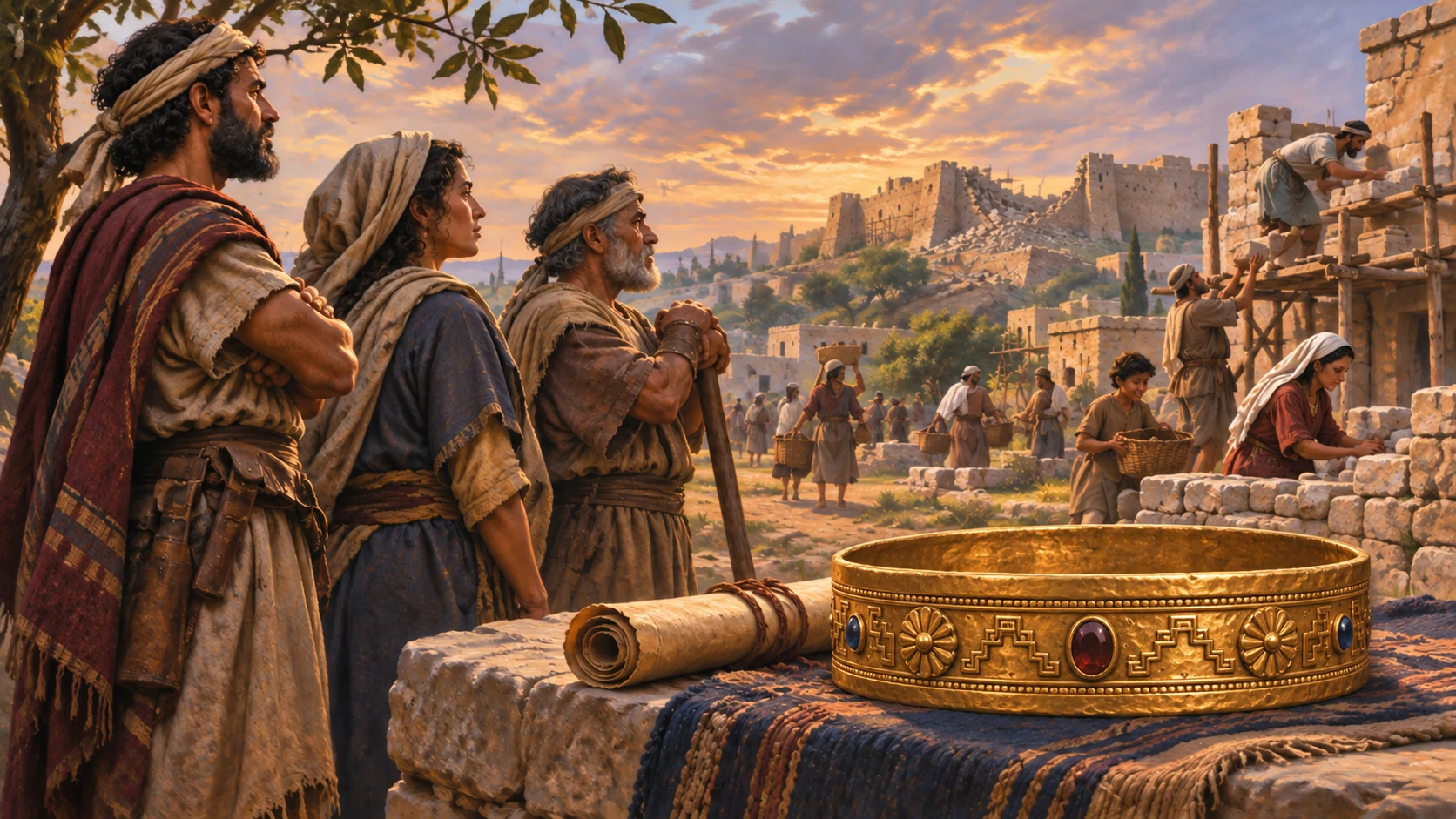
The bronze destined for Solomon’s temple and the gifts dedicated to God show the king refusing, at least here, to treat wealth as an exclusively private possession (18:8, 11). Yet the temple’s glory must never mask the ethical cost of power. Later, David is told that Solomon—not a king who has shed much blood—will build the house (22:8–10). Victory may prepare a future that the victor is not appointed to complete.
Justice Is the Public Test of Covenant Kingship
Verse 14 is not a decorative closing sentence. Justice and righteousness reveal what the kingdom is meant to provide for Israel’s people. Prophetic hope for David’s heir deepens the same measure (Isa 9:6–7; 11:1–5). Worship without care for the vulnerable is a broken witness (Isa 1:16–17).
The Greater Son of David Transforms the Meaning of Victory
Christians recognize the promised Davidic ruler in Jesus (Luke 1:32–33). Jesus rejects coercive models of leadership and teaches that greatness is service (Mark 10:42–45). Christ’s victory comes through faithful suffering, resurrection, and the defeat of evil—not the subjugation of neighboring peoples (Col 2:13–15). The deepest purpose of kingship is a people reconciled to God, practicing justice and sharing peace.
Life Application: Place the Bronze Before God
- Audit the fruits of success. Review whether ministry growth has improved discipleship, care for the poor, safeguarding, and fairness—not simply attendance or financial reserves.
- Dedicate resources transparently. Set clear budgets, publish understandable accounts, and direct gifts toward genuine community needs rather than personal prestige.
- Question harmful methods. Never excuse intimidation, exploitation, or abuse because a program produces impressive results. Repair harm before celebrating expansion.
- Protect the people behind the victories. Check the welfare of staff, volunteers, families, and communities paying hidden costs for institutional achievement.
- Build durable institutions. Establish fair decision-making, records, grievance procedures, and competent administration alongside worship and teaching.
- Prepare work others will finish. Like David setting aside bronze for Solomon, mentor successors and provide tools without demanding personal ownership of every result.
- Measure leadership by justice. Listen to the vulnerable, correct unequal treatment, and make righteousness visible in ordinary decisions.
Reflection Questions
- What recent achievement is tempting a leader or congregation to trust its own strength?
- Which resources are being accumulated instead of serving worship and neighbors?
- Who carries the hidden human cost of celebrated successes?
- Is justice visible in daily administration, or does justice appear only in public speeches?
- What useful preparation can be offered for a future generation without controlling the outcome?
Response Prayer
Lord of the covenant, God who kept the promise to David, receive every victory without receiving our pride. Let gold and bronze become instruments of faithful worship, not monuments to human importance. Where success has hidden suffering, open eyes and restore justice. Give rulers and servants clean hands, honest records, and hearts that seek the Lord. Teach the church to build what the next generation will need and to release what no leader can own. Through Jesus Christ, the righteous Son of David, turn power into service and achievement into praise. Amen.
Window into What Comes Next
The kingdom has grown stronger, treasure has been set aside, and the Chronicler has named justice as the king’s charge. But strength does not remove the danger of misunderstanding. In 1 Chronicles 19, David offers kindness to a neighboring king; suspicion turns kindness into humiliation and then into war. The next chapter asks whether a community can recognize mercy before fear destroys peace.
Annotated Bibliography
- Hill, Andrew E. 1 & 2 Chronicles. NIV Application Commentary. Grand Rapids: Zondervan, 2003. Connects royal power, stewardship, and the chapter’s concern for the public life of Israel.
- Japhet, Sara. I & II Chronicles: A Commentary. Old Testament Library. Louisville: Westminster John Knox, 1993. Explains how the Chronicler selects and shapes military material in light of temple hope.
- Klein, Ralph W. 1 Chronicles: A Commentary. Hermeneia. Minneapolis: Fortress, 2006. Discusses textual variants, officials, and relationships with 2 Samuel 8.
- Knoppers, Gary N. I Chronicles 10–29: A New Translation with Introduction and Commentary. Anchor Bible 12A. New York: Doubleday, 2004. Provides detailed historical and literary analysis of David’s campaigns and administration.
- Sailhamer, John. First and Second Chronicles. Everyman’s Bible Commentary. Chicago: Moody Press, 1983. The supplied commentary relates David’s victories to divine covenant faithfulness and the preparation of worship.
- Williamson, H. G. M. 1 and 2 Chronicles. New Century Bible Commentary. Grand Rapids: Eerdmans, 1982. Situates military success and the temple within the Chronicler’s picture of the Davidic promise.
Be the first to leave a comment.