

When a worthy plan is refused, how can God’s promise guide service for future generations?
Study overview
David sees cedar beams and thinks of a dwelling for God. God sees a shepherd's fragile household and speaks of a kingdom beyond death. The king offers a building; the Lord gives a future.
Passage: 1 Chronicles 17:1–27
Controlling metaphor: A cedar house transformed into a covenant house
Heart-question: When a worthy plan meets God's refusal, can ambition yield to a greater promise?
Introduction: When Good Plans Must Bow
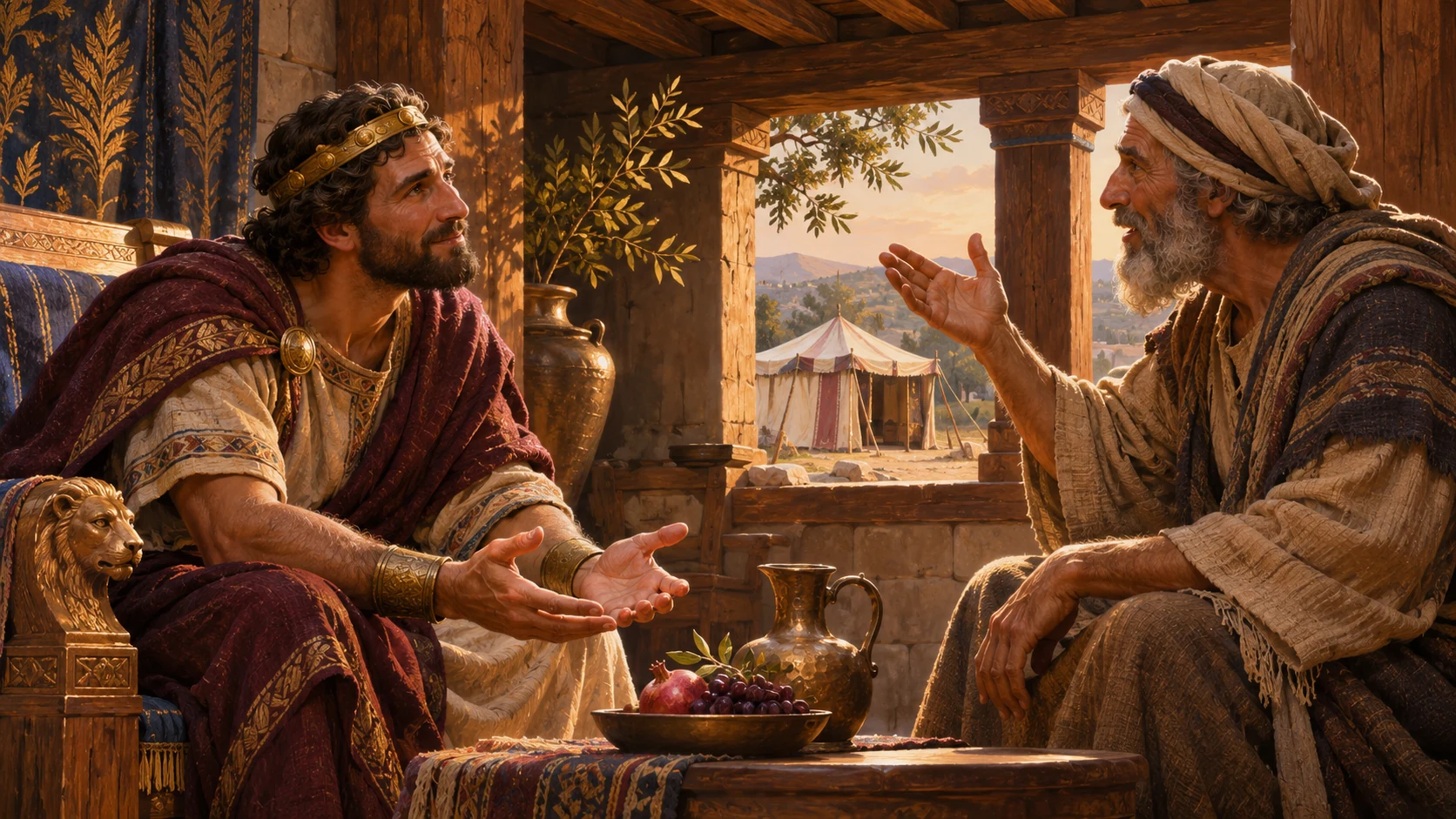
After years of danger, David lives in a cedar palace while the ark remains beneath tent curtains (17:1). The king wants God’s dwelling to receive fitting honor.
The Lord reverses David’s generous proposal. David will not build God’s house; God will establish David’s house—a royal family with a future beyond the king’s lifetime (17:4, 10–14).
This text is about a king's desire to build for God becoming trust in the God who builds a future for the king and the people. The central question is not whether generosity matters, but whether even generous ambition can submit to God's initiative.
Historical and Literary Context: After the Ark, Before the Temple
Chapters 13–16 describe the ark's interrupted journey, David's corrected approach, and Israel's renewed praise. Chapter 16 concludes with a song announcing covenant faithfulness among the nations. Chapter 17 explains why the temple's future belongs to God's promise rather than simply to David's royal program.
The account parallels 2 Samuel 7:1–29, but addresses postexilic readers with a rebuilt temple and no reigning Davidic king. The Chronicler selects details that foreground God's enduring house and kingdom (Japhet 1993; Knoppers 2004). Where 2 Samuel 7:14 includes discipline for a royal son's wrongdoing, 1 Chronicles 17:13 emphasizes lasting divine favor. This difference reflects literary emphasis, not proof that David's successors could sin without consequences (2 Chr 7:17–22).
Sailhamer (1983) locates Israel’s hope in divine promise rather than royal construction. The covenant offered hope beyond David’s death without denying national collapse.
Walking Through the Text
When Cedar Makes the King Restless (17:1–2)
David's palace is secure; the ark is under curtains. David draws Nathan's attention to the contrast, and Nathan initially encourages the plan because God is with David (17:1–2). The prophet's first response appears reasonable, yet Nathan has not received a new word from the Lord.
The wordplay on house contrasts a visible building with a lasting dynasty.
There is nothing inherently selfish about wanting a fitting place for worship. Nevertheless, ministry does not begin and end with a leader's good instincts. Even a noble project must remain open to God's correction.
When God Refuses the Building Without Rejecting the King (17:3–6)
That night, the Lord tells Nathan to correct the earlier encouragement: David is not the one to build God's dwelling (17:3–4). God recalls moving with Israel in tent and tabernacle, without demanding a cedar house from Israel's shepherd-leaders (17:5–6).
The rhetorical questions reverse David's assumption. God’s nearness never depended on grandeur; the Lord accompanied Israel through the wilderness (Exod 25:8; 40:34–38).
The refusal is not abandonment. God can decline a project while preserving the calling of the person who proposed the project. A congregation that identifies God's faithfulness with the success of one building scheme may mistake a chosen method for God's ultimate purpose.
When the Shepherd Is Reminded Who Carried Whom (17:7–10a)
The divine speech turns to memory. God took David from the pasture, made David ruler, accompanied David, and defeated enemies (17:7–8; cf. 1 Sam 16:11–13). The verbs focus on divine action: I took, I was with, I cut off, I will make.
God then promises to appoint a place for Israel, plant the people securely, and grant rest from oppression (17:9–10a). The language recalls the land promise to Abraham and Israel's longing for rest (Gen 12:1–3; Deut 12:9–11).
The promise is larger than David's reputation. God's purpose is a people dwelling in safety under divine rule. The Chronicler's readers could recognize the gap between promise and lived experience after invasion and exile. That gap is not erased; the remembered promise becomes grounds for hope.
When the Builder Discovers God Is Building a House (17:10b–15)
The reversal arrives: the Lord will build David a house (17:10b). When David's life ends, God will raise a descendant, establish the descendant's kingdom, and appoint that son to build God's house (17:11–12).
God's promise introduces a father-and-son relationship: God will be father to the royal heir, and the heir will be God's son (17:13). This is covenant kingship, not a claim that Solomon is divine. The words anticipate Solomon's temple-building commission (1 Chr 22:9–10; 28:5–6).
Yet the promise stretches further: the heir is established in God's house and God's kingdom forever (17:14). David’s royal house serves a kingdom belonging to God.
Chronicles does not resolve every tension between Solomon's historical reign and an everlasting throne. Later royal failures and exile make a fuller fulfillment necessary (2 Chr 36:11–23; Isa 9:6–7). Nathan delivers the entire revelation to David (17:15). A human proposal has become a divine promise.
When the King Sits Down Before the Lord (17:16–22)
David responds not by arguing for cedar, but by sitting before the Lord. The first words are a question of humility: Who am I, and what is my house? (17:16). The shepherd-king remembers that life and kingship have been gifts.
Verse 17 reaches toward the future and includes a difficult Hebrew expression rendered in differing ways: David is treated as a person of high standing, or David is shown future generations. The exact wording is debated; the main emphasis remains God's astonishing regard for an undeserving servant (Klein 2006).
The prayer moves beyond David. The king celebrates God's uniqueness and remembers Israel redeemed from Egypt to become God's own people (17:20–22; Exod 6:6–7). Personal gratitude becomes covenant memory.
When Prayer Learns to Say, “Do as You Promised” (17:23–27)
David's final petition does not attempt to improve God's plan. David asks the Lord to establish the spoken word, magnify the divine name, and bless David's house (17:23–27).
The king's confidence rests in the promise already given. David dares to pray because God has revealed God's intention (17:25). Prayer is therefore not leverage against heaven. Prayer is a response of trust that asks God to accomplish what God has freely pledged.
The palace cannot endure forever; covenant hope reaches beyond David’s lifetime.
Theological Reflection: A House That Human Hands Cannot Secure
Grace Comes Before Religious Achievement
God rescued David from shepherding and accompanied Israel before anyone proposed the temple (17:5–8). Worship is a response to divine initiative, not a way to make God indebted to human effort. The tabernacle already demonstrated God's willingness to dwell with a mobile people (Exod 25:8). Buildings serve God's presence; buildings do not manufacture God's presence.
The Davidic Promise Serves God's People and Kingdom
The promised dynasty is inseparable from Israel's secure dwelling and rest (17:9–14). The goal is not a famous family detached from the needs of ordinary households. Scripture later confronts kings who use power without justice (Jer 22:13–17; Ezek 34:2–4). Covenant leadership carries responsibility for the vulnerable.
The Promised Son Points Beyond Solomon
Solomon will build the temple, fulfilling an immediate dimension of the promise (2 Chr 3:1; 6:4–11). But Solomon and the later kings cannot provide unending righteousness or an everlasting throne. The prophetic hope moves toward a Davidic ruler characterized by justice and peace (Isa 11:1–5). Christian readers recognize Jesus as the promised Son of David (Luke 1:32–33), the true temple where God meets humanity (John 2:19–21), and the risen king whose reign cannot be extinguished by death (Acts 2:29–36).
Prayer Begins Where Control Ends
David stops directing the project and begins receiving God's word (17:16, 23–27). A mature faith can hear not through this person, not in this way, not yet without treating the answer as rejection. Prayer becomes an act of surrendered confidence, grounded in God's character rather than guaranteed success for personal plans (Matt 6:10; Jas 4:13–15).
Life Application: Building Under the Promise
- Submit good projects to Scripture and counsel. Before launching a building campaign, ministry, or family investment, ask whose needs will be met and whether the plan serves God's calling rather than public prestige.
- Receive correction without resentment. If a cherished proposal is declined, distinguish personal disappointment from actual rejection by God. Make space for others to carry the work.
- Remember the pasture. Leaders should recount the people, sacrifices, and divine mercies behind present opportunities; gratitude restrains entitlement.
- Build for those who come after. Invest in mentoring, children's education, honest finances, and sustainable ministries rather than projects that depend entirely on one personality.
- Protect the people behind the building. Measure success by integrity, fair treatment, access, discipleship, and care for vulnerable households—not architecture alone.
- Turn promises into prayer. Pray through God's revealed character and purposes; accept that faithful obedience may take a different form from the original plan.
Reflection Questions
- Which worthy ambition has become too closely tied to personal identity or honor?
- Where might God be redirecting a community from visible construction toward deeper covenant faithfulness?
- Does leadership remember the pasture, or claim the present kingdom as a personal achievement?
- Who will be strengthened when current leaders are no longer present?
- What prayer of surrender must replace an insistence that God approve an existing plan?
Response Prayer
Lord God, shepherd of Israel and giver of every good promise, receive the cedar plans in our hands. Forgive the pride that mistakes a building for divine presence or a title for divine approval. Teach leaders to remember the pasture, care for the people, and bless generations still unseen. When cherished plans are refused, give humility to listen and courage to serve differently. Establish the house only God's grace can build. Through Jesus Christ, faithful Son of David and true meeting place of heaven and earth, make the church a dwelling of worship, justice, and hope. Amen.
Window into What Comes Next
David has heard a promise reaching beyond death. First Chronicles 18 will turn to battles, boundaries, and administration, showing the Lord's help as David's kingdom grows. The question ahead is whether expanding royal strength will serve the people and the promise rather than consume them. The house of cedar has become a window toward God's kingdom.
Annotated Bibliography
- Hill, Andrew E. 1 & 2 Chronicles. NIV Application Commentary. Grand Rapids: Zondervan, 2003. Explores the relationship between Davidic leadership, covenant promise, and pastoral application.
- Japhet, Sara. I & II Chronicles: A Commentary. Old Testament Library. Louisville: Westminster John Knox, 1993. Examines the Chronicler's reshaping of Nathan's oracle for the community after exile.
- Klein, Ralph W. 1 Chronicles: A Commentary. Hermeneia. Minneapolis: Fortress, 2006. Discusses textual questions, including David's difficult wording in 17:17 and differences from Samuel.
- Knoppers, Gary N. I Chronicles 10–29: A New Translation with Introduction and Commentary. Anchor Bible 12A. New York: Doubleday, 2004. Offers detailed literary and theological analysis of David's covenant and the temple's future.
- Sailhamer, John. First and Second Chronicles. Everyman's Bible Commentary. Chicago: Moody Press, 1983. The supplied commentary highlights God's freedom to choose the temple builder and the future hope carried by the promised Son of David.
- Williamson, H. G. M. 1 and 2 Chronicles. New Century Bible Commentary. Grand Rapids: Eerdmans, 1982. Places 1 Chronicles 17 within postexilic temple concerns and enduring Davidic hope.

Be the first to leave a comment.