

When suspicion destroys peace, how can truth and care protect wounded people’s dignity?
Study overview
Condolences travel across a border; suspicion meets them at the gate. The envoys return with torn garments and wounded dignity. Soon an entire countryside hears the sound of war that began with a kindness misunderstood.
Passage: 1 Chronicles 19:1–19
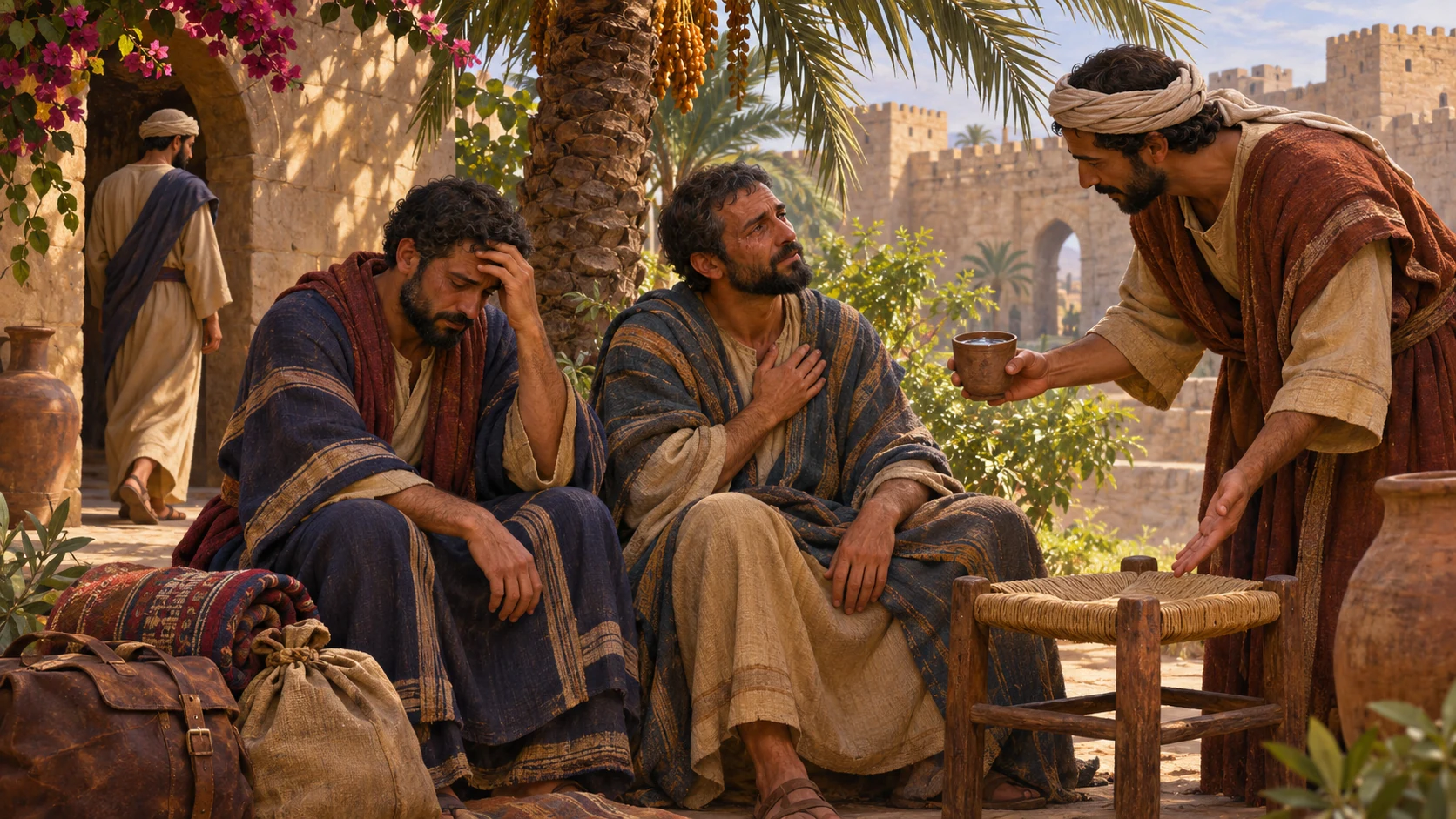
Controlling image: Shaved beards and torn garments, restored in quiet at Jericho
Heart-question: What happens when fear interprets kindness as a threat, and how should God's people respond when dignity has been violated?
Introduction: When Suspicion Becomes an Interpreter
One rumor can make kindness look like manipulation and persuade a ruler to answer uncertainty with humiliation. Consequences spread far beyond the rumor.
First Chronicles 19 opens with remembered kindness, not conquest. David sends condolences to Hanun after Nahash dies. Advisers label the envoys spies; Hanun humiliates them; Ammon hires foreign soldiers. Condolences become conflict.
This text is about remembered kindness becoming rejected mercy—and about courage seeking faithfulness amid the destruction caused by suspicion. Can leaders discern without gullibility, defend victims without vengeance, and trust God amid danger?
Historical and Literary Context: The King's Promise and the Cost of Peace
God promised David a secure place for Israel and the defeat of enemies (1 Chr 17:8–10). Chapter 18 records victories, dedicated treasures, and David's administration of justice (18:11, 14). Chapter 19 instead begins with a compassionate diplomatic mission.
The narrative closely parallels 2 Samuel 10. Chronicles places the material within the rule of a temple-preparing king. Sailhamer (1983) understands this episode as responding to aggression and public humiliation, rather than portraying David as initiating a war of expansion. Ancient warfare is recorded, not universally endorsed.
For displaced Israelites, the lesson transcended military tactics: power without truth unravels nations, while covenant faithfulness requires courage and justice (2 Chr 20:12, 15). Chapter 20 continues the campaign toward Rabbah (20:1–3).
Walking Through the Text
When Condolence Is Mistaken for Conspiracy (19:1–3)
Nahash dies, and Hanun becomes king. David remembers the kindness shown by Nahash and decides to show kindness to Nahash's son (19:1–2). The Hebrew ḥesed evokes loyal kindness, here expressed through condolences. Nahash’s earlier favor is unexplained; its circumstances should not be invented.
Hanun's officials challenge the meaning of the visit. The advisers ask whether David genuinely honors the dead king, then accuse the delegation of coming to investigate, spy, and overthrow the land (19:3). The accusation is unproven; David’s declared purpose is consolation.
The new king must decide which interpretation to trust. A gesture intended for peace becomes alleged hostility. Suspicion is not discernment merely because suspicion sounds cautious.
When Shaved Beards Expose Wounded Dignity (19:4–5)
Hanun seizes the envoys, shaves their beards, cuts their garments at the hips, and sends them away (19:4). Exposed bodies and shaved beards turn envoys into public spectacles; the injury is political and personal.
David's response deserves careful attention. Hearing about the men, David sends people to meet the delegation and directs the envoys to remain at Jericho until their beards grow back (19:5). Instead of forcing an immediate public return, David allows recovery at Jericho.
The text does not describe every form of care. Still, David’s restraint protects victims from further exposure. Wounded people must never become props for a leader’s anger or reputation.
When Fear Purchases Another War (19:6–9)
Ammon recognizes the offense against David; instead of an apology, military preparations follow (19:6). Hanun and the Ammonites spend one thousand talents of silver to hire chariots and horsemen from Aram-naharaim, Aram-maacah, and Zobah (19:6–7). The account lists 32,000 chariots near Medeba and Ammonite troops at the city gate (19:7–9).
Ancient military figures lack a modern counting method. The point is escalation into a costly regional alliance.
David sends Joab and the army's mighty men after hearing of the preparations (19:8). No attempt at reconciliation is reported. Fear turns one cruelty into an expensive military alliance.
When Courage Makes Room for Mutual Help (19:10–15)
Joab faces Aram in the field and Ammon near the city: a two-front threat (19:9–10). Joab selects a force to confront the Arameans and places the remaining troops under his brother Abishai against the Ammonites (19:10–11).
Joab promises mutual aid: Abishai must help against Aram if needed, and Joab will help against Ammon (19:12). This is mutual rescue, not competition. Then Joab calls for courage on behalf of the people and the cities of God, ending with submission to what the Lord judges good (19:13).
Joab plans, shares responsibility, and acts courageously without claiming guaranteed victory. The Arameans flee; when the Ammonites see their allies retreat, the Ammonites withdraw into the city. Joab returns to Jerusalem (19:14–15). The conflict continues.
When Submission Ends a Battle but Not Every Wound (19:16–19)
Aram summons reinforcements from beyond the Euphrates under Shophach, Hadadezer’s commander (19:16). David gathers all Israel, crosses the Jordan, and engages the Arameans (19:17). The Aramean forces flee; the Chronicler records the defeat of 7,000 chariot personnel and 40,000 foot soldiers, together with Shophach's death (19:18).
Second Samuel 10:18 gives different numbers, mentions horsemen, and calls the commander Shobach (Klein 2006; Knoppers 2004).
Hadadezer's subordinate rulers make peace with David and become subject to him. Aram no longer agrees to support Ammon (19:19). Submission follows defeat; reconciliation is not established. The Ammonite campaign continues in chapter 20.
Theological Reflection: When Mercy Is Refused
Covenant Kindness Requires Truthful Interpretation
David's initial ḥesed (19:2) stands against the advisers' unfounded accusation (19:3). Suspicion can turn the language of prudence into a tool of destruction. Scripture calls God's people to test claims and reject false witness (Exod 20:16; Prov 18:13, 17). Christian love is not naïve; love seeks the truth rather than delighting in evil (1 Cor 13:6).
Dignity Matters More Than Public Image
The envoys bear the humiliation of rulers who failed to listen (19:4–5). Jericho provides space to recover without immediate exposure. God's concern for the shamed and vulnerable appears throughout Scripture (Isa 61:1–3; Luke 4:18–19). A church committed to worship must resist using wounded members to settle institutional disputes or protect reputations.
Courage and Dependence Belong Together
Joab's call joins strategy, mutual aid, protection of the people, and surrender to the Lord's will (19:10–13). This is no permission to baptize modern warfare as God's command. The enduring lesson is that responsible courage acts without pretending to control outcomes. Later, Jehoshaphat will face danger with an explicit confession of dependence: the people do not know what to do, but their eyes are on God (2 Chr 20:12).
The Son of David Reveals the Deeper Peace
David's reign offers partial security through battle, but the resulting peace is limited and costly. The prophets anticipate a ruler whose justice gives lasting peace (Isa 9:6–7; 11:1–9). Christians recognize Jesus as the Son of David who breaks down hostility through the cross and creates one reconciled people (Eph 2:14–18). The church therefore pursues peacemaking and refuses to confuse coercive submission with restored relationships (Matt 5:9; Rom 12:18).
Life Application: Refuse to Turn Kindness into War
- Verify before accusing. When a message, donation, or visit is viewed suspiciously, check facts and hear all parties before repeating rumors.
- Protect dignity after humiliation. Meet privately with those publicly embarrassed, respect confidentiality, and allow recovery rather than demanding immediate public testimony.
- Repair an offense before escalation. Encourage truthful acknowledgment, apology, restitution, and safe mediation instead of building alliances around defensiveness.
- Build mutual-support teams. Like Joab and Abishai, establish clear ways for leaders and ministries to help one another under pressure, without competition for credit.
- Protect people from the cost of pride. Before funding disputes or disciplinary battles, ask whose family resources, safety, and well-being will be consumed.
- Use courage without triumphalism. Resist injustice and defend vulnerable people, but never claim every victory proves divine approval or excuses coercion.
- Distinguish settlement from reconciliation. An agreement may end open conflict; restoring trust also requires truth, safety, changed conduct, and time.
Reflection Questions
- Which act of kindness has been interpreted through fear rather than evidence?
- Who is living in shame because leaders refused to listen or apologize?
- Where is a community spending resources defending pride rather than repairing harm?
- What promise of practical help would strengthen partners facing danger together?
- What would genuine peace require beyond merely ending a dispute?
Response Prayer
Lord of covenant kindness, rescue hearts from the suspicion that turns comfort into accusation. Teach leaders to listen before judging and to protect people who have been stripped of dignity. Meet the wounded on the road to Jericho; let shame give way to healing. Grant Joab's courage without arrogance, Abishai's readiness to help, and humility to leave outcomes in God's hands. Turn the swords of rivalry away from neighbors. Through Jesus Christ, the faithful Son of David and Prince of Peace, restore truth, justice, and the courage to seek reconciliation. Amen.
Window into What Comes Next
The Arameans withdraw, but the conflict with Ammon has not disappeared. First Chronicles 20 returns to the siege of Rabbah and remembers further victories against the Philistines. The Chronicler will continue tracing God's preservation of David's kingdom, while the wider biblical story reminds readers that even successful kings require moral accountability. A kingdom can survive foreign enemies and still face danger within its own walls.
Annotated Bibliography
- Hill, Andrew E. 1 & 2 Chronicles. NIV Application Commentary. Grand Rapids: Zondervan, 2003. Relates Davidic leadership and the moral responsibilities of communal decision-making to contemporary ministry.
- Japhet, Sara. I & II Chronicles: A Commentary. Old Testament Library. Louisville: Westminster John Knox, 1993. Analyzes the Chronicler's selection and arrangement of David's campaigns in a covenant-centered narrative.
- Klein, Ralph W. 1 Chronicles: A Commentary. Hermeneia. Minneapolis: Fortress, 2006. Examines the parallel narrative in 2 Samuel 10, personal names, and textual differences in military figures.
- Knoppers, Gary N. I Chronicles 10–29: A New Translation with Introduction and Commentary. Anchor Bible 12A. New York: Doubleday, 2004. Offers detailed historical and literary analysis of the Ammonite-Aramean conflict.
- Sailhamer, John. First and Second Chronicles. Everyman's Bible Commentary. Chicago: Moody Press, 1983. The supplied commentary emphasizes David's defensive response to aggression within the larger fulfillment of God's promise.
- Williamson, H. G. M. 1 and 2 Chronicles. New Century Bible Commentary. Grand Rapids: Eerdmans, 1982. Places warfare, leadership, and the movement toward temple hope within the Chronicler's theological history.

Be the first to leave a comment.