

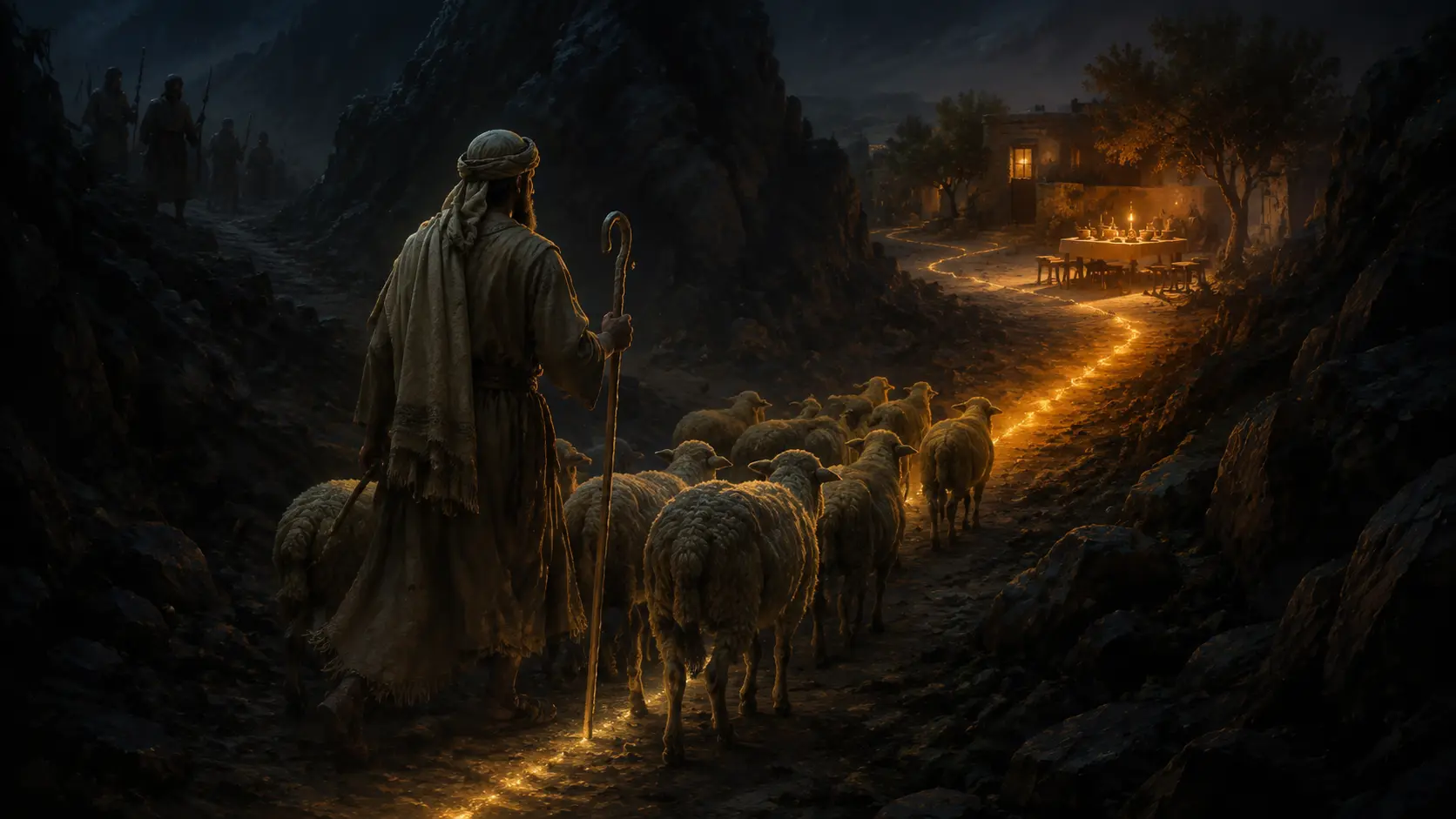
The Shepherd does not erase the valley. He walks it with us until fear loses its throne. Beyond the shadow, a table waits, and goodness is already coming from behind.
01
1.0 Introduction: What Kind of Safety Can Survive a Dark Valley?
Psalm 23 is remembered in hospitals, graveside services, and seasons when ordinary language feels too small. Yet it is not a poem about escaping danger. It contains need, a death-dark valley, enemies, and tested peace.
“The Lord is my shepherd” is therefore not sentimental scenery. A sheep is vulnerable and cannot manufacture pasture, water, or safety. Yet the psalm does not shame dependence. Security rests in the character of the Shepherd, not in the strength of the sheep.
This text is about vulnerable dependence becoming fearless communion, because the Shepherd does not promise a life without valleys or enemies; he provides, accompanies, protects, hosts, and brings his people home.
The poem moves from grass and water to a dark canyon, the Host’s table, and finally Yahweh’s house. Biblical security is not control over the road but belonging to the One who walks it with us.
02
2.0 Historical and Literary Context: From Psalm 22’s Cry to Psalm 24’s Gates
Psalm 23 belongs to the carefully shaped collection of Psalms 15–24. Psalms 15 and 24 frame the unit with questions about entering Yahweh’s holy place, while Psalm 19 stands at the center celebrating Torah. BibleProject’s study notes pair Psalm 23 with Psalm 16 as confessions of confidence and describe Psalm 23 as the king trusting Yahweh’s compassion to deliver him into God’s presence.
Psalm 22 begins with abandonment, passes through mortal danger, and ends in praise. Psalm 23 speaks from trust, although the darkest valley still lies on the path.
Goldingay identifies two controlling images: Yahweh as Shepherd in verses 1–4 and Yahweh as Host in verses 5–6. Kidner likewise stresses that the poem’s peace is not escape and that its climax is not material blessing but the Lord himself. Shepherd language also carries royal force: the Shepherd feeds, guides, defends, and brings the worshiper toward God’s house.
03
3.0 Walking Through the Text
04
3.1 Psalm 23:1–3a — When the Shepherd Makes Enough Possible
The first decisive reality is Yahweh. Everything flows from who shepherds the speaker. “I shall not lack” is not a guarantee of limitless possession; it is confidence that the Shepherd will not abandon the sheep without what is needed for life.
Green pasture and restful waters portray enoughness. The sheep does not merely snatch food while fleeing; it lies down. Provision includes freedom from constant panic.
“He restores my life” can suggest reviving a depleted person and retrieving one who has wandered. Kidner allows physical, psychological, and spiritual dimensions to overlap. Human beings are whole creatures: exhaustion, fear, and spiritual disorientation affect one another.
Psalm 23 rejects both prosperity preaching and disembodied spirituality. “I lack nothing” does not promise abundance, and God’s care reaches bread, rest, direction, and restored life.
05
3.2 Psalm 23:3b — When the Right Path Reflects God’s Name
The Shepherd “leads me in paths of righteousness for his name’s sake.” Goldingay emphasizes paths consistent with Yahweh’s faithfulness; Kidner also hears moral weight, because the flock’s life should honor the Shepherd’s name.
These belong together. Grace does not merely remove us from the wrong road; it trains us to walk differently. Yahweh leads faithfully, and those being led learn faithfulness.
Guidance is therefore larger than finding a private blueprint for career or location. Biblical guidance asks, “What path fits the name of the God I belong to?” A path may be efficient and still be unrighteous. The Shepherd’s route is measured by his character.
06
3.3 Psalm 23:4 — When “He” Becomes “You” in the Dark
The landscape narrows into a death-dark canyon. The psalm never says the sheep wandered there by mistake. The valley can lie on the Shepherd’s path. Faithfulness does not guarantee that every road will be bright.
Then the grammar becomes intimate. “He makes” and “he leads” become “You are with me.” In trouble, theology spoken about God becomes prayer spoken to God.
The rod and staff signal protection and direction. “God with us” includes God acting, guiding, correcting, and protecting.
The valley remains dangerous, but fear is placed beneath a greater reality. Courage is not emotional numbness. It is walking while danger remains because the Shepherd remains nearer than the threat.
07
3.4 Psalm 23:5–6 — When the Shepherd Becomes the Host
Verse 5 changes the picture. The worshiper becomes an honored guest. Yahweh lays a table, anoints the head with oil, and fills the cup generously. Enemies remain visible, but they do not control the menu, the seating, or the future. God’s hospitality publicly contradicts their verdict.
In the biblical world, eating at someone’s table could express belonging, loyalty, and covenant fellowship. Kidner therefore sees more than survival: the guest is welcomed into an enduring relationship. Deliverance reaches its goal in communion.
Then pursuit changes direction. “Goodness and steadfast love will follow me” sounds gentle, but Goldingay notes that the Hebrew verb commonly means pursue or chase. Enemies may pursue, yet goodness and covenant commitment pursue more surely. God’s hesed is not passive goodwill; it comes after the beloved with determination.
The destination is Yahweh’s house “for length of days.” Whether the final verb is understood as returning repeatedly or dwelling there, the movement is clear. Pasture is good, water is necessary, and the table is abundant, but the greatest gift is the Host himself.
08
4.0 Theological Reflection
First, God’s provision is personal without becoming private. “My shepherd” names covenant belonging, but the Shepherd cares for a flock. Personal faith should deepen responsibility toward people who lack food, rest, safety, or companionship.
Second, guidance includes comfort and formation. The Shepherd revives and leads. Grace restores us for faithful paths, and correction can be part of protection.
Third, God’s presence is active faithfulness. Psalm 23 does not promise the absence of dark places; it promises that darkness does not cancel the Shepherd’s companionship or authority.
Fourth, salvation aims at communion. The movement is not from poverty to luxury but from vulnerability to the house of Yahweh. The final gift is life with God.
09
5.0 Canonical and Christological Horizon
Psalm 23 gathers a long biblical shepherd story. Jacob speaks of God as the one who shepherded him (Gen. 48:15). Israel is led through wilderness like a flock. Ezekiel 34 condemns rulers who feed themselves while scattering the sheep and promises that Yahweh himself will search for them while raising up “my servant David” as shepherd. Divine kingship, covenant care, and messianic hope meet in the image.
Jesus enters this scriptural world in John 10: “I am the good shepherd.” He does not avoid danger; he lays down his life for the sheep and takes it up again. Psalm 22 has already shown the suffering king, while Psalm 23 gives language for divine care through death’s shadow. The New Testament does not turn every detail of Psalm 23 into prediction, but resurrection reveals why death cannot be the final shepherd of God’s people.
Hebrews calls Jesus the “great shepherd of the sheep” whom God brought back from the dead (Heb. 13:20). Revelation gives a striking reversal: the Lamb becomes Shepherd and guides God’s people to springs of living water (Rev. 7:17).
The table also opens into the gospel. Jesus gathers people around meals, gives himself in the covenant meal, and announces God’s banquet. Psalm 23’s longing for Yahweh’s house reaches toward resurrection, restored creation, and God dwelling with humanity.
10
6.0 Life Application
1. Name your Shepherd before naming your shortage. Let identity in God’s care frame anxious planning.
2. Build rhythms of pasture and water. Sleep, food, Sabbath rest, prayer, and healthy limits belong to faithful creaturely life.
3. Ask whether your desired path fits God’s name. Refuse shortcuts built on deception, exploitation, or revenge.
4. In a dark valley, turn statements about God into prayer to God. “You are with me” can resist despair.
5. Receive both rod and staff: seek protection from harm and remain teachable when God redirects you.
6. Become a table-maker. Let God’s hospitality reshape how you feed, welcome, protect, and honor others.
7. When fear or hostility feels relentless, rehearse the stronger pursuit of God’s goodness and steadfast love.
11
7.0 Reflection Questions
1. Where do I currently feel the pressure of lack, and what would trusting the Shepherd look like without denying practical need?
2. What kind of rest do I resist because I confuse constant activity with faithfulness?
3. Which “right path” is difficult because it protects God’s name and another person’s dignity?
4. What valley has moved my faith from speaking about God to speaking directly to him?
5. How could my home, church, leadership, or resources become a table of God’s hospitable care?
12
8.0 Response Prayer
Yahweh, my Shepherd and gracious Host, lead me where life can be restored. Give me enough for today, wisdom for the right path, and courage when the road descends into darkness. Teach my heart to say, “You are with me.” Use your rod to defend what is vulnerable and your staff to correct what wanders. Prepare your table where shame and hostility have tried to name me. Let your goodness and steadfast love pursue me until my life becomes hospitality for others. Through Jesus, the Good Shepherd who laid down his life and rose again, bring us through every valley into the joy of your presence. Amen.
13
9.0 Window into What Comes Next: From the Shepherd’s House to the King’s Gates
Psalm 23 ends with the worshiper at Yahweh’s house. Psalm 24 asks who may ascend Yahweh’s mountain, then summons the gates to open for the King of Glory. The Shepherd who brings his servant home is also the victorious King. Psalm 23 delivers us to the threshold of royal worship.
14
10.0 Bibliography
BibleProject. The Book of Psalms: Study Notes. Portland, OR: BibleProject.
BibleProject. Book of Psalms: Guide with Key Information and Resources. Portland, OR: BibleProject.
Goldingay, John. Psalms, Volume 1: Psalms 1–41. Baker Commentary on the Old Testament Wisdom and Psalms. Grand Rapids: Baker Academic, 2006.
Kidner, Derek. Psalms 1–72. Kidner Classic Commentaries. Downers Grove, IL: IVP Academic, 2008.
Wright, N. T. Simply Jesus: A New Vision of Who He Was, What He Did, and Why He Matters. New York: HarperOne, 2011.
Be the first to leave a comment.