
The earth is already his before the procession begins. The worshiper climbs, but the greater movement is God’s own arrival. Hands are searched, hearts are opened, and ancient gates must learn whom they were built to welcome.
01
1.0 Introduction: What Happens When God Refuses to Stay in the Religious Corner?
We divide life into territories: worship, work, public life, and the hidden heart. Psalm 24 collapses those borders: “The earth is Yahweh’s, and all that fills it.” Before anyone climbs the holy hill, every field, body, workplace, and nation already stands inside God’s claim.
Yet the psalm does not stop with ownership. It asks who may ascend Yahweh’s mountain, then turns toward the gates and commands them to open for the King of Glory. Human beings seek God’s face; then God himself arrives as King. We cannot welcome divine presence while protecting life from divine rule.
This text is about worship becoming welcome for the true King, because the God who owns the whole earth does not merely invite people into his presence; he claims the right to enter, examine, bless, and rule the places we call ours.
Psalm 24 therefore moves in three great steps: the world belongs to Yahweh; those who seek him must come with integrity; and the gates must open to Yahweh the victorious King. Creation, holiness, and kingship meet at the doorway.
02
2.0 Historical and Literary Context: The Closing Gate of Psalms 15–24
BibleProject reads Psalms 15–24 as a carefully shaped unit framed by two temple-entrance poems. Psalm 15 asks who may dwell on Yahweh’s holy hill. Psalm 24 closes the sequence with a similar question in verses 3–6, then adds a dramatic proclamation of Yahweh’s kingship in verses 7–10. Psalm 19 stands at the center, showing that the life fit for God’s presence is Torah-shaped.
Psalm 23 prepares the approach. The shepherd leads the king through the dark valley and toward Yahweh’s house; Psalm 24 reaches the mountain and asks who can stand there. The answer is not ritual display but integrity—clean hands, a pure heart, truthful allegiance, and honest speech.
Goldingay sees three sections: Yahweh’s ownership of the world (vv. 1–2), qualifications for approaching him (vv. 3–6), and the glorious King entering the gates (vv. 7–10). Their original relationship is uncertain, yet together they work as processional theology. Kidner likewise hears a procession toward Zion, possibly recalling David bringing the ark to Jerusalem (2 Sam. 6; 1 Chr. 13–16).
03
3.0 Walking Through the Text
04
3.1 Psalm 24:1–2 — When the Whole Earth Becomes Sacred Ground
“The earth is Yahweh’s.” The opening places ownership before achievement. Fields are not first ours because we bought them; bodies are not first ours because we inhabit them; nations are not finally owned by rulers. The Creator’s claim is deeper than every human title deed.
Verse 2 grounds ownership in creation: Yahweh founded the earth upon the seas. The imagery recalls Genesis 1. Goldingay emphasizes security, while Kidner notes that even the threatening sea belongs to God. Chaos is no equal rival to the Creator.
This makes spirituality concrete. If the earth and its fullness belong to Yahweh, worship cannot excuse exploitation. Soil, money, food, power, and people are gifts held under the Creator’s sovereignty. The psalm begins globally, then becomes liturgical.
05
3.2 Psalm 24:3–6 — When the Pilgrim Is Examined on the Way Up
The question now narrows: “Who may ascend Yahweh’s mountain? Who may stand in his holy place?” The verbs matter. Ascending suggests deliberate approach; standing suggests being received before the King rather than merely passing through a sacred moment.
The answer joins conduct and inward truth: clean hands and a pure heart. Clean hands refuse violence and dishonest action; a pure heart refuses the divided life that performs holiness while cultivating corruption. Psalm 15 made the same connection; Psalm 24 repeats it at the closing frame.
The next phrases concern allegiance and truth. Kidner notes that “lifting up the soul” can mean trust. The worshiper rejects emptiness—idolatry, false security, or deception—and false oaths. Goldingay stresses the harm false oaths do to neighbors. Worship is tested by what we trust and whether our words can be believed.
Such people receive blessing and vindication from “the God of their salvation.” Verse 6 turns the description into a community: this is the generation that seeks him, that seeks his face. Holiness is not solitary religious polish; it is the shared vocation of a people who desire God’s favorable presence.
06
3.3 Psalm 24:7–10 — When the Gates Are Asked to Make Room for Glory
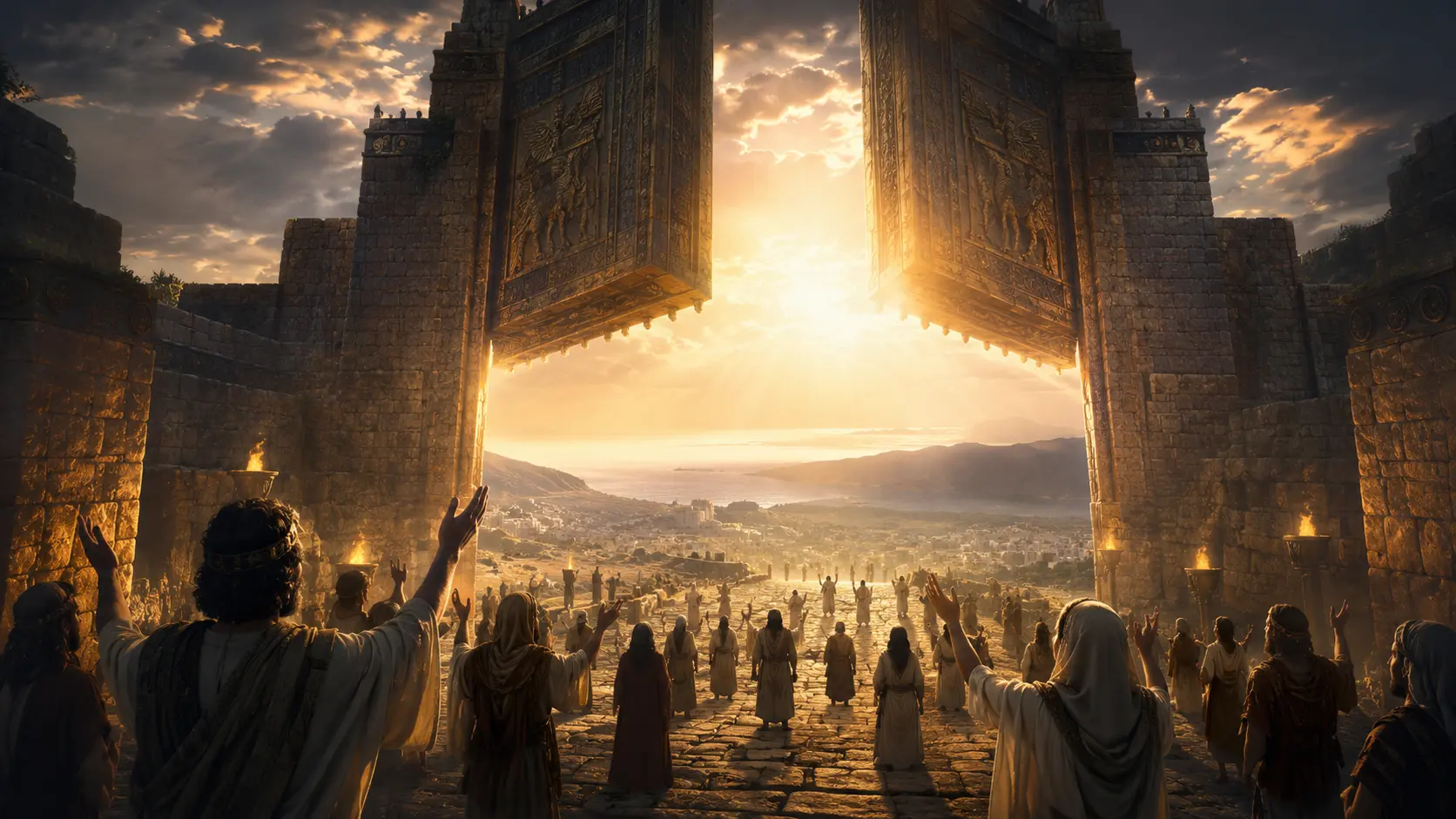
Suddenly the worshipers are no longer the ones asking to enter. The gates themselves are addressed: “Lift up your heads, O gates.” The image is deliberately oversized, as though ordinary architecture cannot contain the arriving Majesty. Ancient doors must rise because the King is greater than the city built to receive him.
“Who is this King of Glory?” The answer names Yahweh as mighty in battle. Kidner hears Exodus 15, where Yahweh defeats Pharaoh and brings his people through the sea. The King entering Zion is the God whose reign was revealed in liberation.
The repeated question ends with “Yahweh of armies—he is the King of Glory.” Goldingay suggests the title may point especially to the heavenly host. It does not baptize human aggression; ultimate victory belongs to the God whose holiness already condemns deceit and injustice.
The reversal is complete: humans asked to stand before Yahweh; now the city must receive Yahweh. The God we seek is also the King who comes seeking rightful rule.
07
4.0 Theological Reflection
First, creation is ownership before resource. The Creator’s prior claim turns possession into stewardship: we receive, cultivate, share, and protect what remains God’s.
Second, holiness is integrated life. Clean hands without a pure heart become performance; a pure heart without clean hands becomes fantasy. Biblical holiness joins motive, action, allegiance, and speech. The God of the sanctuary is concerned with contracts, rumors, violence, money, and hidden loyalties.
Third, seeking God includes submitting to God. Many people want blessing, comfort, or spiritual experience without the King’s claim. Psalm 24 will not separate face from throne. To seek Yahweh’s face is to welcome Yahweh’s reign.
Fourth, divine victory must be read through divine character. “Mighty in battle” is no blank authorization for religious violence; it confesses that evil, oppression, and chaos will not finally rule God’s world.
08
5.0 Canonical and Christological Horizon
Psalm 24 looks backward to creation, Exodus, and Zion. Genesis 1 stands behind the earth amid the waters; Exodus 15 behind the warrior-King. David’s ark procession gives a natural horizon for the language of entry. Isaiah later sees nations streaming to Yahweh’s mountain to learn his ways (Isa. 2:2–4).
The New Testament quotes Psalm 24:1 in 1 Corinthians 10:26. Paul uses the Creator’s ownership to frame Christian freedom and responsibility; the temple procession reaches into ordinary meals and conscience.
Verses 7–10 are not quoted in the New Testament as a prediction of Jesus’ ascension, so we should not overclaim. Yet they open naturally toward the gospel: Jesus announces God’s kingdom, embodies clean hands and a pure heart, suffers under violent powers, rises, and is exalted as Lord. The crucified one is called “the Lord of glory” in 1 Corinthians 2:8. Christian tradition rightly hears the opened gates as fitting language for the risen King, while Psalm 24 itself first proclaims Yahweh’s kingship.
Revelation ends not with escape from the earth Yahweh owns, but with God dwelling among humanity in renewed creation. The holy-place question opens into a cleansed people under the Lamb’s reign.
09
6.0 Life Application
1. Treat possessions as entrusted. Review money, land, time, influence, or technology and ask how Yahweh’s ownership should change your use of it.
2. Bring hands and heart into the same prayer. Confess both visible actions and hidden motives rather than polishing one while protecting the other.
3. Audit what your soul is “lifted” toward. Name the thing you instinctively trust for security—status, political power, savings, charisma, connections—and refuse to make it your savior.
4. Make truthfulness part of worship. Keep promises, correct misleading words, and resist exaggeration even when dishonesty would make life easier.
5. Seek God’s face with a community. Build relationships that encourage integrity rather than private religious performance.
6. Open a real gate. Identify one room of life you have kept from Christ’s rule—business practice, sexuality, resentment, ambition, family conflict—and welcome his authority there.
7. Resist triumphalism. Celebrate God’s victory by practicing the character of his kingdom: justice, mercy, truth, peacemaking, and protection of the vulnerable.
10
7.0 Reflection Questions
1. What part of my life do I behave as though it belongs to me more than it belongs to God?
2. Where are my “hands” and “heart” telling different stories?
3. What empty security am I most tempted to trust when I feel threatened?
4. Which gate in my life is hardest to open to the rule of the King of Glory?
5. How does Psalm 24 change my understanding of victory, holiness, and the presence of God?
11
8.0 Response Prayer
King of Glory, the earth is yours, and so am I. Clean what my hands have done and purify what my heart has hidden. Free me from empty trusts and deceptive words. Teach me to seek your face without resisting your throne. Lift the gates I have kept low. Enter the rooms I have guarded from you, and make my home, work, relationships, and worship places where justice, mercy, truth, and peace are welcomed. Defeat what destroys your good world and form us for your presence. Amen.
12
9.0 Window into What Comes Next
Psalm 24 closes the great temple-framed movement of Psalms 15–24 with the gates open and Yahweh acclaimed as King of Glory. Psalm 25 begins differently: the voice becomes personal again—“To you, Yahweh, I lift up my soul.” The one who has refused to lift the soul to emptiness in Psalm 24 now lifts it directly to God, asking for guidance, forgiveness, and deliverance. The gates have opened, but discipleship continues on the road.
13
10.0 Bibliography
BibleProject. The Book of Psalms: Study Notes. Portland, OR: BibleProject.
BibleProject. Visual Commentary: Psalm 8—Study Notes. Portland, OR: BibleProject.
Goldingay, John. Psalms, Volume 1: Psalms 1–41. Baker Commentary on the Old Testament Wisdom and Psalms. Grand Rapids: Baker Academic, 2006.
Kidner, Derek. Psalms 1–72. Kidner Classic Commentaries. Downers Grove, IL: IVP Academic, 2008.
Be the first to leave a comment.