

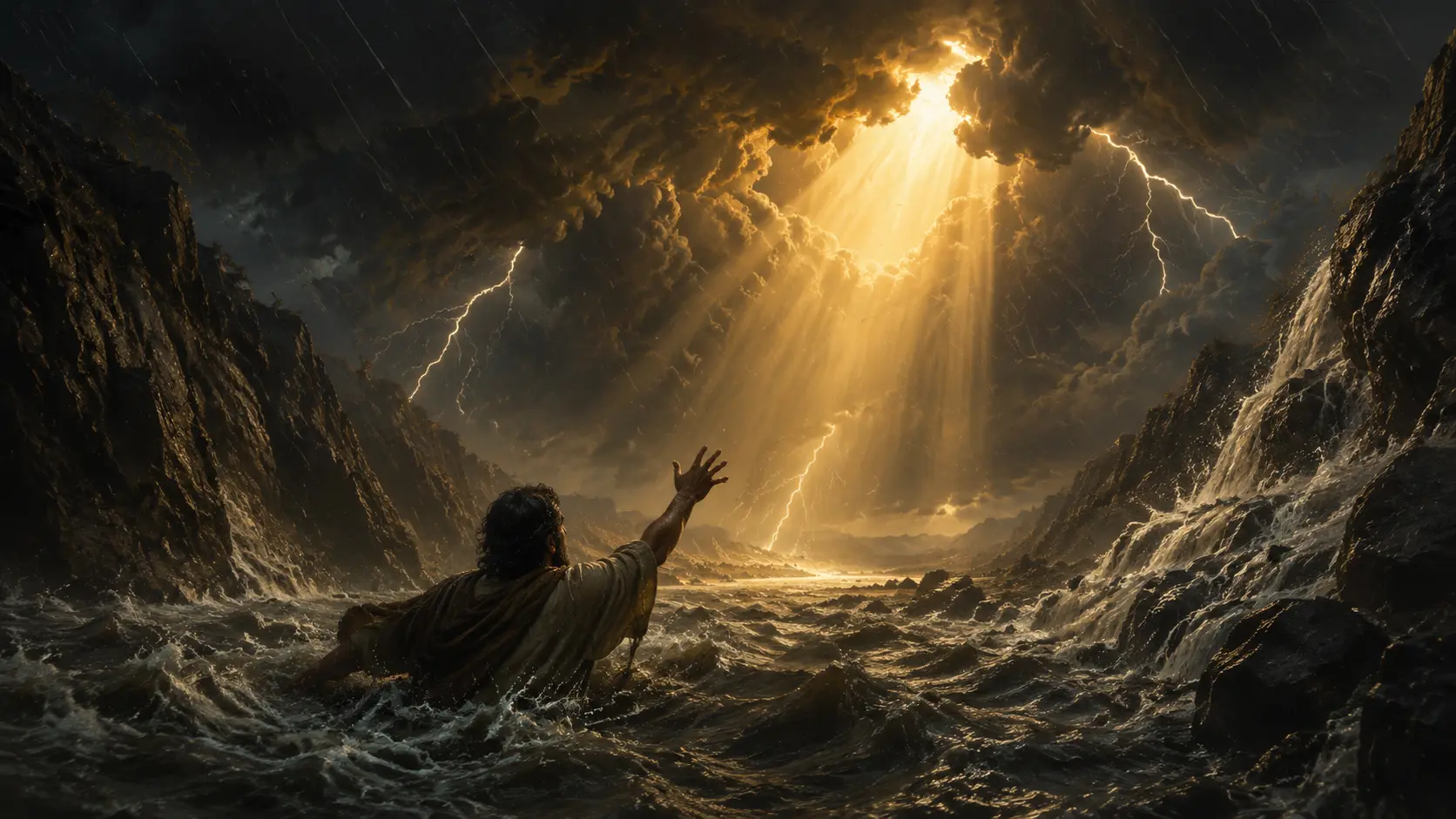
A cry rises from waters too deep for human strength. Heaven bends; thunder answers; a hand reaches into the flood. The rescued man stands again—not to boast that he survived, but to confess that every solid place beneath his feet was gift.
01
1.0 Introduction: What Do We Do with the Life God Has Rescued?
Psalm 18 is not a quiet song. It arrives with cliffs, floods, earthquakes, thunder, lightning, armies, bows, high places, and nations. David looks backward over a life repeatedly pressed toward death and sees one reality beneath all the events: Yahweh reached down. The psalm names the God whose power turned narrow places into open ground.
What happens after rescue? We pray urgently when water reaches our throat, yet once shore lies beneath our feet we can forget who drew us out. David refuses that amnesia. He remembers refuge, receives strength, and turns victory into praise among the nations.
This text is about rescue becoming vocation, because God does not merely pull David from the flood; he forms the rescued servant into a faithful king whose strength is meant to serve God’s covenant purposes.
02
2.0 Historical and Literary Context: A King Looking Back from the Far Shore
Psalm 18 is closely paralleled in 2 Samuel 22, where it appears near the end of David’s story as a retrospective song. Its heading links the poem to deliverance from Saul and other enemies and calls David “the servant of Yahweh.” That title matters: before he is celebrated as king, he is identified as servant.
BibleProject places Psalm 18 within Psalms 15–24. Psalms 15 and 24 frame the unit with covenant faithfulness; Psalms 16–18 portray David delivered and elevated, while Psalms 20–23 mirror them with a royal figure opening toward messianic hope. Psalm 19 stands at the center celebrating Torah. Royal power sits under divine instruction.
Goldingay sees verses 1–2 and 49–50 framing a movement from danger and prayer to divine response, rescue, and reversal. Heights and depths recur: David sinks toward death, Yahweh reaches down, lifts him, and sets him high. Kidner likewise notes how real rocks and strongholds became signs of the deeper Refuge who carried David.
03
3.0 Walking Through the Text
04
3.1 Psalm 18:1–6 — When Refuge Receives a Name
The psalm begins with affection before explanation: “I love you, Yahweh, my strength.” Then metaphors rush forward—rock, fortress, deliverer, shield, horn of salvation, stronghold. David’s geography has become theology. Caves, cliffs, shields, and mountain refuges were real parts of his survival, but he now sees that the created shelter was never the deepest shelter. Yahweh was.
Then death becomes ropes, Sheol becomes snares, and destructive waters rise. The repeated images make escape feel impossible. David cries. The king’s first weapon is not a sword but prayer, and his cry reaches the heavenly palace.
05
3.2 Psalm 18:7–15 — When Heaven Bends Toward Human Distress
The answer is enormous. Earth shakes; mountains tremble; smoke and fire signal divine anger; Yahweh rides upon a cherub; thunder becomes his voice; lightning becomes his arrows. Kidner connects the imagery with Sinai and the exodus, while Goldingay reads the storm language as a poetic way of confessing Yahweh’s extraordinary involvement in David’s deliverance.
The poetry magnifies theological reality. The God who confronted Pharaoh and brought Israel through the sea is the living King who can act again. David’s private crisis is placed inside Israel’s covenant story of liberation.
Yet the grandeur moves toward one threatened human being. Divine majesty is not distance: heaven bends because a servant’s cry has been heard.
06
3.3 Psalm 18:16–29 — When the Hand Reaches into the Flood
“He drew me out of many waters.” The verb recalls Moses being drawn from water in Exodus 2. David’s rescue becomes a personal exodus. The enemies were stronger than he was; that admission protects the testimony from self-congratulation. He was not rescued because he had enough hidden strength. Yahweh became his support and brought him into a “broad place”—room after constriction, breath after drowning.
Verses 20–24 can sound self-righteous. Both Kidner and Goldingay caution us to hear them covenantally, not as sinless perfection. David will later fail grievously. Here he claims integrity in the conflict being remembered: he has not abandoned Yahweh and has sought the covenant’s way.
Then the poem widens: Yahweh shows faithfulness to the faithful, but brings crookedness to account; he saves the afflicted and humbles proud eyes. Grace is not moral indifference. The God who rescues the weak also opposes the arrogance that crushes them.
07
3.4 Psalm 18:30–45 — When Rescued Feet Learn to Stand
The psalm turns from rescue to empowerment. God’s way is whole and his word tested. He gives David strength, deer-like footing, trained hands, and steady steps.
This refuses two distortions: “God acted, so my action did not matter,” and “I acted, so God was unnecessary.” Biblical agency is covenant partnership: gift produces action. Human courage, skill, providence, guidance, and extraordinary intervention are gathered into praise.
Kidner highlights the surprising line, “your gentleness made me great.” The God who strengthens David also stoops to him; power received from such a God cannot justify arrogant domination.
08
3.5 Psalm 18:46–50 — When Victory Becomes a Song among the Nations
The ending erupts in doxology: Yahweh lives; the Rock is exalted. Neither enemies nor military success get the final word. God does.
The horizon expands beyond Israel. David will praise Yahweh among the nations, and Paul later quotes Psalm 18:49 in Romans 15:9 concerning the Gentiles. The closing promise of covenant love to David and his offspring makes this thanksgiving part of a larger Davidic hope: God’s faithfulness to his anointed becomes good news the nations can sing.
09
4.0 Theological Reflection
10
4.1 God’s Power Is Personal, Not Mechanical
Psalm 18 never reduces God to a force that believers can activate. Yahweh hears, descends, reaches, delights, trains, judges, and keeps covenant. The center is relationship: the God of cosmic thunder is also “my God,” and his power serves faithful love.
11
4.2 Integrity Is Covenant Loyalty, Not Moral Perfection
David’s language of righteousness must not be used to create a theology in which deliverance is earned by flawless performance. The psalm celebrates a life oriented toward Yahweh. Covenant grace calls forth covenant faithfulness, and when pride twists life, the same God who saves also humbles.
12
4.3 Rescue Restores Human Vocation
God does not save David into passivity. He gives room, light, strength, balance, skill, and courage. Redemption restores agency. Grace redirects human action so people can participate in God’s purposes without pretending to be their own saviors.
13
4.4 Victory Must End in Worship, Not Self-Exaltation
The final destination of deliverance is praise among the nations. Any testimony that enlarges the rescued person while shrinking God has missed the psalm. Biblical victory becomes doxology and witness.
14
5.0 Canonical and Christological Horizon: From David’s Rescue to the Crucified King
Psalm 18 looks back to the exodus and Deuteronomy 32, where Yahweh is Israel’s Rock, and stands within the Davidic covenant story. In its original voice it is a real king’s thanksgiving for military deliverance; that historical meaning must remain.
Yet the Psalter places David inside a larger messianic horizon, and Romans 15:9 hears verse 49 in relation to Christ and the Gentiles. Jesus, the faithful Davidic king, enters the deepest waters of death and is vindicated in resurrection. His victory is cross-shaped: evil is judged, death defeated, and outsiders gathered into one worshiping people.
For Jesus’ followers, therefore, Psalm 18 cannot authorize personal vengeance or religious violence. Romans 12 forbids private revenge just before Romans 13 reflects on public justice. Our deepest battle is against sin, death, and the powers that deform human life. The risen King trains our hands not for domination but for faithful service, truth, justice, courage, forgiveness, and costly love.
15
6.0 Life Application
1. Name the rocks God has used. Remember people, places, opportunities, and ordinary means through which God sheltered you, but do not confuse the means with the Giver.
2. Cry before you calculate. When the waters rise, prayer is not the last resort of the powerless; it is the first act of covenant trust.
3. Let rescue restore responsibility. Ask what capacity, courage, or service God is rebuilding in you after a season of survival.
4. Guard integrity after success. Deliverance can become spiritually dangerous if gratitude quietly turns into entitlement.
5. Refuse to weaponize the psalm. Do not label personal opponents “God’s enemies” in order to sanctify anger, revenge, nationalism, or abuse of power.
6. Turn testimony outward. Tell the story of God’s help so that others can see the living Rock, not merely admire your endurance.
16
7.0 Reflection Questions
1. Which “rock” in my life have I begun to trust more than the God who provided it?
2. Where do I currently feel trapped in narrowness, and what would it mean to cry honestly to God there?
3. Has a past rescue made me more humble and useful, or more entitled and self-protective?
4. Where am I tempted to confuse God’s justice with my desire to defeat someone?
5. How could my testimony become praise that welcomes people beyond my own circle into hope?
17
8.0 Response Prayer
Yahweh, my Rock and Deliverer, when waters rise beyond my strength, teach me to cry to you. Reach where I cannot escape alone. Bring me into room to breathe, and keep freedom from becoming pride. Train my feet for faithfulness, my hands for service, and my heart for mercy. Let every victory become praise and every rescued life become a gift to others. Through Jesus, the crucified and risen King, make your name known among the nations. Amen.
18
9.0 Window into What Comes Next: From the Warrior’s Song to the Voice of Torah
Psalm 18 ends with the rescued king praising God among the nations. Psalm 19 will now slow the battlefield and lift our eyes to another kind of speech: the heavens declaring God’s glory and the Torah forming a whole life. The warrior has been strengthened; next, the king must listen. Power that has been rescued by God must be instructed by God.
19
10.0 Bibliography
BibleProject. “The Book of Psalms.” Old Testament Overview Guide. BibleProject, 2026.
BibleProject. The Book of Psalms: Study Notes. BibleProject.
Goldingay, John. Psalms. Vol. 1, Psalms 1–41. Baker Commentary on the Old Testament Wisdom and Psalms. Grand Rapids: Baker Academic, 2006.
Kidner, Derek. Psalms 1–72. Kidner Classic Commentaries. Downers Grove, IL: InterVarsity Press, 2008.
Be the first to leave a comment.