

Can a human being truly be made new from within?
01
Introduction
If you change your clothes but the same fear remains in your heart, what has really changed? Can life begin again without erasing the years you have already lived?
After making a mistake, a person may sincerely say, “From today on, I will be different.” Yet before long, another ordinary morning arrives—and fear, pride, old habits, or the need for approval returns like a guest who already knows the way home.
New routines can help. Better decisions matter. But neither can reach every hidden corner of the heart where we have learned to protect ourselves, justify ourselves, or avoid the costly way of love.
Jesus told Nicodemus, a respected religious teacher, that he needed to be born again—or born from above (John 3:1–8). He was not talking about polishing old behavior or building a better spiritual reputation. He was speaking about new life that God himself gives through the Spirit.
New birth does not erase our memories. It does not make us instantly mature. Nor does it cause every wound to disappear in a single day.
It is the beginning of God’s renewing work within us: joining us to the life of Christ, reshaping our desires, and teaching us to live now in the light of God’s coming new creation.
Here are ten reasons to believe that this new beginning is not merely a future hope. It is a present reality.
02
1. Jesus told even a respected religious leader that he needed to be born again
Nicodemus came to Jesus at night. He was a teacher of Israel, well acquainted with Scripture, and respected in his community. Yet Jesus told him that no one could see the kingdom of God without being born from above (John 3:1–3, 10).
Jesus did not dismiss Nicodemus’s learning. He simply showed its limits.
Knowing many true things about God is not the same as having the life of God within us—just as knowing everything about rain cannot make a seed sprout.
This message reaches the person who has sat in church for decades as surely as it reaches the person who has never entered one. A respected family name cannot create this life, and a shame-filled past cannot shut the door to it.
We all need a life we cannot manufacture for ourselves.
When Nicodemus asked how such a thing could happen, Jesus pointed him to the work of the Spirit of God (John 3:4–8).
Life Message: Bring Jesus your questions and your whole story. New life is not reserved for people with a certain kind of background.
03
2. God promised to change the heart, not merely add more rules outside it
The prophets watched Israel possess God’s commandments and still repeatedly turn away from him.
Jeremiah announced a day when God would write his instruction on the hearts of his people and forgive their sins (Jeremiah 31:31–34).
Ezekiel spoke of people being cleansed, receiving a new heart, and being led by God’s Spirit in his ways (Ezekiel 36:25–27).
These promises came from a God who refused to leave his people where their failures had brought them.
Imagine knowing that you need to apologize, yet spending the journey home rehearsing excuses. A rule can tell you what you ought to say. By itself, it cannot give you a humble, truthful, and compassionate heart.
The prophets’ hope does not make obedience unnecessary. It goes deeper. It reaches the inner place from which our words, choices, and habits flow.
New birth is rooted in this ancient promise: God himself can do something new within us.
Life Message: Ask God to reach the place where your best intentions keep getting stuck.
04
3. The resurrection of Jesus opens a genuinely new future
Peter says that God “has given us new birth into a living hope” through the resurrection of Jesus Christ (1 Peter 1:3).
Paul likewise says that anyone who is in Christ is a new creation (2 Corinthians 5:17).
This is more than a burst of emotion or a fresh resolution to become a better person.
Jesus passed through death and was raised to life. In his resurrection, God opened a future that human failure and the power of death could never have opened on their own.
Your past choices may still require an apology. You may need to return what you took, confess a wrong, or rebuild trust over a long period of time. The resurrection does not erase those responsibilities.
But it does mean that your past does not have the right to write every page that follows.
You can face the harm you caused while learning to live as someone joined to the risen Christ.
That is what a true new beginning looks like—not pretending yesterday never happened, but refusing to let yesterday have the final word.
Life Message: Let the risen Jesus give you courage to face your past without surrendering your whole future to it.
05
4. God’s Word invites us to receive this life by faith
John says that those who receive Christ and believe in his name are given the right to become children of God. This birth does not come from ancestry, human effort, or natural strength, but from God himself (John 1:12–13).
James says that God gave us birth through the word of truth (James 1:18). Peter also connects new birth with the enduring word of God (1 Peter 1:23–25).
The good news is heard, considered, and received.
It is not a secret reserved for a few people with dramatic testimonies.
For one person, faith may begin while slowly reading a Gospel on the bus ride home. For another, it may begin through a patient conversation with a friend who helps them ask questions they have avoided for years.
Hearing the good news does not mean we understand everything about God.
Faith begins when we turn toward the Christ proclaimed in that good news and ask him to do within us what we cannot do for ourselves.
Life Message: Read the stories of Jesus with one honest question: What would it mean for my life to trust the person I meet here?
06
5. The Spirit gives us a life we cannot imitate
Jesus speaks of being born of water and the Spirit, then compares the Spirit’s work to the wind: we can recognize its movement, but we cannot control it (John 3:5–8).
Paul also describes the Spirit as the one who gives life and brings believers into a new relationship with God (Romans 8:9–16).
God is the one who gives this life, even as he calls us to respond.
Some people remember the exact day they turned to Christ. Others look back after several months and realize that they are praying more honestly, letting go of an old lie, or beginning to care for a neighbor they once avoided.
We should not make one kind of testimony the standard for everyone.
Feelings may burn brightly today and fade tomorrow. The Spirit’s work is often seen more clearly over time, as faith, truthfulness, love, and endurance begin to grow.
New birth is not a stage on which we display instant perfection before other people.
It is the beginning of spiritual life that continues to grow, deepen, and mature.
Life Message: Learn to recognize the Spirit’s work even when it unfolds slowly. Your journey does not have to look exactly like someone else’s.
07
6. Baptism makes the new beginning visible before others
When people in Jerusalem received the message about Jesus, they were baptized and entered a shared life of learning, fellowship, meals, and prayer (Acts 2:37–42).
Paul says that baptism into Christ is connected with his death and resurrection so that believers may walk in newness of life (Romans 6:3–4).
The waters of baptism therefore make visible that a person is turning toward Jesus and joining his people.
Baptism is not a certificate proving that every temptation has ended.
Nor is it a medal awarded to someone who has reached spiritual perfection.
It is a living sign that our whole embodied life is being drawn into the mystery of dying and rising with Christ.
A healthy Christian community does not say to the newly baptized person, “Now you have graduated.” It welcomes them into a life of continued learning, asking questions, growing, worshiping, and walking with others.
Baptism points beyond the water itself to the living Lord who continues his work among his people.
Life Message: As you learn to trust Christ, consider the visible step by which your faith becomes joined to the life of his people.
08
7. New life changes even what we learn to desire
Paul contrasts the works of the flesh with the fruit of the Spirit: love, joy, peace, patience, kindness, faithfulness, gentleness, and self-control (Galatians 5:16–23).
When Paul speaks of the flesh, he does not mean that our physical bodies are evil. He is describing a way of life bent away from God and ruled by desires that resist his purposes.
The Holy Spirit works differently. He nurtures a new kind of life within us, so that even our deepest desires begin to be redirected by the way of love.
A person who once felt compelled to win every argument may slowly learn to listen.
Someone who spent years hiding behind lies may begin to tell the truth.
If we look only for dramatic change accompanied by great noise, we may miss this quieter work.
Fruit does not appear in an explosion.
It grows.
A tree may already be alive while still needing time, rain, light, and care.
New birth gives us a living beginning—not an exhibition of instant perfection.
Life Message: Notice the small moments when love begins to matter more than winning, defending yourself, or hiding.
09
8. A new heart learns new habits in ordinary days
Paul tells believers to put away falsehood and destructive anger and to learn truthfulness, kindness, and forgiveness (Ephesians 4:22–32).
He also tells them to leave old patterns behind and clothe themselves with compassion, kindness, humility, and love (Colossians 3:9–14).
These instructions would make little sense if new birth removed every difficult habit in a single moment.
God’s gift of new life draws us into a pattern of repeated choices.
Your next faithful step may be admitting a lie at work, calling someone whose trust you broke, refusing to pass on a rumor, or asking for help with a habit that has become deeply rooted.
Some patterns take time to unlearn and may require patient support from wise and trustworthy people.
And not every storm of life, physical illness, or painful experience should be treated as the result of a personal sin that simply needs to be rebuked.
The point is this: inward renewal seeks a way to become visible in our words, schedules, use of money, relationships, and ordinary decisions.
Grace does not remain hidden in the heart.
It begins to walk with our feet.
Life Message: Choose one small act of truth or mercy through which new life can become visible today.
10
9. New birth becomes visible in our love for others
John says that love for fellow believers is a sign that we have passed from death to life.
He then asks how someone with material resources can see a brother or sister in need and refuse compassion. Christian love, he says, must be expressed not only in words but also in action (1 John 3:14–18).
Paul likewise describes Christ bringing formerly divided people together into one new humanity and making them members of God’s household (Ephesians 2:14–22).
New birth begins within us, but it does not remain there.
It reshapes the way we live with other people.
It does not allow us to say, “I have changed,” while we continue to ignore a hungry neighbor or despise people who are different from us.
Yet service must not become another competition in which we try to prove that we have been born again more deeply than someone else.
When people share food, protect the vulnerable, forgive, serve, and sit together across old boundaries, we catch a glimpse of God’s new world.
Love does not purchase new birth.
It shows that new life has begun to take root.
Life Message: Let someone else experience genuine goodness because of the life God is growing within you.
11
10. New life is real today, but its fullness is still to come
Paul says that believers already have the Spirit, yet they still groan as they wait for the redemption of their bodies (Romans 8:23–25).
He also trusts that God will continue the good work he has begun in them (Philippians 1:6).
John looks forward to the day when God will make all things new (Revelation 21:1–5).
The gift of today and the promise of tomorrow belong together.
This keeps us from thinking that every stumble proves nothing has changed.
But it also keeps us from pretending that we have already arrived while our actions are still hurting other people.
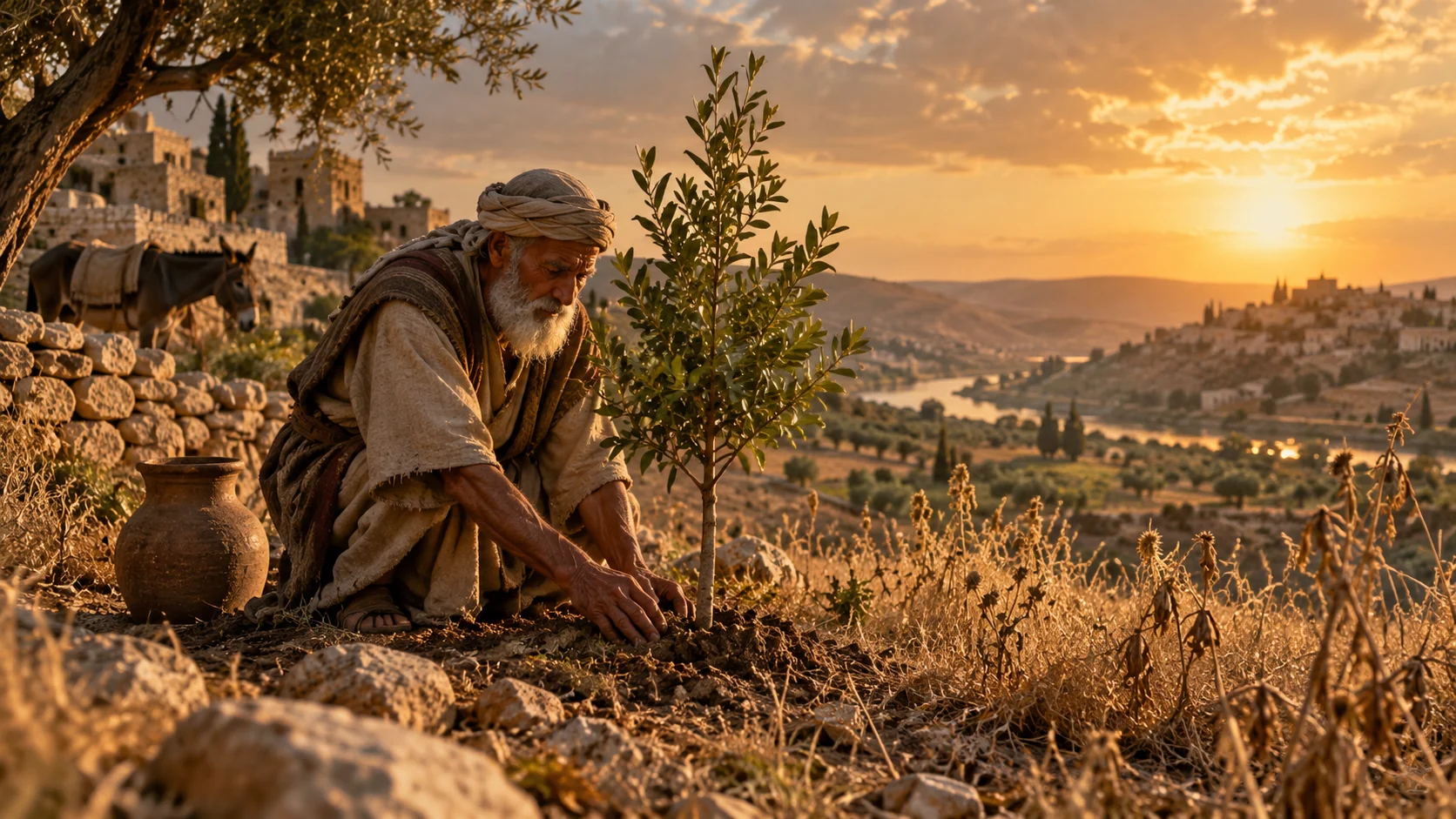
A seedling is alive long before it becomes a great tree.
But it still needs light, water, care, and time.
When you stumble, confess and begin again.
When you notice that you have grown, thank God without becoming proud.
God’s promise about tomorrow gives meaning to today’s patience.
Life Message: Treasure the life God has begun within you without pretending that his work is already complete.
12
Conclusion and Invitation
Jesus spoke about being born from above to a man who already knew many true things about God.
The prophets had promised a new heart. The resurrection of Christ opened a new future. And now the Spirit of God gives life that begins to show itself in faith, baptism, changing habits, truthful relationships, and costly love.
You do not need a flawless testimony with no unanswered questions in order to begin.
And you do not need to pretend that you have already arrived.
You are invited to respond to God’s promise, receive the life he gives, and begin walking in his direction.
If you long for a new beginning, tell Jesus the truth about the places where your own strength has reached its limits.
Read his conversation with Nicodemus in John 3.
Ask the Spirit to give you life.
Take one faithful step toward trust.
And find people who can help you learn the way of Christ.
You do not have to become spiritually mature before you are allowed to begin.
A new beginning does not require perfection. It begins with grace.
13
Final Prayer
Lord Jesus, you know the parts of my life that I cannot make new by the strength of my own resolve.
Give me the life you described to Nicodemus.
Let your Spirit enter my fears, desires, habits, and decisions. Teach me to trust you, tell the truth, and love my neighbors.
Where I need to make things right, give me courage. Where I need to grow, give me patience. Where I am tempted to give up, remind me that your work is not finished.
Let the beginning you give me today grow patiently within me until my life increasingly reflects yours.
Amen.
If this lesson has left you with a question, or if you have a story of change you can share honestly, send us a short message. Your gradual beginning may help someone else believe that life can begin again for them too.

Be the first to leave a comment.