

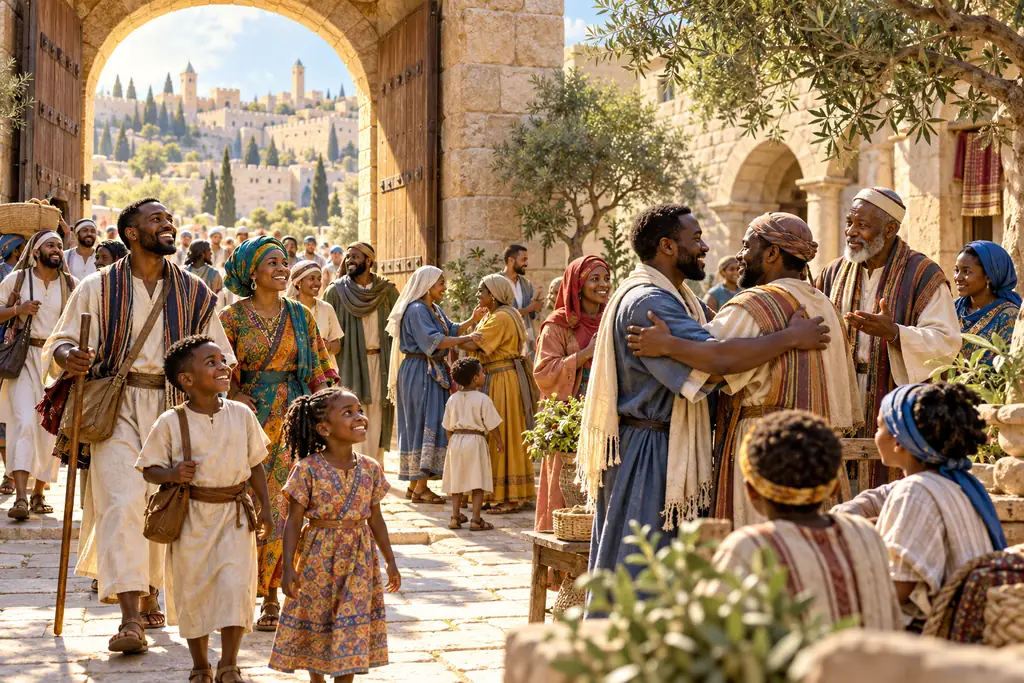
How does the joy of going to worship become a responsibility to seek justice and peace for the city?
01
Overview
The third Song of Ascents: worship, justice, and the well-being of the city
Key text — Psalm 122:6–9 (study rendering): “Ask for Jerusalem's peace. May those who love you live securely. May peace dwell within your walls and well-being within your strongholds. For the sake of my family and companions I will say, ‘Peace be with you.’ For the sake of the house of the LORD our God, I will seek your good.”
We know the feeling of reaching a place we have longed to see. A student arrives at a university after years of preparation. A family walks through the door of a relative's home after a difficult journey. A worshiper enters a congregation where others know the prayers, songs, and burdens that have been carried along the road. Relief becomes gratitude: We have arrived.
But what happens next? Does arriving at a holy place mean that the journey's work is finished? Psalm 122 answers with a surprise. It begins with delight at going to worship and ends with a commitment to seek the city's good. The traveler has not come merely to receive a religious experience. Having reached Jerusalem, the worshiper discovers a responsibility to pray for the peace of the community in which God's house stands.
Psalm 120 heard the distress of someone surrounded by hostile words: “I am for peace.” Psalm 121 blessed a traveler with the assurance of the LORD's watchful care. Psalm 122 finally places feet within Jerusalem's gates. Yet this arrival is not an escape from the world's difficulties. The destination itself needs prayer, justice, safety, and neighbors who genuinely care for one another.
Here is the question that will guide our reading: What if the deepest joy of gathering before God is meant to send us back into the world as seekers of peace?
02
1.0 Introduction
Psalm 122 is one of the fifteen Songs of Ascents (Psalms 120–134). Its nine verses are brief but carefully shaped. They describe the delight of going to the LORD's house (v. 1), standing inside Jerusalem (v. 2), recognizing the city's significance for Israel's united worship and administration of justice (vv. 3–5), and praying for its peace (vv. 6–9).
The poem turns from celebration to intercession. The name Jerusalem is repeated, and words related to peace, security, flourishing, and good gather around it. The opening and conclusion are held together by an important phrase: “the house of the LORD” (vv. 1, 9). The city matters to the pilgrim because of God's relationship with his people there, not because impressive buildings can make a city holy by themselves.
The movement of the poem can be heard as three questions. Why do we go? To worship the LORD together. What should a holy city be? A place of shared belonging and just decisions. What should we do once we have arrived? Pray for its inhabitants and seek their well-being.
This last movement prevents us from reducing worship to private spiritual satisfaction. Psalm 122 makes joy in God inseparable from concern for the people living around God's house. It also keeps our expectations realistic: a city may possess a temple, walls, and a royal history while still needing peace. The psalm prays because the good it celebrates must be protected, cultivated, and sometimes restored.
03
2.0 Historical and Literary Context
The third Song of Ascents
Psalm 122 follows a memorable sequence. Psalm 120 begins in alienation amid deceit and hostility. Psalm 121 looks for help on a vulnerable journey. Psalm 122 speaks of feet standing in Jerusalem. This arrangement invites us to hear the three psalms as a movement from conflict, through trust, toward shared worship and responsibility for peace. That is a literary reading of their placement, not proof that all three were composed as one continuous travel narrative.
The superscription identifies Psalm 122 as a Song of Ascents, of David. The Hebrew heading can connect the psalm with David in several ways; it does not settle the date or the identity of the historical writer. David made Jerusalem the center of his royal rule and brought the ark there (2 Sam. 5–6). Solomon later built the temple (1 Kgs. 6–8). Pilgrims in different generations could therefore sing a poem whose worshiping and royal features recalled Jerusalem's place in Israel's story.
Israel's festival calendar encouraged gathering for worship, thanksgiving, and remembrance of the LORD's saving acts (Exod. 23:14–17; Deut. 16:1–17). Such travel demanded planning, especially for households far from the sanctuary. The psalm's happiness at hearing an invitation to go is therefore more than the excitement of a casual outing. It is the joy of joining a community that recognizes the same God.
The precise occasion remains uncertain. John Goldingay notes that Psalm 122 is among the most explicitly pilgrim-oriented songs in the collection, but he also observes that its verbs may suggest someone looking back on a visit, perhaps while preparing to return home. Derek Kidner vividly reads verses 1–2 as the moment of arrival. Both readings capture genuine dimensions of the poem: joy remembered, feet planted in the city, and a prayer that follows the experience.
Jerusalem: more than a destination
In Psalm 122, the Hebrew text repeatedly names Jerusalem, not Zion. Goldingay observes that the name here helps keep the focus on the actual inhabited city: its gates, buildings, public institutions, and residents. The psalm does not invite us to contemplate an abstract religious symbol detached from human life. God's people travel to a place where people live, make decisions, celebrate festivals, and face threats.
The poem's structure reinforces this focus. Verses 2–5 describe Jerusalem as the meeting place of Israel's tribes and the seat of the Davidic house's judgment. Verses 6–9 turn into a succession of requests and commitments concerning the city's welfare. The final appeal, “For the sake of the house of the LORD our God”, returns us to the reason for the opening joy.
Its language is musical. There is a play of sounds between Yerushalayim (Jerusalem), shalom (peace or wholeness), and related terms for security and ease. This is literary wordplay; the exact historical etymology of Jerusalem's name is a separate question. The echo is enough to make peace sound like the fitting desire for this city.
A city admired, not idealized
Jerusalem was never automatically identical with justice, peace, or God's approval. Israel's prophets repeatedly challenged its corruption, oppression, false security, and misuse of worship (Isa. 1:21–27; Jer. 7:1–11; Mic. 3:9–12). The psalm's celebration therefore belongs alongside prophetic accountability. To love the city truly is not to deny what harms it.
The poem's reference to royal thrones also invites careful historical reading. A city's role in settling disputes and administering public life was significant before the exile; the poem could also be sung later as an act of memory and hope. Neither Goldingay nor Kidner treats its details as grounds for absolute certainty about composition or date.
04
3.0 Walking Through the Text
3.1 Psalm 122:1 — “I was glad when they said to me”
The opening delight belongs to an invitation: “Let us go to the house of the LORD.” The speaker does not say only, “I decided to go.” Others spoke, and their words awakened joy. Shared faith begins, in this verse, with someone calling another person to participate.
The destination is described as the LORD's house. The journey is not ordinary tourism, though the worshiper may also marvel at the city. The attraction is God's worshiping community and the opportunity to acknowledge his deeds. Kidner reminds us that the festivals' primary purpose was thanksgiving to God; human fellowship was a rich consequence, not a substitute for worship.
The verse challenges both spiritual isolation and religious compulsion. Community can invite and encourage; it should not manipulate. To be glad at an invitation does not mean that every congregation is a safe or joyful place for every visitor. The psalm gives us a picture of what gathering ought to inspire and a question for our own churches: Do our words make other people glad to come into God's presence?
3.2 Psalm 122:2 — “Our feet are standing within your gates”
The grammar can be understood as “our feet are standing” or, as Goldingay suggests, “our feet have stood.” The first pictures the arrival vividly; the second can sound like a thankful recollection. It is unnecessary to choose one with more certainty than the text warrants.
Either way, the line is beautifully physical. Not merely our thoughts, hopes, or prayers—our feet have reached the gates. God meets embodied people in real places. The journey has involved roads, fatigue, effort, companionship, and arrival.
The voice has also shifted from “I” in verse 1 to “our” in verse 2. The pilgrim belongs to others. The gates mark a threshold: an outsider to the city has become a guest within its public life. Arrival should produce gratitude, not a claim that the worshiper now owns the place or stands above those who live there.
3.3 Psalm 122:3 — “A city bound together”
Jerusalem is admired as a city built closely together. The Hebrew expression is compact and somewhat difficult to translate: the city is constructed as something joined to itself. Goldingay emphasizes the visible density and unity of its buildings, which could impress someone arriving from an open rural landscape. Kidner hears a fitting image for the unity of God's gathered people.
We should not force the two observations into opposition. The immediate object is an actual built city; from that picture, readers can rightly consider the meaning of communal belonging. But a city with adjoining walls may still contain divided hearts. Urban design does not automatically create social peace.
The line asks whether our communities have something better than mere proximity. People can sit in one sanctuary, share one neighborhood, or attend one conference while remaining separated by resentment, class, ethnicity, or fear. The built environment may bring people together; only justice, trust, truthfulness, and patient love can help them live well together.
3.4 Psalm 122:4 — “The tribes of the LORD go up”
Jerusalem gathers the tribes, which the poem names as belonging to the LORD. Israel was not a featureless crowd. Different tribes carried distinct histories and identities, yet they came to acknowledge one God. The verse does not celebrate unity by erasing difference.
The phrase sometimes translated “as was decreed for Israel” evokes the appointed obligation to gather and give thanks (compare Deut. 12; 16). The exact force of the Hebrew phrase often rendered “testimony” or “statute” is debated, but the central action is clear: the people ascend to praise or give thanks to the LORD's name.
To give thanks to the divine name is to remember the character and actions of the LORD, particularly his deliverance and faithful provision. The pilgrims' diversity finds a center beyond themselves. As Kidner notes, the gathering was not primarily a technique for manufacturing national cohesion; it was worship, from which fellowship could flow.
For contemporary communities, this is a corrective to making ethnicity, institutional identity, or a charismatic leader the center of religious life. Faithful unity does not require everyone to sound the same. It requires that God's truth and mercy be honored above the desire of any one group to dominate.
3.5 Psalm 122:5 — “Thrones for judgment were set there”
The psalm's next reason to value Jerusalem may surprise us. After worship comes judgment: the thrones associated with David's house. The Hebrew reference is to public decisions and the exercise of governing authority. Kidner rightly presses the point that judgment, in this setting, should mean justice—a ruler's essential obligation, not a decorative display of power.
A capital is not holy merely because a king rules from it. Authority should protect those whose voices can be drowned out: the poor, people without influence, victims of exploitation, and households caught in disputes. Israel's ideal of righteous rule appears vividly in Psalm 72:1–4, where the king is expected to defend the needy and restrain oppressors.
Goldingay observes that multiple “thrones” may point to the king's household and wider judicial work, rather than to one solitary monarch handling every case. Scripture itself recognizes delegated administration (Exod. 18:13–26). The verse places fair decisions alongside worship at the heart of communal flourishing.
This connection is uncomfortable in a necessary way. A church may sing beautifully while concealing abuse. A nation may celebrate its heritage while denying justice. A congregation may speak constantly of unity while refusing to hear those harmed within it. Psalm 122 will not allow praise to silence such questions.
3.6 Psalm 122:6 — “Pray for the peace of Jerusalem”
The poem now moves from description to appeal. In a study rendering: “Ask for Jerusalem's peace; may those devoted to you live securely.” The verb translated “pray” has the wider sense ask or seek. The following lines show that the asking is a prayerful wish for the city's well-being.
The repeated Hebrew shalom means more than the absence of armed conflict. It can encompass security, reconciliation, healthy relationships, and conditions under which people can live well. The accompanying words related to ease and security deepen that vision. The sound of shalom echoing near Jerusalem gives the invitation poetic force.
The line often rendered “may those who love you prosper” should not be turned into a financial formula: Love Jerusalem and God will make you rich. In this setting, prosperity and ease concern the city's safety and welfare. Nor does love of a city require defending every policy carried out in its name. Prayer for peace is most faithful when it seeks the life and dignity of all its inhabitants.
The historical Jerusalem is important to Jews, Christians, and Muslims today, and its modern circumstances involve real people, contested claims, and painful histories. This psalm should never become a license for contempt, forced removal, or violence against anyone. Its appeal is for peace, not for a religious justification of domination.
3.7 Psalm 122:7 — “Peace within your walls”
Walls and strongholds appear in verse 7. The city needs security because it can be threatened. Yet the prayer's repeated “within” draws our attention inward. A city might have substantial walls while its residents fear one another, endure extortion, or lack a fair hearing.
Kidner highlights the concern for concord within the city. Goldingay draws out the broad range of security and flourishing implied by the poetry. Both insights matter. External protection is good; inward justice, trust, and neighborliness are just as necessary. A strong wall cannot rescue a community that has accepted cruelty as normal.
The verse also challenges simplistic accounts of peace. Silence is not always peace. A victim who cannot speak freely may appear quiet while living in danger. A community may avoid open arguments by denying the suffering of its weakest members. Biblical shalom must be able to face uncomfortable truths and make room for repair.
3.8 Psalm 122:8 — “For the sake of my family and friends”
The poet makes the motivation personal: “For the sake of my brothers and companions, I will speak peace concerning you.” These are relationships, not abstract statistics. The speaker's affection reaches the people who live and gather in the city.
This line prevents prayer for Jerusalem from becoming admiration of stonework or allegiance to an idea while disregarding residents. The worshiper desires peace because people matter. A city worthy of prayer is a city filled with neighbors, children, workers, visitors, elders, strangers, and friends—people whose lives are affected by decisions made inside it.
The verse also raises a question for religious leadership. When we seek institutional reputation or political advantage, whose well-being are we actually protecting? Is it the vulnerable neighbor, or merely the image of the organization? The psalmist's declared reason—“for the sake of my family and friends”—reorders our priorities toward real persons.
3.9 Psalm 122:9 — “I will seek your good”
The psalm ends where it began: with the house of the LORD our God. The same God who invited joy at the beginning is the reason the poet commits to the city's welfare at the end. Worship turns into responsibility.
The closing expression can be heard chiefly as seeking or asking for the city's good, a continuation of prayer. Goldingay notes that the context particularly supports that sense. Yet the language naturally presses the reader to consider action as well. A prayer for peace that never alters the way we treat neighbors is in danger of becoming empty speech.
The poem does not instruct every pilgrim to govern Jerusalem, solve every dispute, or guarantee peace by personal effort. Its final promise is humbler and more demanding: “I will seek your good.” That is a direction of life. Whatever one's resources or role, a worshiper can refuse to delight in the city's suffering and can contribute to its healing.
The psalm leaves us not with triumphant certainty that peace has already arrived, but with a prayerful commitment to pursue it. The journey to the temple is complete; the work of faithful love continues.
05
4.0 Theological Reflection
4.1 Worship and public justice belong in the same story
The poem brings together the LORD's house and the thrones of judgment. Worship remembers God's righteousness; the administration of justice should make that righteousness visible in public relationships. Scripture does not suggest that every state institution is automatically divine, nor that religious leaders have authority beyond accountability. Rather, rulers and communities stand under God's concern for truth, the poor, and those exposed to oppression (Ps. 72:1–4; Isa. 1:17; Mic. 6:8).
A worship service that ignores corruption, exclusion, exploitation, or abuse is in danger of praising God with words while denying his character in practice. Yet political activism alone is not a substitute for worship either. Psalm 122 gives the two their proper relationship: we gather to honor God and leave with increased responsibility toward other people.
4.2 Peace is more substantial than quietness
The Hebrew notion of shalom can include safety from attack, social well-being, good relationships, and the conditions needed for people to flourish. The psalm also speaks of ease or security (shalvah and related forms). This does not mean that every occurrence of shalom carries an identical theological definition. Its context here—walls, public judgment, worship, friends, and the city's good—makes the larger picture persuasive.
Thus a city is not at peace simply because the powerful can move without disturbance. Shalom must be examined from the perspective of those who suffer most. A marketplace can be busy while vendors are extorted. A neighborhood can look calm while women and children live in fear. Biblical prayer should lead us to ask who is still excluded from the peace we celebrate.
4.3 Unity is neither uniformity nor denial of harm
The tribes retain their names even as they ascend together. Shared worship does not erase the cultures, histories, or gifts of different groups. It also cannot require those who have been wronged to pretend that no wrong occurred.
The psalm provides an ideal for communities that need reconciliation. Reconciling people may require confession, restitution, protection of the vulnerable, and patience. A call to “be united” becomes unfaithful when it silences a complaint or shields misconduct. True belonging grows where people can seek justice without being treated as enemies of peace.
4.4 The holy place does not replace the living God
Jerusalem matters because of the LORD's house; it is not worshiped in place of the LORD. Israel's prophets warn against trusting buildings, rituals, or institutional prestige as if they guaranteed divine approval (Jer. 7:4–11). The city's religious importance increases the seriousness of injustice rather than excusing it.
The same temptation confronts churches today. We can love a building, institution, history, or tradition so much that we cease to ask whether God's character is being honored. Psalm 122 calls for joyful attachment, but never for idolatrous attachment.
4.5 Praying for a city means caring about actual people
The concluding verses identify brothers, companions, and the LORD's house as reasons for seeking Jerusalem's good. This is an outward movement from worship toward solidarity. It echoes, in a different historical setting, Jeremiah's counsel to exiles to seek the welfare of the city where they lived (Jer. 29:7).
Such concern may take different forms: supporting just procedures, repairing broken relationships, welcoming strangers, promoting safe streets, feeding families, or teaching young people to tell the truth. No single form exhausts the psalm. But it does not leave us free to separate prayer from compassion.
4.6 Love for Jerusalem need not become hostility to others
Psalm 122 names a particular city within a particular covenant story. Respect for that specificity is necessary; we should not replace historical Israel with a vague spiritual abstraction. At the same time, honoring a city does not authorize hostility against other peoples. Later biblical voices envision nations drawn to God's instruction and the abandonment of warfare (Isa. 2:2–4; Mic. 4:1–4).
For readers living amid political and religious disagreement, this means that prayer for Jerusalem must be marked by humility. Ancient promises cannot simply be equated with endorsement of every modern political claim. The persons who inhabit the city today deserve the same concern for life, dignity, security, and just treatment that gives this psalm its moral seriousness.
06
5.0 Canonical and Christological Horizon
The prophets deepen the meaning of Jerusalem's peace. Isaiah describes a future in which nations learn God's ways and turn weapons toward cultivation rather than war (Isa. 2:2–4). In Isaiah 1:21–27, however, the same city must be confronted over corruption and restored through justice. The Bible's hope is not that Jerusalem's importance exempts it from judgment, but that God's faithfulness aims to transform a troubled community into a place where righteousness dwells.
Jesus shares the psalm's concern, even as he laments the city. Jesus traveled to Jerusalem and taught in its temple precincts. Yet as he approached the city, he wept over its failure to recognize what makes for peace (Luke 19:41–44). Goldingay and Kidner both notice the piercing relationship between this lament and Psalm 122. Jesus' tears are not a denial that Jerusalem matters; they show how deeply its failures matter. Matthew 23:37 likewise portrays grief over a city resistant to God's messengers.
The cross challenges the way we pursue peace. Jesus' death in Jerusalem exposes what happens when religious and political authorities defend themselves through falsehood and violence. His resurrection vindicates God's way of self-giving love. When the risen Jesus announces peace to fearful disciples (John 20:19–21), peace becomes more than a slogan or a bargain protecting the powerful. It becomes a commission to bear witness, forgive, and live truthfully.
The new community learns a wider hospitality. In Acts 2:1–11, people from multiple languages hear God's works proclaimed in Jerusalem. The same book recounts serious disputes about distribution and belonging (Acts 6:1–7); shared worship does not remove the need for just attention to neglected members. Ephesians 2:14–22 presents Christ as the one who makes peace between divided peoples and depicts believers as being built into a dwelling place for God. That metaphor echoes Psalm 122's themes of gathering and God's house, though it does not erase Israel's history or the physical city.
The final biblical vision is a renewed city. Revelation 21–22 imagines the new Jerusalem descending from heaven, with God dwelling among human beings, death removed, and the nations brought into healing. The destination of biblical hope is not a private escape from the material world. It is God's presence renewing human community and creation. Psalm 122's longing for a city with worship, justice, and peace finds a larger horizon there.
This Christian reading is canonical and retrospective. The first singers of Psalm 122 were not covertly describing Jesus' triumphal entry, the formation of the church, or the New Jerusalem in detail. They were expressing Israel's joy and concern for its earthly holy city. The New Testament extends the story in light of Jesus without making that original meaning disappear.
07
6.0 Life Application
- Recover the joy of worshiping together. Ask whether your church gatherings help people recognize God's goodness. Encourage participation without turning an invitation into pressure, and make room for those who arrive tired, uncertain, or grieving.
- Notice the people behind a place. When praying for your congregation, city, or nation, name ordinary lives: children traveling to school, those who work at night, the unemployed, market traders, patients, and families needing shelter. Love should become specific.
- Join worship with fairness. If you carry leadership responsibility, ensure that complaints are heard without retaliation. Review how money is handled, how decisions are made, and whether the vulnerable can obtain help. Justice is not an optional supplement to praise.
- Seek peace that includes truth. When conflict appears in a family, congregation, or workplace, resist the temptation to enforce silence merely to protect appearances. Listen carefully, protect people from harm, and seek a fair path toward repair.
- Welcome diversity without demanding sameness. Psalm 122's tribes come together as distinct members of one people. Make space for different languages, generations, life experiences, and cultural expressions while centering shared worship on the LORD.
- Pray for Jerusalem without turning prayer into hostility. Ask God for the security, dignity, justice, and peaceful coexistence of every resident. Refuse prejudice against Jews, Muslims, Christians, Palestinians, Israelis, or any other group.
- Practice the peace you request. Choose one tangible contribution to your community's good: helping a neighbor, mediating a minor dispute, supporting a family in crisis, improving accessibility, or working with others for safer public spaces.
- Let gratitude lead to commitment. At the end of a worship service, retreat, or pilgrimage, ask not only, “What did I receive?” but also, “Whose good am I now called to seek?” Carry the final verse into the coming week.
- Reject the illusion that buildings make a community righteous. Appreciate good facilities without making them the measure of spiritual success. Ask whether people are becoming more truthful, generous, accountable, and merciful.
- Hold present work within future hope. Revelation's vision of healing among the nations does not make present justice unnecessary. It gives patient courage for work whose completion we cannot secure by our own power.
08
7.0 Reflection Questions
- What circumstances have made you genuinely glad when someone invited you to worship with others? What circumstances have made such an invitation painful or difficult?
- How does the movement from Psalm 120 through Psalm 122 deepen the meaning of arriving in Jerusalem?
- What is the difference between a city whose buildings are closely joined and a community whose residents live in genuine solidarity?
- Why does Psalm 122 place thrones of judgment alongside the house of the LORD? What should this mean for religious leadership today?
- How would you explain shalom without reducing it either to silence or to personal prosperity?
- Whose safety and dignity are easily overlooked when your community talks about peace?
- How can Christians honor Jerusalem's distinctive biblical significance without using Scripture to excuse injustice or hostility toward those who live there?
- Why did Jesus weep over Jerusalem (Luke 19:41–44)? What does his lament reveal about faithful love for a community?
- In what ways does the New Testament vision of God's dwelling among people extend, rather than erase, Psalm 122's concern for a real place and real inhabitants?
- What one concrete act can you take this week to make your family, congregation, neighborhood, or city a more truthful and peaceful place?
09
8.0 Response Prayer
LORD our God, I thank you for every person who has invited me to worship, every companion you have given me on the road, and every place where your mercy has been remembered. Give me the joy of entering your presence without becoming blind to the needs of those around me. Let our congregations be places of welcome, truthful speech, and fair decisions. Where there is fear, teach us courage; where there is hidden harm, bring truth into the light; where there is division, guide us toward patient reconciliation. We pray for the peace of Jerusalem and for the welfare of every person who calls it home. We pray also for the neighborhoods and cities in which we live. Make our prayers honest and our actions compassionate. Through Jesus Christ, who wept for the city, bore the cross, and rose to announce peace, teach us to seek our neighbors' good. Amen.
10
9.0 Window into What Comes Next
Psalm 120 began with the pain of hostile words and a longing for peace. Psalm 121 blessed the traveler with the LORD's unceasing care. Psalm 122 brought the pilgrim inside Jerusalem's gates, rejoicing in worship and praying for the city's welfare. The movement is beautiful, but it is not the end of every struggle: the people who have arrived still need mercy, justice, and God himself.
Psalm 123 begins with eyes lifted—not toward the hills, as in Psalm 121, but toward the One enthroned in heaven. Those who pray there have had enough of contempt and scorn. The perspective changes from delight in Jerusalem to patient dependence on the LORD's mercy. A holy city's walls cannot fully protect people from mockery, humiliation, or injustice.
The next question is therefore: When we have reached the place of worship but still feel despised, how do we keep our eyes on the God whose mercy we need?
11
10.0 Bibliography
- Scripture: Psalm 122; Psalms 72:1–4; 120–123; Exodus 18:13–26; 23:14–17; 26:11; 2 Samuel 5–6; 8:15; Deuteronomy 12; 16:1–17; 1 Kings 6–8; Isaiah 1:17, 21–27; 2:2–4; Jeremiah 7:1–11; 29:7; Micah 3:9–12; 4:1–4; Matthew 23:37; Luke 19:41–44; John 20:19–21; Acts 2:1–11; 6:1–7; Ephesians 2:14–22; Revelation 21–22.
- Goldingay, John. Psalms, Volume 3: Psalms 90–150. Baker Commentary on the Old Testament Wisdom and Psalms. Grand Rapids: Baker Academic, 2008. Commentary on Psalm 122, especially the psalm's civic focus, the possibility of retrospective pilgrimage speech, judicial thrones, and the range of shalom.
- Kidner, Derek. Psalms 73–150. Tyndale Old Testament Commentaries. Downers Grove, IL: InterVarsity Press, 1975; later editions. Commentary on Psalm 122, “Beloved city,” especially joy at arrival, tribal unity, justice, and inward peace.
- BibleProject. Book of Psalms overview and related teaching resources on biblical poetry and the canonical shape of the Psalter. Included for general canonical orientation, not as a source for the specific Hebrew-text judgments attributed above.
- The Book of Psalms — Study Notes and Book of Psalms: Guide with Key Information and Resources, project background resources on the Psalter and its literary collections. Translation note: Brief Scripture lines marked “study rendering” are interpretive renderings prepared for this analysis rather than quotations from a specified published Bible version. Where the Hebrew permits more than one reasonable reading, the alternatives have been indicated.


Be the first to leave a comment.