

How does God’s promise to David carry our hope beyond the plans of one leader?
01
Overview
The ark, the covenant, and the surprising answer to a king's desire to give God a dwelling
Key text — Psalm 132:11–12, 15, 17 (explanatory study rendering): “The LORD has sworn a trustworthy promise to David, from which he will not turn: ‘One of your own descendants I will place on your throne.’ ... ‘I will richly bless Zion's provisions and satisfy its poor with bread.’ ... ‘There I will cause David's strength to flourish; I have prepared a lamp for my anointed one.’”
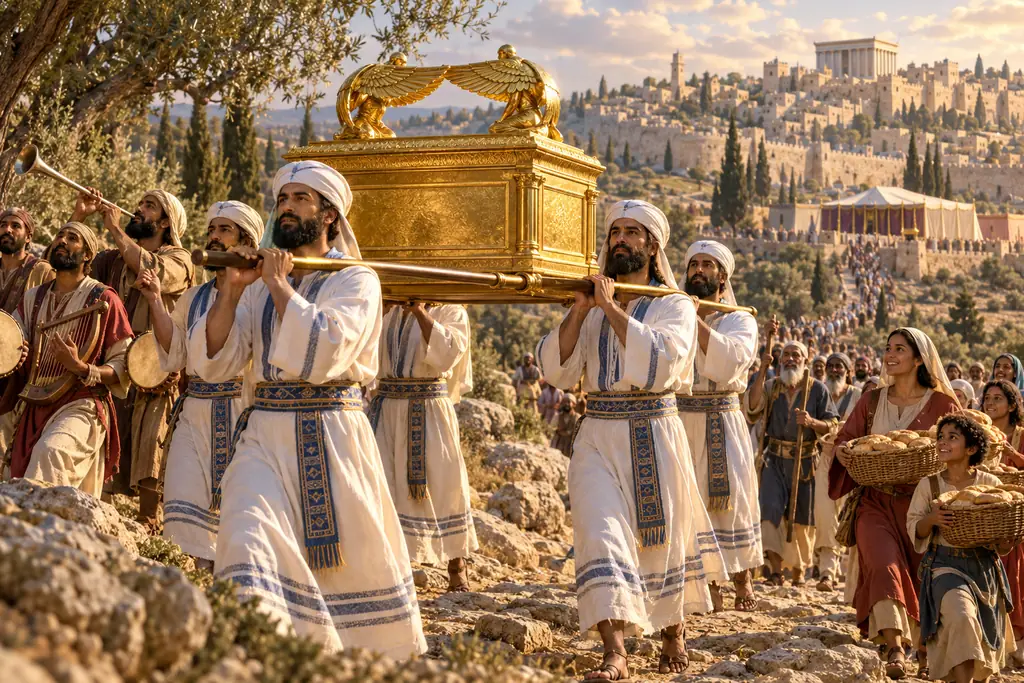
A king has a comfortable house, while the sacred chest associated with the LORD's presence remains in a tent. The contrast troubles him. He longs to secure a proper resting place for worship. But when he seeks to build a house for God, God makes a larger promise: God will establish a house for him—a royal family whose story will reach beyond the king's own lifetime.
This is the heartbeat of Psalm 132. The psalm remembers David's devotion, summons worshipers toward God's dwelling, recalls the LORD's oath to David, and ends with a picture of bread for the poor, joyful worship, and a flourishing royal future. It is not merely about a sacred building or political succession. It asks how God's presence, faithful promises, responsible leadership, and the well-being of ordinary people belong together.
Psalm 131 taught the pilgrim to quiet the heart before God. Psalm 132 now calls the community to remember a king's restless devotion—and to discover that even the king's greatest undertaking depends upon God's prior faithfulness. Our deepest security lies not in what we build for God, but in the God who keeps his word.
02
1.0 Introduction
Psalm 132 belongs to the Songs of Ascents (Psalms 120–134), the sequence associated with worshipers journeying toward Jerusalem. At eighteen verses, it is the longest of that collection. Many Songs of Ascents are brief, intimate prayers; this one is expansive, historical, and deliberately structured around worship and kingship. It looks backward to David and forward through God's promise.
Its two main movements answer one another. Verses 1–10 ask God to remember David and describe his determination to find a dwelling for the LORD. Verses 11–18 recall God's answer: an oath concerning David's descendants and a commitment to Zion. David's oath to God is met by God's oath to David. The human search for a dwelling is answered by God's decision to dwell with his people.
Yet the psalm is not a simple exchange: “Build me a sanctuary, and I will make you successful.” The biblical narrative complicates that reading. In 2 Samuel 7, God reminds David that he has never depended on an impressive cedar house. David does not finally build the temple; Solomon does. The divine promise is not a contract purchased by religious effort. It is grace that takes a faithful human desire and gives it a future larger than its initiator imagined.
The central question is therefore both theological and practical: What happens when devotion to God is purified of the desire to control God's presence or guarantee our own success? Psalm 132 teaches the community to remember faithfully, worship reverently, pray for just leadership, feed the poor, and hope beyond the visible failure of earthly institutions.
03
2.0 Historical and Literary Context
2.1 David, the ark, and the unfinished building project
The historical memories behind the poem are chiefly found in 2 Samuel 6–7 and 1 Chronicles 13–17. David brought the ark of the covenant toward Jerusalem, an undertaking marked by celebration but also by the death of Uzzah and a renewed recognition of God's holiness (2 Sam. 6:6–15). Later David noticed the contrast between his palace and the ark's tent, and expressed a desire to build a temple (2 Sam. 7:1–3). Through Nathan, God redirected the initiative: a descendant would build the house for God's name, while God would establish David's royal house (2 Sam. 7:4–16).
The ark was a sacred sign associated with the covenant and divine enthronement (Exod. 25:10–22; 1 Sam. 4:4). It was not a container capable of confining God. Solomon later acknowledged that heaven itself cannot contain the LORD (1 Kings 8:27). Psalm 132's language of a dwelling, footstool, and resting place celebrates the possibility of encountering God in worship without reducing the Creator to a local deity.
The precise oath attributed to David in Psalm 132:2–5 is not narrated verbatim in Samuel or Chronicles. Rather, the poem puts the intensity of his commitment into the recognizable language of a solemn vow. Goldingay notes the poetic and retrospective character of the recollection; Kidner emphasizes its portrayal of David's zeal. We should not invent a separate, otherwise unknown ceremony in order to make the poetry sound like a transcript.
2.2 When was Psalm 132 composed?
Its historical setting is debated. The petition, “Do not turn away the face of your anointed” (v. 10), implies that David's successors—or the community remembering their claims—matter to the speaker. Some understand the poem in a period when the dynasty still ruled; others find it especially meaningful after exile, when God's promise had become painfully difficult to see fulfilled.
Kidner associates the language with the early royal and temple traditions and notes its appearance in Solomon's prayer as reported in 2 Chronicles 6:41–42. Goldingay rightly cautions that Chronicles is a later literary witness, so its use of this material does not by itself establish that the psalm was composed before Solomon dedicated the temple. The text does not give us a secure composition date. Both the royal past and the worshiping community's later memory are important to interpretation.
2.3 Two complementary oaths
The psalm's form is unusually elegant:
- Psalm 132:1–5: A plea to remember David and his vow concerning God's dwelling.
- Psalm 132:6–10: A communal summons to worship, closing with prayer for God's anointed.
- Psalm 132:11–12: The LORD's oath concerning David's throne and the responsibility of his descendants.
- Psalm 132:13–16: God's choice of Zion, with promises of provision and joyful worship.
- Psalm 132:17–18: A flourishing royal future, answering the earlier plea for the anointed.
In both halves, David and Zion are intertwined. In both, priests and worshipers appear. The request that priests be clothed with righteousness (v. 9) receives an answer in the promise that they will be clothed with salvation (v. 16). The structure draws attention away from a single heroic king toward a relationship of divine faithfulness, communal worship, and public responsibility (Goldingay 2008, commentary on Psalm 132).
2.4 Psalm 132 among the Songs of Ascents
Psalm 131 ends by calling Israel to hope in the LORD. Psalm 132 supplies historical content for that hope: the LORD has made promises and chosen to dwell with his people. Psalm 133 will then speak of the goodness of a united community; Psalm 134 will close the collection with worshipers blessing the LORD in his sanctuary.
Read in sequence, these poems move from a humbled heart, to covenant remembrance, to shared life, and finally to blessing. Worship is more than private comfort: it concerns the character and future of a whole people.
04
3.0 Walking Through the Text
3.1 Psalm 132:1 — “Remember David and all his hardships”
The opening is an appeal: “LORD, remember David.” In biblical prayer, asking God to remember is not a suggestion that he has forgotten. It asks him to act consistently with a relationship and promise already established (Exod. 32:13; Ps. 25:6–7). The worshipers call upon God's faithfulness in the present by recalling a servant's devotion in the past.
The Hebrew word for David's hardships can suggest affliction, labor, or costly exertion. Kidner associates it with the strain David brought upon himself in honoring the ark; Goldingay explores whether it may also evoke the troubles endured by David or his successors. The poem offers no catalogue of the hardships. Its emphasis is the costliness of commitment rather than suffering as an achievement deserving a reward.
This matters pastorally. We may honor those who served with sacrifice, but we should not imagine that human sacrifice purchases divine approval. David's story is part of a covenant relationship in which God's grace remains foundational.
3.2 Psalm 132:2 — “He swore to the LORD ... the Mighty One of Jacob”
The vow is made not to David's own ambition but to the “Mighty One of Jacob.” The title recalls Genesis 49:24 and the God who sustained Israel long before Jerusalem became its capital. David's project is thus placed inside a story older and greater than his reign.
The language of swearing and vowing underscores seriousness. It does not make every vow a wise or obligatory spiritual practice. Scripture also warns against rash speech and manipulative promises (Eccl. 5:1–7; Matt. 5:33–37). Here the oath is a poetic way of saying that David considered the worship of God too important to be treated as an afterthought.
3.3 Psalm 132:3–5 — “I will not rest until I find a place for the LORD”
The king names ordinary comforts—entering his house, lying on his couch, permitting sleep—and refuses to give them priority over finding a place associated with God's dwelling. The wording resembles an emphatic, unfinished form of oath; it need not mean that David literally remained sleepless until the ark reached Jerusalem. Indeed, 2 Samuel 6 recounts a significant interruption in the ark's journey.
The contrast is striking: David has a home, while the sacred symbol of God's covenant has no settled place in his capital. Nevertheless, the language must be read beside God's reply in 2 Samuel 7. The LORD never complains that he has been deprived of adequate accommodation; he redirects David from building a house for God to receiving the promise that God will build a house for David.
Religious commitment is genuine when it serves God's purposes; it becomes distorted when we imagine God needs our structures to be God. A congregation may need a building, but no building substitutes for justice, worship, prayer, and love.
3.4 Psalm 132:6 — “We heard of it in Ephrathah; we found it in the fields of Jaar”
The poem now shifts from “he” to “we.” The people join the memory. The most likely referent of “it” is the ark or the place where it had been found, although the wording is compressed. “Jaar” is commonly linked to Kiriath-jearim, where the ark remained for a lengthy period (1 Sam. 7:1–2; 1 Chr. 13:5–6).
“Ephrathah” is more difficult. It is often associated with Bethlehem (Mic. 5:2). Kidner explores possible regional connections with Kiriath-jearim, while other readings understand the verse as news heard in David's home region and a discovery elsewhere. The poem does not explain its geographic shorthand; interpreters should acknowledge the uncertainty rather than silently convert both names into one unquestioned route.
The theological movement is clearer than the map: a remembered discovery becomes a shared invitation to worship. What earlier generations sought, later worshipers now celebrate together.
3.5 Psalm 132:7 — “Let us go to his dwelling; let us bow at his footstool”
The verbs are plural and invitational: “Let us go ... let us bow.” The poem is no longer only telling a story of David. It places that story on the lips of a people preparing to approach God together. The “footstool” imagery suggests God's royal presence and the humility appropriate to worship (Ps. 99:5; 1 Chr. 28:2).
The word does not imply that the ark or temple contains the whole of God's being. It marks the place of a covenant encounter with the One enthroned over creation. Worship at God's footstool means learning that neither king, priest, nation, nor institution is the center of the universe.
A modern parallel is useful: a church gathering ceases to be true worship when it becomes a platform for personalities, prestige, or competition. The people have gathered to bow before God, not to magnify their own importance.
3.6 Psalm 132:8 — “Arise, LORD, and come to your resting place”
The petition recalls the ancient cry associated with the ark's movement: “Rise up, LORD” (Num. 10:35). What once accompanied the ark's journeys now appears as an invitation to God's rest among his people. The imagery is deliberately personal: a people ask the living LORD to be present with them.
The ark is called the symbol of God's strength. Yet the poem cannot mean that divine power is controlled by moving an object. The disaster narrated in 1 Samuel 4 warns against using the ark as a magical guarantee of victory. Psalm 132 calls for covenant worship rather than ritual manipulation.
The paradox is beautiful: the God who needs no shelter chooses to make himself known among limited human beings. Divine transcendence and divine nearness are not opposites in Israel's faith.
3.7 Psalm 132:9 — “Clothe your priests with righteousness; let your faithful people shout for joy”
The request concerns both leaders and the whole community. Priests are to be clothed in “righteousness”; those who belong to God are to rejoice. The Hebrew clothing metaphor turns moral and spiritual character into the visible garments of worship. Goldingay emphasizes language that can express faithfulness or integrity; the traditional rendering “righteousness” likewise points to conduct fitting the covenant.
A robe may signify an office, but it cannot make corrupt behavior holy. Psalm 132 refuses to separate worship from the moral quality of its ministers. Joy is not manufactured through performance. It grows when a people encounter God's faithfulness and live in ways that honor it.
Verse 16 will answer this petition with a promise of priests clothed in salvation. The change of expression connects human righteousness with God's saving initiative, rather than pretending they are the same thing.
3.8 Psalm 132:10 — “For David's sake, do not reject your anointed one”
The first half ends as it began: with an appeal to remember David. Yet the focus now falls upon “your anointed”—a royal descendant or successor whose future requires divine mercy. The language points beyond David's personal lifetime. Remember the promise, and do not abandon those whose future depends on it.
The title “anointed” first belongs within Israel's royal institutions. It should not be read as though a later Christian confession were already stated explicitly at every occurrence of the term. Nevertheless, the plea becomes significant in the Psalter's continuing meditation on the future of David's house (Pss. 2; 72; 89).
The verse also exposes the limits of royal authority: the king needs prayer. He is not God's substitute; he remains a servant accountable to God.
3.9 Psalm 132:11–12 — “The LORD swore to David”: promise and responsibility
The poem answers David's oath with a greater oath from the LORD. God promises to place one of David's descendants upon his throne. This recalls the covenant announced through Nathan (2 Sam. 7:11–16), which transformed David's desire to construct a temple into a promise about his descendants.
Verse 12 then introduces a condition: descendants must keep God's covenant and teaching if their descendants are to continue reigning. It would be misleading either to ignore the unconditional-sounding declaration of verse 11 or to erase the explicit conditional wording of verse 12. Together they speak of God's steadfast purpose and the moral accountability of those who inherit authority.
The historical books show royal failure and judgment. Psalm 89 cries out over the apparent humiliation of the Davidic promise; the exile made that question urgent. Psalm 132 does not erase the crisis. It gives worshipers words with which to keep appealing to God's fidelity when history looks contradictory.
Promises from God must not be weaponized to protect a ruler from criticism. Those entrusted with leadership remain answerable for covenant faithfulness and the treatment of the vulnerable.
3.10 Psalm 132:13–14 — “The LORD has chosen Zion ... this is my resting place”
Now Zion itself is named. The city is not holy because David made it politically important, but because God is pictured as choosing to dwell among his people there. The language of divine choice points to initiative and love. The words “resting place” recall the movement from wandering to settlement, but they should not be treated as a proof that God can be confined to one geographic coordinate.
Solomon's dedication prayer says that the heavens cannot contain God (1 Kings 8:27). The prophets later challenge the assumption that possession of a temple protects an unjust society (Jer. 7:1–15). Goldingay draws attention to how the poem intertwines the LORD's choice and the royal history; Kidner warns against turning Zion's election into immunity from divine judgment.
When a church or nation calls itself chosen, the question should be: Chosen for what kind of witness, worship, and responsibility? Election is never permission for arrogance or oppression.
3.11 Psalm 132:15–16 — “I will satisfy her poor with bread”
The divine promises become wonderfully concrete. Zion's supplies are blessed. Those who are poor are satisfied with bread. Priests receive garments of salvation, and worshipers shout for joy. Worship, nourishment, salvation, and rejoicing stand together.
The detail about bread is essential, not incidental. The vision of God's dwelling reaches into the lives of people who worry about tomorrow's meal. Psalm 132 will not allow its readers to be fascinated by royal power and religious architecture while overlooking hungry neighbors. The covenant community's health is measured, in part, by whether the vulnerable can eat (Deut. 15:7–11; Isa. 58:6–10).
The movement from verse 9 to verse 16 is also revealing: the people ask for righteous priests; God promises salvation that enables joyful service. God's generous action creates the setting in which human faithfulness can flourish.
These images are promises in the poetry of a particular covenant setting, not a mechanical guarantee that every worshiper will immediately become prosperous. In times of scarcity, they become standards by which God's people are called to share and to pray.
3.12 Psalm 132:17 — “There I will cause a horn to flourish for David; I have prepared a lamp”
Two images convey royal vitality. The horn, drawn from the strength of an animal, represents power and renewed capacity. The lamp evokes a continuing royal line and the refusal to let the light of the dynasty be extinguished (2 Sam. 21:17; 1 Kings 11:36; 15:4). Some interpreters hear a further resonance with the biblical promise of a coming “Branch,” because the Hebrew verb for flourishing is related to language used in messianic prophecy (Jer. 23:5; Zech. 3:8). That is a meaningful canonical connection, but the verse itself first speaks of David's continuing royal hope.
The text's future orientation matters. A vulnerable people may not yet see the flourishing promised. Their hope rests not on evidence that every king has succeeded, but on God's declared commitment to his purposes.
3.13 Psalm 132:18 — “I will clothe his enemies with shame, but his crown will shine”
The psalm closes with another clothing contrast. The enemies of the anointed are clothed in shame, while the royal crown flourishes or shines. A crown is a sign of authority, but the poetic emphasis is not sheer domination. In the wider biblical story, legitimate kingship exists to protect justice and the needy (Ps. 72:1–4, 12–14).
Readers should not recruit this verse to bless personal vengeance or political triumphalism. The poem expresses hope that the purposes of God will outlast opposition. Biblical hope ultimately invites us to ask whether our exercise of influence resembles the justice, faithfulness, and mercy of the God whom the psalm praises.
The last word is not David's sleepless determination. It is God's promise of enduring life beyond a fragile human project.
05
4.0 Theological Reflection
4.1 The greatest gift is God's presence, not religious prestige
David's concern for God's dwelling is admirable. Yet the narrative in 2 Samuel 7 reveals that God's presence is grace, not the achievement of human construction. This protects us from two opposite errors: neglecting the common life of worship, and believing God is more present where buildings are larger or ceremonies more impressive. Sacred space is meaningful when it directs a people toward the living God and strengthens their obedience.
4.2 God remembers the past without imprisoning us in it
The worshipers recall David not to recreate the past perfectly, but to find courage for the present. Their community can honor a founder while acknowledging that every historical leader was limited. Faithful remembrance preserves God's promises; nostalgia idolizes human arrangements. Psalm 132 gives room for gratitude without pretending that the royal past was flawless.
4.3 God's covenant combines gift and ethical summons
Verses 11–12 belong together. God's faithfulness is never a prize earned by political performance, but royal descendants may not use divine commitment as permission to disregard God's instruction. The covenant is both gift and responsibility. Wherever leaders invoke divine blessing to silence questions about their conduct, Psalm 132:12 needs to be heard again.
4.4 God's rule must reach the hungry
In the middle of a royal and temple psalm, the LORD promises bread for the poor. This reveals the nature of the kingdom anticipated by biblical worship. God's greatness is not divorced from bodily needs. A church that praises divine sovereignty but ignores exploitation, hunger, or exclusion has not understood the worship it celebrates (Isa. 58:1–12; James 2:14–17).
4.5 Rest is not achieved by controlling everything
Psalm 131 pictured a person who has quieted the soul. Psalm 132 remembers someone refusing to rest before pursuing a holy task. These are not contradictions. Faithful rest allows necessary work to be done without pretending the worker is indispensable. David's role is real, but Solomon builds what he does not; and even Solomon's achievement rests on God's faithfulness. The servant can labor diligently and eventually release the project to God.
4.6 The collapse of an institution does not erase the question of God's promise
The catastrophe of Jerusalem's fall raises an unavoidable theological problem: what happened to the words about an enduring throne and dwelling? Scripture itself gives voice to that problem in Psalms 74, 79, and 89 and in Lamentations. Psalm 132 must be heard in conversation with these difficult texts. Faith does not require us to pretend that every promise has already appeared in the way we expected. It invites lament, discernment, and hope grounded in God's character rather than institutional invulnerability.
06
5.0 Canonical and Christological Horizon
5.1 David receives a house instead of building the one he imagined
In 2 Samuel 7, the decisive initiative belongs to the LORD. David hopes to provide a house for God's name, and God promises to establish David's house across generations. The chapter's immediate historical horizon includes Solomon and the continuing dynasty; its larger biblical significance unfolds amid both the achievements and failures of David's descendants.
5.2 Israel's prophets hold the promise open
Isaiah speaks of a Davidic ruler characterized by justice and peace (Isa. 9:6–7; 11:1–9); Jeremiah anticipates a righteous Branch who will govern wisely (Jer. 23:5–6). Psalm 89 refuses easy answers when kingship seems broken. These voices do not flatten into a single prediction with an uncomplicated timeline. Together they keep alive the question of how God's faithfulness will finally be vindicated.
5.3 The New Testament recognizes Jesus as David's promised heir
Luke announces a son to whom God will give the throne of David (Luke 1:32–33); Zechariah celebrates the raising of a “horn of salvation” in David's house (Luke 1:68–79). Peter connects the promise concerning David's descendant to Jesus' resurrection and exaltation (Acts 2:29–36). These are specifically Christian, later canonical readings; Psalm 132's earliest hearers first encountered promises in the language of their royal and temple history.
Jesus' kingship also redefines expectations of royal strength. He enters Jerusalem humbly, suffers at the hands of rulers, and is vindicated by God in resurrection (Mark 11:1–11; Acts 2:23–36). The true heir of David does not save by reproducing the failures of oppressive power.
5.4 God's dwelling is not confined to a building
John speaks of the divine Word dwelling among humanity in Jesus (John 1:14). Jesus presents his own body as the temple whose destruction and raising will disclose God's saving presence (John 2:19–21). The New Testament then describes a community being formed into God's dwelling through the Spirit (Eph. 2:19–22; 1 Pet. 2:4–10). Hebrews portrays believers approaching the heavenly Zion and the gathered people of God (Heb. 12:22–24).
These Christian developments should not be used to deny Israel's role in the story or to dismiss the ancient psalm as meaningless apart from Christianity. Instead they show how early followers of Jesus understood the covenant's reach to be widened by Israel's Messiah.
5.5 The poor, the King, and the promised renewal of creation
The bread promised in Psalm 132:15 resonates with Jesus' feeding of the hungry and his proclamation of good news to the poor (Luke 4:18–19; 9:10–17). The final biblical vision is not a royal palace isolated from suffering crowds, but God's dwelling with humanity, the healing of the nations, and the removal of death and mourning (Rev. 21:1–5; 22:1–5). Psalm 132 points toward this horizon when it binds God's presence to faithful rule and provision for the needy.
07
6.0 Life Application
- Put God's purposes ahead of religious display. When planning a building, conference, or ministry initiative, ask how it will nurture prayer, sound teaching, hospitality, justice, and practical service—not merely visibility or status.
- Work wholeheartedly, then entrust the outcome to God. David's dedication matters even though he does not complete the temple. Some faithful work prepares the way for another generation. Do not confuse unfinished work with wasted work.
- Measure leadership by accountability. Psalm 132 remembers a king but also speaks of keeping God's covenant. Pray for civil and spiritual leaders; also insist that they be truthful, just, and answerable for harm.
- Make room for reverent communal worship. “Let us go ... let us bow” calls people out of solitary self-sufficiency. Seek worship that includes the overlooked and points attention away from celebrity personalities toward the LORD.
- Make bread for the poor part of the community's worship. In an East African congregation or any other setting, consider transparent benevolence funds, fair employment, meals for vulnerable households, and mutual aid that preserves dignity rather than publicizing recipients' suffering.
- Remember God's faithfulness without romanticizing the past. Honor the sacrifices of elders and founders, but remain ready to correct harmful habits. Faithful memory should produce gratitude and responsibility, not nostalgia that silences honest criticism.
- Refuse to turn sacred spaces into magical guarantees. A church building, a title, or a religious object is no substitute for faithfulness. God's presence calls for changed lives, not institutional immunity.
- Hold hope and lament together. When institutions collapse, prayers seem unanswered, or good leaders disappoint, read Psalm 132 alongside Psalm 89. Scripture provides language both to remember the promise and to speak truthfully about what is broken.
- Recognize that family promises cannot be monopolized by modern political dynasties. Davidic covenant language belongs to Israel's specific biblical story. Today's rulers cannot automatically claim divine succession, permanent legitimacy, or freedom from public scrutiny.
- Let hope for Christ's kingdom become visible now. The Messiah's rule is anticipated whenever churches protect the vulnerable, practice integrity, reconcile divided people, and share the gifts of creation.
08
7.0 Reflection Questions
- Why does Psalm 132 begin by asking the LORD to remember David's efforts rather than celebrating David's achievements as sufficient in themselves?
- What do David's vow and God's oath have in common, and how do they differ in their significance?
- How can sacred buildings support worship without becoming substitutes for God's presence or excuses for institutional pride?
- What is uncertain about Ephrathah and Jaar in verse 6, and why does that uncertainty not destroy the psalm's central message?
- How do verses 11–12 balance God's commitment to David with the accountability of the royal descendants?
- What does the promise of bread for Zion's poor reveal about the relationship between worship and economic justice?
- In what ways does God's answer in verse 16 exceed the community's request in verse 9?
- How might someone misuse the psalm to protect a political or religious leader from criticism? How would you answer from Scripture?
- How do 2 Samuel 7, Psalm 89, Luke 1, and Acts 2 deepen or challenge our reading of the promise to David?
- What unfinished work may God be asking you to pursue faithfully, even if another person will see its completion?
- How can your congregation or household make divine faithfulness more tangible to someone struggling for food, dignity, or belonging?
- What does it mean to hope for the reign of Christ while admitting that the world—and often the church—remains in need of renewal?
09
8.0 Response Prayer
LORD, Mighty One of Jacob, you are not confined to houses built by human hands, yet you graciously make yourself known among your people. Teach us to honor you without trying to control you. Give us David's willingness to serve, but save us from pride that mistakes our achievements for your kingdom. Clothe those who lead with integrity. Fill hungry neighbors with bread, protect the vulnerable, and let our worship be marked by truth and joy. When promises seem delayed and our work remains unfinished, strengthen our trust in your faithfulness. Through Jesus Christ, the promised Son of David, shape us into a people who reflect your justice, mercy, and peace. Amen.
10
9.0 Window into What Comes Next
Psalm 132 ends with a flourishing crown, a people gathered around God's dwelling, and the promise of abundant provision. It gives the pilgrim a story of covenant remembrance—why this community has reason to worship and hope together.
Psalm 133 takes the next step. It asks what it looks like when God's people actually live together in unity. The images shift from ark, throne, and Zion's provision to precious oil flowing down Aaron's beard and refreshing dew associated with Hermon and Zion. The question changes from Will God keep his promises? to What kind of shared life should those promises produce among us?
A faithful reading of the two psalms holds both questions together. God's dwelling among his people is not meant to produce rival factions around religious power. It is meant to nurture brothers and sisters who receive his blessing and extend peace to one another.
11
10.0 Bibliography
- Scripture: Genesis 49:24; Exodus 25:10–22; Numbers 10:33–36; Deuteronomy 12:5–14; 15:7–11; 1 Samuel 4; 7:1–2; 2 Samuel 6–7; 21:17; 1 Kings 8:27; 11:36; 15:4; 1 Chronicles 13–17; 28:2; 2 Chronicles 6:41–42; Psalms 2; 24; 68; 72; 74; 79; 89; 99; 120–134; Isaiah 9:6–7; 11:1–9; 58:1–12; Jeremiah 7:1–15; 23:5–6; Micah 5:2; Luke 1:32–33, 68–79; 4:18–19; 9:10–17; Mark 11:1–11; John 1:14; 2:19–21; Acts 2:29–36; Ephesians 2:19–22; James 2:14–17; 1 Peter 2:4–10; Hebrews 12:22–24; Revelation 21:1–5; 22:1–5.
- Goldingay, John. 2008. Psalms, Volume 3: Psalms 90–150. Baker Commentary on the Old Testament Wisdom and Psalms. Grand Rapids: Baker Academic. Commentary on Psalm 132, “The Reciprocity of Prayer.” Particularly useful for the two-part structure, the meaning and reciprocity of the oaths, the historical ambiguity, Zion's significance, and the detailed exegetical questions of verses 1, 5–6, and 11–18.
- Kidner, Derek. 1975. Psalms 73–150: A Commentary. Tyndale Old Testament Commentaries. Downers Grove, IL: InterVarsity Press. Commentary on Psalm 132, “The ark ascends to Zion,” pp. 484–488. Especially useful for the ark's movement to Zion, David's devotion, the Ephrathah/Jaar difficulty, the matching petitions and answers, and the images of horn, lamp, and crown.
- BibleProject. The Book of Psalms. Overview and literary study resources on the Psalter, royal hope, and the Songs of Ascents; included as a guide to the wider canonical setting, not as an independent verse-by-verse commentary on Psalm 132. Translation and interpretive note: The key text is a fresh explanatory rendering for study, not a verbatim quotation from a named English Bible version. Historical reconstruction, literary interpretation, and later Christian application are distinguished throughout. The exact composition date, the geographical referent of “Ephrathah,” and some details of the psalm's original performance remain uncertain.


Be the first to leave a comment.