

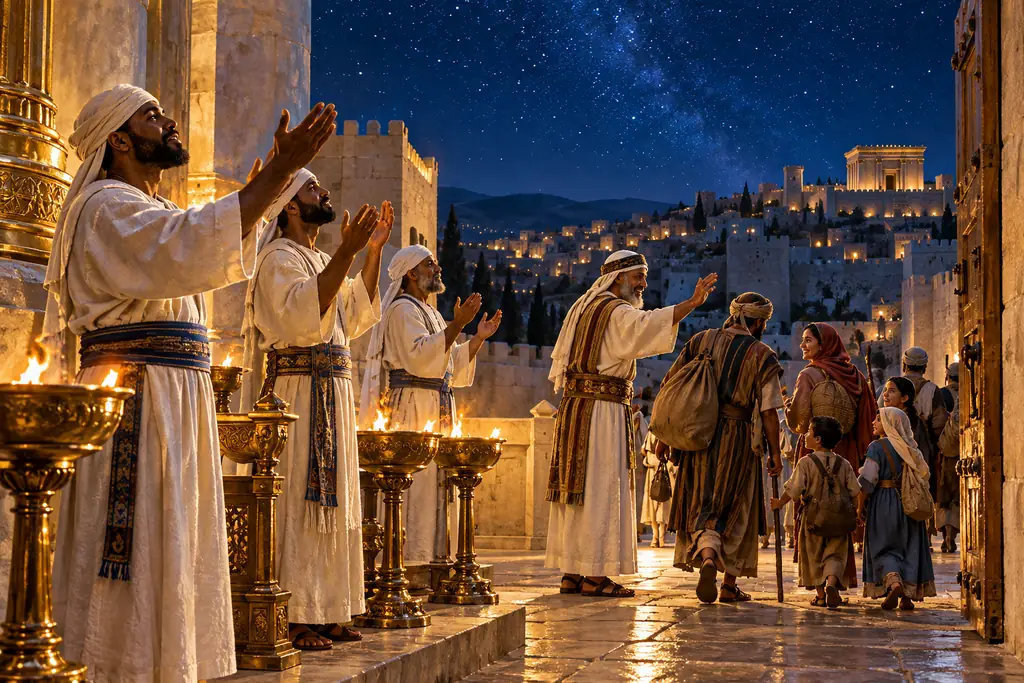
How does the journey of worship become a blessing we carry even through life’s nights?
01
Overview
The final Song of Ascents, the servants of the LORD, and the blessing that comes from Zion
Key text — Psalm 134:1–3 (explanatory study rendering): “Come, bless the LORD, all you servants of the LORD, who stand in the LORD’s house during the nights. Lift your hands toward the holy place and bless the LORD. May the LORD bless you from Zion—the One who made heaven and earth.”
A pilgrimage may be remembered for the moment people arrive. After many days on the road, they see the destination, greet familiar faces, and join the songs for which they have traveled. But what happens when the gathering is over? The visitors return to their homes. Lamps grow dim. The temple attendants remain at their stations. Does worship end when most of the worshipers have gone?
Psalm 134 answers with a remarkably short song. It has no account of a miracle, no long description of human suffering, and no argument to defend. It calls those serving at the LORD’s house to bless him during the night. Then, in a beautiful reversal, a blessing is spoken upon the worshiper from Zion in the name of the Creator of heaven and earth.
The final Song of Ascents invites us to see worship as more than an event we attend. It is a life sustained by gratitude, service, and the presence of the God whose goodness does not end when the building empties. We bless the LORD by acknowledging who he is; the LORD blesses us by giving what we cannot give ourselves.
02
1.0 Introduction
Psalm 134 is the fifteenth and final Song of Ascents (Pss. 120–134). The collection began with a distressed worshiper far from peace, surrounded by deceit and hostility (Ps. 120). It has led us through prayers for protection, joy in Jerusalem, mercy under contempt, deliverance from danger, patient hope, work and family, covenant promise, and the beauty of communal unity. Now the journey closes with three verses of praise and blessing.
The setting seems simple: servants are standing in the LORD’s house at night, and someone summons them to worship. A response follows: “May the LORD bless you from Zion.” The first two verses address a group; the final verse addresses a person in the singular. This shift has led interpreters to imagine a liturgical exchange, perhaps between departing pilgrims and the priests or Levites who remain at the sanctuary. The proposal is attractive, but the psalm does not tell us who spoke each line or on what occasion it was performed.
Goldingay calls attention to how little the poem adds after its opening invitation. Unlike many hymns, it does not proceed to name a succession of reasons for praise. As the last song in this collection, however, it may not need to: the preceding fourteen songs have already supplied a lifetime of reasons. Kidner likewise hears a fitting completion of the journey from the alienation of Psalm 120 to the worship of God in his house.
The poem moves through three gestures: a call to bless the LORD, hands lifted in worship, and a blessing received from the LORD. Its theological heart is reciprocal but not symmetrical. God needs no enrichment from our praise. We, however, depend utterly on the gifts of our Maker. The life of faith is sustained when recognition of his goodness becomes service, and his gracious blessing sends us forward.
03
2.0 Historical and Literary Context
2.1 The last of the Songs of Ascents
The heading reads simply “A Song of Ascents.” Unlike a number of songs in the collection, Psalm 134 does not add the name of David or Solomon. Scholars cannot establish its date, composer, precise setting, or prescribed use. It may have been sung by people reaching the sanctuary, by pilgrims preparing to depart, or by a congregation addressing temple ministers at the end of the day. We should preserve that uncertainty.
Yet its position in the collection is unmistakably meaningful. Psalm 133 celebrates brothers and sisters living together and concludes that the LORD commands blessing at Zion. Psalm 134 immediately calls the LORD’s servants to bless him and concludes with a blessing from Zion. The two poems are linked not only by location but by the theme of blessing shared within a worshiping community. Goldingay describes them as companions, and he sees the exchange of blessing in Psalm 134 as embodying the fellowship celebrated in Psalm 133.
The final words, “maker of heaven and earth,” echo the confession of Psalm 121:2: “My help comes from the LORD, who made heaven and earth.” At the beginning of the pilgrims’ movement, their Creator was their helper on the road; at its conclusion, their Creator blesses them from Zion. The God of the journey remains the God of the destination—and of the journey home.
2.2 Who are the servants standing at night?
The Hebrew description is “servants of the LORD” who “stand in the house of the LORD during the nights.” To stand before a master or king could mean attending to duty, readiness to serve, or participating in ceremonial service. It is not merely a comment about standing rather than sitting.
Kidner argues that the particular servants are chiefly priests and Levites. He appeals to texts describing Levitical singers who served day and night (1 Chr. 9:33), those assigned to thank and praise God morning and evening (1 Chr. 23:30), and the tribe’s ministry of standing before God and blessing in his name (Deut. 10:8). This reading fits a farewell scene in which departing pilgrims acknowledge those who remain to serve.
Goldingay keeps a wider range of possibilities open. “Servants” can describe Israelites generally, not only religious officials, and ordinary worshipers might be addressed. He nevertheless regards temple workers, night attendants, and guards as plausible hearers. First Chronicles 9:27 refers to guards lodged around the temple; the priests and Levites also prepared for worship and maintained the sanctuary. We should not imagine an uninterrupted public night service merely because the psalm mentions the night: the evidence supports night duties, but it does not establish a continuous nightly liturgy in a particular form.
2.3 “Bless” as praise and blessing
A single Hebrew verb, bārak, binds the poem together. In verses 1 and 2, human beings are told to “bless” the LORD—an expression often translated “praise.” In verse 3, the LORD is invoked to “bless” a human being. The repetition is deliberate, but the meaning shifts with the direction of the action.
We do not make God greater by blessing him. We confess his greatness, thank him, and acknowledge his character and works. God, on the other hand, is the giver of life, protection, and flourishing. Kidner puts special weight on this difference: blessing God is grateful acknowledgment; God’s blessing gives people what they lack. Worship and reception belong together without turning worship into payment for divine benefits.
2.4 Zion and the Creator of everything
Zion was a particular place associated with the LORD’s presence among Israel, and the temple was a concrete meeting place for covenant worship. But the final words prevent us from treating God as a local deity whose power stops at a city boundary. The one invoked from Zion is the Maker of heaven and earth.
This pairing of the particular and the universal is not accidental. The Creator chose to make himself known through the story, worship, and covenant life of a particular people; his creative sovereignty nevertheless extends beyond them. The psalm’s blessing is neither a magical property of temple stones nor a promise that access to God is controlled by human gatekeepers. Its source is the LORD himself, worshiped in Zion and sovereign over the whole creation.
04
3.0 Walking Through the Text
3.1 Psalm 134:1a — “Come, bless the LORD”
The psalm opens with a summons. The Hebrew particle often translated “Behold” or “Come now” gives urgency and warmth: pay attention; here is what should happen next. Praise is not introduced as a private mood that may or may not arise. It is an invitation into an act fitting for people who belong to the LORD.
The wording resembles the opening of hymns that call people to worship before speaking of God’s mighty works. But Psalm 134 is unusual because its call nearly fills the song. Goldingay suggests that the previous Songs of Ascents have already provided the material for the praise this final psalm requests. The weary pilgrimage, answered prayers, shared meals, deliverance, restored hope, and covenant promises can now be gathered into a single response: Bless the LORD.
This matters when we have no elaborate words for prayer. Sometimes faithful worship begins not with a new insight but with the remembered goodness of God. A short sentence of thanksgiving can carry the weight of a long journey.
3.2 Psalm 134:1b — “All you servants of the LORD”
The address is plural and inclusive of the group being summoned. If the hearers were priests, singers, guards, or Levites, the word servants first describes their relationship to God, not their status above the congregation. Their duty is not a personal possession or a source of unlimited authority. They serve the LORD.
The term also reaches beyond the ancient temple when heard canonically. Moses is called a servant of the LORD (Josh. 1:1), Israel is called God’s servant in prophetic texts (Isa. 41:8–9), and Christian communities later speak of service to God through Christ (Rom. 12:11; Col. 3:23–24). Those broader connections are not proof that every Israelite served on the temple’s night watch. They demonstrate a recurring biblical conviction: the worth of service rests in belonging to God, not in being seen by an audience.
There is dignity here for tasks rarely celebrated. Caring for the sanctuary, preparing for morning worship, keeping watch, and singing when others sleep do not make a person less important than those who lead a great festival. The invitation includes the people still at work.
3.3 Psalm 134:1c — “Who stand in the LORD’s house during the nights”
The night makes the invitation unexpectedly moving. People often speak of worship when the congregation is full and the choir is audible. This psalm notices those who remain when the crowd has dispersed. Whether it pictures actual night attendants or uses the night to emphasize continuing service, the effect is the same: devotion to the LORD is not confined to public celebration.
Kidner links this line with the day-and-night duties of the Levitical singers (1 Chr. 9:33) and their morning and evening praise (1 Chr. 23:30). Goldingay points out that regular public offerings are not clearly described as being conducted throughout the night; keeping watch, preparation, and early prayer might better explain the phrase. Neither reading licenses an exact timetable that the text never supplies.
In the wider Songs of Ascents, the night can also evoke vulnerability. Psalm 121 promises that the keeper of Israel neither slumbers nor sleeps; Psalm 130 imagines watchmen waiting for morning. Psalm 134 does not identify the night as evil. It places worship there, reminding us that the God who watches over his people does not abandon them when human activity grows quiet.
3.4 Psalm 134:2a — “Lift your hands”
Worship involves bodies as well as words. The lifted hands may convey prayer, dependence, openness to receive, or a gesture associated with blessing. Psalm 28:2 describes hands lifted toward God’s holy sanctuary in a plea for help; Psalm 63:4 associates lifted hands with blessing the divine name. Leviticus 9:22 describes Aaron raising his hands to bless the people.
Goldingay emphasizes that this gesture commonly expresses an appeal to God and therefore dependence, rather than mere celebration. Kidner directs attention to the holiness of the action. The precise nuance here need not be forced into one option: lifting hands can be a fitting response of creatures who turn toward their Creator in adoration and need.
The point is not to prescribe a single compulsory posture for every congregation. Scripture also portrays standing, kneeling, bowing, silence, and singing. The question is whether bodily actions express a truthful orientation of the heart. Raised hands cannot substitute for justice, humility, or love; neither should worshipers be judged for praying without them.
3.5 Psalm 134:2b — “Toward the holy place”
The Hebrew is compact and allows discussion. The term may point to the sanctuary—the sacred place toward which hands are lifted—or carry the sense of holiness, so that the phrase evokes worship performed in holiness. Kidner notes both readings, although the sanctuary-oriented rendering is common. He suggests that the language could be compared, at the level of biblical theology, with lifting “holy hands” in 1 Timothy 2:8. That is a connection for reflection, not proof that the New Testament writer is quoting Psalm 134.
Goldingay proposes another distinction: those standing in the earthly sanctuary may lift their hands toward the heavenly sanctuary where God truly reigns. His reading fits the Psalter’s awareness that the heavenly Creator cannot be contained within a building (compare Ps. 150:1 and 1 Kgs. 8:27). Yet the short phrase does not establish the intended direction with certainty.
Whatever precise spatial sense is adopted, the direction of worship is Godward. The sacred setting matters because it reminds worshipers whom they serve; it is not a stage on which leaders display themselves.
3.6 Psalm 134:2c — “And bless the LORD”
The second command repeats the first and brings verses 1–2 into a small frame: bless the LORD, lift your hands, bless the LORD. Repetition does not signal a shortage of ideas. It trains attention. The words bring the singers back to the One who is worthy of acknowledgment.
The command also resists reducing worship to a transaction. Nothing in this verse says, “Praise God enough and he will give you exactly what you ask.” The appeal is appropriate because God is worthy. The blessing in verse 3 follows as a gracious word, not as a wage paid for correct ritual performance.
A congregation might learn something from this economy of words. A short refrain, sung with understanding and followed by honest service, may express more faith than prolonged words that leave the vulnerable untouched. The goal is not to diminish liturgy but to unite liturgy with a life that honors the LORD.
3.7 Psalm 134:3a — “May the LORD bless you from Zion”
The command becomes a blessing. The plural address of verses 1–2 gives way to a singular “you.” This distinction is visible in the Hebrew and is important to Goldingay’s interpretation. It suggests that a group—perhaps temple servants—may be answering an individual speaker, such as a pilgrim preparing to leave. The imagined exchange resembles a farewell blessing, but the text itself does not identify the voices.
The wording recalls the priestly benediction: “The LORD bless you and keep you” (Num. 6:24). It also resembles Psalm 128:5, where the LORD is asked to bless a worshiper from Zion. The singular form speaks tenderly to persons within the community: the God whose people gather in crowds also sees individuals. Yet we should not conclude that blessing is an exclusively private matter; the whole gathering participates in speaking it.
A blessing is a prayerful declaration rooted in God’s character. It need not predict wealth, a trouble-free journey, or a guaranteed outcome. The pilgrim can leave with confidence in God’s mercy while remaining responsible for the uncertainties of the road ahead. To bless another person in God’s name is to direct their hope toward God, not toward the supposed power of the speaker.
3.8 Psalm 134:3b — “The One who made heaven and earth”
The final description expands the horizon. A blessing from Zion comes from the God who made everything. The walls of the temple do not confine his reach. The One whom worshipers meet in a specific place is also the One whose authority embraces the journey, the night, the nations, and the future.
The phrase recalls Psalm 121:2 and reinforces the arc of the collection. At the beginning, the traveler asks where help comes from and answers: from the Creator. At the close, that same Creator is invoked to bless. God is not merely a companion for a festival. His care accompanies his people when they scatter again.
The psalm ends without reporting what happened to the departing traveler or the night servants. That is fitting. Its final word is not a human achievement but an invocation of divine blessing. The worshiper leaves the temple, but not the world of the Creator.
05
4.0 Theological Reflection
4.1 Worship is directed toward God, not the worshiper’s importance
The last Song of Ascents contains no praise of the skill of its singers, the beauty of its buildings, or the status of its officials. The only greatness named is the LORD’s. This is a valuable corrective wherever congregations become absorbed in personalities, titles, competition, or impressive events. Worship leaders matter as servants, not as owners of divine presence.
Praise should therefore encourage humility. The most gifted preacher, musician, administrator, or teacher stands before God as a recipient of mercy. A church honors its calling when those who lead direct attention beyond themselves.
4.2 Faithfulness includes the unseen hours
Night service gives the psalm a pastoral reach beyond the sanctuary. Nurses on duty, parents caring for a sick child, guards protecting a neighborhood, volunteers preparing food, and caregivers assisting elderly relatives often serve while others rest. These are modern analogies, not occupations mentioned in the Hebrew poem. They help us recognize the worth of faithful acts without applause.
At the same time, Psalm 134 must not be used to demand endless work or sleep deprivation. The Lord who receives night-time praise is also the giver of rest (Ps. 127:2). Communities should honor workers through adequate rest, safe conditions, appropriate pay, and shared responsibilities. Faithfulness does not mean accepting exploitation.
4.3 Blessing moves in two directions—but God remains the giver
The repeated verb bārak shapes the poem. We bless God with gratitude; God blesses us with life-giving generosity. This is relationship, not exchange of equal gifts. God's goodness precedes human praise, and our praise recognizes rather than purchases his favor.
A healthy worshiping community can reflect this pattern. Its members thank God and bless one another through prayer, kindness, hospitality, encouragement, and service. No minister should claim that divine blessing can be bought, controlled, or guaranteed through an offering, anointing, or personal loyalty.
4.4 Corporate worship remembers particular people
Verse 3 is addressed in the singular. The invitation summons a community; the blessing lands upon a person. This suggests a beautiful meeting of shared faith and individual care. Large gatherings can give participants courage, but they can also render some invisible. The psalm reminds us to notice those who come burdened, elderly, lonely, grieving, or far from home.
A congregation that blesses individuals without caring for the community also misses the point. God’s favor is not merely a private possession. Prayers for one another should become structures of mutual support, fairness, and responsibility.
4.5 Zion points to God’s covenant presence, not a monopoly on God
Zion matters in Israel’s story because God chose to be known there in covenant worship. But the Creator cannot be confined to a place or controlled by people. Solomon’s prayer at the dedication of the temple itself acknowledges that even heaven cannot contain God (1 Kgs. 8:27).
For Christian readers, this guards against two opposite errors. We should not despise Israel’s historical worship as though its places and practices were meaningless. Neither should we treat any modern building, city, minister, or denomination as uniquely able to dispense divine life. The LORD who blesses from Zion is sovereign over all creation.
4.6 The last song teaches worship that survives departure
The Songs of Ascents do not conclude with pilgrims living forever in a festival crowd. They conclude with a blessing. The story of faith necessarily continues beyond a sacred gathering. After the benediction, people return to families, work, uncertain roads, and difficult responsibilities.
The quality of worship is seen in how we live after we leave. If we bless God with our mouths but demean colleagues, neglect the weak, or falsify our dealings, our practices contradict the God we proclaim. The journey home becomes a place where worship must take ordinary, visible form.
06
5.0 Canonical and Christological Horizon
5.1 A closing response to fifteen Songs of Ascents
The canonical journey begins in Psalm 120 with someone longing for peace among people who love conflict. Psalm 121 confesses help from the Maker of heaven and earth; Psalm 122 celebrates gathering in Jerusalem; Psalm 123 pleads for mercy; Psalms 124–130 revisit rescue, injustice, work, blessing, tears, and forgiveness. Psalms 131–133 introduce quiet trust, Davidic promise, and life together. Psalm 134 turns all of this experience into praise and sends a worshiper away under God’s blessing.
Goldingay observes that Psalm 134 resembles Psalm 150: a conclusion filled with an invitation to praise. Psalm 134 ends a pilgrimage collection; Psalm 150 will end the Psalter. In both places, the final word is not that every human problem has been solved, but that the LORD remains worthy of worship.
5.2 Israel’s priestly and temple traditions
The servants who bless the LORD recall Israel’s priestly vocation. Numbers 6:22–27 gives the priestly blessing; Deuteronomy 10:8 describes Levitical service and blessing in God’s name. Chronicles speaks of singers and temple ministers carrying out daily responsibilities (1 Chr. 9:33; 23:30; 25). Psalm 134 makes best sense against these traditions without requiring us to reconstruct a precise nightly ceremony.
This context also reminds us that praise was communal labor. Singing, guarding, preparing, maintaining, and blessing were forms of ministry. The most visible part of worship depended on less visible service. No servant, however, was the source of the promised blessing; that role belongs to God.
5.3 From earthly Zion toward the worship of God through Christ
In the New Testament, Jesus speaks of worship in which knowing the Father is not restricted to one mountain, while also insisting that salvation comes from the Jews (John 4:21–24). These claims should not erase Israel’s history. They locate Christian worship within the wider story of the God first revealed through Israel.
Hebrews 12:22–24 describes believers approaching Mount Zion, the heavenly Jerusalem, and Jesus the mediator of a new covenant. Kidner relates Psalm 134’s blessing from Zion to this Christian horizon. The psalm does not explicitly predict that passage, but the canonical connection shows how Christians can understand access to God through Jesus without turning geography into an idol.
5.4 Jesus blesses his followers as they go
Luke 24:50–53 portrays the risen Jesus lifting his hands and blessing his disciples as he departs. They respond by worshiping and returning to Jerusalem with joy, continually praising God. This is a compelling thematic parallel to Psalm 134: lifted hands, blessing, worship, and a community sent onward.
Luke does not state that Jesus is formally reenacting Psalm 134, and we should not claim a direct quotation. But read together, the passages reveal a consistent biblical pattern: the people who receive God’s gracious promise answer with praise. The living Christ sends his followers into the world under a blessing rather than leaving them to manufacture hope alone.
5.5 Jesus’ priestly ministry and the church’s vocation
Hebrews portrays Jesus as the High Priest who intercedes for his people and whose decisive self-offering is not repeated endlessly (Heb. 7:23–28; 10:11–14). First Peter calls believers a “royal priesthood” invited to declare God’s excellencies (1 Pet. 2:9–10). These are later Christian theological developments; they are not definitions of the night servants in the original psalm.
They nevertheless speak to the church’s calling. Christian ministers are not gatekeepers who own divine blessing. The church is a people gathered by Christ to praise, serve, pray, and bear witness. That ministry includes public proclamation and quiet works of mercy. Leadership is accountable because it belongs to God.
5.6 The God who neither sleeps nor abandons creation
Psalm 121 tells pilgrims that the Keeper of Israel neither slumbers nor sleeps. Psalm 134 shows human servants awake in worship, but it never suggests that God needs their vigilance to remain present. The Creator who watches over them also sustains the world outside the sanctuary.
Revelation 7:15 describes worship before God’s throne, while Revelation 21:1–5 pictures the fulfillment of God’s promise to dwell with renewed humanity. Christians may hear Psalm 134 as a modest anticipation of such life: praise offered to God and blessing flowing from his presence. Its original horizon remains Israel’s temple worship; the later hope draws the psalm into the Bible’s movement toward restored creation.
07
6.0 Life Application
- End your gatherings with a meaningful blessing. Rather than using a benediction as a signal that the event is over, allow its words to become a prayer for how people will live when they leave.
- Honor those whose service is unseen. Thank cleaners, guards, musicians, visitors to the sick, children's teachers, and those who prepare worship spaces. Let appreciation include fair treatment and appropriate support.
- Practice gratitude at the end of the day. Name one mercy received, one responsibility still unfinished, and one burden to entrust to God. Brief evening prayer can reorient an anxious mind.
- Protect rest as part of faithful service. Do not use the language of sacrifice to justify exhausting volunteers or employees. Share duties, respect safe schedules, and remember that the Creator also gives rest.
- Make corporate worship personal without making it exclusive. Speak to those who are easily overlooked. Pray for individuals while strengthening the whole community’s habits of care.
- Keep worship God-centered. Evaluate whether singing, preaching, and leadership direct people to the LORD or mainly promote particular personalities. Welcome truthful questions and accountability.
- Refuse to turn blessings into financial transactions. A blessing is not a product purchased by a donation, an honorarium, or loyalty to a spiritual leader. Practice generosity freely and transparently.
- Let prayer shape your public conduct. If your hands are lifted in worship, let them also be ready to work honestly, support the vulnerable, and repair harms you have caused.
- Include those who cannot attend the gathering. Visit the sick, make teaching accessible, keep contact with prisoners and homebound members where appropriate, and remember caregivers who worship from difficult circumstances.
- Carry the blessing beyond the sanctuary. Ask what God-centered living might look like at a workplace, market, school, hospital, family table, or neighborhood meeting during the coming week.
08
7.0 Reflection Questions
- How does Psalm 134 bring the fifteen Songs of Ascents to an appropriate conclusion?
- What changes when we read Psalm 134 beside Psalm 133 and their shared emphasis on blessing from Zion?
- What evidence supports identifying the nighttime “servants of the LORD” with priests or Levites? Why should we not make the identification absolute?
- What is the difference between human beings blessing the LORD and the LORD blessing human beings?
- Why is the singular “you” in verse 3 significant for the proposed call-and-response reading?
- What do Kidner and Goldingay each emphasize about the nighttime setting and the servants who stand in God’s house?
- What are the possible meanings of lifting hands “toward the holy place”? How should those options affect our confidence about the phrase?
- How does Psalm 121’s description of the LORD as Maker of heaven and earth illuminate Psalm 134:3?
- Why should receiving divine blessing not be equated with guaranteed prosperity or freedom from danger?
- What connections can Christians responsibly draw between Psalm 134, Luke 24:50–53, and Hebrews 12:22–24?
- Who performs faithful but largely unseen service in your church, family, or community? How could that service be honored without encouraging exhaustion?
- What would change if the last words of your worship gathering shaped the first choices you made after leaving?
09
8.0 Response Prayer
LORD, Maker of heaven and earth, we praise you for carrying us through roads of uncertainty, seasons of grief, and moments of joy. Thank you for the communities in which we have learned to call upon your name and for the servants whose faithfulness often goes unnoticed. Forgive us when we turn worship into a display, blessing into a bargain, or service into an occasion for pride. Teach us to raise our hands with humble hearts and to use those same hands for justice, kindness, and honest work. Guard those who serve through the night; give the weary rest and the lonely companionship. As we leave places of worship, let your blessing accompany us into ordinary responsibilities. Through Jesus Christ, our risen Lord, make us a people who bless your name and carry your mercy into the world. Amen.
10
9.0 Window into What Comes Next
Psalm 134 ends the fifteen Songs of Ascents with a simple and memorable movement. The LORD’s servants are summoned to bless him in his house, even at night. Then the worshiper receives a blessing from Zion in the name of the One who made heaven and earth. The collection that began with a cry from a hostile environment concludes not with a triumphant announcement that every struggle is over, but with worship and a word of grace for the road ahead.
Psalm 135 expands this short summons into a fuller hymn. It again calls the servants of the LORD, those standing in the courts of his house, to praise his name (135:1–2). But now it explains why: God is good, has chosen his people, rules creation, acts in history, and stands in contrast to powerless idols. Psalm 134 provides the final blessing of the pilgrimage; Psalm 135 invites the community to rehearse the reasons the LORD alone deserves praise.
The journey therefore continues in a new form. Those whom the Creator has blessed return to the work of remembering his goodness and making it known.
11
10.0 Bibliography
- Scripture: Exodus 15; Deuteronomy 10:8; Numbers 6:22–27; Leviticus 9:22; 1 Kings 8:22–30; 1 Chronicles 9:27, 33; 23:26–30; 25; Psalms 28:2; 63:4; 120–135; 150; Isaiah 41:8–10; John 4:21–24; Luke 24:50–53; Romans 12:11; Ephesians 4:11–16; Colossians 3:23–24; 1 Timothy 2:8; Hebrews 7:23–28; 10:11–14; 12:22–24; 1 Peter 2:9–10; Revelation 7:15; 21:1–5.
- Goldingay, John. 2008. Psalms, Volume 3: Psalms 90–150. Baker Commentary on the Old Testament Wisdom and Psalms. Grand Rapids: Baker Academic. Commentary on Psalm 134, “The Reciprocity of Praise and Blessing.” Important for the pairing with Psalm 133, uncertainty about the liturgical speakers, the role of nighttime servants, the gesture of lifted hands, the singular blessing, and the relationship between Zion and the Creator’s heavenly rule.
- Kidner, Derek. 1975. Psalms 73–150: A Commentary. Tyndale Old Testament Commentaries. Downers Grove, IL: InterVarsity Press. Commentary on Psalm 134, “Unceasing praise,” pp. 489–490. Especially useful for Levitical duties, the possibility of pilgrims and temple ministers exchanging greetings, the alternative senses of “holy place,” the difference between praising God and receiving his blessing, and the reference to Hebrews 12.
- BibleProject. The Book of Psalms. Literary and thematic overview of the Psalter and its movement toward sustained praise. Used for broad canonical orientation rather than as a verse-by-verse source for Psalm 134. Translation and interpretive note: The key text is an explanatory study rendering rather than a verbatim quotation from any named Bible version. The identity of the speakers, the precise liturgical use, and the meaning of “toward the holy place” are disputed. Distinctions between what Psalm 134 says, scholarly historical proposals, and later Christian theological applications have been retained throughout.


Be the first to leave a comment.