

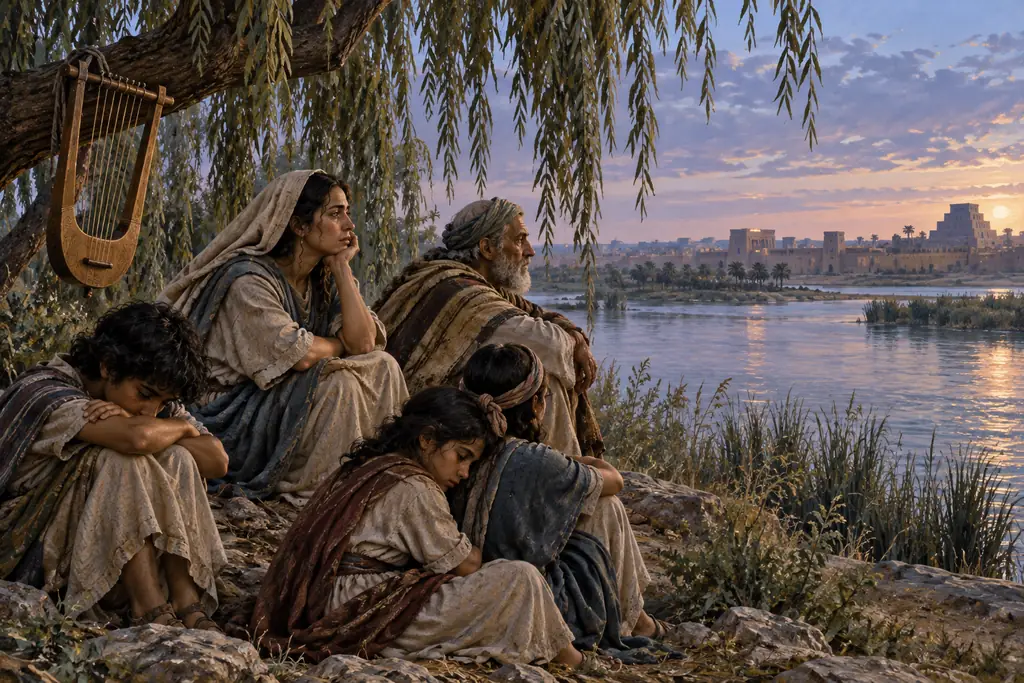
When songs fall silent in exile, how can we bring grief and anger before God?
01
Overview
Beside Babylon's rivers, remembering Zion, refusing forced joy, and carrying wounded anger before God
Key text — Psalm 137:1, 4 (explanatory study rendering): “Beside Babylon's waterways we sat and wept as we remembered Zion. How could we sing the LORD's song in a foreign land?”
A people who once sang about God's enduring love now sit in silence. Their instruments hang from the trees. Their captors demand entertainment, perhaps precisely the songs that recall Jerusalem's glory. What was once a source of joy has become a reminder of devastation. What does worship sound like when the people who know God's promises can scarcely bear to sing?
Psalm 137 does not offer an easy answer. It begins with displacement, proceeds through a fierce commitment to remember Jerusalem, and ends with words about retaliation that are profoundly disturbing. The temptation is to stop reading before verse 9, or to make the violence sound harmless. Neither approach honors the victims who speak here—or those threatened in its closing words. The psalm invites a harder practice: attending honestly to historical violence, grieving without pretence, asking God to remember injustice, and discerning what Christian discipleship can and cannot do with a wounded community's cry.
Read immediately after Psalm 136, with its twenty-six declarations that God's steadfast love endures, Psalm 137 reminds us that the same biblical people who praise God's faithfulness also know desolation, unanswered questions, and anger. Scripture makes room for both voices.
02
1.0 Introduction
Psalm 137 is a communal lament rooted in the catastrophe of Jerusalem's destruction and the Babylonian exile. In 587/586 BCE, Babylonian armies captured Jerusalem, devastated the temple, and deported many of Judah's people (2 Kgs. 25; Jer. 52). The psalm's images are concrete: waterways, trees, suspended instruments, cruel requests for song, the lost city, and the memory of its destruction.
The poem has three movements. Verses 1–4 recall communal grief and the humiliation of being commanded to sing. Verses 5–6 shift to an individual's solemn promise not to forget Jerusalem. Verses 7–9 turn toward remembered wrongdoing by Edom and Babylon, concluding with a horrifying image of reciprocal violence. The movement is from tears, to faithful remembrance, to the desperate demand that injustice not be forgotten. It does not end with explicit consolation.
John Goldingay reads the text as a distinctive communal prayer: the people first speak about their suffering; only in verse 7 do they explicitly address the LORD. Derek Kidner describes a growing intensity, from pathos to defiance to imprecation. Their insights belong together: the psalm is both a record of unbearable loss and the difficult emergence of a voice that will not let its oppressors define reality.
Its final verse must be approached with moral seriousness. The ancient words describe what the speaker hopes will happen to Babylon's children; they are not instructions given by God to contemporary readers. Yet merely calling the words “figurative” would evade the text. The violent image is there, and the church has to read it honestly, in the light of the biblical witness to God's justice, the dignity of the vulnerable, and Jesus' command to love enemies (Matt. 5:43–48).
03
2.0 Historical and Literary Context
2.1 Jerusalem's fall and life in displacement
The destruction of Jerusalem involved military conquest, hunger, killing, humiliation, and the loss of institutions through which Judah understood its life before God. The temple was destroyed; the monarchy collapsed; many inhabitants were uprooted, while others remained amid ruins (2 Kgs. 25; Lam. 1–5). The exile was therefore not simply homesickness. It was the breaking of political, familial, liturgical, and communal life.
Babylon's rivers could refer to the Euphrates and its network of canals. Ezekiel lived among exiles by the Chebar canal (Ezek. 1:1–3; 3:15); Ezra later gathered travelers near the Ahava waterway (Ezra 8:21–23). These passages provide a plausible setting for an exilic gathering, though they do not establish where the events of Psalm 137 occurred. The trees may have been willows or Euphrates poplars; Goldingay favors the latter in this regional setting.
2.2 Was it written during exile or afterward?
The historical disaster is identifiable; the composition date is not. Kidner emphasizes the vividness of a first-hand exilic experience. Goldingay points out that the narrator speaks of having sat there and raises the possibility of composition after return to Judah, when people still recalled Babylon and continued to resent Edom's actions. The fall of Babylon to Cyrus in 539 BCE did not physically destroy the city, so the psalm's declaration of Babylon's coming devastation does not by itself settle the date.
It is wiser to say that Psalm 137 gives voice to Israel's exilic trauma whether composed in Babylon, after return, or shaped through subsequent communal memory. Its first-person plural allows later generations to participate in the remembered grief rather than treating the story as someone else's remote misfortune.
2.3 A lament that reverses the songs of Zion
Zion songs such as Psalms 46, 48, 76, and 84 celebrate God's presence and the security or beauty of his city. Psalm 137 holds those songs against a terrifying question: where are their claims now that Zion has fallen? Goldingay describes Psalm 137 as an inversion of the Zion hymn. Its speakers remember the city and its songs, but with tears instead of rejoicing, suspended instruments instead of festival music, and taunting enemies instead of astonished nations.
After Psalm 132's covenant memories and Psalms 133–134's worship around Zion, Psalm 137 exposes the devastation of losing that place. It also stands immediately after Psalm 136's refrain about enduring love. The Psalter does not conceal the tension between remembered faithfulness and present ruin.
2.4 The three movements and the voices they use
The repeated “we,” “our,” and “us” in verses 1–4 establish shared memory. Verses 5–6 change to “I,” turning public mourning into a personal vow. Verse 7, uniquely and explicitly, speaks to “LORD.” Verses 8–9 turn to “daughter Babylon,” personifying the imperial city as the addressee of the final declaration. These changes of address are part of the meaning: injured people find a way from shared paralysis to remembering, promising, and appealing for accountability.
2.5 Biblical echoes of Edom and Babylon
Obadiah 10–14 accuses Edom of gloating over Judah, standing by while it suffered, and participating in its distress. Lamentations 4:21–22 and Ezekiel 25:12–14 also connect Edom with judgment for hostility. Isaiah 13 and Jeremiah 50–51 contain harsh oracles against Babylon, including imagery of retaliation. These prophetic intertexts illuminate the language of Psalm 137; they do not remove its ethical difficulty or turn its closing verse into a command to harm children.
04
3.0 Walking Through the Text
3.1 Psalm 137:1 — Sitting and weeping beside the waters
The opening creates a collision between the surrounding landscape and the community's inner world. Babylon's canals could sustain agriculture and commerce; their waters do not wash away the loss of Zion. The people sit, weep, and remember. These are not isolated emotions but communal acts that allow the suffering to be named together.
The Hebrew verb of remembering, zākar, is more than accidental recall. It may involve deliberately keeping a lost reality before the mind. Here Zion is not merely an admired old city. It is the city associated with the LORD's dwelling, the temple, and the promises to David (Pss. 48; 132). To remember Zion is to wrestle with the apparent collapse of a world of worship, identity, and hope.
Grief is not a failure of faith. Scripture does not demand that exiles rename loss as blessing. A person who weeps beside a hospital bed, after violent displacement, or at the site of a destroyed home need not manufacture cheerful words for God. The first faithful act may be to sit with others and tell the truth.
3.2 Psalm 137:2 — Instruments suspended from the trees
The lyres have not been destroyed; they have been hung up. Instruments associated with praise remain physically present but are no longer played. The willows or poplars become a silent stand for a community's interrupted worship.
One interpretation is that the worshipers have temporarily lost the ability to sing; another is that they actively refuse to perform sacred songs for their captors. The next verse gives the refusal its sharper meaning. Silence can be the expression of sorrow, but it can also be the defense of dignity against exploitation.
This is not a universal prohibition against making music during grief. The Bible's lamentations are themselves carefully shaped compositions. Rather, a particular kind of joyful Zion hymn has become impossible to perform without dishonoring the memory of what happened.
3.3 Psalm 137:3 — When the captors demand a joyful song
The captors request songs associated with Zion, and those who humiliate the exiles demand joy. We cannot know exactly what performance they expected; the text's depiction of mockery makes clear that the demand is cruel. Songs once offered freely to God are now being solicited under the authority of those who helped devastate the city they celebrate.
Goldingay observes that the request may focus on the words of Zion songs, precisely the claims about the city that could now be ridiculed. The cruelty is therefore theological as well as social. The oppressors seek a spectacle out of the captive people's deepest convictions.
There is a difference between inviting an injured person to share their story and demanding that the injured person entertain an audience. Churches can repeat such harm when they force recently bereaved people to offer a triumphant testimony before they have even been heard. Worship must never become a stage on which another person's wounds are used for applause.
3.4 Psalm 137:4 — How can we sing the LORD's song abroad?
The question is not primarily whether God's presence is geographically restricted to Jerusalem. Scripture can portray God speaking and acting in foreign territory—indeed, Ezekiel receives visions in Babylon (Ezek. 1). The dilemma is whether a joyful hymn praising Zion's security can be sung truthfully while Zion lies devastated and its singers are held captive.
Kidner hears in this question a courageous refusal to make the song an instrument of mockery. Goldingay notices that the community's inability to praise may also express a deeper crisis: the old Zion hymns seem impossible to reconcile with what history has just done to Jerusalem.
There is no immediate resolution. Some lamenting believers still sing; others can only listen while a community sings for them. Both realities can belong to faithful worship. The question also challenges churches that measure spirituality only by emotional exuberance: a wounded silence can be more honest than a coerced chorus.
3.5 Psalm 137:5 — If I forget Jerusalem, let my right hand forget
The voice turns from “we” to “I.” The speaker makes a solemn self-curse: if Jerusalem is forgotten, may the right hand lose what makes it useful. The Hebrew does not explicitly supply the object of the second “forget.” Traditional translators infer the skill of playing an instrument, a natural possibility given the hanging lyres; others leave the expression deliberately unfinished. We should not claim greater precision than the verse supplies.
The promise is not a declaration that every existing feature of ancient Jerusalem was flawless. The biblical prophets frequently criticized the city for injustice (Isa. 1:21–23; Jer. 7). To remember it truly is to remember both God's purposes for it and the wrongs that led to its ruin. Faithful memory is not national nostalgia immune to self-examination.
The speaker refuses to let conquest determine what is worth remembering. Loss can take away land, buildings, and instruments. It need not take away responsibility toward a community and the promises by which it has lived.
3.6 Psalm 137:6 — May my tongue cling if I cease remembering
Now the tongue is placed under the same solemn obligation as the hand. If the speaker forgets Jerusalem, may speech and song become impossible. The two images mirror the skills by which a singer could ordinarily bring joy: hand to play, tongue to sing.
The reference to Jerusalem as one's highest joy is startling because verse 1 has just described the city as the cause of tears. The speaker's deepest joy lies not in the immediate experience of happiness but in enduring allegiance to God's purposes. Memory becomes a moral commitment, not simply a private emotion.
There is also an important limit: Christians should not weaponize this oath to deny other peoples' suffering or to bless every action of any present-day government. Honoring ancient Israel's story does not excuse injustice today. True remembrance has room for other wounded communities; it need not compete over whose grief is permitted to matter.
3.7 Psalm 137:7 — LORD, remember what Edom did
For the first time the LORD is directly addressed. The people ask God to remember Edom's behavior on Jerusalem's day of devastation, when Edomites are depicted as cheering the destruction down to the foundations. The language echoes the prophetic accusations in Obadiah 10–14 and Ezekiel 25:12–14.
The presence of Edom is especially painful because Israel and Edom traced their ancestry to Jacob and Esau (Gen. 25:19–26; Deut. 23:7). The verse therefore evokes more than an enemy's hostility; it evokes the wound of a neighbor—or kin—rejoicing at disaster.
The request is precise: “LORD, remember.” In biblical prayer, divine remembrance means attention that leads toward action, not merely mental recollection. The speaker does not specify a practical plan for revenge. Kidner notes the juridical character of the accusation, as if a case is being brought before the Judge. Goldingay likewise observes that this is the psalm's single explicit petition. Asking for justice is not the same thing as taking violent retribution into one's own hands.
3.8 Psalm 137:8 — Daughter Babylon, accountable for what she did
The speaker addresses Babylon as a personified city, “daughter Babylon,” and announces an approaching reversal: one who brings recompense will be called fortunate. The verse reflects the ancient understanding that wrongs committed by an empire should not disappear from public memory simply because the empire is powerful.
The wording has links with Jeremiah 50–51, especially the expectation that Babylon will be repaid for what it inflicted on Judah. The description of Babylon as destined for devastation is consistent with prophetic language, though it should not be used as a simple way to date the psalm. The Persian takeover in 539 BCE did not annihilate Babylon city.
The claim to just recompense raises a lasting ethical question. How can victims demand accountability when the institutions able to deliver it are controlled by those responsible for the injury? The psalm's speaker turns outward toward God, refusing the captors' assertion that power alone determines what is right. But the image of proportionate repayment moves, in the next verse, into a morally horrifying wish.
3.9 Psalm 137:9 — The horrifying end: children and retaliatory violence
The closing verse calls fortunate the person who seizes Babylonian infants and kills them violently. This is genuinely what the image describes. It is not a euphemism for harmless defeat, nor a command for believers to injure children. Children are vulnerable human beings; their lives cannot be treated as legitimate objects of revenge because of crimes committed by rulers or soldiers.
The brutal language resonates with ancient accounts of conquest and prophetic depictions of Babylon's downfall (Isa. 13:16; compare 2 Kgs. 8:12; Nah. 3:10). In Psalm 137, the victims imagine the imperial city undergoing what the conquered knew imperial warfare could do. Kidner calls attention to the juridical idea of recompense, while insisting that the passage's emotional force must not be reduced to an antiseptic formula. Goldingay more strongly connects the closing words with prior prophetic judgment oracles and with sufferers entrusting their anger to God's consideration.
There is a distinction between understanding where such words come from and approving the act they envision. Trauma can make the language of retaliation feel like the only available language of justice. The biblical poem preserves that raw voice rather than making survivors sound more composed than they are. But preserving a prayer in Scripture is not the same as appointing its every desire as a rule for discipleship.
For Christians, the ethical reading must include Jesus' instruction to love and pray for enemies, Paul's prohibition on personal vengeance, and the promise of God's final judgment (Matt. 5:44; Rom. 12:17–21; Rev. 6:10). None of these dismiss the pain. They require the church to seek protection for children, truth about war crimes, accountable justice, and an end to cycles of revenge. The last verse should disturb us, and the suffering that provoked it should disturb us too.
05
4.0 Theological Reflection
4.1 Lament belongs alongside praise
Psalm 136 ends in repeated celebration; Psalm 137 opens with exhausted grief. This juxtaposition refuses the assumption that remembering divine faithfulness eliminates human suffering. Israel can sing that God's steadfast love endures and also confess that its own songs feel impossible. Authentic worship needs room for thanksgiving and bewilderment, the joyful testimony and the unfinished lament.
When congregations demand visible cheerfulness as proof of faith, they can make the wounded feel abandoned twice: first by what happened, then by a religious culture unable to hear it. Biblical worship has other resources—silence, tears, complaint, mourning, and the sober presence of companions (Job 2:11–13; Lam. 3:19–24; Rom. 12:15).
4.2 God is present beyond the ruined sanctuary
The speakers cannot sing the old Zion hymns in Babylon, yet the larger biblical account does not present God as trapped inside the destroyed temple. Ezekiel encounters God's glory among exiles (Ezek. 1); Jeremiah instructs exiles to seek the welfare of the city in which they live, even while they long for renewal (Jer. 29:4–14). These texts should not be imposed as an easy answer on Psalm 137's grief, but they show that displacement does not place people outside the reach of God.
There is a pastoral distinction between affirming that God can be present and telling an injured person exactly what God is doing. The first offers hope; the second can become presumptuous. Psalm 137's silence warns against explanations supplied too quickly.
4.3 Memory preserves identity and carries responsibility
For people stripped of home and influence, remembrance may be one of the few freedoms left. But this psalm's remembrance is tied to a particular story—Zion, covenant, worship, and the promises of God—not to the claim that one's own community can do no wrong. Isaiah and Jeremiah show that Jerusalem itself had to answer for its injustices.
Keeping truthful memory includes the names of the harmed, what was taken from them, and the responsibilities of those who remain. It may lead to documenting abuse, preserving family histories, pursuing restitution, and teaching the next generation without handing it a duty to hate.
4.4 The difference between anger, justice, and revenge
Anger at atrocity can be a morally appropriate response. A failure to be troubled by cruelty would not be spiritual maturity. But anger can also grow into the desire to injure innocent people as a substitute for accountability. Psalm 137 places both realities uncomfortably close together.
A demand for justice asks that wrongdoing be named, victims protected, and those responsible held accountable through fair processes. Revenge tries to make another person's suffering repair our own, often spilling onto people who did not commit the offense. The psalm helps us recognize that temptation; the wider biblical witness places a limit on its expression (Deut. 24:16; Ezek. 18:20; Rom. 12:19–21).
4.5 A wounded text is not a ready-made weapon
Goldingay notes that Christians in communities familiar with spiritual or physical threats may hear imprecatory psalms as cries for protection rather than as merely embarrassing texts. That insight warns readers who enjoy safety not to dismiss the language of those who live under severe oppression. Still, prayer for protection must never be turned into a spiritual justification for attacking a tribe, religion, political group, or children associated with an opponent.
The question is not only, “Do I understand why the exiles were angry?” It is also, “How will I protect other vulnerable people from my anger?” Jesus' teaching, the protection of the innocent, and careful accountability belong in the answer.
4.6 The psalm's ending remains unresolved
There is no final verse announcing that Babylon has repented, Edom has apologized, or the exiles are finally restored. The poem closes on the edge of a moral abyss. Its unfinished quality matters. The Bible sometimes refuses to offer the harmony we wish to hear because history has not yet become harmonious.
We can read Psalm 137 in the hope that God will vindicate the oppressed while confessing that we do not have authority to determine the violent form that judgment should take. Faith can wait for God's justice without treating our darkest desire as God's final word.
06
5.0 Canonical and Christological Horizon
5.1 Israel's exile is not a disposable backdrop
Before making Christian connections, we must hear the actual voice of Judah's displaced people. The destruction of Jerusalem and the humiliation in Babylon are not metaphors invented to describe a generic bad week. Israel's historical experience of political domination and exile matters in its own right. Christian interpretation must not erase Jewish grief or treat Israel simply as a failed stage before the church (Rom. 9:4–5; 11:17–24).
5.2 Jesus does not demand a performance of joy
The Gospels portray Jesus weeping over Jerusalem (Luke 19:41–44), grieving at Lazarus's tomb (John 11:33–36), and crying out in abandonment at the cross (Mark 15:34, drawing on Ps. 22). His life gives Christians permission to take suffering seriously, not to deny it with religious slogans. His lament over Jerusalem is especially significant: the city treasured in Psalm 137 remains a site of compassion, warning, and sorrow in the ministry of Jesus.
5.3 Enemy-love is not indifference to wrongdoing
Jesus commands love for enemies and prayer for persecutors (Matt. 5:43–48; Luke 6:27–36). Such love refuses to make an enemy's children targets of harm. It does not require calling evil good or abandoning those in danger. Jesus confronts hypocrisy, injustice, and exploitation; disciples likewise have responsibilities to tell the truth, shelter victims, and resist abuse.
Paul instructs believers not to repay evil for evil, but to leave vengeance to God while overcoming evil with good (Rom. 12:17–21). That is a Christian reorientation of the impulse voiced in Psalm 137: anger may be entrusted to God's judgment; personal retaliation must not become the congregation's mission.
5.4 Babylon as a symbol and the danger of misuse
The book of Revelation later employs “Babylon” as a symbol of an oppressive, seductive imperial order (Rev. 17–18). That is a later canonical development, not the original historical reference in Psalm 137. The symbolism challenges systems built on domination, exploitation, and bloodshed. It gives no warrant to stereotype modern populations or to declare particular ethnic communities inherently Babylonian.
Revelation also contains the cry of suffering witnesses asking how long until God judges injustice (Rev. 6:9–11). Their cry is taken seriously, yet the larger hope is the end of death, mourning, and tears, not the perpetual reproduction of empire's cruelty (Rev. 21:1–5).
5.5 The cross, resurrection, and a different horizon
At the cross, Christians see an innocent sufferer subjected to political and religious violence; in the resurrection, they confess that violence and death do not have ultimate sovereignty (Acts 2:23–24; 1 Cor. 15:20–28). The cross does not make the suffering of Judah's exiles unreal. It deepens the conviction that God meets victims without blessing cruelty, and that judgment and reconciliation cannot be reduced to our desire for revenge.
The promised new creation offers a future in which the children whom war endangers are no longer threatened by death or oppression. Psalm 137 does not itself describe that future; Christians hold the lament and the New Testament promise together without pretending that the unresolved last line was already painless.
07
6.0 Life Application
- Allow grief to be named. In prayer, counseling, and congregational life, give people room to lament without demanding an uplifting conclusion (vv. 1–2).
- Do not force wounded people to perform. Avoid treating testimony, singing, forgiveness, or public composure as an obligation imposed by an audience (v. 3).
- Practice companionable presence. Sit with bereaved or displaced people, listen, and offer practical help before supplying explanations (v. 1; Job 2:13).
- Preserve truthful community memory. Record experiences of displacement, violence, and recovery without exaggeration or erasing the dignity of others (vv. 5–6).
- Keep faith from becoming nostalgia. Remember what was good about a place or church while also admitting injustice in its history (vv. 5–6; Jer. 7:1–11).
- Pray honestly about anger. Tell God what you actually feel; then seek wise counsel before deciding what action is just (vv. 7–9).
- Distinguish accountability from retaliation. Support lawful, proportionate measures that protect victims and hold perpetrators responsible; reject collective punishment (vv. 8–9).
- Protect children in every community. Do not blame the young for crimes attributed to their parents, rulers, or ethnic group (v. 9; Ezek. 18:20).
- Resist the exploitation of sacred language. Reject leaders who use lament or judgment texts to incite hatred, intimidation, or violence (Matt. 5:44; Rom. 12:19–21).
- Care for people living in exile today. Offer hospitality, language assistance, food, accompaniment, and practical support to refugees and displaced neighbors (Deut. 10:18–19).
- Learn to worship through silence as well as song. A solemn service can include confession, Scripture, intercession, and quiet remembrance alongside praise (vv. 1–4).
- Keep hope open beyond the unfinished ending. Let the biblical promise of renewed creation encourage perseverance without denying present suffering (Rev. 21:1–5).
08
7.0 Reflection Questions
- What changes when we read Psalm 137 immediately after Psalm 136's refrain about God's enduring love?
- Why does remembering Zion cause tears rather than the joy found in earlier Zion hymns?
- What is the difference between an invitation to sing and a captor's demand for entertainment?
- In what ways can silence express both grief and a refusal to be humiliated?
- How do the changes from “we” to “I” and then to direct address to God shape the psalm?
- Why is Edom's behavior in verse 7 experienced as a particularly painful betrayal?
- How can readers recognize the historical and emotional reality of verse 9 without endorsing violence against children?
- What distinguishes a legitimate demand for justice from a desire for revenge?
- How does Jesus' lament over Jerusalem and his command to love enemies guide Christian reading of this psalm?
- What practices would make your church or community a safer place for traumatized people to tell the truth?
- How might truthful memory become a commitment to protect future generations rather than teach them hatred?
- What does the unfinished ending teach about praying while justice is still awaited?
09
8.0 Response Prayer
LORD, you hear songs of praise and the silence of those who can no longer sing. Remember those driven from home, those mocked in their weakness, and those whose wounds are still open. Teach us not to dismiss grief or excuse oppression. Receive our anger without allowing it to become cruelty. Guard the lives of children and every vulnerable neighbor. Give courage to those seeking truth and just accountability, and restrain every hand tempted toward revenge. In Jesus Christ, teach us to love without surrendering justice and to wait for the day when tears and death will be no more. Amen.
10
9.0 Window into What Comes Next
Psalm 137 ends without restored instruments, an apology from the captors, or a resolved explanation of suffering. The memory of Jerusalem is held fiercely, and the final words expose how deeply imperial violence can damage the moral imagination of the wounded. We must not rush past that ending merely because the next psalm will sound more hopeful.
Psalm 138 opens with personal thanks: “I give you thanks, O LORD, with my whole heart” (study rendering of v. 1). Where Psalm 137 asks how God's song can be sung away from Zion, Psalm 138 depicts a worshiper who praises God's faithful love and truth, even amid danger. The movement across the collection does not mean that every exile's grief has already ended. It lets the reader hear two honest responses to God side by side: the song suspended by suffering, and the song renewed by remembered faithfulness.
11
10.0 Bibliography
- Biblical texts: Genesis 25; Deuteronomy 10, 23–24; 2 Kings 24–25; Ezra 8; Nehemiah 1; Psalms 22, 42, 46, 48, 76, 84, 126, 132–138; Isaiah 1, 13, 40, 52; Jeremiah 7, 29, 50–52; Lamentations 1–5; Ezekiel 1, 3, 18, 25, 35; Obadiah 10–14; Matthew 5; Mark 15; Luke 6, 19; John 11; Romans 9, 11–12; 1 Corinthians 15; Revelation 6, 17–18, 21–22.
- Goldingay, John. 2008. Psalms, Volume 3: Psalms 90–150. Baker Commentary on the Old Testament Wisdom and Psalms. Grand Rapids: Baker Academic. See “Psalm 137: Being Mindful of Jerusalem,” especially the uncertain date, reversal of Zion songs, patterns of remembering, and theological discussion of judgment.
- Kidner, Derek. Psalms 73–150. Tyndale Old Testament Commentaries. Downers Grove, IL: InterVarsity Press. See “Psalm 137: By the Waters of Babylon,” particularly the three movements of pathos, defiance, and imprecation, and the discussion of justice and Christian response.
- BibleProject. Book of Psalms: biblical-literary overview of lament, praise, covenant, and hope for God's reign. https://bibleproject.com/explore/video/psalms/ Study note: The key verse is an explanatory rendering rather than a quotation from a named Bible translation. This study distinguishes the historical experience expressed by the psalm, commentators' interpretations, and later Christian theological application. The violence in Psalm 137:9 is discussed as part of the text, not endorsed as an ethical instruction.


Be the first to leave a comment.