

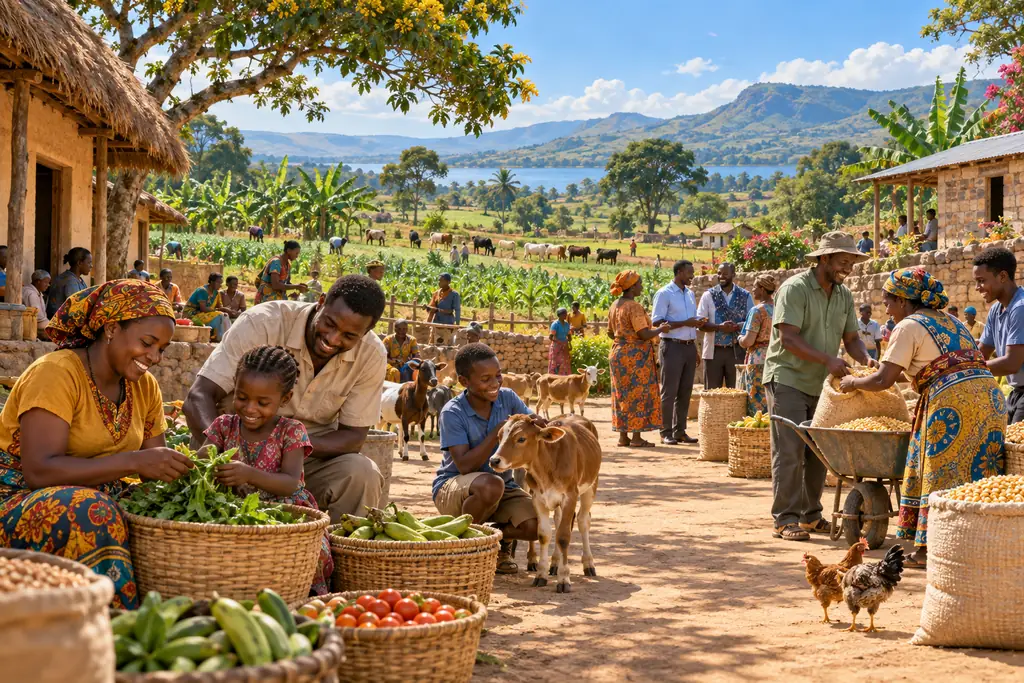
How can the strength we ask from God help children, families, and communities live in peace?
01
Overview
God's strength, human frailty, and the kind of flourishing worth seeking
Key text — Psalm 144:3–4, 15 (explanatory study rendering): “LORD, what is a human being that you take notice of him, a mortal that you give him thought? A human being is like a breath; his days pass like a shadow. ... Blessed are the people for whom life is like this; blessed are the people whose God is the LORD.”
What should we pray for when our community is threatened? Victory over an enemy? Protection for the vulnerable? Wise leadership? A secure livelihood for families? Psalm 144 refuses to keep these questions apart. It begins with the language of a warrior, pauses to marvel that the eternal God cares about short-lived human beings, and ends with an extraordinary picture: young people growing well, harvests secured, animals flourishing, and public squares free of cries of distress.
The surprising destination of this royal prayer is not the king standing above defeated nations; it is a community able to live in peace. Such a movement does not erase the psalm's military language. It asks readers to hear that language in its ancient setting and to test what kind of life the speaker ultimately desires.
For people today, including pastors, public servants, parents, and those leading congregations through uncertainty, the psalm raises a demanding question: Does the strength we seek from God protect other people's lives, or merely strengthen our own position?
02
1.0 Introduction
Psalm 144 is a fifteen-verse prayer attributed to David. Its opening praises God as the one who equips and protects a royal fighter (vv. 1–2). It then acknowledges the fragility of human life (vv. 3–4), pleads for God's dramatic intervention against dangerous and deceitful adversaries (vv. 5–8), announces a new song while renewing the plea (vv. 9–11), and ends with a vision of secure families, productive labor, and public peace (vv. 12–15).
Its main literary feature is the reuse of earlier biblical prayer. Much of Psalm 18's language of royal rescue reappears, but the verbs often change: what Psalm 18 recounts as something God did, Psalm 144 asks God to do again. Echoes of Psalms 8, 33, 39, 102, and 104 create a conversation between inherited faith and a fresh crisis. The community has received ancient testimony, yet its present danger still requires a living prayer.
Derek Kidner appropriately calls it a king's song: its martial beginning cannot be explained away, yet the last stanza describes a peaceful people, not an empire's trophies. John Goldingay emphasizes the way praise from the past is applied to present circumstances. They differ on how confidently we can place its composition in David's own lifetime, but both recognize its movement from peril to hoped-for communal blessing (Kidner 1975, on Ps. 144; Goldingay 2008, on Ps. 144).
Our guiding question is therefore: What does a leader who trusts the LORD ask God to accomplish, and for whose benefit?
03
2.0 Historical and Literary Context
2.1 The Davidic voice and the question of date
The Hebrew heading reads Of David. The Greek Septuagint adds a reference to Goliath, linking the poem with David's famous confrontation (1 Sam. 17). That addition belongs to a later textual tradition, not to the wording of the Hebrew heading, and the psalm itself never names Goliath. Its language fits royal warfare and insecurity, but no particular historical battle can be confirmed.
Kidner keeps open the possibility that David himself reused themes from his earlier songs. Goldingay regards the psalm as particularly suitable for a later king or even a postexilic governor praying in David's language. He notes some later-looking linguistic features and the way the prayer reshapes established psalmody. This is a legitimate scholarly disagreement. Neither position authorizes us to invent a date or to read the psalm as a literal account of a single battle.
A king could pray it in time of threat; later worshipers could also hear the voice of a leader pleading for his people's safety. Its canonical function extends beyond its first speaker.
2.2 A deliberate collage of Scripture
The opening phrases recall Psalm 18:2, 34, and 47. The question about human beings echoes Psalm 8:4, now joined to Psalm 39's language of fleeting life. The bowed heavens, lightning, and rescue from waters recall Psalm 18:9, 14, 16. A new song with stringed music recalls Psalm 33:2–3. The smoking mountains resemble Psalm 104:32 and the revelation at Sinai (Exod. 19:18).
This is more than borrowing beautiful lines. Psalm 18 speaks with the confidence of remembered deliverance. Psalm 144 places those memories beside vulnerability and new need. The God who acted in the past is asked to act in the present. In that way the psalm offers a model for communities that inherit treasured biblical language but face situations their ancestors never described exactly.
2.3 Its place among the final Davidic psalms
Psalm 143 ended by asking God both to rescue the servant and to teach him the right way to walk. Psalm 144 begins with the same idea of divine teaching, but this time God trains the leader's hands for battle (144:1). The juxtaposition is provocative: to learn God's way must include questions about the use and limits of power. Psalm 145 will then move from a threatened royal speaker to an expansive alphabetic celebration of God's kingdom and compassion toward all creation.
This sequence need not be a record of successive events. Read together, however, these psalms encourage a transformation of perspective: personal rescue, responsible public leadership, and the character of the universal King.
2.4 Four interpretive cautions
First, war is real in the poem. Its violence must be acknowledged rather than reduced to a metaphor for every modern frustration. Second, the Hebrew of verse 2 varies between my people and peoples. Each suggests different dimensions of royal power. Third, the grammar that introduces verses 12–14 allows debate: these lines can sound like a request, a desired outcome, or a description of the fortunate condition named in verse 15. Finally, the images of sons, daughters, harvests, and cattle reflect an ancient agrarian household, and should not become a measure by which to shame people with different family circumstances.
04
3.0 Walking Through the Text
3.1 Psalm 144:1 — “Blessed be the LORD, my rock”
The psalm opens in praise before making its request. God is called a rock: stable, dependable, and able to provide refuge. Yet the same verse identifies him as the one who trains the speaker's hands and fingers for warfare. The fighter does not attribute all his skill to private greatness. He understands preparation and protection as gifts that place him under responsibility to the LORD.
Kidner notes that the image joins expressions from Psalm 18. Goldingay points to a striking connection with the preceding psalm: Psalm 143 asked God to teach the servant to do God's will, while Psalm 144 thanks God for training the hands for combat. The distinction matters. Military competence is not identical to moral rightness. A trained hand still needs a conscience; effectiveness cannot by itself sanctify a cause.
This is a historical royal prayer, not a universal command for Christians to wage war. The New Testament portrays Jesus confronting evil through faithful suffering and resurrection, even while it takes violence and unjust power seriously (Mark 10:42–45; Eph. 6:10–18).
3.2 Psalm 144:2 — “My steadfast love, my fortress, my shield”
A cascade of images portrays divine protection: faithful love, fortified refuge, stronghold, deliverer, shield, and the one in whom trust is placed. Notably, the Hebrew can call God “my steadfast love”, an unusually personal form of the covenant term ḥesed. This is not merely a list of military defenses. The trusted God is committed to the speaker in relationship.
The final clause has a textual difficulty. The Masoretic Hebrew and Greek tradition speak of God subduing “my people” under the king; other ancient witnesses read “peoples”, which matches the parallel in Psalm 18:47. If my people is original, the focus can be domestic order; if peoples, foreign opponents are prominent. Either reading raises an ethical problem for interpreters today. Public order is desirable, but a ruler can misuse an appeal to God's authority to suppress legitimate criticism. The psalm must never be made a blank cheque for coercive leadership.
3.3 Psalm 144:3 — “Why do you take notice of a human being?”
The royal voice changes tone. Having described God's strong protection, the speaker wonders why God should take any notice of him at all. The language echoes Psalm 8:4, where a small human being stands under an immense night sky. In Psalm 144, the question has a sharper personal edge: Why would the Creator pay attention to someone whose powers and political achievements are so small by comparison?
The question does not diminish human dignity. Its astonishment depends upon the fact that God does care. True humility is not self-contempt but knowing that our importance comes from God's gracious attention rather than from titles or military accomplishments.
3.4 Psalm 144:4 — “His days are like a passing shadow”
Human life is compared to a breath and to a shadow that passes. The word sometimes translated vanity or breath (hebel) does not necessarily mean life is meaningless. Here it emphasizes transience: even strong rulers grow old, lose influence, and die. The opening warrior cannot guarantee his own tomorrow.
This is why Psalm 144 is so different from the language of invincible rulers. The speaker asks for help precisely because he is mortal. Pastors and civic leaders should hear a warning here: institutions, campaigns, and reputations endure only in limited ways. A wise person asks not merely how to win, but what good can remain for others when his or her season of responsibility is over (Ps. 90:12; Jas. 4:13–15).
3.5 Psalm 144:5 — “Bend the heavens and come down”
The first extended petition begins with cosmic imagery. The worshiper asks God to open the heavens, descend, and touch mountains so they smoke. The image evokes God's manifestation at Sinai (Exod. 19:18) and poetic depictions of God's sovereignty over creation (Ps. 104:32). The mountains are not an instrument the king can control. They demonstrate that divine authority outruns royal authority.
A key literary turn has occurred: Psalm 18 celebrated a God who once came down; Psalm 144 asks him to come down now. The petitioner refuses the thought that ancient deliverance is only a museum story. Yet we should not infer that every faithful prayer must be followed by spectacular natural events. The language expresses the scale of need and confidence in God's freedom to act.
3.6 Psalm 144:6 — “Send lightning and scatter them”
Lightning becomes the LORD's arrow, and the enemy's forces are scattered. This belongs to the ancient language of divine warfare. It portrays opposition as too dangerous for the king to overcome unaided. It also raises moral questions: identifying any contemporary opponent as one whom God wants destroyed would require knowledge the psalm does not grant its readers.
Biblical faith recognizes God's opposition to evil and God's concern for victims of violence. But it also requires discernment, restraint, truthful judgment, and concern for human life. A modern church cannot simply adopt this royal battle prayer as permission for vigilante action or attacks on people of another faith or nation.
3.7 Psalm 144:7 — “Reach down and rescue me from the great waters”
The prayer moves from mountains and lightning to water. “Great waters” recall Psalm 18's image of overwhelming danger. The speaker asks God to reach down from on high and pull him out. The waters likely signify a threat that could engulf him, rather than an account of a literal near-drowning incident. The second half specifies another danger: the hand of foreigners.
The term for foreigners identifies perceived outsiders in a military or political crisis, not an eternal moral category. The psalm does not teach that foreigners are by nature deceitful. Israel's own Scriptures repeatedly insist on justice and welcome toward foreigners who live among the people (Exod. 22:21; Lev. 19:33–34). We must distinguish the particular adversaries named in a prayer from entire nations or ethnic groups.
3.8 Psalm 144:8 — “Their right hand is a right hand of falsehood”
These enemies speak what is empty or false. The repeated charge concerns their speech and pledged trustworthiness. The right hand may evoke an oath sworn before God or the hand offered to seal an agreement. In that setting, to call a right hand deceptive is to say that even the outward gesture of trust has been corrupted.
Kidner draws attention to the oath-making associations of the right hand; Goldingay treats the false speech as part of the danger against which the leader prays. The verse matters far beyond ancient diplomacy. A community cannot flourish when promises are used as traps. Political negotiation, business contracts, marriage vows, and ministry commitments depend upon words that can be trusted. To ask for deliverance from deceit also commits us to reject deceit in our own conduct.
3.9 Psalm 144:9 — “I will sing a new song”
The atmosphere changes. The speaker announces praise accompanied by a ten-stringed instrument. The phrase “new song” recalls Psalm 33:2–3. It may refer to a new composition or to the freshness of worship arising from renewed confidence in God's action. The striking feature is that the prayer for rescue is not finished. Verse 11 will repeat it. The worshiper sings toward the promised future while still standing in danger.
A congregation can do the same without fabricating testimonies. It may remember prior mercies, proclaim God's worth, and keep asking for relief. Gratitude need not falsify the present. A new song can be an honest act of hope, not a claim that every wound has already healed.
3.10 Psalm 144:10 — “The one who gives deliverance to kings”
God is named as the one who saves kings and rescues his servant David from the deadly sword. The royal memory is now explicit. For a later ruler, David's story could provide grounds for prayer: the LORD's relationship with David is not merely an inaccessible legend. God may still give help to leaders who seek him.
But there is a careful balance. The verse describes God as the giver of rescue; it does not say that every person claiming David's authority deserves rescue or that successful rulers automatically have God's approval. Scripture judges kings by their treatment of the poor, their faithfulness, and their refusal to use power destructively (Deut. 17:14–20; Ps. 72:1–4; Jer. 22:13–17).
3.11 Psalm 144:11 — “Rescue me from the hand of foreigners”
The plea from verses 7–8 returns, now introduced by the sword mentioned in verse 10. Repetition is deliberate: after praising the God who saved David, the worshiper asks for present deliverance from the same kind of danger. The argument is not, I once prayed, therefore I can stop needing help. It is, You have been faithful, therefore I dare to ask again.
This is an important pastoral insight. Repeated prayer need not be evidence of a weak faith. Some threats persist; some deliverances unfold over time. Prayer can be persistent while also making room for prudent security measures, mediation, lawful action, and the rebuilding of broken trust.
3.12 Psalm 144:12 — “May our sons grow; may our daughters stand strong”
Suddenly the psalm moves from the king's safety to the next generation. Sons are pictured as well-nourished young plants, daughters as elegantly carved corner pillars of a palace. In its ancient setting, this language celebrates healthy growth, strength, beauty, and the prospect of a stable community. Kidner highlights the emphasis on the rising generation rather than an empire's expansion; Goldingay sees a picture of young people being well nourished and formed.
The imagery is shaped by an ancient, male-centered household economy and speaks of boys and girls differently. We should neither erase that historical feature nor turn it into rigid expectations that boys must only be powerful and girls only decorative. Read with the wider biblical witness to human dignity (Gen. 1:26–28; Gal. 3:28), the enduring ethical point is that both sons and daughters are worthy of protection, nourishment, education, and opportunity. Moreover, people without children do not thereby lack divine favor. This is a community's prayer for its young, not a fertility test for individuals.
3.13 Psalm 144:13 — “May our storehouses be full”
The vision includes grain stores containing varied produce and flocks multiplying in the fields. Food security is not treated as a merely secular matter. A community's worship has practical implications for whether households can eat, whether work is productive, and whether resources are sustained through seasons of uncertainty.
But this is a picture of hoped-for abundance, not a promise that every faithful farmer or small-business owner will prosper each year. Drought, conflict, corruption, disease, and economic structures can ruin livelihoods. The prayer should energize responsible stewardship, fair trade, and care for people who lack food—not blame them for their circumstances (Deut. 15:7–11; Jas. 2:14–17).
3.14 Psalm 144:14 — “No breach, no forced departure, no outcry”
The Hebrew first mentions cattle that bear loads or may be understood in connection with fruitfulness. Then comes a difficult phrase often rendered as the absence of breaches, going out, and cries in the streets. Some translations favor agricultural or reproductive language throughout. Goldingay argues that broken defenses, people driven out, and public cries of distress fit the broader setting of a threatened city. Kidner also considers the security reading more likely for the last part of the verse.
Under that reading, flourishing means far more than warehouses full of goods. People are not being driven from their homes; city walls are not breached; public places are not filled with lament. For communities familiar with displacement, insecure streets, or recurring violence, this is a deeply human vision. The best evidence of good leadership is not a leader's display of force but the security and well-being of the people.
3.15 Psalm 144:15 — “Blessed are the people whose God is the LORD”
The ending gives the vision its theological center. The community is called fortunate or blessed when these conditions of life prevail. Yet a second declaration goes deeper: blessed are the people whose God is the LORD. Goldingay sees this as recognition that the LORD, not merely the monarch, stands behind the community's hope. Kidner stresses that knowing God is more fundamental than possession of every gift (compare Hab. 3:17–19).
Verses 12–14 contain no ordinary finite verbs, and the connecting Hebrew expression has more than one possible nuance. They may function as a prayer—may our sons ... may our barns ...—or as an extended description of the conditions called blessed in verse 15. Some readers have even taken the picture differently in relation to the preceding enemies, though the dominant argument and closing beatitude favor a desired flourishing of God's people. The uncertainty should be acknowledged, but it does not obscure the central movement: from warfare to a people living securely under God's care.
05
4.0 Theological Reflection
4.1 The LORD is not a weapon in the hands of leaders
The psalmist thanks God for strength, but the prayer simultaneously confesses mortal weakness. This keeps human authority from becoming absolute. No king, politician, church official, or military commander may claim that skill and success are sufficient proof of divine endorsement. The prophetic test of power involves truth, justice, and protection of the vulnerable (Mic. 6:8; Jer. 22:15–16).
4.2 Remembered deliverance becomes a language for present prayer
Psalm 144 uses Psalm 18 almost as a prayer book within the prayer book. Earlier testimony is not copied mechanically; it is reshaped for a new need. This is a model for preaching and public prayer: honor what Scripture says in its context, then ask how its account of God's character informs responsible action in the present. We do not need to pretend our circumstances are identical to David's to learn from the trust voiced here.
4.3 Our frailty can open the way to humility and courage
Verses 3–4 are not a detour from verses 1–2. They are a correction to the temptation to glorify the warrior. Human beings are short-lived; God's regard for them is an undeserved wonder. Wise leaders can therefore admit uncertainty, consult others, correct decisions, and prepare successors without fearing that humility will make them irrelevant.
4.4 Truthful speech is essential to lasting peace
The repeated reference to deceptive words (vv. 8, 11) suggests that lies can be as destabilizing as open conflict. Agreements broken by dishonesty damage markets, families, congregations, and diplomacy. Psalm 144 asks protection from such threats. Its ethical mirror is unavoidable: we should not demand honesty from opponents while spreading half-truths to protect ourselves.
4.5 Peace is a positive picture of public well-being
The ending refuses to define success only as enemy defeat. It imagines growing children, food in storage, productive animals, secure neighborhoods, and no cries of distress. This anticipates other prophetic pictures where flourishing includes safe households and the fruits of work (Isa. 65:17–25; Mic. 4:1–4). The psalm is not identical to those later promises; nevertheless, its horizon extends beyond survival toward shared well-being.
4.6 Prosperity is a gift, not an automatic spiritual formula
The agricultural images belong to communal hope. They do not establish a contract by which God must make every faithful household wealthy. The Bible itself preserves the witness of righteous sufferers and poor believers (Job; Ps. 73; Luke 6:20; 2 Cor. 8:1–5). Psalm 144 challenges us to work toward food security and public safety while honoring those who suffer without interpreting their hardship as divine rejection.
4.7 The hope of children must include the dignity of every person
The young plants and corner pillars picture the next generation's promise. Their ancient cultural framing should be read critically, not weaponized against daughters, women, unmarried adults, people who cannot have children, or those whose children have died. The life God values is broader than one household pattern. Communities can embody the prayer by educating girls and boys, preventing exploitation, protecting children, and respecting families in many circumstances.
4.8 God-centered public life serves people rather than manipulating them
The last line does not invite leaders to use God's name as a slogan in place of accountability. It grounds the community's hope in the LORD's character. In biblical terms, worship must be accompanied by justice (Isa. 1:11–17; Amos 5:21–24). A public claim to honor God is contradicted when policies encourage violence, corrupt agreements, or disregard for the poor.
06
5.0 Canonical and Christological Horizon
5.1 From the human king to the LORD's kingdom
Psalm 144 speaks through a royal figure and expects God to preserve public order and well-being. Psalms 2, 72, and 89 develop different facets of Davidic kingship: God's appointment, the king's duty to defend the poor, and the painful question of covenant promises when monarchy fails. Psalm 144 participates in that conversation. Its final blessing is about the LORD's people, not a king's private reputation.
Psalm 145, placed next, proclaims the LORD's kingship over all generations and his compassion toward all he has made. The pairing invites us to measure every human ruler against God's greater reign.
5.2 Jesus reshapes expectations of kingly strength
Christians read the Davidic prayers in light of Jesus, whom the New Testament presents as the promised Messiah (Luke 1:32–33; Acts 2:29–36). Yet Jesus does not simply imitate every feature of ancient royal warfare. He rejects the coercive pattern of rulers who dominate others and describes his kingship through service (Mark 10:42–45). At his arrest he refuses a violent defense by his disciples (Matt. 26:52–54). Through the cross and resurrection, God confronts sin, death, and the powers that enslave humanity (Col. 2:13–15; 1 Cor. 15:20–28).
This is a canonical Christian reading of royal hope, not a claim that Psalm 144 directly narrated Jesus' crucifixion. The ancient psalm's plea for rescue remains historically meaningful, while the Gospel transforms how Christ's followers exercise power and understand victory.
5.3 Human fragility and the true human vocation
Psalm 144:3 echoes Psalm 8's amazement at God's concern for humanity. Hebrews 2:5–18 develops Psalm 8 in relation to Jesus, who entered the human condition and suffered death, yet was crowned with glory. Read together, the texts can deepen our confidence that human weakness is neither invisible nor beneath God's concern. They also challenge any theology that treats strength as invulnerability.
5.4 New creation and the flourishing of communities
The final vision of safe streets and fruitful life resonates with prophetic hopes of restored creation (Isa. 11:1–9; 65:17–25) and with the New Testament's expectation that death and mourning will end (Rev. 21:1–5). Psalm 144 does not contain a developed doctrine of resurrection or the new earth. Those connections arise when Christians read the psalm within the larger scriptural story. They invite us to practice now—imperfectly and patiently—the justice, provision, and peace that God's future will fully establish.
07
6.0 Life Application
- Ask what your strength is for. When God gives influence, professional competence, or institutional responsibility, ask who is safer and better served because you possess it (Ps. 144:1–2; Mark 10:42–45).
- Let human frailty make you teachable. Admit when you need counsel. Prepare those who will lead after you. Do not confuse a title with permanence (vv. 3–4; Ps. 90:12).
- Take deception seriously without stereotyping outsiders. Verify claims before repeating them, keep commitments, and resist the temptation to label entire ethnic or religious communities as enemies (vv. 7–8, 11; Lev. 19:33–34).
- Turn inherited testimonies into honest present prayer. Recount God's faithfulness, but name what remains dangerous or unresolved today. Gratitude and petition can inhabit the same worship service (vv. 5–11).
- Measure leadership by the condition of ordinary households. Ask about schools, food security, safety, honest wages, accessible care, and the treatment of the powerless—not only reports of institutional growth (vv. 12–14; Ps. 72:1–4).
- Invest in the next generation without forcing them into narrow roles. Support the intellectual, spiritual, emotional, and physical flourishing of both girls and boys. Honor people who are single, childless, or living with family loss (v. 12).
- Pray for peace and work for the conditions that sustain it. Rebuild trust, oppose exploitation, encourage reconciliation where it is safe, and support lawful means of protection (v. 14; Matt. 5:9).
- Refuse prosperity-based judgments about faith. Celebrate abundance with thanksgiving, share resources fairly, and stand with those facing poverty, illness, or displacement (vv. 13–15; Jas. 2:14–17).
- Let public worship produce accountable action. A new song of praise should not hide corruption or suffering. Ask what practice the congregation will change because it calls the LORD its God (vv. 9, 15; Amos 5:24).
08
7.0 Reflection Questions
- Why does Psalm 144 move from describing a warrior's training to confessing the brevity of human life?
- How does the psalm reuse Psalm 18? What changes when remembered victory becomes a present prayer?
- What ethical concerns arise from the variant readings “my people” and “peoples” in verse 2?
- Where do false promises or manipulated words threaten trust in our families, institutions, or communities?
- What does it mean to sing a “new song” before a crisis has been resolved?
- Why is the image of healthy sons and daughters an important part of the psalm's vision of peace? How can we apply it without limiting anyone's dignity?
- How does an abundance of grain or livestock differ from the deeper blessing of knowing the LORD?
- If we measured successful leadership by the absence of fear and cries of distress in public spaces, what would need to change?
- What steps can we take to seek justice without allowing the psalm's ancient warfare imagery to justify contemporary violence?
- How does Jesus' model of servant-kingship challenge or deepen your understanding of Psalm 144?
09
8.0 Response Prayer
LORD, our Rock and faithful refuge, we thank you for every strength and skill you have placed in our hands. Do not allow us to use those gifts for pride or to injure those you have made. Remind us that our lives pass like a breath and that every day is sustained by your mercy.
Where communities are threatened by violence and deceit, protect the vulnerable and establish justice. Give leaders humility, courage, truthful speech, and restraint. May children grow safely, workers receive fair reward, homes have enough, and our streets become places where neighbors can live without fear.
Teach us to sing your praise without ignoring the wounds around us. Shape our lives after Jesus, the King who serves. Let the blessings we receive become blessings we share. And make our deepest joy not merely what we possess, but that you are our God. Amen.
10
9.0 Window into What Comes Next
Psalm 144 begins with a threatened leader praising the LORD for strength, and ends with a nation longing for fruitful and peaceful life. Its final words put the deepest blessing in perspective: fortunate are the people whose God is the LORD.
Psalm 145 opens another horizon. It is a carefully constructed alphabetic hymn that celebrates not merely God's help to one king but the greatness and compassion of God's own kingdom. One generation will tell the next of his mighty deeds; his rule will extend through all generations; and his mercy will reach all he has made (Ps. 145:4, 9–13).
The transition is beautiful. After asking God to protect a community and make its life flourish, we are invited to praise the King whose goodness is greater than every human kingdom. Psalm 144 asks what God's help may mean for the people; Psalm 145 teaches the people to contemplate who their God is.
11
10.0 Bibliography
- Scripture: Psalm 144; Psalms 8; 18; 33; 39; 72; 90; 104; 143; 145; Exodus 19:18; Leviticus 19:33–34; Deuteronomy 17:14–20; Isaiah 1:11–17; 11:1–9; 65:17–25; Jeremiah 22:13–17; Micah 4:1–4; Habakkuk 3:17–19; Mark 10:42–45; Luke 1:32–33; Matthew 26:52–54; Hebrews 2:5–18; 1 Corinthians 15:20–28; Revelation 21:1–5.
- Goldingay, John. 2008. Psalms, Volume 3: Psalms 90–150. Baker Commentary on the Old Testament Wisdom and Psalms. Grand Rapids: Baker Academic. Discussion of Psalm 144, “The Interplay between Past Praise and Present Context.”
- Kidner, Derek. 1975. Psalms 73–150. Tyndale Old Testament Commentaries. Downers Grove, IL: InterVarsity Press. Discussion of Psalm 144, “A King's Song.”
- BibleProject. Book of Psalms overview and biblical-theological study materials. Used for the broader canonical framework, not as authority for disputed Hebrew readings.
- Project resources. The Book of Psalms—Study Notes and Book of Psalms: Guide with Key Information and Resources, for the literary and teaching framework of the Psalms series.


Be the first to leave a comment.