

How can we sing of victory and long for justice without turning praise into permission for violence?
01
Overview
The LORD's delight in the humble, the limits of human power, and the challenge of singing victory without becoming violent
Key text — Psalm 149:4 (explanatory study rendering): “For the LORD delights in his people; he adorns the humble with deliverance.”
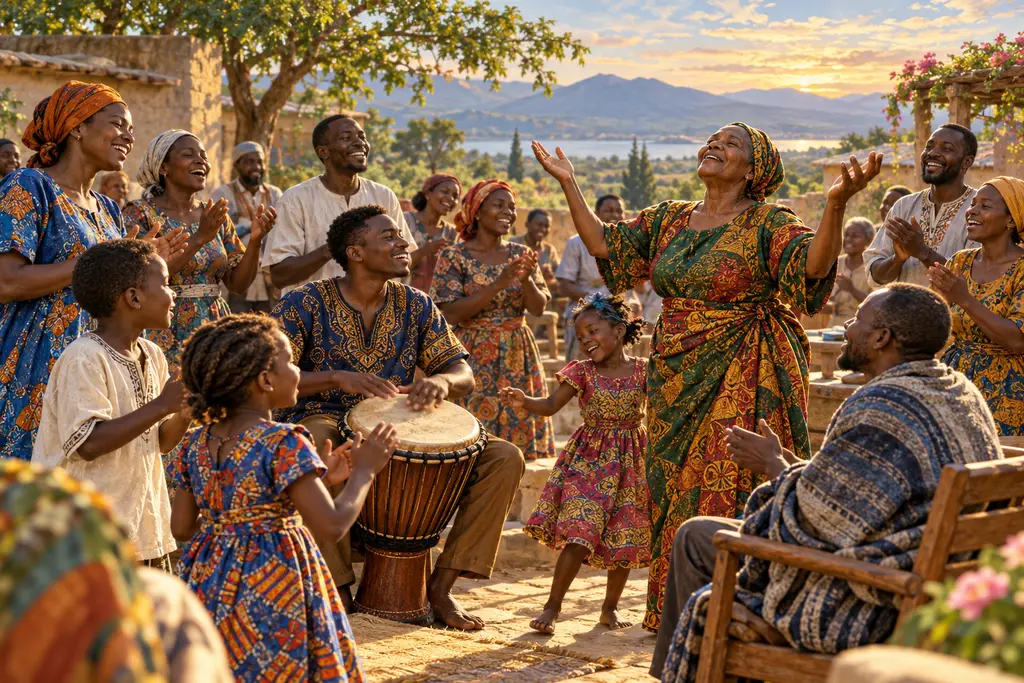
A congregation sings with joy. A young person beats a drum; an older worshiper remembers a time when hope seemed impossible. The song announces that God has not forgotten his people. Then, almost without warning, the words turn from dancing and delight to swords, chains, and judgment upon rulers. What kind of praise is this?
Psalm 149 will not let us keep worship safely separated from the world's injustices. Nor will it allow us to treat every religious claim of victory as the will of God. Its worshipers know what it means to be weak; they imagine the arrogant powers of the world brought low. The very passage that gives the oppressed hope can become dangerous when a powerful group uses it to sanctify its own violence.
To hear this psalm faithfully, we must listen at more than one level: to Israel's original hope, to the poem's place near the end of the Psalter, and to how Jesus transforms the meaning of victory for his followers. The question is not simply whether we can sing Psalm 149 today. It is how we can sing about God's justice while remaining faithful to God's character.
02
1.0 Introduction
Psalm 149 is the fourth of the five concluding Hallelujah psalms (Psalms 146–150). Like its neighbors, it opens and closes with hallelu-yah, “Praise the LORD.” But it has a more unsettling shape than Psalm 148. The earlier song summoned the whole creation to praise; this one addresses the people of Israel specifically and asks them to rejoice in the LORD as their Maker and King.
The nine verses form two intertwined movements:
- Verses 1–4: A new song, the congregation of the faithful, dancing and music, and God's delight in a humble people.
- Verses 5–9: The faithful rejoicing in honor, high praise alongside a two-edged sword, and the reversal of oppressive power in scenes of judgment.
The first movement gives the second its moral setting. The song belongs to those whom God graciously raises up, not to people claiming that strength makes them right. Yet the second movement is genuinely severe. We cannot interpret the sword away merely because its presence makes modern worshipers uncomfortable.
Four questions guide our study. What makes this song “new”? Why does the Creator delight in the humble? What did swords and bound kings mean within ancient Israel's story? And how should Christians read such language in light of the crucified and risen King?
03
2.0 Historical and Literary Context
2.1 From the universal choir to Israel's particular calling
Psalm 148:14 ended with God raising a “horn,” an image of strength, for his people, and naming Israel as the people near him. Psalm 149 begins precisely with that community. Derek Kidner suggests that the final lines of Psalm 148 may have supplied the seed from which Psalm 149 developed; that is a literary possibility, not a demonstrated history of composition.
This placement is significant. Israel's praise is not meant to deny the praise of all nations and creatures. Psalm 148 has already summoned them. Psalm 149 asks what God's saving rule means for a people who have experienced vulnerability and who hope that the oppressive ordering of the world will be reversed. Psalm 150 will then widen the invitation once more: everything that breathes should praise the LORD.
The poem provides no dated event, named battle, or identifiable human author. References to Zion, the humbled community, and royal defeat fit periods when Israel remembered conquest, exile, and restoration. John Goldingay identifies echoes of Isaiah's promises to Zion and Jeremiah's language of joyful restoration, and considers a postexilic setting plausible. Plausible is not certain: the psalm cannot securely be tied to a single military victory, festival, or later movement.
2.2 The congregation of the *ḥasidim*
Three times the poem names God's loyal or faithful people (vv. 1, 5, 9). The Hebrew term ḥasidim is related to the vocabulary of covenant loyalty. Depending on context, English Bibles may render it “faithful ones,” “godly ones,” or “saints.” It is not a license to assume that everybody in the group is morally flawless.
Some readers have attempted to identify the word with a much later named religious faction, but the psalm itself does not establish that identification. Its focus is communal belonging and fidelity to the LORD. Likewise, “assembly” (qahal) does not by itself prove that every scene occurs inside a temple building. Goldingay observes that gatherings of praise and celebration could take place elsewhere, including after a deliverance.
2.3 Praise and the language of royal reversal
The opening recalls Psalms 96 and 98 and Isaiah 42:10, each summoning a “new song.” The reference to dance and instruments recalls Miriam's celebration after the sea crossing (Exod. 15:20–21) and passages about Zion's restoration (Jer. 31:4, 13). The later images of rulers in chains reverse the plight of peoples previously conquered and led away captive.
These are not disconnected topics. Ancient kings could deport, enslave, and humiliate defeated communities. For a community deprived of influence, imagining those rulers forced to answer for their deeds is an image of vindication. The song belongs first to the vulnerable looking for deliverance, not to empires seeking another justification for expansion.
2.4 Two commentators, two emphases
Goldingay challenges readings that immediately turn the sword into a harmless metaphor. Verses 7–9 describe military and political action in language that ancient hearers could understand literally. He asks interpreters to take Scripture's engagement with power and injustice seriously, rather than simply declaring such texts irrelevant.
Kidner likewise recognizes the setting of Israel's wars, but emphasizes that the church must not identify its human enemies with the enemies of God's kingdom. He reads Christian struggle through the New Testament's emphasis on the word of God, spiritual resistance, the cross, and final judgment entrusted to Christ. These two approaches differ in emphasis, but both guard against casual, self-serving use of the psalm.
04
3.0 Walking Through the Text
3.1 Psalm 149:1 — A new song among the faithful
“Praise the LORD! Sing to the LORD a new song, his praise in the assembly of the faithful.” The newness need not mean that nobody has ever composed or sung these notes before. In biblical praise, a “new song” often answers a fresh realization of God's saving action or an anticipated act of deliverance (Ps. 96:1; 98:1; Isa. 42:10).
Worship here is communal. The wounded individual is not left to carry hope alone. A congregation remembers who its God is and what he has promised. A new song can emerge even before every situation changes: faith begins speaking in anticipation of a future that fear cannot yet see.
Yet a song becomes genuinely new in more than musical style. If a congregation sings about God's justice while protecting abuse or celebrating its own status, its performance contradicts the God it claims to praise. Newness includes renewed allegiance to God's purposes.
3.2 Psalm 149:2 — Rejoice in your Maker and King
“Let Israel rejoice in its Maker; let the children of Zion rejoice in their King.” “Maker” can refer broadly to God's act of creation, but in this context it also recalls God's making of Israel into a people through covenant and deliverance (compare Isa. 43:1, 15; 44:2). The community is neither self-created nor held together ultimately by a human ruler.
“King” names the LORD himself. That matters because later verses speak of other kings being humbled. The poem contrasts the rule of God, who delights in the lowly, with human authority that can become arrogant or destructive. Its first loyalty is therefore theological, not partisan or tribal.
The “children of Zion” are not asked to forget Jerusalem's losses. The city's very name can carry memories of devastation. Their joy is an act of hope: desolation is not the community's final identity.
3.3 Psalm 149:3 — Praise with movement and music
“Let them praise his name with dancing; let them make music to him with tambourine and lyre.” The worship is bodily and audible. It includes rhythm, movement, and communal celebration. References such as Exodus 15:20–21 and Jeremiah 31:13 show how dance could accompany rejoicing in liberation and renewal.
This verse challenges the assumption that reverence is always silent or motionless. The same Scriptures also make room for quiet prayer and lament. Cultural expressions of worship vary; Psalm 149 is not a command that all churches reproduce one musical style. It is a reminder that gratitude can involve the whole person.
Music should also be truthful. Strong rhythm does not make a message sound; solemn presentation does not make it holy. The character of the God being praised must shape the character of the people who praise him.
3.4 Psalm 149:4 — God delights in the humble
“For the LORD delights in his people; he adorns the humble with deliverance.” This is the theological center of the psalm. Before any sword appears, we hear about divine delight. God is not depicted as reluctantly tolerating his people but as taking pleasure in them.
The word translated “humble,” “meek,” or “afflicted” (ʿanawim) can evoke both low social status and the receptive posture of people who depend on God. We should not dissolve the poverty and vulnerability of the word into a merely private attitude. The LORD lifts those whom the powerful may overlook.
“To adorn” is a striking verb. Deliverance becomes a kind of beauty or honor bestowed on people who have been shamed. Goldingay draws attention to the future-oriented hope of this line: the community praises because God's disposition toward it gives grounds to expect saving action. Some translations phrase the verb as present action. In either case, the gift is God's, not a reward for worldly dominance.
3.5 Psalm 149:5 — Joy even upon their beds
“Let the faithful rejoice in honor; let them sing aloud upon their beds.” What kind of beds are these? Kidner suggests restful sleep without fear or reclining at a celebratory meal. Goldingay prefers taking ordinary beds seriously, recalling the nights in which distressed people lie awake, lamenting their losses. The psalm may envision those nights being transformed by joy.
There is no secure basis for inventing a special temple sleeping ritual here. What is clear is that praise extends beyond a scheduled service. The place of anxious thought and sleepless memory can become a place where hope is spoken.
The word “honor” also matters. A humiliated people need more than survival: they need their dignity restored. God's saving concern reaches the wounds left by public contempt.
3.6 Psalm 149:6 — Praise in their mouths, a sword in their hands
“Let the high praises of God be in their throats and a two-edged sword in their hands.” This is the poem's sharpest turn. The Hebrew image of a sword with two “mouths” pictures a blade that cuts on both sides. The praise and the sword stand side by side.
Some later interpreters understood the sword as Scripture, prayer, or proclamation. Those are possible Christian applications, especially in conversation with Hebrews 4:12 and Ephesians 6:17. But they should not be passed off as the only thing the ancient poem could have meant. Goldingay argues that the following verses make a genuinely martial scene likely; Kidner acknowledges the older warfare setting before describing the church's different struggle.
Theologically, verse 6 is uncomfortable because praise and force are brought into close proximity. We must neither erase that discomfort nor use it to baptize violence. The question becomes urgent: whose cause is being defended, by whose authority, against whom, and by what means? Repeating “God” over a human agenda does not make that agenda holy.
3.7 Psalm 149:7 — Retribution and the nations
The purpose is described as “to carry out vengeance among the nations, punishment among the peoples.” The Hebrew language can also carry the idea of redress or a response to wrongdoing. Goldingay prefers to emphasize that the envisioned action answers injustice rather than expressing unrestrained personal spite.
Yet the poem still speaks in the idiom of judgment and force. In its ancient context, nations and rulers could devastate smaller communities. A reversal of those relations could be imagined as the vindication of people who had been treated as disposable.
A necessary ethical boundary follows. This verse does not tell an individual believer to attack someone of another nationality, religion, or political opinion. Nor is it a standing permission for a church, leader, or state to claim divine approval for retaliation. The psalm articulates an ancient community's longing that oppression will not go unanswered. Responsible Christian application must pass through the teaching and example of Jesus.
3.8 Psalm 149:8 — Kings and nobles bound
“To bind their kings with chains and their nobles with iron fetters.” The reversal is severe. Those accustomed to issuing orders are imagined subject to judgment. Those who could once chain other people are themselves chained.
The picture is not a mandate to celebrate cruelty. Rather, its original rhetorical force lies in the overturning of untouchable privilege. Human rank cannot exempt a ruler from moral accountability. Psalm 146 has already warned the faithful not to make mortal rulers their final hope; Psalm 149 imagines what happens when such rulers answer to a higher King.
For contemporary communities, this suggests the importance of lawful accountability, truth-telling, and protection of victims. No office, uniform, pulpit, or title places a person above justice. But ensuring accountability today is not the same thing as claiming a private right to imprison one's opponents.
3.9 Psalm 149:9 — The written judgment and the people's honor
“To execute upon them the judgment written; this is honor for all his faithful ones. Praise the LORD!” What is “the judgment written”? The psalm does not name a single document. Jewish interpretation has variously connected it with Torah passages and prophetic announcements; references such as Deuteronomy 32:41 and Isaiah's judgments have been proposed. Goldingay treats it as an announced divine decision, but the precise referent remains open.
The final “honor” corresponds to the honor promised to the faithful in verse 5. The humiliations of the past do not settle the future. Yet we must notice how the poem concludes: “Praise the LORD,” not “praise our weapons.” The central actor remains the God whose delight and deliverance stand behind the song.
Here the ethical difficulty does not disappear. History shows how easily people claim that their own preferred sentence is “written” by God. The psalm cannot be responsibly applied without rigorous testing of such claims by the wider witness of Scripture, particularly the life and teaching of Jesus.
05
4.0 Theological Reflection
4.1 Praise is a declaration about who truly rules
The recurring call to praise is not religious decoration. It makes a claim about ultimate authority. Israel's Maker is Israel's King; the rulers of the nations are not sovereign over truth or justice. To sing this song is to reject the idea that human power has the final word.
That is why the psalm can be deeply consoling to those under oppression. Praise names a reality greater than the threats surrounding them. But the same language can be corrupted when a powerful community identifies its own preferences with God's will. True worship includes humility before the King whom we cannot manipulate.
4.2 God delights in a people who cannot save themselves
Verse 4 interrupts every interpretation based on conquest as the highest good. The object of God's delight is a community described as humble or afflicted. The Lord's action is not presented as admiration for raw strength. God beautifies the vulnerable with deliverance.
This resonates with Hannah's song (1 Sam. 2:1–10), Mary's song (Luke 1:46–55), and Psalm 146's picture of the LORD lifting the bowed down. Deliverance can include social, political, and bodily well-being. It is not only an invisible feeling; nor should it be reduced to material success.
4.3 Justice is necessary; vengeance is spiritually dangerous
People harmed by abuse, trafficking, corruption, persecution, or war need more than advice to be patient. Biblical hope includes God's opposition to evil. Psalm 149 refuses to picture the world as morally indifferent. Those who wound others are answerable.
At the same time, anger can become a counterfeit of justice. Whenever harmed people gain influence, they face the temptation to reproduce the humiliation they suffered. The psalm's unsettling images require both moral seriousness about wrongdoing and vigilance against cruelty presented as righteousness.
4.4 We must distinguish the text's horizon from our calling
We can acknowledge that ancient Israel knew a setting of armed conflict and that Psalm 149 speaks in those categories. We can also acknowledge that Christian discipleship is governed by Jesus' commandments, including love of enemies and refusal of revenge (Matt. 5:43–48; Rom. 12:17–21). These statements are not contradictory when we attend to covenant context, literary genre, and the story's movement toward Christ.
Goldingay's insistence that violent imagery must not be explained away keeps us honest about what the poem actually says. Kidner's emphasis on the church's non-worldly weapons helps us ask what faithfulness looks like after the cross and resurrection. Neither an evasive metaphor nor a literal application to present-day enemies is sufficient.
4.5 A worshiping community should be recognizable by its justice
Psalm 149 joins music with the public ordering of life. Modern congregations should not imagine that passionate singing compensates for mistreatment of children, exploitation of workers, unequal access to justice, or dishonest leadership.
The better test of praise is its fruit. Does worship make us truthful? Does it teach restraint in the use of power? Does it strengthen courage to protect those who cannot defend themselves? Does it form a community that seeks a neighbor's good even when the neighbor disagrees? Such questions take the psalm's concern for God's rule seriously while rejecting its misuse.
06
5.0 Canonical and Christological Horizon
5.1 The new song from Exodus to the final Psalms
Miriam's song follows liberation from Pharaoh's army (Exod. 15). Isaiah 42:10 calls for a new song as the LORD announces justice to the nations. Psalms 96 and 98 summon the world to praise the Judge who comes to set things right. Psalm 149 belongs to this stream, but gives prominence to Israel's faithful community.
The biblical story refuses two reductions: praise is not merely a private mood, and justice is not simply the triumph of whichever human group seems strongest. God's action is directed toward a world repaired under his righteous rule.
5.2 The King who conquers through the cross
Jesus proclaims God's kingdom, welcomes the poor and excluded, and confronts oppressive and hypocritical forms of power (Luke 4:18–19; 6:20–36). Yet he refuses to establish the kingdom by instructing his disciples to injure his enemies. When a follower uses a sword at his arrest, Jesus tells him to put it away (Matt. 26:52; compare John 18:36). He prays for his persecutors (Luke 23:34).
The resurrection does not mean God has abandoned justice. It means Christian hope is centered on the crucified and risen Messiah, whose victory unmasks evil and opens the possibility of repentance and renewal. His people must not confuse fidelity to him with coercion in his name.
5.3 What becomes of the two-edged sword?
In Ephesians 6:12, the church's struggle is not against flesh and blood, and the “sword of the Spirit” is identified with God's word (Eph. 6:17). Second Corinthians 10:3–5 likewise speaks of a struggle that overturns proud arguments rather than imprisoning political adversaries. Hebrews 4:12 uses the image of a sharp, two-edged sword to describe the searching power of God's word.
Revelation 19 portrays the exalted Christ with a sword proceeding from his mouth, a vivid image of his authoritative judgment. Revelation 12:11 describes the faithful overcoming through the Lamb's blood and their testimony, even at the cost of their lives. These texts do not prove that Psalm 149 originally meant “Bible preaching” rather than combat. They do show how the church should understand its own mission and hope in the light of Jesus.
5.4 Final judgment is not private revenge
The New Testament takes judgment seriously, but entrusts final judgment to God and his Messiah (Acts 17:31; 1 Cor. 15:24–28). It does not empower Christians to appoint themselves executioners of every person they call wicked. Romans 12:19 explicitly refuses personal vengeance and directs believers toward doing good to enemies.
The church can speak publicly against injustice, pursue lawful protection, support victims, and insist upon accountability. Indeed, failing to protect the vulnerable can itself betray the God Psalm 149 praises. But moral courage and personal violence are not interchangeable.
5.5 From Psalm 149 to the renewed creation
The final praise of the Psalter looks toward a world in which God's purposes are not forever resisted. Revelation 21–22 pictures the end of mourning and death and the healing of the nations. This is not a vision of one ethnic group endlessly humiliating another. It is God's final work of restoring what evil has damaged and bringing creation into his peace.
Psalm 149's longing that unjust power not prevail can be heard within that larger hope, without pretending that all its ancient imagery has become uncomplicated. Christian confidence is finally in the Lord's victory, not in the community's ability to defeat others by force.
07
6.0 Life Application
- Sing with memory and hope. Recall a specific experience of God's faithfulness, personal or communal. Let that memory fuel gratitude without claiming that every hardship has ended.
- Make room for joyful worship. Welcome appropriate music, rhythm, and embodied expressions of thanksgiving without imposing one culture's style as the only holy form.
- Ask whom your worship leaves out. Verse 4 centers God's delight in humble and vulnerable people. Include those who feel overlooked, and listen carefully to their needs.
- Reject the worship of human power. Appreciate good leadership, but never give leaders the final loyalty that belongs to God. Expect transparency and accountability.
- Confront wrongdoing without cruelty. Document abuse, protect those at risk, report crimes through lawful channels, and seek fair outcomes rather than retaliatory harm.
- Examine martial religious language. When a speaker calls opponents “enemies of God” and urges followers to injure them, test the claim against Jesus' example and refuse manipulation.
- Practice a new song through renewed conduct. Repair a relationship where possible, repay a debt, apologize honestly, or take concrete steps to correct an injustice.
- Let the cross define victory. In conflict, ask whether your methods reflect truth, mercy, courage, and the dignity of other people—or merely promise the satisfaction of winning.
- Keep praying for those under oppression. Stand with people harmed by war or persecution without assuming that every side speaking God's name acts on God's behalf.
08
7.0 Reflection Questions
- What makes the “new song” of Psalm 149 more than a change in music or lyrics?
- How does God's delight in the humble (v. 4) challenge the way our communities measure success and power?
- Why might dancing and instruments be appropriate expressions of praise? How can worship traditions honor different cultures without dismissing one another?
- What do Goldingay's historically direct reading and Kidner's Christ-centered application each help us see—and what could go wrong if we ignore either?
- What emotions do the images of swords and chained rulers awaken in a victim of oppression? How might someone already in power hear those images differently?
- When does a legitimate demand for justice begin to turn into a desire to humiliate or destroy?
- How do Jesus' teaching on enemies, his death, and his resurrection reshape the way Christians respond to Psalm 149:6–9?
- Where does my church need to connect its public praise with protection of the vulnerable and honest accountability?
- What would a “new song” of truthful, courageous, compassionate action look like in my life this week?
09
8.0 Response Prayer
LORD, our Maker and King, teach us to sing the new song of your faithfulness. Thank you that you delight in people whom the world often overlooks. Lift those who are burdened by fear, injustice, and humiliation. Where our communities are wounded, bring truth, protection, and healing. Where we have used religious words to excuse pride or cruelty, forgive and correct us. Give us courage to oppose evil without becoming its servants. Form our hearts by Jesus, the King who gave himself for his enemies and rose to renew creation. Let our praise be heard not only in music but also in justice, mercy, and faithful love. Amen.
10
9.0 Window into What Comes Next
Psalm 149 asks God's faithful people to celebrate their Maker and King while imagining the overthrow of arrogant power. Its ending forces us to consider how worship, justice, and the desire for victory can either remain faithful to God or be distorted by human ambition.
Psalm 150 brings the Psalter to its final crescendo. Its focus is no longer swords or chains, but the praise of God with instruments, movement, and breath. After all the prayers of lament, judgment, hope, and thanksgiving across the Psalms, its closing invitation is expansive: “Let everything that breathes praise the LORD.” The journey ends by opening worship to every living voice.
11
10.0 Bibliography
- Scripture: Exodus 15:1–21; Deuteronomy 32:35–43; 1 Samuel 2:1–10; Psalms 2; 33; 96; 98; 144:9; 145–150; Isaiah 42:1–17; 43:1, 15; 45:14; 61; Jeremiah 31:4, 13; Matthew 5:43–48; 26:52; Luke 1:46–55; 4:18–19; 6:20–36; 23:34; John 18:36; Acts 17:31; Romans 12:17–21; 1 Corinthians 15:24–28; 2 Corinthians 10:3–5; Ephesians 6:12–17; Hebrews 4:12; Revelation 5; 12:11; 19; 21–22.
- Goldingay, John. 2008. Psalms, Volume 3: Psalms 90–150. Baker Commentary on the Old Testament Wisdom and Psalms. Grand Rapids: Baker Academic. Commentary on Psalm 149, especially the literary two-part movement, the vulnerability of Zion, the historical force of the sword imagery, and the discussion of how the text is used.
- Kidner, Derek. Psalms 73–150: A Commentary. Tyndale Old Testament Commentaries. Downers Grove, IL: InterVarsity Press. Commentary on Psalm 149, “Victory Celebration,” including the possible interpretations of verse 5 and the comparison between Israel's warfare and the church's non-worldly struggle.
- BibleProject. The Book of Psalms study resources, project-provided overview and study notes. Consulted for the final Hallelujah sequence and its place in the wider movement of the Psalter. Specific interpretive claims about Psalm 149 above are attributed to Goldingay, Kidner, or the biblical text rather than to a stand-alone BibleProject commentary on this psalm. Translation and interpretation note: Verse excerpts above are brief explanatory study renderings, not quotations attributed to a particular published Bible translation. The original poem's ancient royal and military imagery is distinguished from subsequent Christian interpretation and present-day ethical application.


Be the first to leave a comment.