

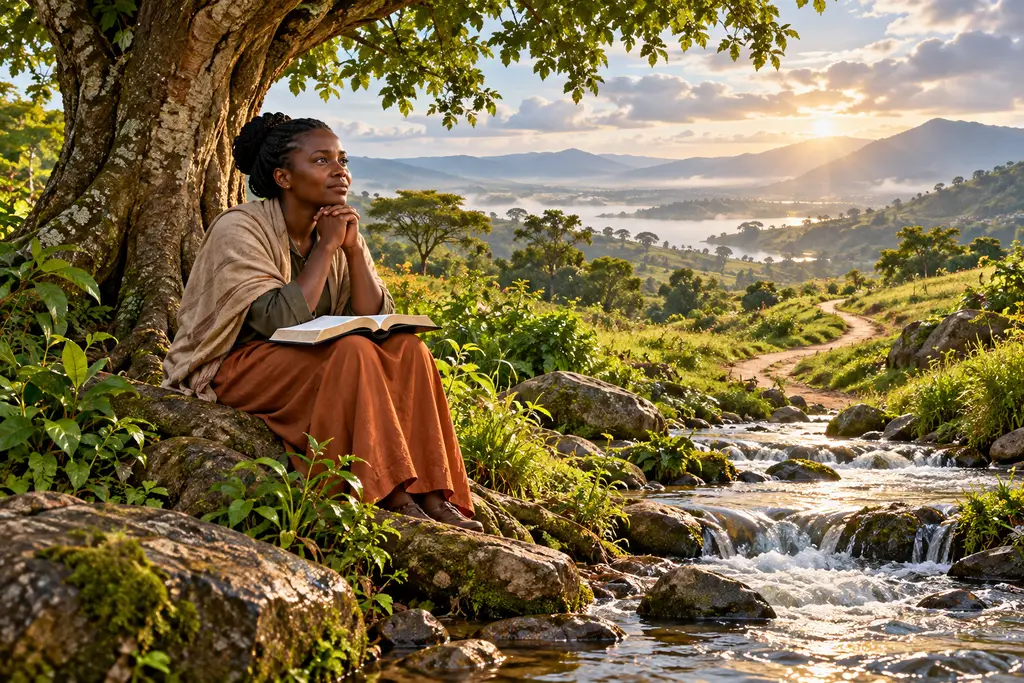
Why does a book that begins beside a tree teach us to pray through tears and end with Hallelujah?
01
Overview
A Journey through Psalms 1–150: Learning to Pray, Live Wisely, and Hope in God's Kingdom
02
Introduction: When God Gives Words to Our Tears
There are days when we come before God with songs of thanksgiving. Life seems good, doors are opening, and our hearts overflow with joy.
But there are other days when we come before him without even the words to pray.
We have lost someone or something precious. We cannot understand what has happened. We have watched the wicked prosper while the faithful suffer. Or we have sat in silence for so long that we begin to wonder whether God is still listening.
In both circumstances, the Bible invites us to open the same book: Psalms.
Here we meet people who worship God with joy and cry out to him in anguish. Some celebrate victory; others are fleeing their enemies. Some confess their sins; others cry out for justice. Some praise God because he has answered them; others keep calling on him even when heaven seems silent.
David can say, “The LORD is my shepherd” (Psalm 23:1), yet in Psalm 13 he cries out in pain, “How long, O LORD?”
These two voices do not contradict each other. Both arise from a faith learning to depend on God amid the realities of life.
That is the beauty of the Psalms.
The Psalms do not teach us to pretend that everything is all right. They teach us to draw near to God even when things are not all right.
But this book is far more than a collection of comforting prayers. Read together, its 150 psalms tell the story of God, his people, and the world he intends to redeem.
It is a story that begins with a tree planted beside streams of water (Psalm 1), passes through the tears of people waiting for justice, and ends with an invitation to every creature to praise its Creator (Psalm 150).
This is the journey on which we are about to embark.
03
1. Where Did the Psalms Come From? Their Historical Setting
The book of Psalms is a collection of 150 ancient Hebrew poems, songs, and prayers. They emerged across different periods of Israel's history, among people facing many different circumstances.
We often call it the Psalms of David. There is good reason for that: 73 psalms have headings that associate them with David, Israel's king, musician, and poet (1 Samuel 16:14–23; 2 Samuel 23:1–2).
Yet David did not write every psalm.
We also encounter the names of Asaph, the sons of Korah, Solomon, Moses, Heman, and Ethan. Other psalms have no named author.
Even where a name appears, we need to read carefully. A heading such as “Of David” may indicate his authorship, an association with his life, or a tradition of songs connected to him. Not every heading necessarily tells us the complete circumstances in which that psalm was composed.
Some of these songs were used in Israel's worship, first in connection with the tabernacle and later in the Jerusalem temple (1 Chronicles 25; Nehemiah 12:45–47). Others reflect family life, personal struggles, the nation's history, and the journeys of those traveling to worship.
In that world, faith was not separated from everyday life.
Fields and livestock, kings and judges, rain and drought, war and peace, marriage and family, sickness and death—all found their way into the language of prayer.
So when we read the Psalms, we do not enter a world inhabited by people with no problems. We enter the history of people learning to trust God in the midst of their problems.
From Jerusalem to Exile
One of the defining events in Israel's history was the fall of Jerusalem in 586 BC, when the Babylonians destroyed the temple and carried many people into exile (2 Kings 25).
The temple had been a central place of national worship. It was associated with God's presence, the memory of his covenant, and the hope attached to David's royal line.
But now the temple lay in ruins. A king from David's line no longer sat on the throne in Jerusalem. Many people were far from their homeland.
In those circumstances, a profound question arose:
How can we go on worshiping God when the world we knew has collapsed?
Psalm 137 preserves the anguish of people sitting by the rivers of Babylon, remembering Zion.
Yet the story did not end there.
Songs and prayers from different generations were gathered and arranged in ways that helped God's people continue to remember his promises. The final shaping of the book is associated with the period after the exile, although many of its psalms are much older.
BibleProject scholars have described this collection through a striking image: the Psalms are like a temple built of words.
Even someone far from Jerusalem could enter these songs, remember God's mighty acts, bring their pain before him, and learn to live in his presence.
That image still speaks to us today.
Someone lying in a hospital bed, a grieving mother, a young person struggling to find work, or a believer far from their community can open the Psalms and find words with which to approach God.
The walls of the temple may be far away. But prayer cannot be confined within walls.
04
2. Why Are the Psalms Arranged in Five Books?
When we read individual psalms, we may find great comfort. But when we read them in their order, we begin to discover a much larger story.
The Psalter is divided into five books. Each of the first four concludes with words blessing God (Psalms 41:13; 72:18–19; 89:52; 106:48).
This fivefold arrangement recalls the five books of the Torah, which lay the foundation for the story of God's covenant with Israel.
Just as the Torah teaches us to hear and respond to God's word, the Psalms teach us to speak to him through prayer, praise, and faithfulness.
Book One: Psalms 1–41 — Learning to Trust God
Here we frequently meet David: a man chosen to become king who nevertheless suffers, is pursued by enemies, repents, and asks God to rescue him.
In Psalm 8, we are reminded that God created humanity with dignity and entrusted human beings with responsibility within his creation (Genesis 1:26–28).
In Psalm 19, we encounter the glory of the Creator proclaimed by the heavens, together with the beauty of his instruction.
In Psalm 23, we learn to trust the Shepherd who leads us even through the valley of the shadow of death.
The question running through this book is: Whom will we trust when life becomes frightening?
Book Two: Psalms 42–72 — Longing for God's Presence and Kingdom
The journey begins with thirst.
As a deer longs for streams of water, the worshiper longs for God's presence (Psalm 42).
We meet the prayers of people separated from their place of worship, facing threats, and longing to see God's justice prevail.
The book ends with Psalm 72, portraying a king who defends the needy, judges the people with justice, and brings blessing to the nations.
Here we are invited to ask: What would a kingdom shaped by God look like in our world?
Book Three: Psalms 73–89 — When Faith Faces Difficult Questions
This book brings us into one of faith's deepest crises.
In Psalm 73, the worshiper struggles to understand why the wicked prosper. In Psalms 74 and 79, the devastation of the nation and its place of worship becomes the occasion for lament. Psalm 88 ends without a clear ray of light.
Then Psalm 89 recalls God's promise to David's royal line but asks how that promise can be reconciled with the kingdom's collapse.
Here we learn that genuine faith can ask difficult questions without giving up the search for God.
Book Four: Psalms 90–106 — God Is Still King
After the painful questions of Psalm 89, Book Four opens with a prayer of Moses:
“Lord, you have been our dwelling place throughout all generations” (Psalm 90:1).
Kings come and go. Kingdoms rise and fall. But God does not change.
Psalms 93–99 boldly proclaim that the LORD reigns. His kingship has not ceased simply because Jerusalem has fallen.
This is a message of hope for every generation that sees its foundations shaken.
Book Five: Psalms 107–150 — From Deliverance to the Praise of All Creation
The final book develops the hope of restoration, faithfulness to the Torah, and God's coming kingdom.
Psalm 119 invites us to love and meditate on God's word. Psalms 120–134 preserve songs associated with journeys to worship. Psalm 145 proclaims the glory of God's kingdom.
Finally, Psalms 146–150 bring us to a great crescendo of praise.
In Psalm 148, heaven and earth, mountains and trees, animals and human beings, young and old alike are invited to praise their Creator.
And Psalm 150 closes the journey with an invitation to everything that has breath.
Still, we should not treat this arrangement as though each psalm merely represents one stage of a single storyline. As John Goldingay emphasizes, every psalm has its own message, worthy of careful attention. The structure of the whole book is a guide to understanding, not a reason to overlook the meaning of individual poems.
We read each psalm as a voice with its own message, while listening for the way these voices join in the great song of Israel's hope.
05
3. Two Doorways into the Book of Psalms
Before we reach David's cry in Psalm 3, we encounter two remarkable psalms.
Psalms 1 and 2 serve as a gateway to the entire collection.
Psalm 1: A Tree Planted by Water
The first psalm does not begin with a plea for help. It begins with a picture of a blessed person.
This person delights in God's instruction and meditates on it day and night. The image is of a tree planted beside streams of water, bearing fruit in its season.
The picture recalls the garden of Eden, where God intended human beings to live in fellowship with him and bring life into his world (Genesis 2:8–10).
But it also reminds us that a life of faith needs roots.
A tree does not produce fruit by making a lot of noise. It bears fruit because it is connected to a source of water.
In the same way, a life that pleases God is not built through religious display, but through a heart that keeps learning, reflecting, and following his teaching.
Psalm 2: The Anointed King
The second psalm changes the scene.
We move from a tree into a world of nations, kings, and struggles for power.
The rulers of the earth rebel against God and his anointed king.
This recalls the covenant God made with David, promising to establish the kingdom through his descendant (2 Samuel 7:12–16).
Psalm 1, then, shows us a life rooted in God's wisdom, while Psalm 2 directs us toward the hope of a King through whom God will accomplish his purposes.
Together, these psalms teach us two essential truths:
The lives of God's people are to be guided by his word, while their ultimate hope rests in his kingdom.
For Christians, this hope finds special meaning in Jesus Christ, the Son of David, whose life, death, and resurrection announce the beginning of God's kingdom victory (Luke 1:32–33; Acts 2:29–36).
06
4. How to Read the Psalms with Understanding and Wisdom
The Psalms are poetry. That means we should not read them in quite the same way we read a news report or a legal code.
Poetry uses imagery, repetition, emotion, and carefully arranged language to help us see truth more deeply.
So we need to learn how to listen.
First: Hear Each Psalm in Its Original Setting
Before asking, “What does this psalm say to me?” it helps to ask:
“What was the writer talking about? What troubles, memories, or hopes lay behind these words?”
For example, we cannot properly understand Psalm 51 without hearing its anguished confession of sin and repentance. Psalm 137 needs to be read with the pain of exile in view.
This helps us avoid treating verses of Scripture as promises detached from their context.
Not every declaration of victory promises that we will never suffer defeat. Not every image of prosperity guarantees material wealth.
Often, the Psalms teach faithfulness to God even when life is not what we hoped it would be.
Second: Read Poetry as Poetry
In Hebrew poetry, what matters is not merely the rhyme of sounds, but also the way thoughts are repeated, compared, or developed.
For example, Psalm 19:1 brings together the heavens and the skies in proclaiming God's glory. The second line strengthens the picture introduced by the first.
This is called poetic parallelism.
Sometimes two lines repeat the same thought in different words. Sometimes they contrast opposing ideas. And sometimes the second thought adds something new.
We must also respect the language of imagery.
When God is called a rock, it does not mean he is literally a stone. When he is described as sheltering us under his wings, the picture communicates his protection and care (Psalms 18:2; 91:4).
A helpful question is: What does this image help me see about God or human life?
Do not be quick to turn every poetic image into a literal scientific description or historical account.
Third: Recognize the Kind of Psalm You Are Reading
The Psalms do not all speak with one voice.
There are psalms of praise, such as Psalms 103 and 150, that lead us to celebrate God's goodness and greatness.
There are psalms of lament, such as Psalms 13, 22, and 88, that bring pain before him.
There are psalms of thanksgiving, such as Psalms 30 and 116, that remember his acts of deliverance.
There are wisdom psalms, such as Psalms 1, 37, and 119, that teach us how to live.
And there are psalms concerned with kingship, justice, and the hope of an anointed king, such as Psalms 2, 72, and 110.
These kinds of poetry can overlap within a single psalm.
So we should not force every psalm into the same reassuring message. Sometimes its purpose is to awaken us, confront us, call us to confess our sins, or teach us to wait.
Fourth: Do Not Fear the Tears and Questions of the Psalms
In some religious settings, people feel that a genuine believer should never show sadness, fear, or doubt.
But the Psalms teach us otherwise.
Psalm 13 portrays someone asking how long God will keep him waiting. Psalm 73 confronts us with the prosperity of the wicked. Psalm 88 ends in darkness without an easy answer.
This does not mean the Bible celebrates despair.
It means that trusting God does not require us to hide the reality of our pain from him.
Biblical lament is not the opposite of faith. Often, it is the way faith continues speaking when answers have not yet come.
And when we encounter psalms asking God to punish the wicked, we should not turn them into permission for personal revenge.
We need to hear the pain of the oppressed, their hunger for justice, and their plea that God will not allow evil to rule forever (Psalms 58; 109; 137).
For Christians, these prayers must also be read in the light of Jesus, who taught us to love our enemies, pray for those who persecute us, and leave final judgment to God (Matthew 5:43–48; Romans 12:19–21).
Faithful reading neither minimizes suffering nor uses it to justify cruelty.
Fifth: Read the Psalms within the Whole Biblical Story
The Psalms repeatedly return to the stories of creation, Abraham, the exodus from Egypt, the covenant at Sinai, David's kingship, and the hope of restoration.
For example, Psalm 8 takes us back to Genesis 1 and God's purpose for humanity. Psalm 78 remembers Israel's history in order to teach the next generation. Psalms 105–106 recall God's acts and his people's failures of faithfulness.
The better we know the rest of Scripture, the more clearly we can understand the language of the Psalms.
Yet we must not use other Scriptures to silence the voice of the psalm we are reading.
Begin with its meaning in Israel's history. Then explore how it contributes to the Bible's larger story.
Sixth: Read the Psalms in the Light of Jesus Christ
Jesus himself drew upon the language of the Psalms.
When he entered Jerusalem, children praised him, and he used Psalm 8 to explain the significance of their praise (Matthew 21:15–16).
On the cross, Jesus spoke the words of lament from Psalm 22 (Matthew 27:46). He also entrusted himself into the Father's hands in words recalling Psalm 31:5 (Luke 23:46).
After the resurrection, he directed his disciples to understand how the Law of Moses, the Prophets, and the Psalms bore witness to the fulfillment of God's plan (Luke 24:44–47).
Nevertheless, reading the Psalms as Christians does not mean that every verse is a direct prophecy about Jesus.
Some psalms address events that people experienced in their own history. Others develop images of kingship, justice, suffering, and victory that take on fuller meaning in the life and work of Christ.
Reading this way honors the ancient writer while recognizing how the biblical story reaches its climax in Jesus.
Seventh: Do Not Rush through the Psalms
The Psalms were written to be read, sung, pondered, and prayed.
Sometimes it is helpful to read a single psalm several times.
The first time, listen to its message.
The second time, notice repeated words or images.
The third time, reflect on what it teaches about God, humanity, and the life of faith.
Then turn what you have read into prayer.
If it is a psalm of thanksgiving, thank God. If it is a psalm of repentance, confess your sins. If it is a lament, tell him your pain. If it is a wisdom psalm, examine your life.
The goal is not to finish the Psalms quickly. It is to let the Psalms teach you how to live before God.
07
5. What Do We Hope to Gain from This Journey?
As we begin studying the Psalms chapter by chapter, our aim is not merely to increase our knowledge of the Bible.
We also want to learn a new way of living.
Developing a Life of Honest Prayer
Many people know they ought to pray, but sometimes they do not know what to say.
The Psalms give us a vocabulary for prayer.
They teach us to give thanks without boasting, to grieve without surrendering hope, to repent without hiding, and to ask God for justice without appointing ourselves the final judges of others.
Our hope is that, as we continue reading, our prayers will become more honest, deeper, and more open to God's word.
Knowing the Richness of God's Character
In the Psalms we encounter God as Creator and King, Shepherd and Savior, righteous Judge and compassionate Father.
He knows the stars, yet he also gathers the tears of his people (Psalms 56:8; 147:4).
He rules over nations, yet he is not far from those whose hearts are broken (Psalm 34:18).
We learn that his greatness does not stand in opposition to his nearness.
Growing in Wisdom and Godly Character
The Psalms invite us to reflect on how we use our words, wealth, power, and relationships.
Psalm 15 asks about the character of someone who may approach God's presence. Psalm 37 calls us to abandon envy and trust the LORD. Psalm 72 portrays government that protects the poor and needy.
So the study of the Psalms should be seen in the way we treat others.
Praise for God must not stop at our lips. It should bear fruit in our lives.
Learning to Wait without Giving Up
Not every prayer in the Psalms receives an answer within a few verses.
Some pray and wait. Others remember past acts of deliverance while enduring present suffering.
Still, they keep calling on God.
In a world that demands quick answers, the Psalms teach us patient faith.
We learn that a delayed answer is not proof that God has forgotten us.
Living in the Hope of New Creation
The journey through the Psalms does not direct us merely toward a better life for ourselves.
It opens our eyes to a world ruled by God's justice, where the poor are heard, the nations are invited to worship him, and all creation joins in his praise (Psalms 72; 96; 98; 148).
In Jesus Christ, this hope gains fresh grounding through his resurrection and the promise of final victory over evil and death (1 Corinthians 15:20–28).
So when we read the Psalms, we learn to live today in the light of the tomorrow God has promised.
That hope calls us to become people of justice, mercy, faithfulness, and peace now.
08
6. How We Will Travel Together through These Reflections
In this Maisha Kamili series, we will read the Psalms in order, chapter by chapter.
We will begin by listening to the voice of each psalm in its own setting. We will consider its poetic images, theological message, and connections with other parts of Scripture.
Then we will ask how that message touches our lives today.
We will reflect on the challenges of family, work, leadership, relationships, temptation, and spiritual life.
Some psalms will lead us to pray. Others will call us to repent, be courageous, seek justice, or persevere.
At every step, we will try to avoid two unhelpful approaches: reading the Bible as an ancient text with nothing to say to us, or reading it as though it spoke directly to our problems without regard for its original meaning.
We will respect the history of Scripture while listening to it as God's word for life today.
And we will not read alone.
The Psalms contain personal prayers, but they are also songs for a community. They can be read at home, used in Bible study groups, sung in church, and included in family prayer.
It helps, therefore, to set aside some quiet time, read the biblical passage itself before reading the reflection, and return to a psalm that speaks to you until its words begin to become part of your own prayers.
Do not hurry to find every answer.
Sometimes a psalm will give you an answer. Sometimes it will give you a better question. And sometimes it will teach you to remain before God even without an answer.
All of this belongs to the journey of faith.
09
7. From Lament to Hallelujah: A Journey That Does Not Erase Tears
There is something remarkable about the arrangement of the book of Psalms.
In its earlier sections, we hear many cries for help. As we approach the end, songs of praise become more frequent. Finally, the last five psalms form a great invitation to worship God.
But this does not mean every believer must move from sorrow to joy within a few days.
Psalm 88 remains in the Bible even after we have read Psalm 23. Its cry was not removed to make the book appear more cheerful.
And Psalm 137 continues to remind us of the anguish of exile, even though we know Psalm 150 ends in praise.
The movement from lament to hallelujah, then, does not deny the suffering that came before.
It declares that suffering will not have the final word in the story God is writing.
The Psalms teach us that we can cry out to God because we trust him, and we can praise him even before we have seen his promises fulfilled.
This is not an invitation to pretend to be happy while we are hurting.
It is an invitation to hold on to the hope that the God who saw his people weeping in Egypt, who was with them in exile, and who raised Jesus from the dead will not allow evil and death to be the ending of his creation's story.
10
Conclusion: Welcome to the Tree by the Water
Our journey begins in Psalm 1.
Before us stands a tree planted beside streams of water. Its roots reach a place of life. Its leaves flourish. Its fruit comes in season.
It is a simple picture, but it carries a great invitation.
Do not build your life on the noise of people whose opinions change from one day to the next. Do not let fear, envy, or desire choose your path for you.
Put down your roots in God's wisdom.
And when we reach the end of the journey, we will hear Psalm 150's invitation: let everything that has breath praise the LORD.
Between that first tree and the final hallelujah lies the whole of our lives: days of joy, seasons of sorrow, answered prayers, unanswered questions, failures requiring repentance, and hope that will not die.
Perhaps you are beginning this journey today with a heart full of praise. Or perhaps you are entering it weary, wounded, and struggling to find words.
Whatever your circumstances, you are welcome.
You do not have to arrange every feeling in your heart before you begin to pray.
Come with your joy. Come with your questions. Come with your scars. Come with your fragile hope, even if it trembles.
On this journey, we will learn to offer God our voices and let his word reshape our hearts.
For the Psalms are not a book for people who have already arrived. They are a book for people learning to walk with God.
11
Reflection Question
- As you begin the journey through Psalms 1–150, which area of your life would you most like God to touch: your prayers, your faithfulness to him, the way you face suffering, or your hope for the future?
12
Prayer for the Beginning of the Journey
Lord our God, we come before you as we are. Some of us bring songs of thanksgiving, while others carry tears we do not know how to express. Teach us to hear your voice in the Psalms. Root us in your wisdom, strengthen us through difficulties, and make us people who live with justice, love, and hope. As we begin this journey, lead us to know Jesus Christ more deeply, our King and the hope of the world. Amen.
13
Sources
- The Holy Bible. The Book of Psalms; Genesis 1–2; 2 Samuel 7; Luke 24:44–47; Acts 2:29–36; 1 Corinthians 15:20–28.
- Goldingay, John. Psalms, Volumes 1–3. Baker Commentary on the Old Testament Wisdom and Psalms. Baker Academic, 2006–2008.
- Kidner, Derek. Psalms 1–72 and Psalms 73–150. Tyndale Old Testament Commentaries / Kidner Classic Commentaries. InterVarsity Press.
- BibleProject. The Book of Psalms: Study Notes; The Book of Psalms: Guide with Key Information and Resources; Visual Commentary: Psalm 8; and Visual Commentary: Psalm 148.


Be the first to leave a comment.