

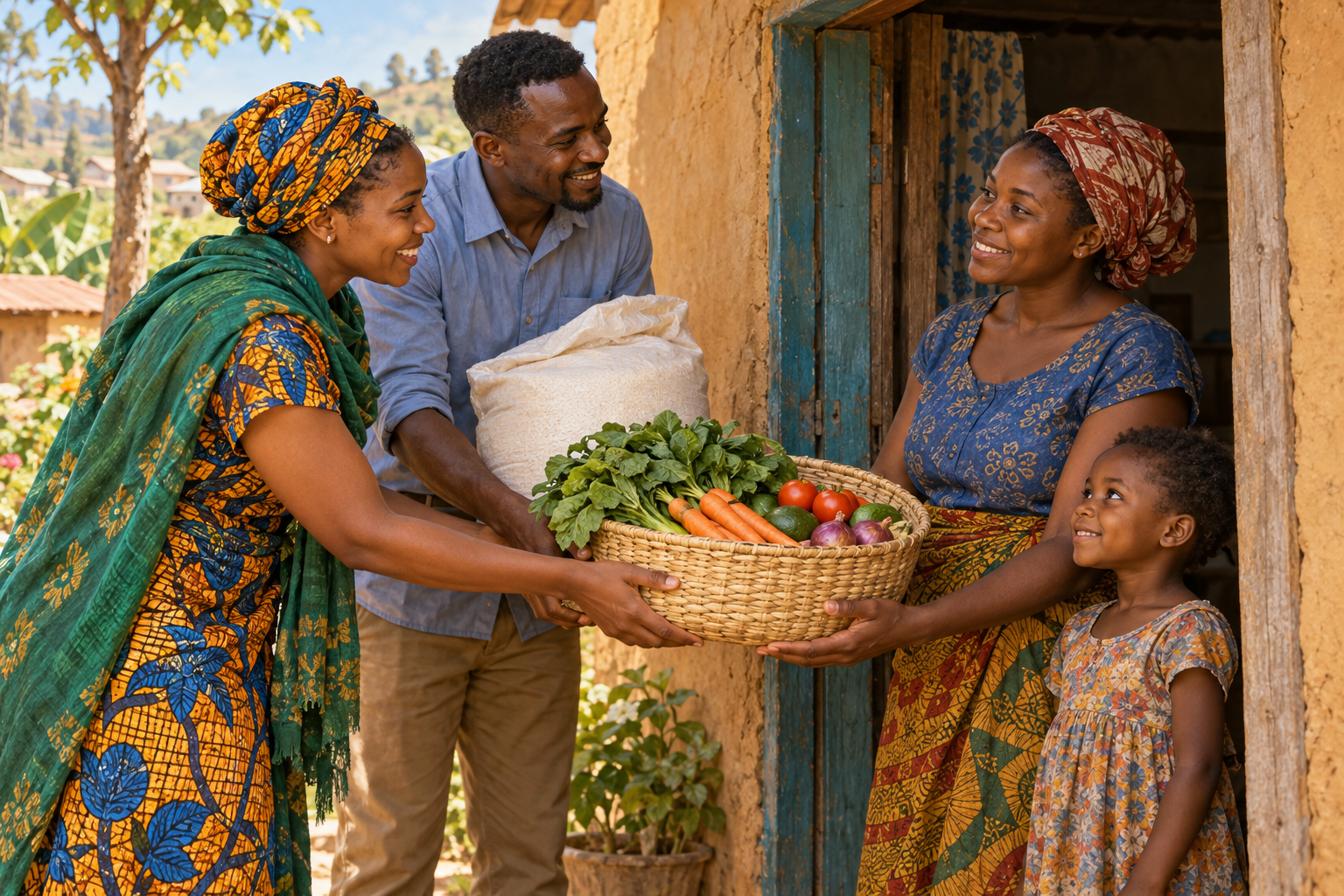
Does faith concern only the soul, or also the wellbeing of society and creation?
01
Introduction
Faith Built on Truth — In Christ, Through Scripture, for Life
If faith is only about getting souls to heaven, why do the prophets speak so strongly about wages, courts, land, hunger, and the treatment of strangers?
And if Jesus came merely to prepare us to leave this world, why did he teach us to pray for God’s kingdom to come “on earth as it is in heaven”?
Christianity can be made much smaller than the Bible makes it.
We can reduce faith to private beliefs, personal morality, and the hope of going somewhere else after death. In that version of Christianity, prayer matters, but wages do not; worship matters, but the treatment of the poor does not; salvation matters, but polluted rivers, corrupt courts, lonely neighbours, and hungry children belong to some other conversation.
The Bible tells a much larger story.
God creates a good world, forms a people to reflect his character, sends prophets to demand justice, comes among us in Jesus, pours out the Spirit, and promises the renewal of creation.
The gospel certainly reaches the inner life—but it does not stop there.
It teaches us to love God with our whole being and to love our neighbours with practical faithfulness.
These ten reasons show why love, justice, and mercy are not optional additions to Christian faith. They are part of its visible shape.
02
1. God created a world he called good
The Bible begins not with human souls escaping the earth, but with God creating heaven and earth and repeatedly calling his creation good (Genesis 1:1, 26–31).
Human beings are made in God’s image and given responsibility within that creation.
In Genesis 2, humanity is placed in the garden to work it and keep it—language that points toward care, service, and faithful stewardship (Genesis 2:15).
That means the physical world matters to God.
Bodies matter.
Soil matters.
Water matters.
Communities matter.
A farmer praying for rain, a mother looking for clean water, a child needing food, and a forest damaged by greed do not belong outside theology.
They belong within the world God loves.
We do not worship creation, but neither are we free to treat God’s handiwork as disposable.
Takeaway: To love the Creator is to learn to care for what the Creator calls good.
03
2. God’s law joined worship to the wellbeing of neighbours
Israel’s Torah never allowed devotion to God to remain private.
The same covenant that commanded worship also protected the poor, the immigrant, the widow, the orphan, the labourer, and the debtor (Deuteronomy 10:17–19; 24:14–22; Leviticus 19:9–18).
Farmers were told not to harvest every corner of their fields so that vulnerable people could gather food.
Employers were forbidden to withhold wages.
Judges were commanded not to distort justice.
This is striking because the Bible does not divide life neatly into sacred and secular spaces.
The field, the marketplace, the courtroom, and the dinner table all stand before God.
A person could sing faithfully at the sanctuary and still break covenant by exploiting a worker the next day.
Biblical holiness reaches both the hands lifted in worship and the hands that sign contracts, pay wages, and break bread.
Takeaway: Faithfulness to God is seen partly in how our ordinary decisions affect our neighbours.
04
3. The prophets rejected worship that ignored injustice
The prophets spoke with startling clarity.
Amos heard God reject religious festivals while justice was being crushed, calling instead for justice to roll down like waters (Amos 5:21–24).
Isaiah condemned fasting that left oppression untouched and hungry people unfed. He called for a faith that loosens injustice and shares bread with those in need (Isaiah 58:3–10).
Micah summarized covenant faithfulness in a few unforgettable words: do justice, love mercy, and walk humbly with God (Micah 6:8).
The point is not that worship is unimportant.
The point is that worship becomes false when our songs praise God’s goodness while our lives protect cruelty.
Imagine a beautiful painting of a well on the wall of a village where people are dying of thirst.
The picture may be impressive, but it cannot give anyone water.
In the same way, religious language cannot substitute for justice, mercy, and faithfulness.
Takeaway: God is not honoured by worship that leaves our neighbour crushed at the gate.
05
4. Jesus announced a kingdom that touched bodies, tables, and outsiders
Jesus did not preach a message concerned only with disembodied souls.
He announced the kingdom of God.
He healed the sick, fed the hungry, touched those considered unclean, welcomed children, ate with sinners, and restored excluded people to community (Luke 4:16–21; Matthew 9:35–36; Luke 7:22; Mark 2:15–17).
His actions showed what God’s reign looks like when it enters wounded human life.
When Jesus taught his disciples to pray, “Your kingdom come, your will be done, on earth as it is in heaven,” he placed the earth itself within the horizon of God’s purpose (Matthew 6:9–10).
Christianity is therefore not merely a waiting room for departure.
It is allegiance to the King whose rule is already breaking into the world and whose followers are called to reflect his character here and now.
Takeaway: Wherever Jesus is King, mercy begins to take visible form in people’s lives.
06
5. Jesus made love of neighbour inseparable from love of God
When Jesus was asked about the greatest commandment, he joined two texts together: love God with your whole being, and love your neighbour as yourself (Deuteronomy 6:4–5; Leviticus 19:18; Matthew 22:34–40).
He would not allow devotion to rise toward heaven while refusing to move toward another human being.
The parable of the Good Samaritan makes that truth painfully concrete (Luke 10:25–37).
The question, “Who is my neighbour?” is answered not with a definition, but with a wounded body beside the road.
Love becomes practical.
It becomes time.
Risk.
Money.
Attention.
Bandages.
Transport.
And a promise to return.
Biblical love is more than warm feeling.
It moves toward need.
Takeaway: Biblical love becomes credible when it crosses the road toward someone in need.
07
6. Jesus placed justice, mercy, and faithfulness at the heart of obedience
Jesus rebuked religious leaders who carefully tithed herbs while neglecting what he called “the weightier matters of the law: justice and mercy and faithfulness” (Matthew 23:23).
He did not tell them to abandon careful obedience.
He warned them that religious precision becomes distorted when it gives great attention to visible details while neglecting the deeper moral weight of God’s character.
That warning still speaks.
A church may debate details of worship while ignoring corruption.
A believer may be strict about personal habits while humiliating employees.
A family may protect its reputation while refusing mercy to a struggling relative.
Jesus calls us to put the centre back in the centre:
justice that gives people what is right,
mercy that bends toward the vulnerable,
and faithfulness that remains steady when convenience disappears.
Takeaway: Christian obedience loses its centre when justice, mercy, and faithfulness become secondary.
08
7. The cross reveals love as self-giving action, not sentiment
At the cross, God’s love is not an idea floating above suffering.
In Jesus, God enters the violence, shame, and hostility of the world and gives himself for enemies (Romans 5:6–10; Philippians 2:5–11).
The cross exposes the power of sin while revealing the shape of self-giving love:
strength used for service,
privilege surrendered for others,
and forgiveness offered without calling evil good.
John draws the practical conclusion with equal force.
Because Christ laid down his life for us, we are called to lay down our lives for one another. If someone has material resources and closes their heart to a brother or sister in need, John asks how God’s love can remain in that person (1 John 3:16–18).
Christian love therefore moves from confession to action.
It becomes provision.
It becomes generosity.
It becomes costly care.
Takeaway: The cross teaches us that love costs something because the love of God did.
09
8. The Spirit forms communities where resources and dignity are shared
The earliest Christian communities understood that the gospel had social as well as personal consequences.
In Acts, believers shared possessions so that needs could be met, ate together, and developed practical structures to care for widows who were being overlooked (Acts 2:42–47; 4:32–35; 6:1–7).
These communities were not perfect.
But they understood that the resurrection had consequences for money, food, power, and belonging.
Paul taught the same pattern.
He urged churches to bear one another’s burdens, honour weaker members, and allow the abundance of some to meet the needs of others (1 Corinthians 12:22–26; 2 Corinthians 8:13–15; Galatians 6:2).
The Spirit does not merely create private spiritual experiences.
He forms a people whose shared life becomes a sign that another kind of community is possible.
Takeaway: The Spirit’s work becomes visible when a community notices burdens and refuses to leave people carrying them alone.
10
9. Biblical hope includes the renewal of creation
Paul describes creation itself as groaning, waiting for liberation from decay alongside the redemption of God’s children (Romans 8:18–25).
That is a remarkably wide vision of salvation.
God’s purpose is not simply to rescue human souls from a doomed material world.
It is to bring creation itself through corruption into freedom.
This does not mean Christians can repair the whole planet by their own strength.
It does mean that care for the earth is not a distraction from faith.
Waste, polluted water, devastated land, and the suffering of communities that depend on damaged ecosystems matter to the God who made the world.
Caring for creation is one way of living now in light of the day when creation’s groaning will give way to renewal.
Takeaway: We care for the earth not because we can save it, but because it belongs to the God who will renew it.
11
10. The resurrection points toward a renewed world where righteousness dwells
Christian hope reaches its climax not in abandoning creation, but in its renewal.
Revelation pictures God dwelling with humanity, tears wiped away, death defeated, nations healed, and the river and tree of life nourishing the renewed city (Revelation 21:1–5; 22:1–5).
Peter speaks of the promised new heavens and new earth “where righteousness is at home” (2 Peter 3:13).
That future sends us back into the present with work to do.
Paul ends his great chapter on resurrection not by telling believers to withdraw from the world, but by urging them to remain steadfast because their labour in the Lord is not in vain (1 Corinthians 15:58).
Every truthful judgment,
every cup of water,
every act of mercy,
every effort to restore a broken community,
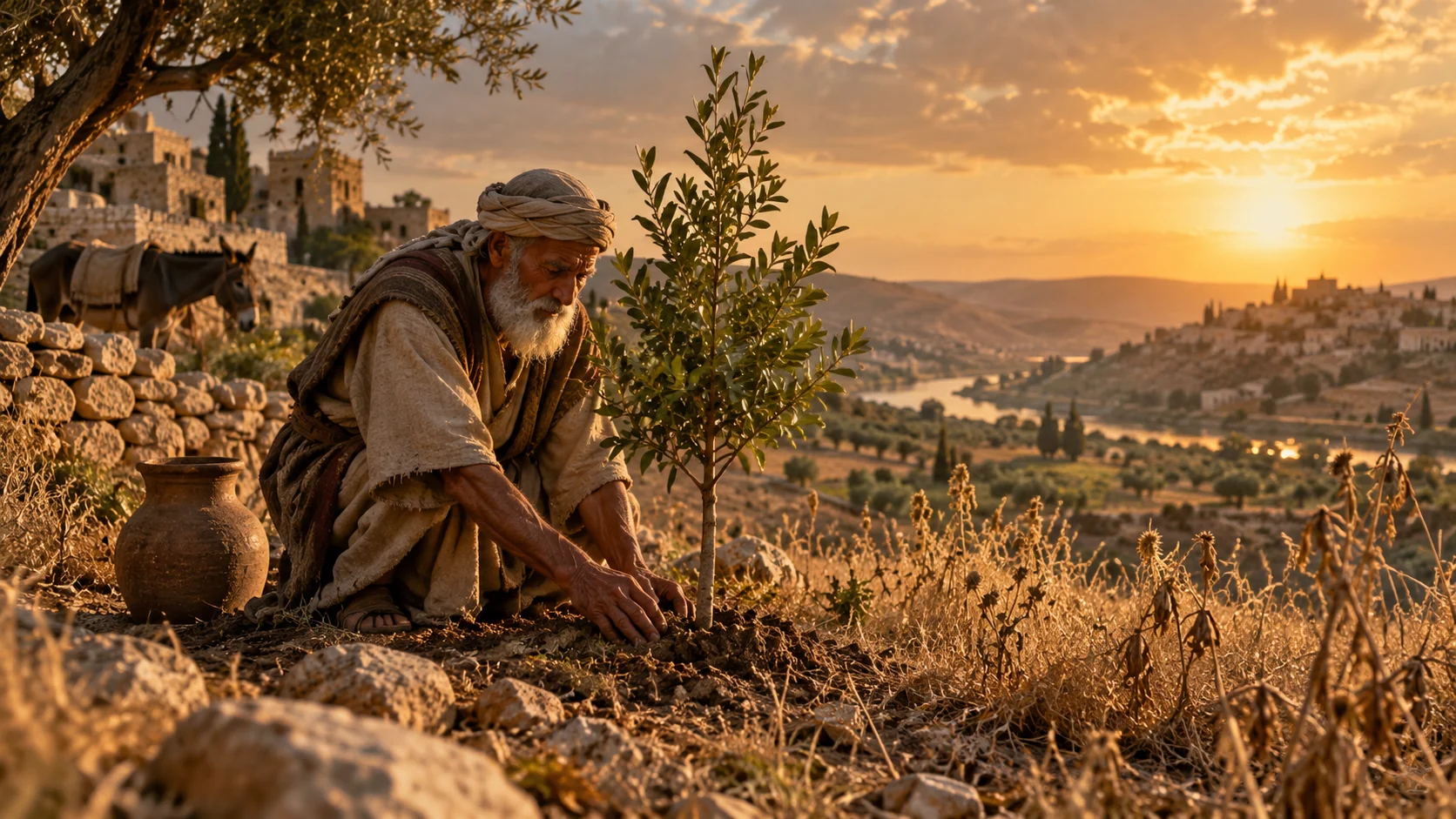
and every seed planted with care
can become a small sign pointing toward God’s coming world.
Takeaway: Resurrection hope does not make us less concerned about this world; it teaches us what kind of world God intends to make new.
12
Conclusion and Invitation
Christian faith does not ask us to choose between saving souls and loving neighbours, between prayer and justice, or between heaven and earth.
Scripture holds together what we often pull apart.
The God who forgives sin also hears the cry of the oppressed.
The Jesus who promises eternal life also feeds crowds and touches the sick.
The Spirit who renews the heart also creates a people who share their bread.
And the future God promises is not an empty heaven, but a renewed creation filled with his presence.
So the question is not only:
“Do I believe the right things?”
It is also:
“What kind of life is my faith producing?”
Does someone eat because I shared?
Does someone stand taller because I treated them with dignity?
Is a worker paid fairly?
Is a lonely person welcomed?
Is the land treated with gratitude rather than greed?
We cannot bring God’s kingdom by our own power.
But we can live as people who have already seen its dawn.
13
A Prayer for Love, Justice, and Mercy
Lord God, teach me to love what you love.
Open my eyes to the neighbour I overlook, the injustice I have learned to call normal, and the parts of your creation I have treated carelessly.
Form in me the mercy of Jesus, the courage of the prophets, and the hope of resurrection.
Let my faith become visible in love, justice, generosity, and faithful care for your world.
Amen.
14
Continue the Journey
Where is God inviting your faith to become more visible—in your family, workplace, church, neighbourhood, or care for creation?
Share a question, testimony, or one practical step you are ready to take.
Be the first to leave a comment.