
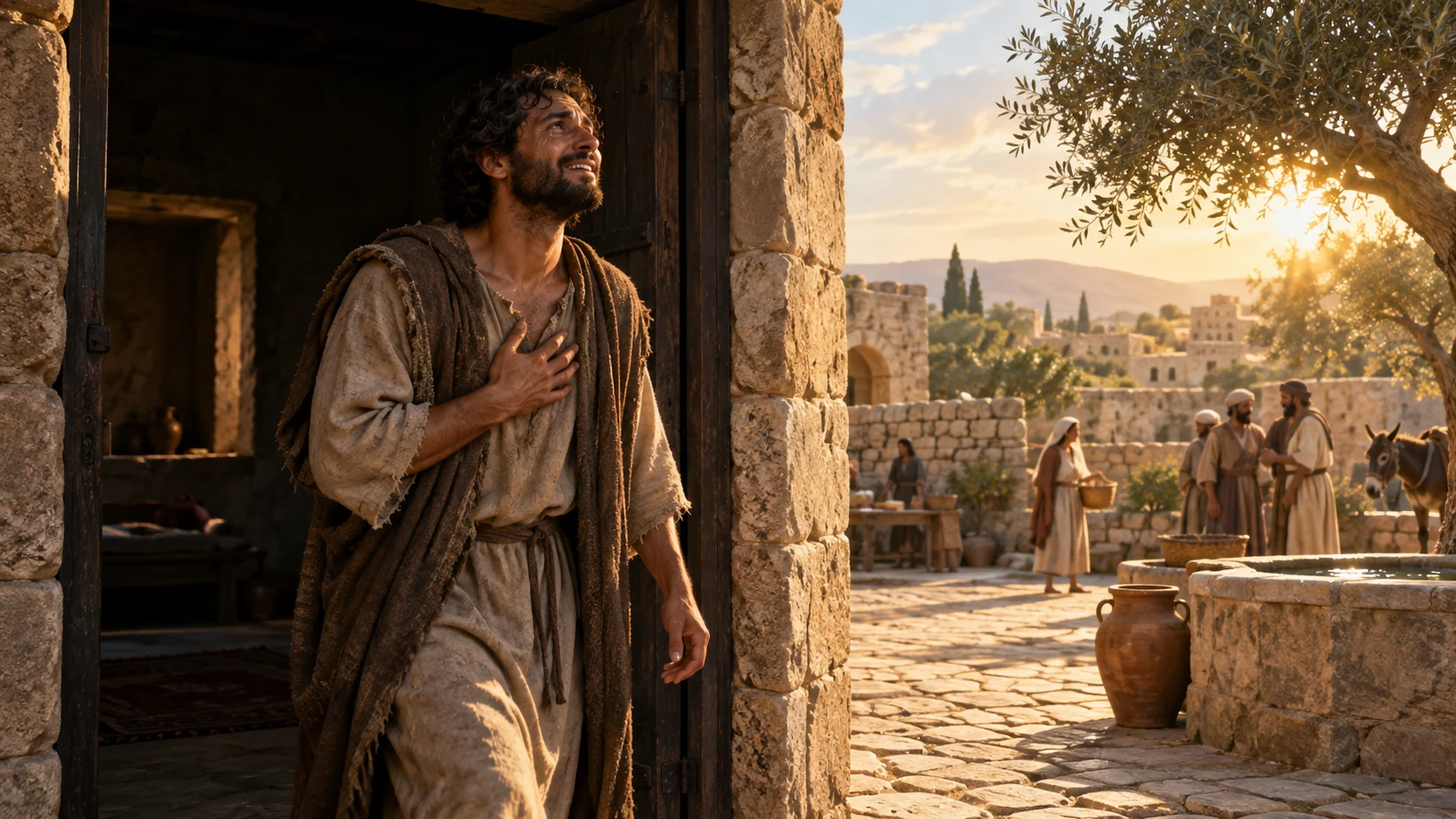
The door is open, but have you learned to live in Christ’s freedom?
Key Scripture
From Exodus, through the Cross, toward New Creation
Galatians 5:1, 13
An Open Door, but Hesitant Feet
Imagine a man who has spent many years in prison. One morning, the iron gate opens. His clothes, documents, and few personal belongings are returned. He is told that he is free to go home.
But outside the gate, he discovers a world that has not stood still waiting for him.
His children have grown. His friends have changed. Some people no longer recognize him. Others look at him with suspicion. He must find work, manage money, rebuild relationships, and make decisions that others have made for him for years.
The gate is open. But the journey of learning how to live as a free person has only just begun.
There is a lesson here that reaches far beyond prison walls:
Leaving a place of captivity is not the same as learning to live in freedom.
And you do not have to have spent a single day behind bars to understand it.
Someone may live in a beautiful house while carrying fear like a prisoner carries chains. Another may have a successful career yet remain controlled by desires that steadily destroy everything worth keeping. A person may attend church every week while still living under the shadow of yesterday's mistakes.
Some are imprisoned by anger. Others by addiction. Others by wounds they have never found the courage or safety to discuss. Still others have spent so many years believing they cannot change that hopelessness has become familiar.
So we must ask a deeper question:
When Jesus Christ promises freedom, what exactly does he mean?
Is he offering forgiveness alone? Or is he also inviting us to learn an entirely new way of living?
To answer that question, we must return to the great story of Scripture.
Egypt: God Delivers Us Not Only from Something, but for Something
The book of Exodus introduces us to Israel living under Pharaoh's rule.
Their labor is exploited. Their bodies serve another man's ambitions. Even their children are threatened. The empire demands their strength while denying their dignity.
But God hears their cry.
He calls Moses and sends him to Pharaoh. Through mighty acts of deliverance, God brings his people out of Egypt and through the waters of the Red Sea (Exodus 3:7–10; 14:21–31).
Yet their story does not end on the opposite shore.
God leads them to Sinai. He establishes his covenant with them and teaches them how to live as a people shaped by worship, justice, mercy, and faithfulness (Exodus 19:4–6).
Why?
Because God did not rescue Israel merely so they could wander without direction. He set them free so they could belong to him and reflect his character before the nations.
Here we discover the first great principle of our journey:
God does not simply set us free from something. He sets us free for a new kind of life.
Biblical freedom is not the removal of every boundary. It is liberation from destructive rule so that we may flourish under the good reign of God.
The Wilderness: When We Leave Egypt but Egypt Has Not Left Us
This is where Israel's story becomes painfully familiar.
The people have crossed the sea. Pharaoh no longer commands them. Yet the moment trouble comes, they begin longing for Egypt.
When food becomes scarce, they remember the meals of slavery. When water runs short, fear takes hold. When Moses delays on the mountain, they fashion a golden calf (Exodus 16; 32; Numbers 11:4–6).
Their bodies have left Egypt, but their imagination still lives in Pharaoh's shadow.
They have grown accustomed to a world in which someone else decides their future. Now freedom requires trust, patience, obedience, and the difficult work of learning to live together differently.
Do we not recognize something of ourselves here?
A person may walk away from a destructive habit yet continue longing for the temporary comfort it once provided. Someone may receive forgiveness and still believe they are worthless. Another may leave an abusive relationship yet carry the painful conviction that respectful love is something they do not deserve.
This is why genuine restoration requires more than a change of circumstances.
It calls for a renewal of the mind, the heart, our daily habits, and our relationships.
The God who brought Israel out of Egypt was also willing to walk with them through the wilderness.
He is still at work in that way today.
Jesus Christ: The Greater Exodus Has Arrived
Israel's journey was never the whole story. It pointed forward to a greater act of deliverance that God would accomplish through Jesus Christ.
The Gospels present Jesus stepping into the story of his people.
As a child, he goes down to Egypt and later returns. He passes through the waters of baptism. He enters the wilderness and faces temptation. Yet where Israel repeatedly failed, Jesus remains faithful to his Father (Matthew 2:13–15; 3:13–17; 4:1–11).
Then he begins announcing the arrival of God's kingdom (Mark 1:14–15).
Consider the kind of work he does.
He forgives sinners. He heals the sick. He welcomes the excluded. He eats with people society has dismissed. He challenges those who use religious authority to burden and oppress others.
In Jesus, freedom is no longer merely an idea to be discussed. It takes on a human face, hands, and feet. It walks through villages, enters ordinary homes, and touches broken lives.
But the climax of this deliverance is found not simply in his miracles.
It is found in his cross and resurrection.
The cross, which the Roman Empire used as an instrument of humiliation and defeat, becomes the place where God confronts the sin and evil of the world.
Through Christ's death and resurrection, forgiveness is announced, the powers of evil are defeated, and the beginning of new creation is revealed (Colossians 2:13–15; 1 Corinthians 15:20–26).
Jesus does not rise from the dead to escape the world God created. His resurrection is the beginning of what God intends to accomplish for creation itself.
This is the good news at the heart of this series:
Our freedom does not begin with the strength of our efforts. It begins with the victory of Jesus Christ.
What we must learn is how to live within the freedom he has won.
The Holy Spirit: When Freedom Becomes Visible in Everyday Life
When Paul writes to the Galatians, he reminds them that Christ has set them free. But he warns them not to use that freedom as an opportunity to become enslaved again to the desires of the flesh. Instead, they are to serve one another in love (Galatians 5:1, 13).
This reveals something profound.
Christian freedom is not permission to do whatever we please. It is the new ability to live as God intended human beings to live.
The Holy Spirit assures us that we are God's children, transforms us from within, and cultivates love, joy, peace, patience, kindness, goodness, faithfulness, gentleness, and self-control (Romans 8:14–17; Galatians 5:22–23).
Such transformation must find room in ordinary life.
It becomes visible when someone acknowledges wrongdoing without making excuses. When a wounded person chooses not to retaliate. When someone learns to manage money honestly, establish a healthy boundary, or ask for help instead of hiding.
It also becomes visible in the church.
The church is called to be a family where those once rejected are welcomed, those who have fallen are restored gently, and those who have been harmed are protected. It should be a community that tells the truth without humiliation and offers grace without covering up wrongdoing.
We are not redeemed so that each of us can construct a private little kingdom.
We are redeemed to learn how to live together as people of God's kingdom.
New Creation: Today's Freedom Has a Greater Tomorrow
But another question remains.
If Christ has already won the victory, why do we still suffer? Why do we continue to face fear, sickness, grief, temptation, and disappointment?
The Bible does not teach that Christ's victory has already removed every trace of suffering from the present world.
Instead, it teaches us to live within a tension:
Already — but not yet.
Already, Jesus has risen from the dead. But we still await the resurrection of our bodies.
Already, the Holy Spirit has been given. But we are still learning to walk by the Spirit.
Already, God's kingdom has entered history through Christ. But we still pray for that kingdom to come in its fullness.
Revelation 21:1–5 directs our eyes toward the promise of a new heaven and a new earth, where God dwells with his people, death is abolished, and every tear is wiped away.
This is not the hope of escaping the world and abandoning it to destruction.
It is the hope of God restoring his creation.
And that hope changes how we live now.
Repairing relationships matters. Working for justice matters. Protecting the vulnerable matters. Seeking appropriate help, raising children, building families, and serving our neighbors all matter.
We are learning to live today in the light of the tomorrow God has promised.
Summary of the Biblical Journey: Freedom Is Both a Gift and a Journey
The biblical story of freedom begins with a God who hears the cries of his people. He rescues Israel from Egypt, but their journey does not end when they cross the sea. They are called to become a community that worships God and reflects his justice. The wilderness reveals that leaving slavery is not the same as removing slavery's patterns from the heart. Redeemed people must still learn how to trust God and live faithfully.
This story reaches its climax in Jesus Christ. Through his life, cross, and resurrection, God opens the way of forgiveness, defeats the powers of evil, and inaugurates new creation. The Holy Spirit enables us to live in ways that reflect this deliverance. We are not redeemed because of our discipline or effort; we learn new disciplines because we have received grace.
Yet our present freedom remains incomplete. We still struggle with suffering, temptation, and human weakness while awaiting the day when God makes all things new.
Walking in freedom therefore means learning to tell the truth, receive forgiveness, repent, establish healthy boundaries, seek help, build safe relationships, and serve others. We do not do these things to earn God's love. We do them because, in Christ, we have been invited to live within that love.
Life Application: Begin with One Step
- Do not try to change your entire life in a single day. Long journeys often begin with one faithful step.
- Identify the chains: What currently exercises destructive control over your life—fear, shame, bitterness, addiction, a false belief about your worth, or an unhealthy pattern of behavior?
- Listen to Scripture: Read Galatians 5:1–13. Ask what kind of freedom Christ is calling you to embrace.
- Choose one realistic action: It might involve making an apology, creating a financial plan, setting a boundary, speaking with a trustworthy person, or seeking professional support.
- Walk with others: Find a wise and safe person or community that respects confidentiality, practices accountability, and speaks the truth in love.
- Lasting change does not always begin with a dramatic moment. Sometimes it begins with an honest conversation, a simple prayer, or a quiet decision to stop hiding.
- A pastoral note: Prayer and spiritual guidance do not replace medical treatment, mental health care, protection services, or legal assistance when these are needed. Seeking appropriate help can itself be an act of wisdom and courage.
Questions for Reflection
- In which area of your life has a door opened, yet you still need to learn how to live in freedom?
- What is the difference between doing whatever you want and living as someone redeemed by Christ?
- What one faithful step will you take during the next seven days?
A Prayer for the Journey
Lord Jesus Christ,
Thank you for not leaving us under the dominion of sin, fear, and death. Through your cross and resurrection, you have opened the way to new life.
Show me the chains I still carry within. Help me not merely to search for an open door, but to learn how to walk in your truth. Give me courage to repent, grace to receive forgiveness, wisdom to establish healthy boundaries, and humility to ask for help when I need it.
Holy Spirit, teach me to live as a citizen of God's kingdom—in my family, my work, my relationships, and every ordinary decision.
Guide me today, and tomorrow too, until the day when you make all things new.
In the name of Jesus Christ. Amen.
A Window into the Next Article
Article 01: You Are More Than Your Past — God Has the Final Word About Who You Are
Before we learn to change our habits and build a new life, we must answer one foundational question:
Who are you?
Is your identity determined by your history? By your mistakes? By the wounds you have suffered? Or by the God who created you and calls you to become a new creation in Christ?
In the next article, we begin where lasting restoration finds its foundation: our identity in Jesus Christ.
Read the next article: You Are More Than Your Past: God Has the Final Word About Who You Are
Sources and References
- Mwakalindile, Enos. Kutembea Katika Uhuru: Safari ya Urejesho wa Maisha Katika Kristo [Walking in Freedom: A Journey of Restoration in Christ]. First edition, 2026. Main Introduction.
- The Holy Bible: Exodus 3; 14; 19; 32; Matthew 2–4; Mark 1; Romans 8; 1 Corinthians 15; Galatians 5; Colossians 2; Revelation 21.
Be the first to leave a comment.