

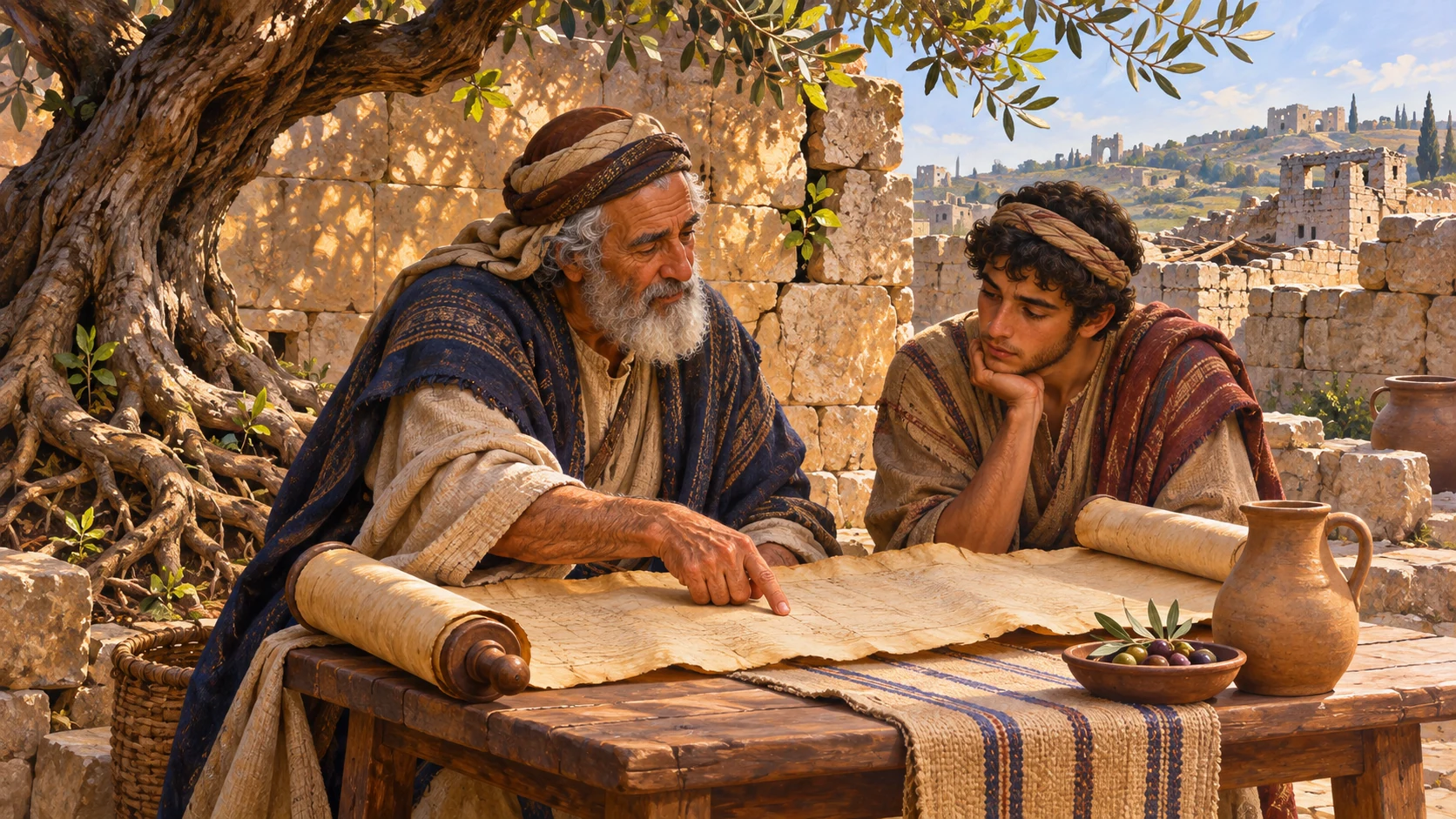
How can ancient names carry covenant hope for a wounded community?
Study overview
The palace has fallen, but the roots have not died. Before a broken people can rebuild the house, the people must remember the family tree.
Passage: 1 Chronicles 1:1–54
Controlling image: Roots beneath damaged soil
Central question: Where can a wounded community find belonging and hope when visible signs of greatness have disappeared?
Introduction: The Hunger to Belong
After a disaster, people search for names. Families count survivors, examine old photographs, and ask whether the past still has a place in the future. Israel faced a similar question after exile. Jerusalem had fallen, the Davidic throne stood empty, and covenant life required rebuilding. Was Israel still the people of God's promise?
First Chronicles opens without a battle, a throne, or a prayer. The first word is Adam (1 Chr 1:1). Before the Chronicler speaks of David's kingdom, the Chronicler reaches beneath Israel's broken political history to humanity's shared beginning. The names may sound like dry records, but buried roots can carry life through a long season of drought.
This text is about forgotten ancestry becoming renewed covenant hope. The question is not merely, “Who were Israel's ancestors?” The deeper question is, “Can God's promises survive the collapse of the institutions once associated with those promises?”
Historical and Literary Context: A Family Tree for a Displaced People
First Chronicles 1–9 forms the genealogical gateway to the history of David, the temple, and Israel's worship. Written from a perspective shaped by exile and return, Chronicles retells earlier biblical history for a community whose political power was limited but whose covenant calling remained. The author's precise identity and date remain debated; the postexilic setting is the essential interpretive horizon.
Chapter 1 draws selectively on genealogical material from Genesis 5; 10–11; 25; and 36. The lists are not a modern census or a complete record of every generation. Names sometimes identify individuals, sometimes family lines, and sometimes peoples or territories. Selection, compression, and arrangement carry theological meaning (Knoppers 2004).
The movement matters: Adam → the nations → Abraham → Isaac and Israel, alongside other branches → Edom's kings and chiefs. Israel's story emerges within the story of the world, not outside the world. Sailhamer emphasizes the connection between humanity's beginnings, the family of David, and the promised blessing reaching beyond Israel (1983, 20–23). The temple is not mentioned in this chapter; the genealogy prepares the wider story that will eventually place worship at the center.
Walking Through the Text
When One Name Holds the Whole Human Family (1:1–4)
“Adam, Seth, Enosh” begins a startlingly compressed account. Ten generations from Adam to Noah become a chain of names, followed by Noah's sons: Shem, Ham, and Japheth (1:1–4; cf. Gen 5). The Chronicler offers neither the garden's beauty nor the flood's terrifying waters. Genesis supplies those narratives; Chronicles supplies the continuity.
The opening name is theologically decisive. Israel does not begin with Abraham as though the rest of humankind were irrelevant. Israel begins with Adam. The God later worshiped in Jerusalem is already the Creator of the whole human family (Gen 1:26–28).
When the Nations Enter Before the King (1:5–23)
The genealogies of Japheth (1:5–7), Ham (1:8–16), and Shem (1:17–23) cover many peoples. Shem, named first in 1:4, comes last here, guiding the reader toward Abraham. Gomer, Javan, Cush, Egypt, Canaan, Asshur, Aram, and many other names echo the table of nations in Genesis 10. Nimrod receives a brief description as a mighty man (1 Chr 1:10); the Chronicler does not retell every associated episode.
This is not a decorative detour. The literary order forces Israel to look outward before looking inward. The names also warn against forcing every ancient name into a confidently identified modern nation.
The theological horizon is larger than one nation. God's later call to Abraham will promise blessing for “all the families of the earth” (Gen 12:3). The presence of so many peoples before Abraham gives that promise a human face. Covenant election is not permission to despise other families; covenant election belongs to a divine purpose reaching toward the nations.
When the Long Road Narrows to Abraham (1:24–27)
The Chronicler repeats a shorter line: Shem, Arpachshad, Shelah, Eber, Peleg, Reu, Serug, Nahor, Terah, and Abram—“that is, Abraham” (1:24–27; cf. Gen 11:10–26). A long catalogue suddenly gathers around one renamed man.
The change from Abram to Abraham recalls the covenant promise of many nations (Gen 17:4–6). Yet 1 Chronicles 1 offers no full retelling of Abraham's journeys, doubts, altars, or obedience. The covenant story is invoked through the name. For returning exiles, that compression matters: God's dealings did not begin with Jerusalem's monarchy and could not end with the monarchy's destruction.
When political power disappears, covenant memory still summons trust and faithfulness.
When the Family Tree Refuses to Erase Its Branches (1:28–42)
Abraham's sons Isaac and Ishmael appear together (1:28). Ishmael's descendants receive their own list (1:29–31); the descendants associated with Keturah follow (1:32–33). Then comes the decisive line: “Abraham became the father of Isaac. The sons of Isaac: Esau and Israel” (1:34). Esau's descendants and the families of Seir fill verses 35–42. “Israel” is the covenant name given to Jacob (Gen 32:28).
The arrangement is striking. Israel's name appears, but the chapter does not immediately abandon the other families. Ishmael, Midian, Esau, and Seir remain in view. Genesis records tensions among related households (Gen 21; 25; 27; 32–33). Chronicles does not resolve those tensions with an idealized family portrait.
Divine election works within a complicated human family. Isaac and Israel belong to the covenant line, but the other branches are not treated as nonexistent. A church seeking covenant identity must therefore resist turning belonging into arrogance. Remembering God's particular call should enlarge gratitude, not shrink compassion.
When Edom Has Kings Before Israel (1:43–54)
The chapter ends, unexpectedly, with Edom. Eight kings are listed as ruling in Edom before any king ruled over the Israelites (1:43; cf. Gen 36:31–39). The repeated rhythm—one king dies, another succeeds—gives way to a list of Edomite chiefs (1 Chr 1:51–54).
The contrast is quiet but sharp. Edom possessed royal structures before Israel's monarchy began. Political precedence, however, is not the same as covenant priority. Neither an earlier throne nor an impressive title proves lasting faithfulness. The repeated notices of death also expose the limits of royal greatness: rulers appear, disappear, and leave their names behind.
The Chronicler does not present every Edomite as wicked or describe the entire list as divine judgment. Edom is granted an actual history. Yet the final placement creates anticipation. After surveying nations and kings, the narrative will move toward Judah, David, and a kingdom defined not simply by royal power but by covenant responsibility and ordered worship (1 Chr 2–3; 11–29).
Theological Reflection: Four Roots of Hope
The Creator's World Is Larger Than Israel's Borders
Adam stands at the beginning; numerous peoples stand along the road to Abraham. Genesis teaches that all humanity bears the divine image (Gen 1:26–27), while Abraham's calling aims at blessing for the families of the earth (Gen 12:3). Israel's election is particular, but God's purpose is never merely tribal. A faithful community remembers both truths.
Covenant Memory Can Outlive Political Collapse
A throne may vanish while a promise remains. For a postexilic audience, genealogies were more than nostalgia: the lists traced continuity across national catastrophe. The prophets could speak of David's fallen shelter being raised again (Amos 9:11), and Chronicles could narrate the possibility of return after ruin (2 Chr 36:22–23). Memory becomes faithful only when remembrance leads to renewed obedience.
God's Choice Is Not a License for Human Pride
The inclusion of Ishmael, Keturah's descendants, Esau, and Seir complicates an easy story of insiders and outsiders. God's covenant dealings with Isaac and Israel do not cancel the humanity or historical reality of neighboring peoples. The right response to received grace is humility, hospitality, justice, and prayer for the nations (Isa 2:2–4).
The Genealogy Opens Toward the True Son of David
The Chronicler has not yet named David, and chapter 1 makes no explicit prediction of Jesus. Nevertheless, the whole book will move toward the Davidic promise (1 Chr 17). Matthew begins Jesus' genealogy with Abraham and David (Matt 1:1), while Luke traces Jesus' ancestry back to Adam (Luke 3:23–38). Paul calls Christ the “last Adam” (1 Cor 15:45). Read canonically, the roots beneath Judah's ruins open toward the renewal of humanity in Christ—not merely the recovery of one nation's prestige.
Life Application: Cultivating the Roots
- Recover covenant memory. Read Genesis 1–12 alongside 1 Chronicles 1. Write down three promises of God and one concrete obedience each promise requires.
- Honor forgotten people. Ask an older family or church member for a testimony. Record the testimony accurately and acknowledge both faithfulness and failure.
- Resist spiritual superiority. Name a community often dismissed as an outsider. Replace careless language with respectful conversation and practical service.
- Build intergenerational worship. Invite children, young adults, and elders to read Scripture, pray, and serve together. Heritage must become shared responsibility, not a badge of status.
- Measure leadership beyond titles. Edom had kings early. Evaluate church and community leaders by integrity, justice, teachability, and care for people—not visibility alone (Deut 17:18–20).
- Repair one broken relationship. Family trees contain wounds as well as blessings. Begin a truthful conversation, confess a specific wrong where necessary, and seek peace without denying harm (Rom 12:18).
Reflection Questions
- Which visible loss has made God's promises feel uncertain?
- Which names or generations have disappeared from the congregation's memory?
- Where has covenant identity become an excuse for pride or exclusion?
- Which family wound needs truth, repentance, or patient reconciliation?
- What concrete act of faithfulness can preserve spiritual roots for the next generation?
Response Prayer
God of Adam and Abraham, Keeper of generations, remember families standing among the ruins. Where memory has faded, restore gratitude. Where pride has hardened the heart, plant humility. Where relationships have been wounded, give courage for confession and patient repair. Keep covenant roots alive beneath exhausted soil. Let worship, justice, and mercy grow together. Through Jesus Christ, the Son of David and hope of the nations, form a people whose names are remembered in love and whose lives bear fruit for the coming kingdom. Amen.
Window into What Comes Next
The first chapter opens the whole human family. 1 Chronicles 2 begins narrowing the lens toward the sons of Israel and especially Judah. Among those names lie broken households, unexpected turns, and the line that will lead toward David. The roots are becoming a tree; the promise is moving toward a throne—and, beyond the throne, toward a house of worship.
Annotated Bibliography
- Hill, Andrew E. 1 & 2 Chronicles. NIV Application Commentary. Grand Rapids: Zondervan, 2003. Connects the Chronicler's literary and theological emphases with practical contemporary discipleship.
- Japhet, Sara. I & II Chronicles: A Commentary. Old Testament Library. Louisville: Westminster John Knox, 1993. A major critical treatment of Chronicles' historical presentation, structure, and distinctive theology.
- Klein, Ralph W. 1 Chronicles: A Commentary. Hermeneia. Minneapolis: Fortress, 2006. Provides sustained textual and historical analysis of the genealogies and the book's larger argument.
- Knoppers, Gary N. I Chronicles 1–9: A New Translation with Introduction and Commentary. Anchor Bible 12. New York: Doubleday, 2004. Examines the genealogies as purposeful literary constructions, including the movement from Adam toward Esau and Israel.
- Sailhamer, John. First and Second Chronicles. Everyman's Bible Commentary. Chicago: Moody Press, 1983. Primary accompanying source; emphasizes the connection between Adam, Abraham, David, covenant faithfulness, and blessing for the nations.
- Williamson, H. G. M. 1 and 2 Chronicles. New Century Bible Commentary. Grand Rapids: Eerdmans, 1982. Offers a historical-literary reading of the Chronicler's aims and the postexilic community's concerns.

Be the first to leave a comment.