

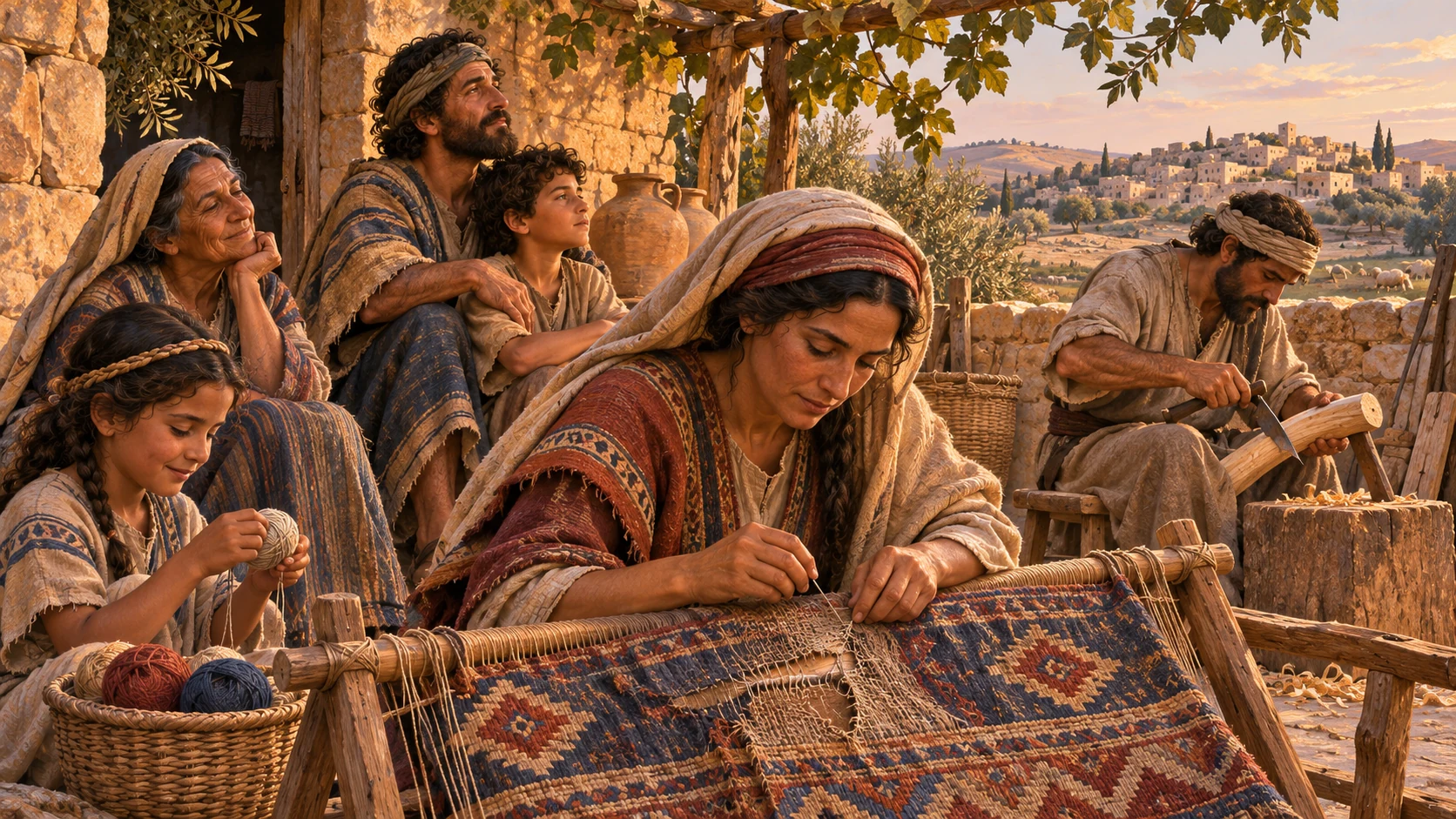
How can truthful family memory nurture worship, justice, and hope?
Study overview
The family cloth bears stains of betrayal and threads of courage. Yet through forgotten households, the promise travels toward Bethlehem.
Passage: 1 Chronicles 2:1–55
Controlling image: A torn family cloth being woven into a shared inheritance
Central question: Can a people with a wounded history become a community of faithful worship and hope?
Introduction: The Stories Beneath the Family Name
A family photograph often hides more than a photograph reveals. Behind smiling faces may stand unresolved conflicts, painful choices, quiet acts of courage, and relatives whose contributions rarely receive recognition. Should a community preserve only heroic stories, or remember the wounds as well?
First Chronicles 2 answers by naming the descendants of Israel, then lingering over Judah. The royal line appears, but not as a spotless pedigree. Judah's failures, Tamar's precarious position, Achar's trespass, an Egyptian servant, daughters, artisans, village founders, and scribal clans all enter the record.
This text is about a wounded family history becoming a testimony to covenant continuity. The heart-question is whether belonging to God's people can be renewed through truthful memory rather than denial, pride, or nostalgia.
Historical and Literary Context: Why Judah Comes into View
The genealogy of all humanity in chapter 1 narrows in chapter 2 to Israel and then to Judah. Chapters 2–3 prepare for David's house; chapters 4–9 widen the lens again to Israel's tribes, Levites, and the restored community. After exile, these lists anchored identity beyond a ruined monarchy (Knoppers 2004; Japhet 1993).
The order is deliberate. Judah is named fourth among Israel's sons (2:1–2) but becomes the subject of the chapter. Genesis 49:8–12 anticipates Judah's leadership; Ruth 4:18–22 and 1 Chronicles 17 carry the line toward David and God's promise. These selective records include individuals, clans, and settlements; difficult readings deserve acknowledgment.
Sailhamer (1983) stresses that the larger genealogical movement prepares readers to understand David's house within God's purpose of blessing. Here that purpose advances through deeply imperfect human relationships.
Walking Through the Text
When Judah's Name Cannot Hide the Wound (2:1–4)
The chapter first names twelve sons of Israel. Then the family record turns to Judah's sons through a Canaanite wife: Er, Onan, and Shelah. Er's wickedness and death are recorded without softening (v. 3; Gen 38:7). Tamar, Judah's daughter-in-law, bears Perez and Zerah (v. 4). Genesis 38 recalls Judah’s failure toward vulnerable Tamar and Judah’s later admission of injustice (Gen 38:26).
A royal family can carry a real promise without possessing an innocent past. Covenant faithfulness requires truthful remembrance, not the laundering of ancestors' reputations. Tamar belongs in the story, not in a footnote to Judah's greatness.
When Trouble Receives a Name (2:5–8)
Perez's sons are Hezron and Hamul; Zerah's line includes Zimri, Ethan, and others. Then the register pauses over Achar, the descendant who brought trouble upon Israel by violating what was devoted to God (v. 7). Joshua 7 calls the offender Achan and describes a theft that damaged the community's life. The form Achar evokes the language of trouble (cf. Josh 7:25–26).
The Chronicler records both lineages and moral consequences. Hidden wrongdoing can undermine public trust and communal worship. Yet the genealogy does not declare every descendant permanently guilty. Memory of judgment must encourage confession and repair, not inherited stigma.
When the Youngest Name Carries the Promise (2:9–17)
Through Hezron's son Ram, the genealogy moves to Amminadab, Nahshon, Salma, Boaz, Obed, Jesse, and David (vv. 9–15). Ruth 4:18–22 supplies a parallel chain. The list does not mention Ruth, but the wider canon remembers Ruth's loyalty and the surprising formation of David's family (Ruth 4:13–22).
David appears seventh in Jesse's list, not first (v. 15). First Samuel 16–17 counts Jesse's sons differently; the reason is not securely known. The narrative lesson remains: royal vocation is not equivalent to automatic privilege or impressive appearance (1 Sam 16:7).
The register also names David's sisters, Zeruiah and Abigail, and the sons associated with both women (vv. 16–17). Amasa's father is identified as Jether the Ishmaelite. Leadership never emerges from a solitary hero.
When a Builder Stands Beside the Royal Line (2:18–24)
Another branch descends from Caleb, also called Chelubai in verse 9, a descendant of Hezron. This Caleb should not simply be confused with Caleb son of Jephunneh. The text names Azubah, Ephrath, Hur, Uri, and Bezalel (vv. 18–20). Exodus 31:2–5 identifies Bezalel as the Spirit-equipped artisan entrusted with work on the tabernacle.
Before the narrative reaches David's preparations for the temple, the family register remembers craftsmanship devoted to God's dwelling. Worship also needs skilled hands and costly service.
Verses 21–24 also describe ties with Machir's family in Gilead and settlements linked with Jair. The wording of verse 24 is difficult and varies among translations. Judah’s history includes marriages and changing regional ties.
When an Egyptian Servant Enters the Family Record (2:25–41)
Jerahmeel's descendants receive an extensive record. Two men are said to die without children (vv. 30, 32); another household encounters a different apparent dead end. Sheshan has daughters but no sons, and an Egyptian enslaved servant named Jarha (v. 34). Sheshan gives a daughter in marriage to Jarha; the genealogy continues through Attai toward Elishama (vv. 35–41).
The text preserves the daughter's importance but does not name the daughter. Marriage does not erase enslavement or establish the woman’s freedom to choose. The genealogy reports an ancient social arrangement; the report is not a Christian endorsement of ownership over human beings.
A seemingly closed family line continues through a daughter and an Egyptian. Covenant memory is more complicated than a narrowly guarded male pedigree. God’s people must learn to see those whom records and institutions so easily overlook.
When Bethlehem Is Woven into the Cloth (2:42–55)
The final section names further Calebite families and numerous places: Ziph, Hebron, Beth-zur, Kiriath-jearim, and Bethlehem. Some names function as ancestors of settlements or clans rather than merely as individual fathers (Klein 2006). A family tree becomes a map of communal belonging.
Bethlehem will become David's town (1 Sam 16:1; Luke 2:4), while Kiriath-jearim will reappear in the history of the ark (1 Chr 13:5–6). The closing verse remembers scribal families at Jabez, described as Kenites associated with the house of Rechab (2:55; cf. Jer 35). The text assigns no temple duties to these scribes, yet records their names.
The royal thread matters, but so do households, craftspeople, and towns.
Theological Reflection: The Meaning of the Woven Cloth
Grace Does Not Require a Fabricated Past
Judah's failure and Tamar's suffering (Gen 38) remain visible in the royal ancestry. God's covenant purpose moves through repentance-worthy situations without calling injustice good. Matthew 1:3 also remembers Tamar. Christian hope rests not on the moral perfection of human ancestors but on God's faithfulness working amid real human responsibility.
The Community Must Remember Both Sin and Service
Achar's trespass harmed Israel (Josh 7); Bezalel's craftsmanship served the sanctuary (Exod 31:1–5). Both names occupy the same chapter. Worship cannot be separated from integrity, and holy service cannot be reduced to public leadership. The hidden hand that builds and the hidden hand that steals both shape communal life.
Covenant Belonging Is More Than Prestige or Bloodline Boasting
Tamar, the unnamed daughter of Sheshan, Jarha the Egyptian, and the Kenite scribes complicate claims of an uncomplicated pedigree. The genealogy neither erases inequality nor resolves every membership question. Deuteronomy 10:18–19 calls worshipers to protect vulnerable strangers: inheritance demands hospitality, not contempt.
Bethlehem Points Beyond David
The line through Boaz, Obed, Jesse, and David moves toward God's promise of a lasting house (1 Chr 17:11–14). Bethlehem joins the wider scriptural expectation of a ruler who will shepherd God's people (Mic 5:2–4). The Gospels present Jesus as David's descendant (Matt 1:1–6; Luke 2:4–11). This canonical reading does not claim that Chronicles explicitly names Jesus. Through the Son of David, a wounded people are invited into a renewed family shaped by mercy and obedience.
Life Application: Repairing the Family Cloth
- Tell family and church history truthfully. Preserve testimonies of faith without concealing harm. Admit a documented failure rather than editing the story for appearances.
- Repair a breach of trust. Where personal wrongdoing has harmed others, confess specifically, return what was wrongly taken when possible, and accept accountability (Josh 7:20–21).
- Protect those with less power. Listen to daughters, employees, domestic workers, and overlooked members. Never use the story of Jarha to excuse exploitation.
- Honor hidden craftspeople. Publicly thank those who clean, build, teach, keep records, maintain facilities, and prepare worship (Exod 31:1–5).
- Make belonging visible. Invite families from different backgrounds into genuine fellowship and shared service, not merely ceremonial inclusion.
- Hand on a living inheritance. Record one older member's story, study one biblical genealogy with a younger person, and connect remembrance with a concrete act of faithfulness.
Reflection Questions
- Which painful episode has been hidden beneath the reputation of a family, church, or ministry?
- What harm needs confession, restitution, or responsible protection of those affected?
- Whose name or contribution has been omitted from the community's shared story?
- Does worship honor faithful service as much as visible leadership?
- What practice will help the next generation inherit truth, humility, and hope rather than silence and pride?
Response Prayer
God of Judah, Tamar, and David, gather the torn threads of family and community. Give courage to name wrongdoing without despair and grace to repair harm without excuses. Protect people whose stories have been silenced. Bless the hands that serve quietly, the hearts that repent honestly, and the households learning to welcome one another. Weave the life of the church around truthful memory, reverent worship, and the mercy of Jesus Christ, the Son of David. Where the cloth has torn, teach God's people to mend with justice, patience, and love. Amen.
Window into What Comes Next
The path has reached David, but the question of the kingdom remains. 1 Chronicles 3 will trace David's sons and royal descendants through the disaster of exile and beyond. The thread that began in a troubled household must now pass through a broken throne. Will the promise survive the fall of the palace?
Annotated Bibliography
- Hill, Andrew E. 1 & 2 Chronicles. NIV Application Commentary. Grand Rapids: Zondervan, 2003. Connects the Chronicler's literary choices with worship and contemporary discipleship.
- Japhet, Sara. I & II Chronicles: A Commentary. Old Testament Library. Louisville: Westminster John Knox, 1993. An important study of the genealogies' historical questions and distinctive theological aims.
- Klein, Ralph W. 1 Chronicles: A Commentary. Hermeneia. Minneapolis: Fortress, 2006. Examines textual difficulties, regional names, and the diverse forms of genealogy in 1 Chronicles 2.
- Knoppers, Gary N. I Chronicles 1–9: A New Translation with Introduction and Commentary. Anchor Bible 12. New York: Doubleday, 2004. Gives detailed treatment of ancestry, kinship, and Judean identity after exile.
- Sailhamer, John. First and Second Chronicles. Everyman's Bible Commentary. Chicago: Moody Press, 1983. The supplied reference commentary; highlights the movement toward Davidic kingship and hope grounded in divine fidelity.
- Williamson, H. G. M. 1 and 2 Chronicles. New Century Bible Commentary. Grand Rapids: Eerdmans, 1982. Helps locate the genealogies within the Chronicler's broader retelling of Israel's history.

Be the first to leave a comment.