

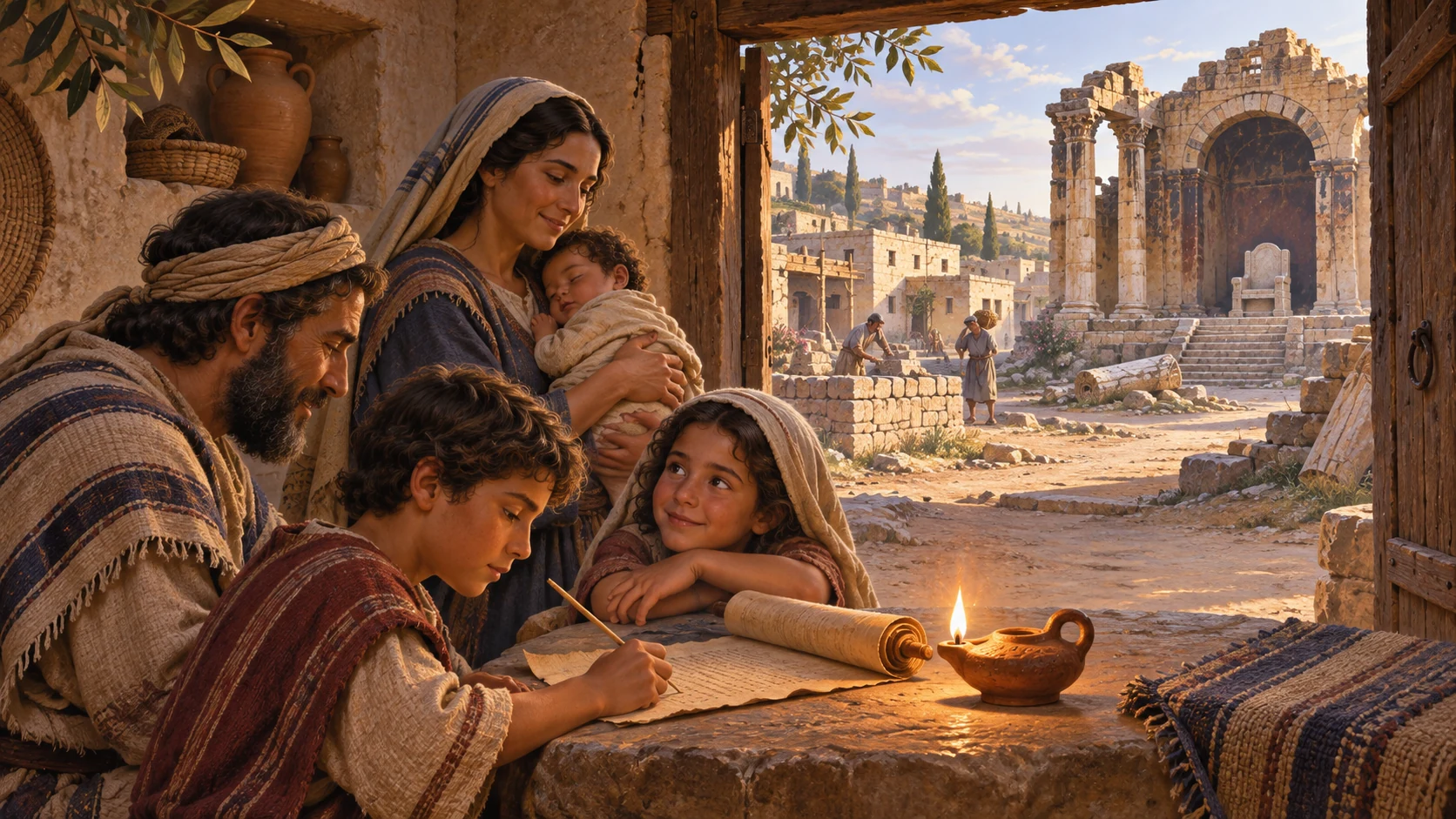
How can God’s promise endure after a throne has fallen?
Study overview
The palace doors close; the throne stands empty. Yet beneath the ashes of a fallen kingdom, God preserves the names of a living family.
Passage: 1 Chronicles 3:1–24
Controlling image: A covenant lamp still burning in a house without a throne
Central question: Can God's promise remain alive when the institution that carried the promise has collapsed?
Introduction: When the Family House Loses Its Roof
After disaster destroys a family home, the question becomes painful: What remains when visible signs of belonging disappear?
First Chronicles 3 brings Israel into that room of loss. The chapter begins with David's children, follows the line of Judah's kings, names the generation taken into Babylon, and continues listing descendants after the throne has vanished. The names continue beyond the fall.
This text is about a fallen royal house becoming a testimony to God's enduring covenant promise. Does covenant hope depend upon a palace or upon the faithful God who promised David a lasting house (1 Chr 17:11–14)? The lamp is not the crown; yet the lamp burns.
Historical and Literary Context: Memory After the Monarchy
Chapters 1–9 establish Israel's identity through remembered generations. Chapter 1 begins with Adam and the nations; chapter 2 narrows toward Judah and David; chapter 3 traces David's household from the united monarchy into exile and beyond. The names anticipate kingship and temple worship.
The book addresses a community living after Jerusalem's destruction and the Babylonian exile, when a restored community existed without an independent Davidic king. The temple again mattered, but the monarchy had not returned. Could God's covenant survive such loss (Japhet 1993; Knoppers 2004)?
Sailhamer (1983) emphasizes that the Davidic record reaches into the postexilic period, where the survival of the family bears witness to divine faithfulness despite political loss. The chapter resists both nostalgia and despair. The throne has a history; the promise has a future.
Walking Through the Text
When the Royal Household Begins with Complicated Lives (3:1–4)
The opening verses name six sons born to David in Hebron: Amnon, Daniel, Absalom, Adonijah, Shephatiah, and Ithream. Their mothers are also identified. Maacah, Absalom's mother, was a daughter of Geshur's king (v. 2).
The list is not a celebration of perfect sons. Readers acquainted with Samuel remember Amnon's assault against Tamar, Absalom's violence and rebellion, and Adonijah's attempt to secure the throne (2 Sam 13–18; 1 Kgs 1). Chronicles does not recount those episodes here. Selective silence does not erase those wounds.
David reigns in Hebron for seven years and six months, then in Jerusalem for thirty-three years (v. 4; cf. 2 Sam 5:4–5). Yet expanding kingship cannot cure family wrongdoing. The promised house will require more than powerful sons.
When Jerusalem Holds Both Glory and Grief (3:5–9)
Four sons born in Jerusalem are named through Bath-shua, also called Bathsheba elsewhere: Shimea, Shobab, Nathan, and Solomon. Her father is Ammiel here and Eliam in 2 Samuel 11:3; other sons follow, including unnamed sons of concubines. The verse ends by mentioning Tamar, David's daughter (v. 9).
The royal register is selective. Solomon will succeed David and build the temple; Nathan later appears in Luke's genealogy of Jesus (Luke 3:31). Bathsheba and Tamar also recall suffering (2 Sam 11–13). The wider canon remembers Tamar's story.
God's purpose advances through an imperfect household. Church communities should resist the temptation to praise a leader's achievements while refusing to hear the harmed.
When a Line of Kings Becomes a Record of Accountability (3:10–14)
From Solomon through Rehoboam, Abijah, Asa, Jehoshaphat, and later rulers, the genealogy traces a selected royal line, ending with Josiah. Five verses compress centuries.
Rehoboam's harshness contributed to division (2 Chr 10); Asa and Jehoshaphat pursued important reforms but were not beyond correction (2 Chr 14–20); Hezekiah renewed temple worship (2 Chr 29–31); Manasseh defiled Judah and later humbled himself (2 Chr 33); Josiah restored covenant attention to God's word and Passover (2 Chr 34–35).
The names invite a moral question: What did each generation do with the inheritance? Kings inherited titles but had to practice faithfulness (1 Chr 28:9).
When the Crown Is Carried into Captivity (3:15–18)
Josiah's sons appear, followed by Jehoiakim and Jeconiah, also called Jehoiachin. The family record now crosses the threshold of national collapse (vv. 15–16; 2 Kgs 24:8–17). Captivity enters through the family register.
Verse 17 introduces Jeconiah as a captive in many translations; the Hebrew form assir may also be understood as a personal name. Shealtiel, Pedaiah, and other descendants are recorded (vv. 17–18). The wording itself signals troubled history (Klein 2006).
Jeremiah's judgment on Jeconiah declares that none of his descendants would prosper while occupying David's throne in Judah (Jer 22:24–30). Yet 1 Chronicles 3 continues the genealogy. Neither instant restoration nor family extinction follows. Judgment is real; survival is not the same as political recovery. The monarchy has fallen, but the family has not been erased.
When a Governor Carries Hope Without Wearing a Crown (3:19–20)
Pedaiah is named as the father of Zerubbabel and Shimei (v. 19). Elsewhere Zerubbabel is called the son of Shealtiel (Ezra 3:2; Hag 1:1). Adoption, levirate kinship, and family succession are suggested, but none is securely established (Japhet 1993; Knoppers 2004).
Zerubbabel returns to prominence in the Persian-period restoration as Judah's governor and a leader connected with rebuilding the temple (Ezra 3:2, 8; Hag 1:12–14). Zerubbabel is not an independent king.
Haggai 2:23 calls Zerubbabel God's chosen signet, echoing an image associated with Jeconiah's judgment in Jeremiah 22:24. The echo suggests hope, not a restored throne. Hope does not require pretending that fulfillment has arrived.
When the Names Continue Beyond the Ruins (3:21–24)
The final verses name descendants including Hananiah, Shecaniah, Neariah, Elioenai, and Anani. Textual and genealogical difficulties remain, especially in verse 21, where translations differ about whether names form a single succession or several branches. A precise chronology is therefore unsafe (Williamson 1982; Klein 2006).
Yet the literary point is unmistakable: the record does not close with Jeconiah's captivity, nor with Zerubbabel's rebuilding efforts. Generations continue after exile. Names survive; the covenant story remains unfinished.
The palace's collapse has not exhausted God's promise. The lamp remains visible among ordinary descendants, far from royal spectacle.
Theological Reflection: What Keeps the Lamp Burning?
God's Promise Is Greater Than the Institution
God promised David a lasting house and kingdom (1 Chr 17:11–14). Exile shattered Judah's political order. This does not deny judgment or guarantee every institution's survival. God remains faithful while earthly forms can be judged, lost, and transformed. Amos envisioned the raising of David's fallen shelter (Amos 9:11). The hope rests on God's initiative, not the survival of a palace.
Covenant Memory Demands Moral Honesty
The list preserves names associated with both reform and rebellion. David's household included injured members; the kings included devoted reformers and destructive rulers. Chronicles will repeatedly ask whether leaders seek the LORD and guard worship (2 Chr 12:14; 26:16–21). A community cannot claim covenant memory while refusing to examine abuse, pride, neglected worship, or damaged trust.
Restoration May Begin Without Visible Glory
Zerubbabel's governorship and temple rebuilding did not reproduce the monarchy of David and Solomon (Hag 2:2–9). Yet God worked in modest circumstances. The response is to rebuild worship, practice justice, and obey God's word (Zech 4:6–10). The lamp survives through humble faithfulness rather than political spectacle.
The Son of David Carries the Story Forward
Matthew traces Jesus' ancestry through the royal line and the exile, including Jeconiah and Zerubbabel (Matt 1:6–12); Luke includes Nathan, another son of David (Luke 3:31). The differences resist easy harmonization. Both Gospels locate Jesus within Israel's remembered Davidic hope. Christians confess Jesus as the risen Son of David whose kingdom cannot be destroyed by death (Luke 1:32–33; Acts 2:29–36). This is a forward reading, not an explicit claim in Chronicles. Christ also forms a living dwelling for God (Eph 2:19–22).
Life Application: Guarding the Lamp
- Tell the whole history. Preserve accounts of faithful leaders and acknowledge documented harm. Include confession alongside celebration.
- Do not confuse position with calling. Leadership titles can change or disappear. Continue teaching Scripture, caring for neighbors, and worshiping faithfully when recognition is absent.
- Protect people harmed by powerful families. Hear complaints without automatically defending a respected name; establish safe reporting, accountability, and appropriate help (2 Sam 13).
- Rebuild the altar before chasing prestige. Restore neglected prayer, Sabbath gathering, Scripture reading, generosity, and shared service (Ezra 3:1–6).
- Honor ordinary descendants. Learn the names and stories of older members, children, volunteers, and people whose contributions rarely reach the public record.
- Pass hope to the next generation. Mentor a younger believer and explain both God's promises and the costly obedience those promises invite.
Reflection Questions
- Which lost position, building, or tradition has become the measure of God's faithfulness?
- What painful part of a family or church history needs truthful acknowledgment?
- Are leaders being judged by faithful worship and justice, or merely by inherited status?
- Which quiet practices of rebuilding have been neglected while visible success receives attention?
- What concrete sign of covenant hope will the next generation inherit from today's choices?
Response Prayer
Faithful God of David, Solomon, the exiles, and the returning remnant, guard the lamp when crowns fall and familiar houses crumble. Give courage to remember truthfully, to confess wrongdoing, and to protect wounded people. Save the church from mistaking prestige for holiness. Renew prayer where worship has grown cold; kindle obedience where fear has taken root. Bless families and congregations rebuilding with small resources and weary hands. Through Jesus Christ, the Son of David, make God's people a living house of mercy, justice, and praise. Amen.
Window into What Comes Next
The royal register has ended, but Israel's story is larger than the palace. 1 Chronicles 4 returns to Judah's wider households and then to Simeon. The lamp shines alongside ordinary families. What might faithful belonging look like beyond royal names?
Annotated Bibliography
- Hill, Andrew E. 1 & 2 Chronicles. NIV Application Commentary. Grand Rapids: Zondervan, 2003. Relates the Davidic family record to covenant faithfulness, worship, and the practical responsibility of later communities.
- Japhet, Sara. I & II Chronicles: A Commentary. Old Testament Library. Louisville: Westminster John Knox, 1993. Examines the Chronicler's literary shaping of Davidic continuity and the historical problems in postexilic names.
- Klein, Ralph W. 1 Chronicles: A Commentary. Hermeneia. Minneapolis: Fortress, 2006. Explores variant readings and genealogical difficulties, particularly the descendants of Jeconiah and Zerubbabel.
- Knoppers, Gary N. I Chronicles 1–9: A New Translation with Introduction and Commentary. Anchor Bible 12. New York: Doubleday, 2004. Provides sustained treatment of royal genealogy, kinship conventions, and Judean identity after the exile.
- Sailhamer, John. First and Second Chronicles. Everyman's Bible Commentary. Chicago: Moody Press, 1983. The supplied commentary; interprets the continuation of David's family beyond the exile as a witness to God's enduring promise.
- Williamson, H. G. M. 1 and 2 Chronicles. New Century Bible Commentary. Grand Rapids: Eerdmans, 1982. Places the succession of kings and later descendants within the book's larger purpose of sustaining postexilic hope.

Be the first to leave a comment.