

How can prayer, labor, and communal growth remain connected to justice for neighbors?
Study overview
After the crown falls, fields still need tending. Among names, births, prayers, workshops, and contested pastures, the God of Israel keeps the memory of a people alive.
Passage: 1 Chronicles 4:1–43
Controlling image: Roots spreading beyond a fallen palace into the fields and villages
Central question: How can a wounded community recover faithful identity when royal glory has disappeared and ordinary survival demands so much?
Introduction: When the Fields Outlast the Palace
When an ancestral house falls, someone must still plant fields, teach children, and preserve family memories. Restoration begins with ordinary work.
First Chronicles 3 has followed David's royal house beyond the exile. Chapter 4 moves away from the palace. The Chronicler remembers Judah's families, Jabez's prayer, a woman connected with Egypt, craftsmen, potters, and Simeon's struggle for land. Ordinary life, including violence, enters the register.
This text is about scattered family memory becoming renewed covenant belonging. Its question: How shall God's people live faithfully after the crown is gone?
Historical and Literary Context: Israel Remembered from the Ground Up
The genealogies of 1 Chronicles 1–9 address a displaced, returning community. Adam and the nations open the account (ch. 1); Judah's line reaches David (ch. 2); David's descendants continue after exile (ch. 3). Chapter 4 returns to Judah's nonroyal clans and then to Simeon. This is purposeful theological history.
The movement from palace to village matters. The Chronicler remembers families, workers, and places because Israel's identity extended beyond the temple (Japhet 1993; Knoppers 2004).
Sailhamer (1983, “Ancestry of Israel”) links Judah's prominence to Jacob's promise of leadership in Genesis 49:8–12 and explains Simeon's placement by the tribe's inherited territory within Judah (Josh 19:1, 9). Israel's roots reach beyond David's throne.
Walking Through the Text
When Judah's Roots Spread into Towns and Households (4:1–8)
Perez, Hezron, Carmi, Hur, and Shobal recall Judah's ancestry. The description “sons of Judah” (v. 1) summarizes an extended line, not necessarily five immediate biological sons. Persons and settlement founders appear together. Zorah, Etam, Gedor, Hushah, and Tekoa appear within the record (vv. 2–5).
The mention of Hur and Bethlehem (v. 4) draws these local roots into the wider Judahite story. Bethlehem will later become David's home (1 Sam 16:1; Ruth 4:18–22). Yet David is not the focus. A sister, Hazzelelponi, receives a name (v. 3); Ashhur's two wives, Helah and Naarah, are remembered with their descendants (vv. 5–7).
Names accumulate like strands in a fabric. Israel's identity does not belong exclusively to prominent men. The royal line grew within ordinary households.
When a Name of Pain Becomes a Prayer for Presence (4:9–10)
Suddenly the list stops. Jabez receives two verses of narrative. His mother gave him a name associated with pain because childbirth had been painful (v. 9). The Chronicler calls Jabez more honorable than his brothers, then records a prayer for blessing, enlarged territory, God's accompanying hand, and protection from harm (vv. 9–10). God grants the request.
The connection between Jabez and pain matters. A painful beginning need not dictate the whole story. More important, Jabez addresses the God of Israel. The plea for God's hand expresses dependence, not entitlement.
Territory mattered in an agricultural society. This prayer should not be turned into a guaranteed method for acquiring money, property, or professional success. One answered prayer is no universal guarantee. Nor does Jabez's prayer override the ethical demands of God's covenant (Deut 10:12–19). The central gift is life lived under God's hand.
When the Workshop Becomes Part of the Family Record (4:11–16)
The names resume. Othniel, remembered elsewhere as Israel's deliverer and judge, appears among the descendants of Kenaz (v. 13; Judg 3:9–11). Verse 14 identifies a settlement as Ge-harashim, the valley of craftsmen, because craftsmen lived there. Other names establish connections with families and settlements, including the line of Caleb son of Jephunneh (v. 15; Num 14:24).
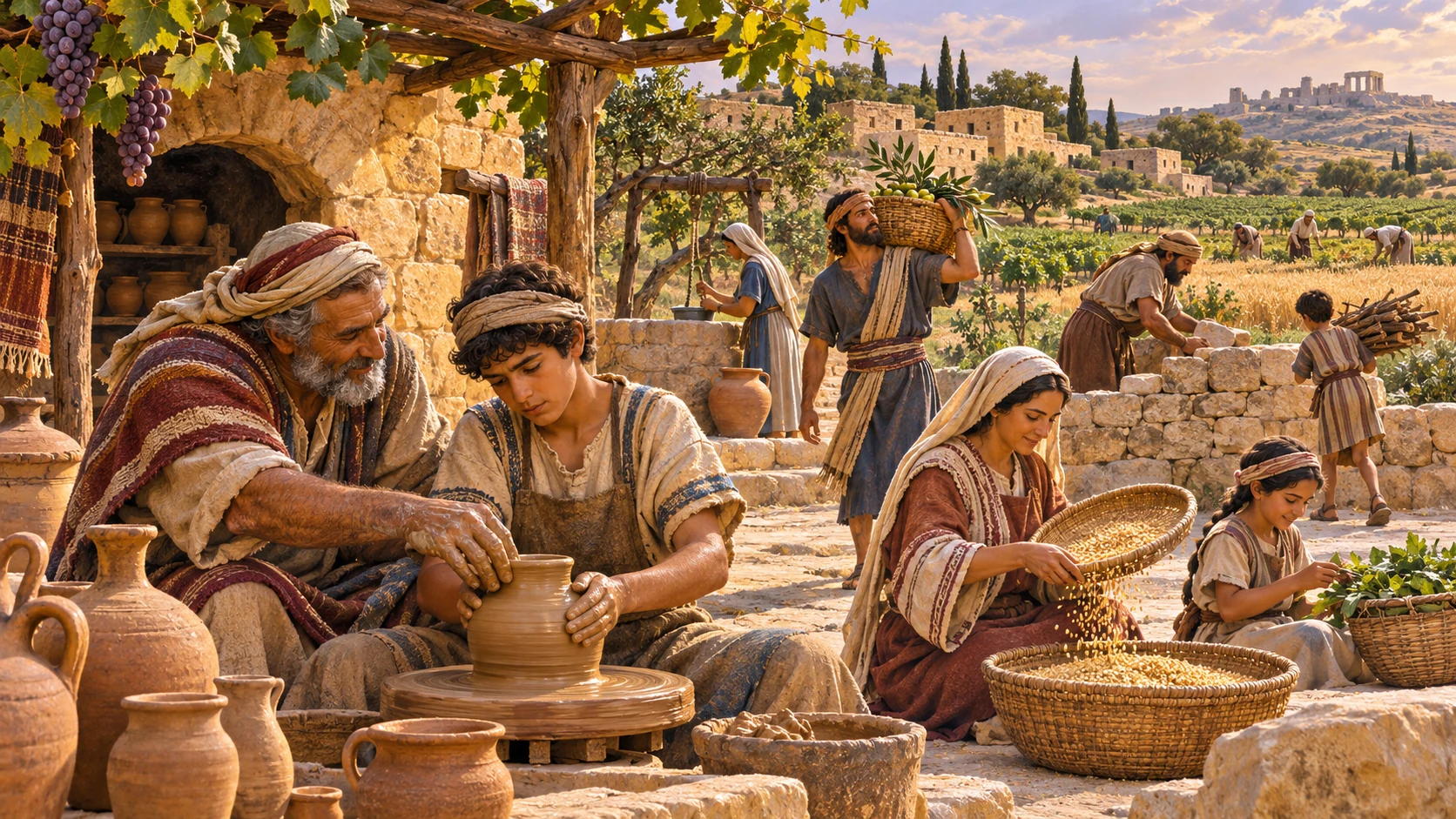
Work enters covenant memory. A people rebuilding after disaster needs teachers and priests, but also artisans, builders, growers, and families capable of sustaining daily life. The genealogy preserves their existence without evaluating their character.
Earlier, Bezalel—descended from Hur—was remembered in Judah's line (1 Chr 2:20; cf. Exod 31:1–5). Skilled work can serve God's dwelling among the people. Honest work also belongs before God.
When Unexpected Names Cross Family Boundaries (4:17–20)
The record introduces Mered, Miriam, and several households associated with places such as Eshtemoa and Gedor. Most striking is Bithiah, described as a daughter of Pharaoh whom Mered married (v. 18). Egypt, remembered as the land of Israel's bondage, now appears within a Judahite family register.
The Hebrew wording in verses 17–19 is difficult: the identity of the mother in verse 17 and the relationship between Bithiah and the “Judahite wife” in verse 18 are disputed. Translations rearrange phrases to clarify possible connections. The text proves neither Bithiah's conversion nor an identification with Exodus 2 (Omanson and Ellington 2014; Knoppers 2004).
Still, the inclusion of a woman bearing an Egyptian royal designation disrupts a simple picture of completely sealed family boundaries. The notice invites reflection on God's blessing beyond Israel (Gen 12:3; Isa 56:6–8). The record supports neither exclusion nor invented biography.
When Potters and Royal Servants Are Remembered (4:21–23)
The descendants of Shelah, Judah's son, include linen-working families and inhabitants of several towns (vv. 21–22). Verse 23 identifies potters who lived in Netaim and Gederah and worked there in the king's service. Royal life depended on labor.
Unlike the royal register in chapter 3, this passage remembers the hands that make vessels, cultivate fields, and maintain communities. Some phrases in verses 21–22 remain uncertain (Klein 2006). Yet verse 23 clearly recognizes skilled labor.
The Chronicler will later devote considerable attention to temple workers, singers, and gatekeepers (1 Chr 23–26). Ordered service sustains communal life. Leaders cannot rebuild alone.
When Simeon's Search for Pasture Reveals Both Survival and Conflict (4:24–43)
Simeon's families were less numerous than Judah's (v. 27). The listed towns include Beersheba, Moladah, Hormah, and Ziklag (vv. 28–31). Joshua 19:1–9 explains why Simeon and Judah are geographically linked: Simeon's inheritance lay within Judah's territory.
Growing clans seek pasture. They find fertile land near Gedor—called Gerar in some ancient textual traditions—and occupy settlements previously inhabited by others (vv. 34–41). During Hezekiah's reign, Simeonite groups attack Hamite settlements and the Meunites. Another group goes to Mount Seir and defeats surviving Amalekites (vv. 42–43).
This is not simple success. The text reports dispossession and lethal conflict. It does not record a direct divine command authorizing these particular campaigns, nor does it supply the perspectives of the displaced communities. Violence must neither be hidden nor used to excuse Christian land seizure. Good pasture comes alongside the destruction of others' homes. Israel's own ancestors require moral scrutiny.
Theological Reflection: Where the Roots Find Life
Covenant Identity Is Larger Than Visible Power
The Davidic promise remains central (1 Chr 17:11–14), but chapter 4 insists that the people of God also consist of uncelebrated households. The returned community must remember farmers, artisans, mothers, children, and families with uncertain status. God's story cannot be reduced to the survival of rulers or institutions. God also demanded justice in everyday life (Deut 16:18–20).
Prayer Seeks God's Hand, Not a Formula for Prosperity
Jabez provides a model of direct dependence on the God of Israel. Prayer is neither a charm nor a substitute for work and justice. Scripture later joins asking with humility, obedience, and God's purposes (1 Kgs 8:37–40; Matt 6:9–13; Jas 4:3). An enlarged horizon may bring greater responsibility.
The Kingdom Has Room for Overlooked Workers and Complicated Histories
Potters, craftsmen, women, and families with links beyond Judah all enter the record. Though not a modern equality manifesto, the genealogy challenges selective memory. The temple's service will likewise require many kinds of labor (1 Chr 23–26). The church becomes a dwelling for God as diverse members serve together in Christ (Eph 2:19–22; 4:11–16).
Remembered Violence Must Not Become a Blueprint for Mission
Simeon's history preserves real contests for livelihood and territory. Christian discipleship cannot use an ancient tribal account to sanctify coercion. The Son of David is announced as the Prince of Peace (Isa 9:6–7); Jesus teaches enemies to be loved rather than expelled in God's name (Matt 5:43–48). The church must protect neighbors and reject religious excuses for violence.
Life Application: Cultivating Faithful Ground
- Recover forgotten names. Record the stories of older members, women, craftsmen, and quiet servants before community memory disappears.
- Pray with open hands. Like Jabez, ask for God's help and protection; refuse to measure answered prayer only by possessions or status.
- Honor skilled work. Encourage apprentices, farmers, builders, caregivers, and artisans; pay fairly and acknowledge labor that keeps the congregation alive.
- Repair family memory honestly. Welcome people with complicated histories without inventing comforting details or concealing genuine harm.
- Restore worship in daily life. Build habits of Scripture, Sabbath fellowship, prayer, generosity, and service that survive the loss of prominent institutions.
- Examine the cost of expansion. Before acquiring land, growing a ministry, or pursuing influence, ask who may be displaced or silenced; choose transparent, peaceful, and just methods.
Reflection Questions
- Whose names are missing from the stories our families and churches celebrate?
- Does prayer seek God's presence, or mainly a larger personal territory?
- Which forms of honest labor receive little honor in our worshiping community?
- What painful or complicated family history must be acknowledged rather than edited away?
- Who bears the cost when our household, institution, or ministry seeks to expand?
Response Prayer
God of Israel, keeper of names and planter of hope, send roots deep into the soil of covenant mercy. Where pain has named a life, teach the heart to call upon the God who hears. Bless hands that shape clay, mend houses, cultivate fields, and care for children. Keep the church from worshiping crowns while forgetting workers. Purify every desire for increase; let no search for a wider field crush another household. Through Jesus Christ, the faithful Son of David, renew prayer, repair worship, establish justice, and make ordinary lives a place where divine mercy grows. Amen.
Window into What Comes Next
The roots stretch through Judah and Simeon. 1 Chronicles 5 crosses the Jordan to Reuben, Gad, and half-Manasseh. Their story asks what happens when strength forgets the God who gave the land.
Annotated Bibliography
- Hill, Andrew E. 1 & 2 Chronicles. NIV Application Commentary. Grand Rapids: Zondervan, 2003. Connects genealogy, prayer, and communal identity with pastoral practice.
- Japhet, Sara. I & II Chronicles: A Commentary. Old Testament Library. Louisville: Westminster John Knox, 1993. Examines the structure and social world of Judah's and Simeon's genealogies.
- Klein, Ralph W. 1 Chronicles: A Commentary. Hermeneia. Minneapolis: Fortress, 2006. Discusses textual uncertainties, local names, and the historical context of the family lists.
- Knoppers, Gary N. I Chronicles 1–9: A New Translation with Introduction and Commentary. Anchor Bible 12. New York: Doubleday, 2004. Provides detailed analysis of kinship, social diversity, and Simeonite settlements.
- Omanson, Roger L., and John E. Ellington. A Handbook on 1–2 Chronicles. Vol. 1. UBS Helps for Translators. Miami: United Bible Societies, 2014. Clarifies the grammatical and translation problems in 4:17–19.
- Sailhamer, John. First and Second Chronicles. Everyman's Bible Commentary. Chicago: Moody Press, 1983. The supplied commentary; links Judah's leadership to Genesis 49 and Simeon's placement to Joshua 19.
- Williamson, H. G. M. 1 and 2 Chronicles. New Century Bible Commentary. Grand Rapids: Eerdmans, 1982. Explores the literary and historical significance of the Chronicler's ancestral records.

Be the first to leave a comment.