

How can a public succession become a test of responsibility and mercy rather than ambition?
Study overview
God’s Promise amid Ambition and a Contested Throne
By Pr Enos Mwakalindile Reading: 1 Kings 1:1–53 Key verse: 1 Kings 1:48 — David blesses the LORD for permitting David to witness a successor seated on the royal throne. (Summary, not a direct quotation.)
Inside the palace, an old king shivers. Beside a feast, ambition rehearses victory. At Gihon, a trumpet interrupts the celebration. Between the throne and the altar, power faces the question of mercy.
Introduction — The Hunger to Arrive First
Ambition often begins with a quiet calculation: an opportunity has opened; a rival has hesitated; the moment must be seized. A family business, a church committee, or a national government can become a banquet of carefully selected supporters. Applause arrives before accountability. A position begins to look like a possession.
First Kings opens inside such a moment. David remains king, but royal strength is fading. Adonijah moves toward the throne. Solomon remains largely silent. Bathsheba and Nathan recognize danger, while Israel waits for a clear announcement. A succession dispute threatens lives as well as titles.
The chapter invites a searching question: Can leadership remain faithful when ambition moves faster than responsibility? The narrator offers neither an innocent palace nor a simple celebration of successful political strategy. David’s household carries old wounds; even the victorious party operates within a dangerous struggle for power.
First Kings 1 portrays a threatened royal succession becoming an occasion for renewed responsibility, public recognition, and provisional mercy, while God’s promise to David continues through deeply imperfect human affairs. The trumpet announces a king. The closing encounter begins to test the character of the kingship.
Historical and Literary Context — An Unfinished Family Story
First Kings 1–2 completes the account of David’s reign before following Solomon. The background includes God’s promise concerning David’s dynasty, David’s taking of Bathsheba and killing of Uriah, Nathan’s confrontation, and the rebellions within David’s household (2 Sam 7; 11–12; 13–20). Provan places the succession narrative within the unresolved tension between dynastic promise and royal failure (Provan 2012, commentary on 1 Kgs 1:1–53).
Adonijah, son of Haggith, appears after the deaths of Amnon and Absalom. Birth order gives Adonijah political plausibility, but the chapter never presents seniority as sufficient authorization. Nor does the chapter explain every earlier discussion about succession. Bathsheba invokes David’s oath; David explicitly confirms the oath in verses 29–30. The earlier giving of the oath has not been narrated.
Commentators weigh the gap differently. Brueggemann reads the speeches as calculated political persuasion; Provan also stresses uncertainty surrounding the earlier oath. The narrative gap warrants caution, rather than a confident accusation of fabrication. David’s eventual public command is explicit (Brueggemann 2000, 14–17).
The wider book moves through Solomon’s rise and failure, the kingdom’s division, prophetic confrontation, and eventual exile. Kings measures public life by covenant faithfulness, rather than royal magnificence alone (BibleProject n.d., 1–3). Deuteronomy 17:14–20 supplies the governing horizon: Israel’s king must remain under God’s instruction. Chapter 1 introduces the problem before chapter 2 makes obedience explicit.
Walking Through the Text
A Cold Chamber and a Vulnerable Kingdom — 1:1–4
David cannot keep warm despite the bedclothes. Royal attendants bring Abishag from Shunem to care for David. The narrator explicitly states the absence of sexual relations.
The scene exposes royal frailty. Earlier accounts featured David’s physical energy and troubling use of power; Kings begins with dependency. Some interpreters connect the sexual detail with perceptions of David’s capacity to rule, but the text does not equate old age with moral unfitness. The pastoral issue is neglected responsibility amid declining strength. Abishag’s service also places a young woman inside palace arrangements serving royal needs; the narrator records no speech or consent from Abishag. Faithful reading should preserve the young woman’s humanity.
A Procession Built around Ambition — 1:5–10
Adonijah exalts Adonijah and prepares chariots, horsemen, and fifty runners. The display recalls Absalom’s earlier royal performance (2 Sam 15:1). Handsome appearance strengthens the resemblance, while verse 6 adds a painful explanation: David has failed to challenge Adonijah’s conduct.
Joab and Abiathar support the project. Zadok, Nathan, Benaiah, and David’s warriors do not. Adonijah’s sacrifices and feast beside En-rogel gather a powerful circle, but the invitation list excludes Solomon and significant potential opponents.
The combination deserves attention: religious ceremony, military support, family prestige, and selective hospitality. Sacred activity can accompany a grasp for power. A feast can generate loyalty without establishing legitimacy. The passage also exposes a parental failure: affection without correction has left ambition dangerously unexamined.
A Mother and a Prophet Break the Silence — 1:11–27
Nathan warns Bathsheba about the danger to Bathsheba and Solomon. The proposed intervention proceeds in stages: Bathsheba petitions David; Nathan follows with supporting testimony. The speeches are coordinated, rather than independent discoveries.
Bathsheba appeals to David’s oath and places Israel’s uncertainty before the king. Nathan asks whether Adonijah’s accession has received David’s authorization. Repeated references to the throne move the issue from private preference to public responsibility. David must clarify the succession.
Bathsheba’s fear of being treated as an offender reveals the danger beneath the celebration. Defeat in a royal contest can become a death sentence. Nathan’s intervention therefore involves more than promoting a candidate. Nevertheless, the narrator presents political strategy alongside concern for life; Nathan delivers no new divine oracle in the scene. Discernment requires attention to the actual speeches rather than assumptions based on prophetic office.
A Remembered Deliverance Becomes Decisive Action — 1:28–40
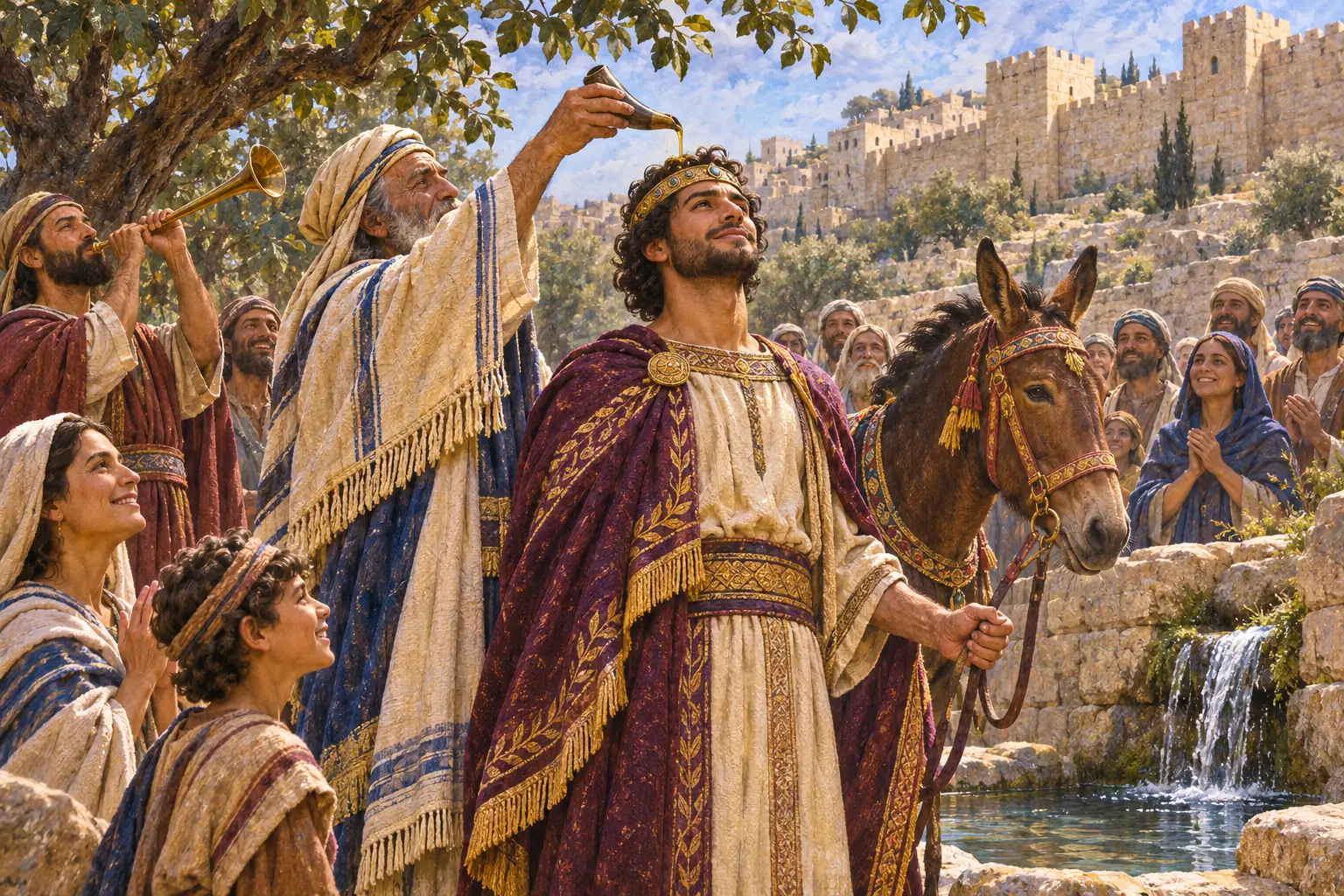
David swears by the living LORD, recalling God’s deliverance through adversity. Memory interrupts paralysis. David confirms Solomon’s succession and gives specific orders: Solomon must ride David’s mule, go to Gihon, receive anointing, and return to occupy the throne.
The mule signifies David’s authorization. Zadok’s anointing with oil from the tent places the accession within Israel’s sacred life. Nathan, Benaiah, and the royal guard participate. Benaiah prays for God’s presence with Solomon and for a throne greater than David’s.
The ceremony becomes public. Trumpet, music, procession, and widespread rejoicing contrast with Adonijah’s selected company. Yet public celebration does not make the process a modern democratic election. Royal command, religious leadership, and armed protection remain intertwined. Provan emphasizes the public character of Solomon’s accession; Brueggemann emphasizes the underlying court politics. Read together, the interpretations help preserve the scene’s legitimacy claims and political complexity (Provan 2012, commentary on 1 Kgs 1:28–40; Brueggemann 2000, 16–18).
The Banquet Hears a Different Future — 1:41–49
Adonijah’s guests hear the city’s celebration while finishing the meal. Jonathan, Abiathar’s son, arrives. Adonijah expects welcome news, but Jonathan reports Solomon’s enthronement.
The report retells the decisive actions: David’s command, the procession, the anointing, the throne, and David’s blessing of the LORD. Repetition makes reversal unmistakable. Adonijah’s confidence has rested on an incomplete picture of events.
The guests disperse in fear. The lavish table cannot preserve the coalition. David, meanwhile, bows on the bed and worships. A king unable to restore youthful strength can still acknowledge God’s generosity and welcome a future beyond David’s reign.
Hands on the Altar, Life under a Condition — 1:50–53
Adonijah flees to the altar and grasps the horns. The aspiring ruler has become a frightened petitioner. Solomon promises safety contingent upon worthy conduct, while warning against wickedness. Adonijah bows before Solomon and returns home.
The chapter ends without an immediate execution. Mercy opens a space for a different future, but the settlement remains conditional and politically charged. The text does not describe complete reconciliation or established repentance. Brueggemann rightly keeps the threat of violence visible beneath the temporary calm (Brueggemann 2000, 19–23).
The altar is no magical shield. Exodus 21:12–14 distinguishes refuge from immunity for deliberate murder; the connection illuminates the wider biblical relationship between sanctuary and accountability. Solomon’s later conduct must still face scrutiny.
Theological Reflection — Promise, Responsibility, and Restraint
God’s fidelity travels through an untidy history
God’s promise to David has not created a morally pure household. The succession emerges through fear, remembered obligation, political skill, and renewed decision. David interprets the outcome as God’s gift in verse 48. Such gratitude invites trust in providence without turning successful maneuvering into proof of divine approval. God’s faithfulness and human accountability must remain together.
Leadership belongs beneath correction
Adonijah’s lack of correction and David’s delayed clarity reveal connected failures. Power needs truthful interruption before private confidence becomes public harm. Deuteronomy’s king reads and obeys Torah to resist pride above fellow Israelites (Deut 17:18–20). A leader’s prestige cannot replace submission to God’s instruction.
Courage can serve the protection of life
Bathsheba speaks from an exposed position; Nathan helps bring danger into the king’s hearing. Courage takes the form of timely speech and practical action. The ethical lesson concerns truthful advocacy, clear responsibility, and protection of threatened lives. Religious status does not authorize deception, and palace strategy does not become a universal method for ministry.
Mercy must change the use of power
Solomon’s first recorded ruling concerns a defeated rival. Restraint matters precisely because punishment is possible. Yet conditional safety remains short of restored trust. Christian communities should distinguish forgiveness, protection, accountability, and renewed access to leadership. Mercy can refuse revenge while retaining necessary safeguards.
Canonical and Christological Horizon — Beyond the First Trumpet
The strongest canonical connection is the promise of a continuing Davidic house (2 Sam 7:12–16). Solomon’s accession advances the dynastic story but cannot exhaust the promise. The later failures of Solomon and subsequent kings deepen the longing for faithful rule.
The New Testament locates enduring Davidic kingship in Jesus (Luke 1:32–33). Jesus’ royal entrance on a donkey participates in the wider biblical imagery of kingship, explicitly shaped by Zechariah 9:9 (Matt 21:1–11). The animals should not be flattened into an identical detail: Solomon rides a mule; Jesus rides a donkey. First Kings 1 supplies part of the royal background, rather than a direct prediction of every feature of the Gospel scene.
Jesus also gives royal greatness the form of service and costly rescue (Mark 10:42–45). The contrast places every Christian exercise of authority beneath the cross. The biblical horizon reaches toward the reign of God and the Lamb, where curse and predatory domination no longer govern creation (Rev 22:1–5). A peaceful coronation becomes a beginning; creation’s healing requires a faithful King.
Life Application — Make Faithfulness Visible
- Clarify a neglected transition. A ministry team or family enterprise should record responsibilities, decision procedures, and succession arrangements before illness or retirement creates a struggle. Accept the cost of sharing influence.
- Invite correction before promotion. Ask a trusted colleague to identify a pattern of pride or exclusion. Receive the criticism without retaliation and name a practical change.
- Examine the invitation list. Before a major decision, include affected members and a thoughtful critic. Hospitality should serve honest deliberation rather than manufacture agreement.
- Protect a threatened voice. Make time to hear an overlooked colleague, a vulnerable family member, or a fearful congregant. Bring substantiated concerns through accountable channels, even at the cost of popularity.
- Turn gratitude into action. Remember a specific experience of God’s help, then complete a delayed duty: communicate a decision, apologize, or delegate a responsibility.
- Practice mercy with safeguards. Refuse humiliation after a dispute. Set clear boundaries and review conduct before restoring sensitive responsibilities. Patient repair may cost more effort than a quick declaration of reconciliation.
Reflection Questions
- Which details distinguish Adonijah’s display from Solomon’s authorization?
- Which neglected conversation currently exposes a household, church, or workplace to avoidable conflict?
- Which excluded voice could challenge a comfortable circle of supporters?
- How does David’s memory of deliverance lead toward responsibility rather than nostalgia?
- Which act of restraint, boundary, or costly apology would bring a present conflict closer to the character of Jesus?
Response Prayer
Living God, faithful through the changing seasons of human strength, receive the worship of a people often tempted by applause. Ambition can turn a table into a campaign and a calling into a claim of ownership. Forgive the pride of grasping hands and the silence of neglected duty.
Grant parents courage to correct with tenderness. Grant leaders humility to hear unwelcome truth. Protect vulnerable lives caught inside struggles for position. Give congregations patience for honest procedures and strength to resist manipulation.
Let remembered deliverance awaken present obedience. Let the trumpet of truth interrupt flattering celebrations. Form generous hearts beneath the reign of Jesus, with mercy strong enough to refuse revenge and wisdom clear enough to preserve accountability.
As familiar leaders grow weak and new responsibilities emerge, sustain faithful service. Establish hope in the enduring kingdom of Christ. Amen.
Window into What Comes Next — The Crown Meets the Commandment
Solomon occupies the throne, and Adonijah has returned home. The kingdom has gained an answer to the succession question, but the moral question remains open. First Kings 2 brings David’s final instructions, the demand for covenant obedience, and a troubling series of political reckonings.
The contrast deserves careful listening: Torah calls the king toward faithfulness; the struggle for security presses toward force. The next chapter will test whether consolidation can be read simply as justice, or whether royal survival also exposes disturbing compromises. Can a secure throne become a faithful throne?
Bibliography
- BibleProject. n.d. “The Books of Kings.” Old Testament Overviews. Supplied PDF, “Books of 1 and 2 Kings: Guide with Key Information and Resources,” 1–3.
- Brueggemann, Walter. 2000. 1 & 2 Kings. Smyth & Helwys Bible Commentary. Macon, GA: Smyth & Helwys. Especially 11–23.
- The Holy Bible: King James Version. 1769 edition. “1 Kings 1.” Bible Gateway. Scripture references and paraphrases are distinguished from direct quotation throughout the study.
- Provan, Iain W. 2012. 1 & 2 Kings. Understanding the Bible Commentary Series. Grand Rapids: Baker Books. Originally published 1995. Commentary on 1 Kings 1:1–53; section references used because the supplied electronic edition has no stable printed pagination.
Be the first to leave a comment.